
The Australian Qualifications Framework (AQF) is a 10-level national system that ranks every qualification, from Certificate I through to a Doctoral degree, by complexity, depth of knowledge and how independently a graduate can apply their skills. Level 1 sits at entry-level certificates; Level 10 sits at doctoral research. Knowing where a course sits helps you match it to a job outcome, a further-study goal, or a credit-transfer and recognition of prior learning (RPL) pathway.
Table of Contents
- What are AQF levels, and why do they matter?
- AQF levels at a glance
- What each AQF level actually means for your career
- How to use the AQF to plan your next study step
- Where to check accreditation and RPL details
- What AQF levels actually measure
- Why the AQF exists and how it developed
- How AQF levels compare internationally
- CTDI: a practical path to AQF-aligned VET qualifications
- Sources
- FAQ
What are AQF levels, and why do they matter?
Every nationally recognised qualification in Australia carries an AQF level, whether it's issued by a TAFE, a registered training organisation (RTO) or a university. That level tells you what a graduate can actually do, not just what the course is called. Two "Certificate" qualifications with similar names can sit at different levels, and two providers can teach toward the same level with different course lengths.
This matters practically. If you're a working professional weighing up a Diploma against a Bachelor degree, the level tells you the jump in complexity and autonomy you're signing up for, not just the extra semesters. If you're chasing a promotion that specifies "Diploma level or equivalent," you need to check what that actually means against the AQF level criteria rather than assume any diploma-branded course qualifies.
AQF levels at a glance
The table below maps each level to its typical qualification type, the sector that usually delivers it, and what a graduate can generally do at that point. Volume-of-learning figures are indicative guides used across the sector, not fixed rules, since study mode and prior experience change the timeframe.
| AQF Level | Typical Qualification | Sector | Graduate Capability (Summary) |
|---|---|---|---|
| 1 | Certificate I | VET | Performs simple, defined tasks under direct supervision |
| 2 | Certificate II | VET | Performs routine tasks with some autonomy in a limited context |
| 3 | Certificate III | VET | Applies a defined skill set independently in a trade or service role |
| 4 | Certificate IV | VET | Applies specialised knowledge with some responsibility for others' work |
| 5 | Diploma | VET (some higher education) | Applies broad technical or paraprofessional knowledge, often supervising others |
| 6 | Advanced Diploma / Associate Degree | VET and higher education | Manages complex tasks and exercises professional judgement in a specific field |
| 7 | Bachelor Degree | Higher education | Applies a broad and coherent body of knowledge, works with initiative in professional contexts |
| 8 | Bachelor Honours / Graduate Certificate / Graduate Diploma | Higher education | Extends discipline knowledge with a research or advanced practice component |
| 9 | Masters Degree | Higher education | Applies specialised knowledge to complex problems, often independently |
| 10 | Doctoral Degree | Higher education | Makes an original, substantial contribution to knowledge through research |
VET providers commonly deliver levels 1 through 6, while universities deliver levels 5 through 10 (Diploma and Advanced Diploma exist in both sectors). Higher education levels 5 to 10 fall under TEQSA's regulatory remit, while VET qualifications are accredited and monitored separately through the national training system.
What each AQF level actually means for your career
Grouping the ten levels into rough bands makes the framework easier to use when you're mapping out study or a career move.
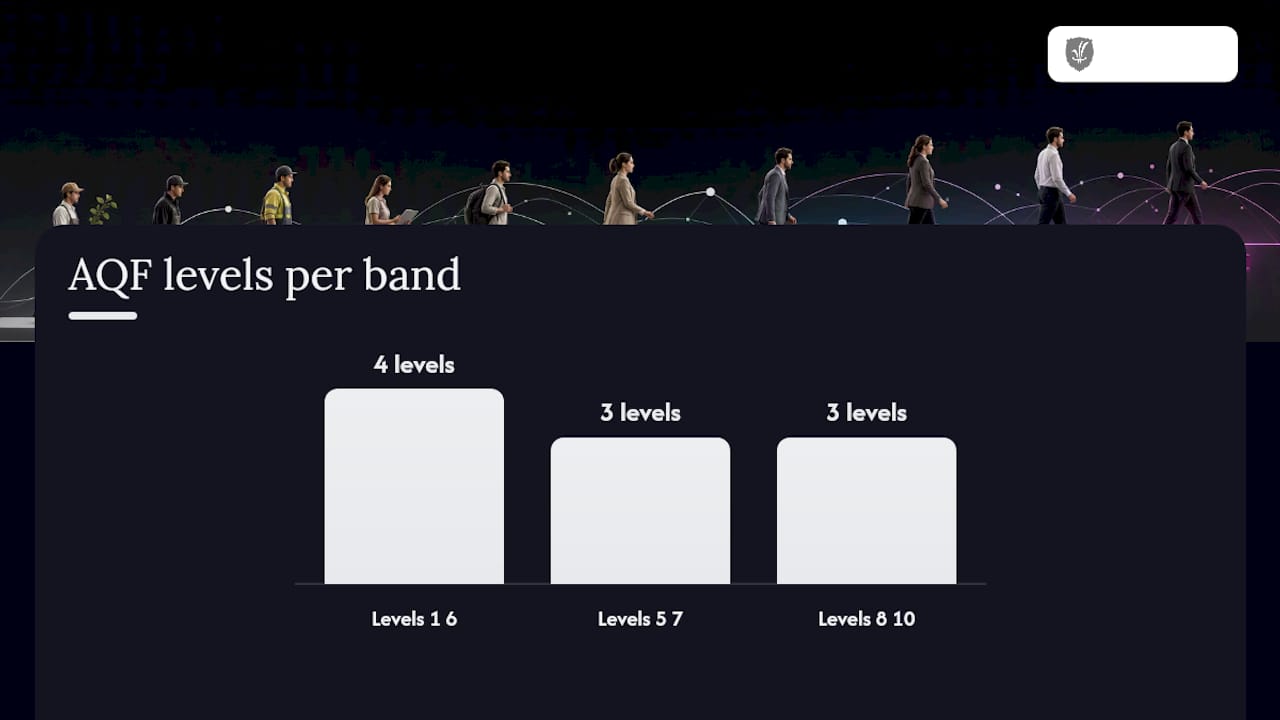
Levels 1 to 4: entry and foundation skills
These are typically delivered through TAFEs and RTOs, and they build toward defined, practical competence in a trade or service role.
- Certificate I and II suit entry-level roles or foundational skills, often completed in under a year.
- Certificate III is the benchmark for many trades and frontline roles, such as retail, hospitality or aged care support.
- Certificate IV signals a step up in responsibility, often held by team leaders, coordinators, or specialists in fields like project support, bookkeeping or workplace training.
Levels 5 to 7: paraprofessional and professional outcomes
This is where the biggest career-planning decisions usually happen.
- A Diploma (Level 5) typically prepares graduates for paraprofessional roles, supervising others or managing defined projects within a broader professional structure.
- An Advanced Diploma or Associate Degree (Level 6) extends that further, often serving as a stepping stone into a related Bachelor degree.
- A Bachelor degree (Level 7) is the standard entry point for most licensed professions and graduate programs, built on a broad and coherent body of theoretical and practical knowledge.
Levels 8 to 10: advanced specialisation and research
Honours, Graduate Certificates and Graduate Diplomas (Level 8) add depth or a research component onto existing Bachelor-level knowledge. A Masters (Level 9) develops advanced, often highly specialised expertise, while a Doctorate (Level 10) requires an original contribution to a field through sustained research.
None of this guarantees a particular salary, promotion or university place. The AQF describes learning outcomes, not job market conditions or admission decisions, which are set independently by employers and institutions.
How to use the AQF to plan your next study step
Turning framework knowledge into an actual decision takes a few concrete steps.
- Identify the level the role or pathway expects. Job ads and course prerequisites sometimes state an AQF level directly (for example, "Diploma or higher"). If they don't, check the level descriptors to see what capability is implied.
- Compare learning outcomes, not just course titles. Two Certificate IV courses can differ in scope. Read the actual units and outcomes listed on the course page against the AQF criteria for that level.
- Gather evidence for RPL before you apply. Work samples, references, licences and past assessments can support a recognition of prior learning application, since RPL compares your existing capability against the same level criteria a new student would need to meet.
- Check articulation arrangements and volume of learning. Some providers have formal agreements letting Diploma graduates move into related Bachelor degrees with credit. Ask the provider directly, since arrangements vary and are never automatic.
Pro Tip: Ask your training provider for an RPL checklist and a sample portfolio before you start your application. Seeing what evidence a successful application typically includes saves you weeks of back-and-forth later.
Where to check accreditation and RPL details
Before enrolling anywhere, confirm the course is genuinely AQF-aligned rather than a certificate of completion dressed up as a qualification.
- Check level descriptors and policy on the official AQF website.
- Confirm university-level courses through TEQSA's provider register, since TEQSA regulates higher education providers responsible for degree-level awards.
- For VET courses, check the provider's scope of registration with the Australian Skills Quality Authority (ASQA).
- On any course page, look for the stated AQF level, a national course code, the regulator reference, and a full list of units and learning outcomes. Our guide to identifying accredited courses walks through what to check before you enrol.
Contact the provider's student services team directly about RPL or credit transfer. Ask what evidence they need and how long an assessment usually takes.
What AQF levels actually measure
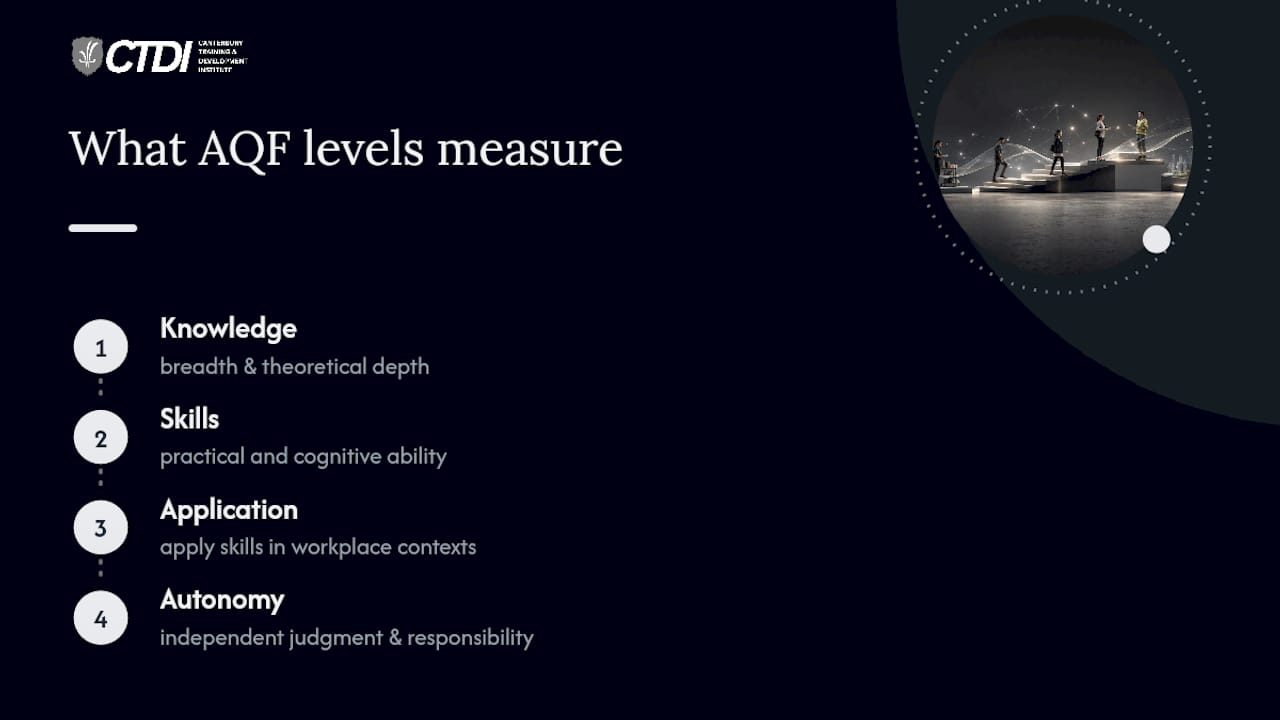
Every AQF level is built around four things: knowledge, skills, the application of those skills, and the degree of autonomy a graduate can work with. Knowledge covers how broad and how theoretical the underlying content is. Skills covers the practical and cognitive abilities a graduate demonstrates. Application and autonomy covers the context: can this person only follow set procedures, or can they exercise judgement, adapt to new problems and take responsibility for outcomes?
This is why level is not simply a proxy for course length. A one-year Certificate IV and a one-year bridging course can sit at different levels because one demands more independent judgement than the other. The official AQF level summaries spell out exactly what's expected in each of these dimensions, level by level, and they're the actual reference point regulators use, not the course marketing.
For working professionals, this distinction is genuinely useful. If your current role already demands independent judgement, supervision of others, or responsibility for outcomes, in practice you may already be operating closer to a Diploma or Advanced Diploma level of capability even without holding that qualification on paper. That's part of the case for RPL, and part of why a level jump in study sometimes feels smaller than expected once you're in the classroom.
Why the AQF exists and how it developed
Australia didn't always have one unified system. Before the AQF, school, VET and university qualifications were assessed under separate, loosely connected state and sector arrangements, making it genuinely hard to compare a TAFE certificate against a university diploma or move credit between them.
The AQF was first introduced in 1995 and went through a major revision in 2011, which tightened the level criteria and formally defined volume-of-learning expectations for each qualification type. Any qualification enrolment from 2015 onward had to meet this revised framework. The underlying goal has stayed consistent: the AQF exists to facilitate pathways between education sectors and into the labour market, so a Certificate IV graduate has a defined route into a Diploma, and a Diploma graduate has a defined (if not automatic) route into a related Bachelor degree.
That pathway design is also what makes RPL possible in principle. Because the framework defines qualifications by what a graduate can demonstrate rather than by seat time, someone with strong on-the-job experience can sometimes have that capability assessed against a level's criteria rather than starting a course from scratch.
How AQF levels compare internationally
The AQF broadly aligns in structure and intent with qualification frameworks used elsewhere, including the UK's Regulated Qualifications Framework and the European Qualifications Framework, in that all three rank qualifications by a level scale tied to learning outcomes rather than hours studied. That structural similarity is one reason Australian qualifications are generally well understood by overseas employers and institutions assessing comparability.
That said, there's no single global authority mapping every level across every country's framework, and equivalence is assessed case by case, particularly when a graduate applies for further study or licensed work overseas. If you're planning to use an Australian qualification internationally, the safest step is to ask the receiving institution or employer directly how they'll assess it, rather than assuming a level number carries the same weight everywhere. Within Australia, though, the AQF level is the one consistent reference point across VET and higher education, which is precisely why it's worth checking before you commit to any course.
CTDI: a practical path to AQF-aligned VET qualifications
If you've worked through the levels above and landed on a Diploma or Advanced Diploma as your next step, some providers deliver nationally recognised online VET diplomas in areas like artificial intelligence, digital marketing and environmentally sustainable management.

Providers often support RPL enquiries and can talk through credit-transfer and articulation questions with course-specific student services before you commit to enrolling, without promising a fixed outcome, since every RPL assessment depends on the evidence you can provide. Employers looking to upskill a team can also explore corporate training partnerships for group enrolments. If a Diploma-level qualification fits where you landed on the AQF scale, the next practical step is to check current course options and enrol or contact student services with your RPL questions before you apply.
Sources
For official detail beyond this guide, check the AQF's own qualifications pages, TEQSA's guidance on higher education level placement, and Study Australia's explainer on how Australian qualifications work in practice.
- AQF levels | AQF
- Australian Qualifications Framework | TEQSA
- Understanding Australian qualifications — Study Australia
FAQ
What is an AQF Level 7 qualification?
AQF Level 7 is the Bachelor degree level. Graduates apply a broad and coherent body of theoretical and practical knowledge with initiative and judgement in professional or technical contexts.
Is AQF Level 7 the same as a bachelor's degree?
Yes. Level 7 is specifically defined as the Bachelor Degree level within the AQF, covering standard three to five-year undergraduate degrees depending on the field and study mode, per Study Australia's guidance.
What is AQF Level 9 in Australia?
AQF Level 9 covers Masters degrees. Graduates at this level apply highly specialised knowledge to complex problems, typically working independently and often incorporating a research or capstone component.
What sits at AQF Level 8 versus Level 9?
Level 8 covers Bachelor Honours degrees, Graduate Certificates and Graduate Diplomas, which extend or deepen existing Bachelor-level knowledge. Level 9 covers Masters degrees, which involve a more substantial step up in specialisation and independent application, per the AQF's official level criteria.
Recommended
- Exactly What Assessors Need: RPL in Australia for Experienced Workers
- Up to 50% Credit: Paperwork Checklist for VET Graduates in Australia
- Decision in 5–10 Days for VET Credit Transfer & RPL, Australia
This article provides general information only. Course requirements, study pathways, credit arrangements and career outcomes may vary. Always confirm current requirements with the relevant education provider or authority.