

Yes, you can get credit transfer or recognition of prior learning (RPL) in Australian VET, and the right choice depends on what you can prove. Use credit transfer when you already hold a certificate, statement of attainment or transcript for an equivalent unit. Choose RPL when your skills come from work experience or informal learning with no matching qualification behind them. Either way, start by gathering your USI details and any transcripts, then contact your provider's skills recognition team before you enrol.
TL;DR:
- Credit transfer is automatic for units with matching codes and content, often providing same-day recognition if completed recently at the same provider.
- Recognition of Prior Learning evaluates skills from work or informal learning through evidence like portfolios, interviews, or demonstrations, which can lead to full or partial credit.
- Applying early before enrolment, gathering verified evidence, and checking unit equivalence on training.gov.au speeds up the process and avoids delays.
- Safety-critical units or those with expiry dates may limit credit, regardless of the paperwork or prior experience, especially for units like first aid.
- Credit reduces course duration and fees but may impact visa conditions for international students; clear pre-assessment and written confirmation are crucial.
Table of Contents
- What is credit transfer in VET?
- RPL vs credit transfer: how recognition of prior learning works
- How do you apply for credit transfer or RPL?
- What evidence do you need for credit transfer or RPL?
- What are provider obligations and your rights as a student?
- How does credit affect your course length, fees and visa status?
- What are typical processing timelines and credit caps?
- How CTDI supports skills recognition and credit transfer
- Who is eligible for credit transfer or RPL?
- What are the benefits and limitations of credit transfer?
- What common challenges come up during credit transfer?
- How does credit transfer affect your future study pathways?
- A pragmatic take on choosing your recognition pathway
- Get your skills recognition pre-assessment with CTDI
- Where to check the official rules yourself
- Sources
What is credit transfer in VET?
Credit transfer is the formal recognition of a unit of competency you have already completed, where that unit is identical or equivalent to one in your new course. It's a paperwork process, not an assessment. If ASQA can see the unit code matches, or a mapping shows the two units cover the same skills and knowledge, you get the credit without sitting through the training again.
Equivalence is checked against the unit's listing on training.gov.au, the national register that holds the current, authoritative version of every unit of competency in the Australian Qualifications Framework (AQF). Providers compare unit codes and titles first. When the codes don't match exactly but the content looks similar, an assessor has to dig deeper. That mapping exercise compares elements, performance criteria and assessment requirements line by line, referring back to training.gov.au's official unit details to confirm the match holds up.
There are two practical paths here, and they move at very different speeds:
- Automatic credit — if you completed a unit at the same provider recently and it appears unchanged in your new course, many providers apply the credit without you lifting a finger.
- Formal application — if the unit was completed elsewhere, or the codes have changed since you studied it, you'll need to submit evidence and wait for a mapping assessment.
A student who finished a Certificate III in Individual Support at one registered training organisation and enrols in a Certificate IV in Ageing Support elsewhere will usually get credit for any shared core units, provided the certificate and transcript check out. A student moving from an old, superseded unit code into a course built on the newer equivalent might wait longer, because someone has to confirm the two versions genuinely cover the same ground. That's the difference between a same-day tick and a two-week wait, and it comes down entirely to how clean the paper trail is.
RPL vs credit transfer: how recognition of prior learning works
RPL doesn't care where you learned something or whether you have a certificate to show for it. It's an assessment process that measures what you can actually do right now against the criteria of a specific unit of competency, whether that competence came from a job, a hobby, volunteer work or ten years running your own business. This is the core credit transfer vs RPL distinction that trips up most first-time applicants: one recognises a piece of paper, the other recognises skill.
Because there's no existing certificate to point to, RPL leans on evidence you build yourself. Typical documentation includes:
- A portfolio of work samples, photos or project records
- Workplace documents like position descriptions, performance reviews or supervisor references
- Assessor interviews where you talk through how you handle specific tasks
- Practical demonstrations, where an assessor watches you perform the skill directly
The assessment process for RPL can land in a few different places. Sometimes you get full credit for a unit outright. Sometimes you get partial recognition, and you complete a smaller assessment task to close the gap. Occasionally the assessor decides your evidence doesn't demonstrate current competency and you go through standard training instead. None of these outcomes is a failure. They just tell you how much of the unit your existing skills already cover.
RPL usually makes more sense than credit transfer when no formal AQF unit exists to match against. If you learned bookkeeping on the job over eight years but never enrolled in a course, there's nothing to transfer. RPL is the only route in.
Pro Tip: Start your RPL portfolio months before you plan to enrol. Gathering supervisor statements and work samples always takes longer than people expect, and a rushed portfolio is the single biggest reason RPL applications come back asking for more evidence.
How do you apply for credit transfer or RPL?
Timing matters more than most students realise. Apply too late and you'll sit through units you didn't need to. Here's the order that actually works:
- Apply before or during enrolment. Most providers want your application lodged as early as possible, ideally before your course starts, so your timetable and fees reflect any granted credit from day one. International students should flag this at the offer stage, since granted credit can change course length and visa conditions.
- Check unit equivalence yourself first. Search training.gov.au for your completed unit and compare it against your target course's units, then check the provider's scope of registration to confirm they're actually authorised to deliver that qualification.
- Collect authenticated evidence. Gather your Statement of Attainment, transcript or qualification certificate, and grant your provider access to your Unique Student Identifier (USI) transcript, or share a secure My eQuals link if your evidence sits there.
- Submit through the provider's recognition portal. Most VET providers run a dedicated Skills and Learning Recognition process, sometimes called a pre-training review. Lodge your documents there and keep a copy of your submission confirmation.
- Follow up in writing. If you haven't heard back within the provider's published timeframe, email the recognition team directly and reference your application date.
- Prepare for an RPL interview or demonstration if requested. Assessors may want to talk through your evidence or watch you perform a task, so block out time rather than treating it as an afterthought.
Providers that publish clear skills recognition guidance tend to move faster, because you know exactly what to submit and where.
What evidence do you need for credit transfer or RPL?
Providers work through a fairly standard checklist of acceptable evidence, and knowing it in advance saves you a second round of requests:
- Qualification certificate or testamur
- Academic transcript or Statement of Attainment
- USI transcript, viewed with your permission
- Employer declarations or workplace references
- Portfolio evidence such as work samples or project files
ASQA lists certificates, statements of attainment and USI transcripts as standard acceptable evidence for credit transfer, and the USI system is the fastest way to let a provider verify your Australian qualification history without you chasing down old paperwork. If your documents come from overseas, expect to provide certified translations alongside the originals.
Melbourne Polytechnic's published procedure gives a useful benchmark here: it aims to authenticate submitted evidence within roughly 5 business days, with formal processing timeframes running longer once authentication is confirmed. Name your files clearly, submit certified copies rather than photos of documents, and lodge everything at once rather than trickling it in. Half of all verification delays come down to a provider chasing one missing page.
What are provider obligations and your rights as a student?
Registered training organisations don't get to wave away credit transfer and RPL requests. Under the national student guidance ASQA publishes, providers must publish a clear policy and give every student the opportunity to apply, unless a specific licensing or regulatory rule blocks it for that qualification.
In practice, that obligation plays out as a fairly predictable sequence:
- Providers must record and retain evidence of every application and decision.
- You should receive a written outcome, not just a verbal yes or no.
- If a decision seems wrong, most providers have an internal review or appeals process you can trigger first.
- If the internal appeal doesn't resolve things, you can escalate a complaint to ASQA or your state's training regulator.
There are legitimate reasons a provider can limit credit even when your evidence looks solid. Licensing requirements for certain occupations, or currency rules for units like first aid and CPR, can lawfully cap what gets recognised regardless of how strong your paperwork is.
How does credit affect your course length, fees and visa status?
Every unit you get credited for is one less unit you have to sit through, and that has knock-on effects worth planning for before you accept an offer, not after.
Granted credit reduces your required units and the total indicative hours in your course, which typically shortens how long the qualification takes to finish. That's good news for your schedule, but it changes the maths on fees too. Ask your provider directly whether reduced hours trigger a fee adjustment or refund, because policies vary a lot on this point and it's rarely explained upfront.
- Request a pre-assessment before you enrol, not after.
- Ask student services how credit affects your total course fee.
- If you're an international student, notify the international office immediately, since granted credit can shorten your course and affect your visa conditions.
- Get any fee adjustment confirmed in writing before you pay.
Pro Tip: If you're on a student visa, ask for the pre-assessment outcome in writing before you accept your offer letter. A shortened course length can affect your visa duration, and that's not something you want to discover halfway through semester one.
What are typical processing timelines and credit caps?
Realistic expectations save you a lot of frustration. Where your evidence is complete and straightforward, credit transfer applications commonly move in around 5 to 10 business days. RPL usually takes longer, because an assessor has to review a portfolio or conduct an interview rather than simply matching a unit code.
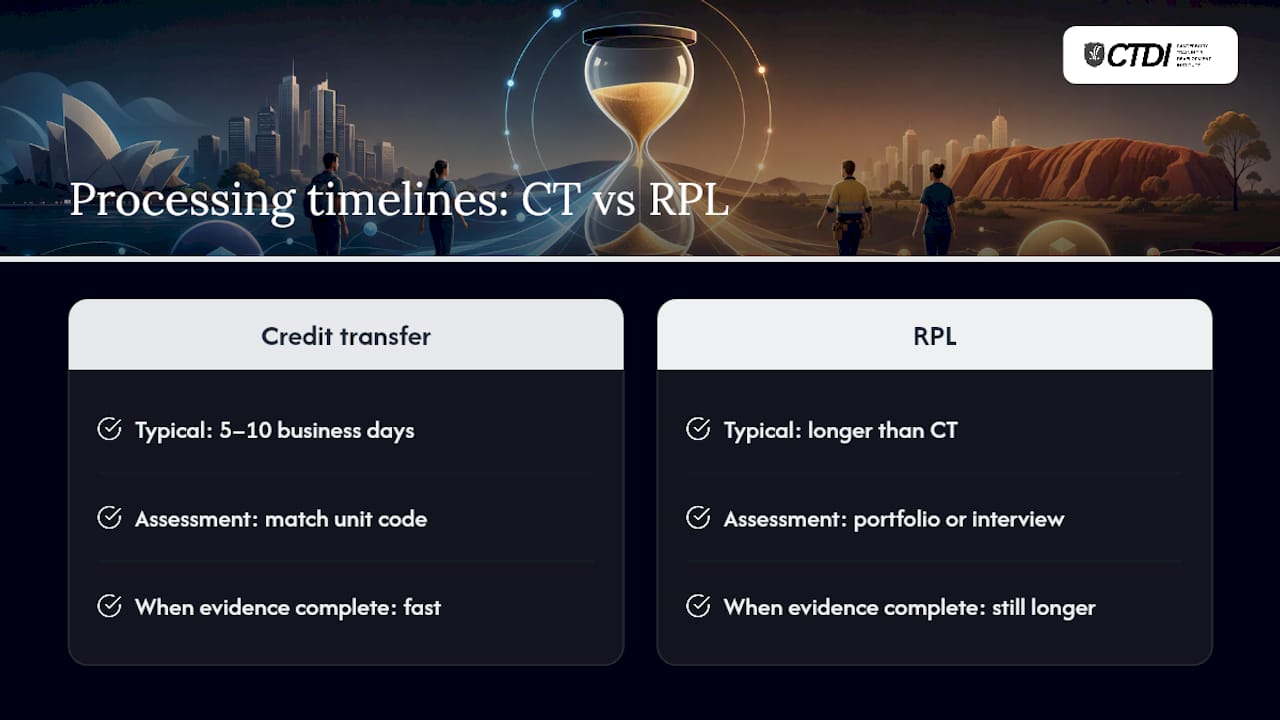
Two structural rules catch people out more than timing does. Provider policies also often cap how much of a qualification can be filled through credit transfer alone, sometimes up to around 80%. And units tied to safety currency, like first aid, often can't be credited past a certain age regardless of how strong the original certificate looks.
None of these caps are universal. Always check your specific provider's published policy rather than assuming the figures above apply everywhere.
How CTDI supports skills recognition and credit transfer
CTDI delivers nationally accredited online VET courses across Artificial Intelligence, Digital Marketing and Environmentally Sustainable Management, and skills recognition sits inside our standard enrolment process rather than as an afterthought.
Students requesting credit transfer or RPL work through a straightforward authentication step: submit your certificates, transcripts or USI details, and our team maps them against the current unit requirements listed on training.gov.au. Where evidence points to workplace or informal learning instead of a formal qualification, we run it through our RPL assessment pathway, which follows the same competency based assessment principles used across the sector.
International students get a pre-assessment before enrolment specifically to flag any visa or course-length implications early, not after enrolment fees are already paid. Our student support team is the first point of contact for questions about evidence, timelines or appeals throughout the process.
Who is eligible for credit transfer or RPL?
Eligibility hinges on evidence, not on who you are or how you learned. Credit transfer requires a completed unit that's identical or genuinely equivalent to one in your target course, backed by a certificate, transcript or Statement of Attainment that a provider can verify against training.gov.au.
RPL has a different bar. You don't need a formal qualification, but you do need evidence strong enough to demonstrate current competency against a specific unit's performance criteria. A folder of vague job descriptions won't cut it. Detailed work samples, supervisor sign-offs and a willingness to sit through an assessor interview usually will.
A few eligibility factors apply across both pathways:
- The unit or qualification must still be current, or a valid superseded equivalent, on training.gov.au.
- Your evidence has to be authenticated, whether that's a certified transcript or a verified USI record.
- Licensing rules for regulated occupations can restrict eligibility regardless of how strong your evidence is.
- Currency requirements on safety-critical units, like first aid, can make older evidence ineligible even if the original result was a pass.
International students face one extra layer: eligibility for credit doesn't automatically mean eligibility to reduce your course length under your visa conditions, so a pre-assessment before enrolment is worth treating as a mandatory step rather than an optional extra.
What are the benefits and limitations of credit transfer?
The upside is straightforward. Credit transfer saves you time, cuts duplicate study, and often reduces your total course fees since you're paying for fewer units of training. For someone who's already completed a Certificate III and wants to step straight into a related Certificate IV, it can shave months off the timeline without any loss of qualification value, because the recognised units carry full national standing.
The limitations sit mostly in scope and control. Credit transfer only works when a matching, currently listed unit exists, so it's no help if your prior learning doesn't map to a formal AQF unit anywhere. It also depends entirely on paperwork quality. A missing transcript page or an illegible certificate can stall an otherwise straightforward application for weeks.
There's also a currency problem worth flagging separately from mapping issues. Units tied to safety-critical skills, like first aid or working at heights, often carry expiry windows built into industry standards. A perfectly valid credit transfer application can still be knocked back if the underlying certificate has simply aged out of relevance, and that's a limitation no amount of paperwork fixes.
What common challenges come up during credit transfer?
The single biggest hold-up isn't policy, it's paperwork. Providers need to match your prior unit against the current version listed on training.gov.au, and units get superseded, renamed or restructured often enough that a straightforward-looking match can turn into a multi-week mapping exercise.
International documents create a second layer of friction. Overseas certificates usually need certified translations, and providers can't authenticate what they can't read, so anything arriving without proper certification gets bounced straight back to you.
Timing trips people up just as often. Students who apply for credit transfer after their course has already started sometimes miss the window entirely, or end up sitting through the first few weeks of a unit they'll later get credited out of, which wastes time on both sides.
Finally, expectations around scope cause real frustration. Students sometimes assume a qualification from a related field will transfer wholesale, when in reality only specific matching units qualify, and the rest of the course still has to be completed as normal. Understanding that credit transfer works unit by unit, not qualification by qualification, avoids a lot of disappointment down the track.
How does credit transfer affect your future study pathways?
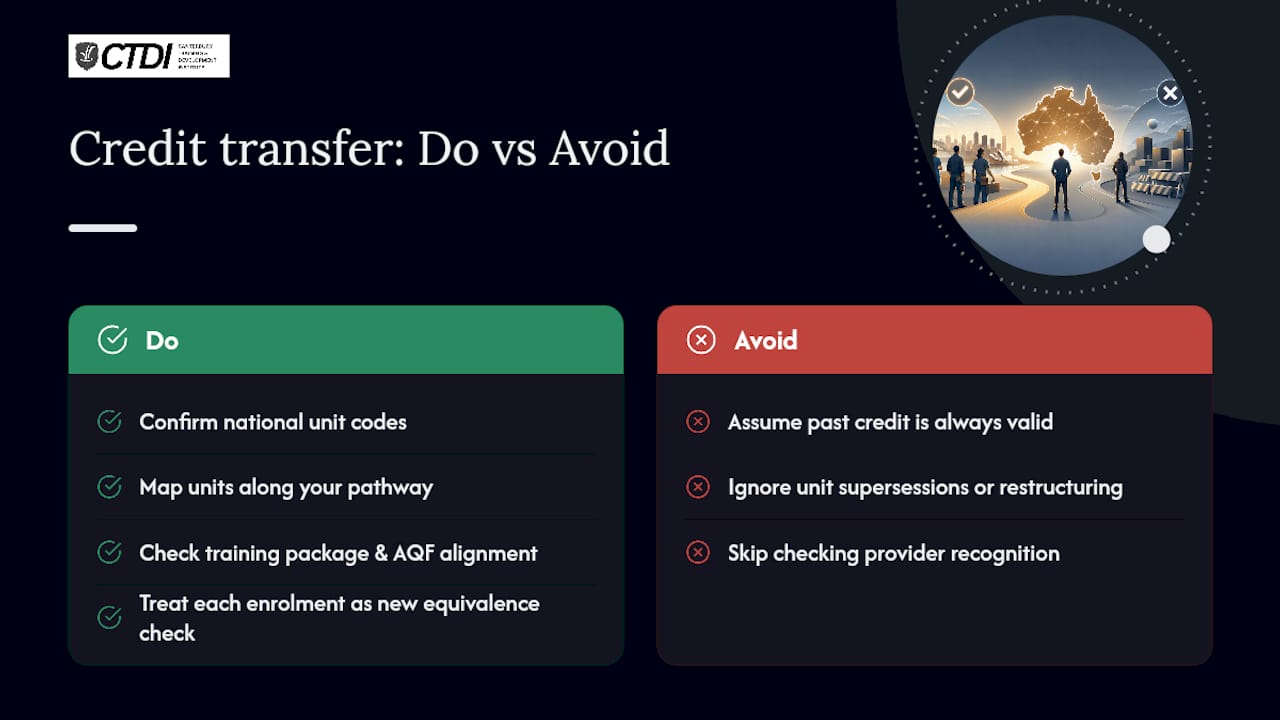
Getting credit for a unit doesn't just shorten your current course, it also carries forward into whatever you study next, provided the receiving provider recognises the same unit. Because credit transfer relies on the national unit codes listed on training.gov.au rather than provider-specific rules, a unit recognised at one registered training organisation should, in principle, be recognised again if you move to another provider offering a course built on the same units.
This matters most for students building a qualification ladder, moving from a Certificate III into a Certificate IV and eventually into a diploma. Shared core units across that ladder mean credit earned early often keeps paying off at every step up, provided the units haven't been superseded in the meantime. It's worth checking how training package qualifications and AQF levels align before committing to a pathway, since some diplomas draw on a wider spread of prerequisite units than others.
The flip side is that credit doesn't transfer perfectly forever. Units age out, get restructured, or get replaced by versions with different performance criteria, so a credit that was straightforward five years ago might require a fresh mapping assessment today. Treat every new enrolment as its own equivalence check, rather than assuming past recognition guarantees future recognition.
A pragmatic take on choosing your recognition pathway
Most students overthink this decision. If you're holding a certificate, transcript or Statement of Attainment for a matching unit, go with credit transfer. It's faster, it's less work, and the evidence bar is lower because you're proving a fact, not demonstrating a skill live. Save RPL for the gaps credit transfer can't fill, where your only evidence is years of doing the work without a piece of paper to show for it.
The mistake I see most often is students waiting until enrolment week to start gathering evidence, then wondering why an application that should have taken ten days drags into two months. Authenticate your documents early. If you're an international student, ask about visa implications before you accept an offer, not after. And keep a written record of every email you send a recognition team, because the appeals process moves a lot faster when you can point to exact dates.
— Sam
Get your skills recognition pre-assessment with CTDI
CTDI gets you into a nationally accredited diploma faster than starting from scratch, because our skills recognition process is built into enrolment rather than bolted on afterwards. If you've already got relevant certificates, workplace experience or a completed unit that overlaps with one of our courses in AI, digital marketing or environmentally sustainable management, our team maps it against current unit requirements before you commit to a single dollar in fees.

Request a pre-assessment through our enrolment page and find out exactly how much credit you're likely to receive before you enrol, not after. If you're weighing up a specific course, the Advanced Diploma of Digital Marketing page outlines the unit structure so you can compare it against your existing qualifications yourself. International students should flag their visa status at this stage too, since our student support team can walk you through how granted credit might change your course length and study conditions before you lock anything in. Get in touch, send through your transcripts, and let us tell you where you actually stand.
Where to check the official rules yourself
- ASQA's credit transfer and RPL guidance for student rights and evidence standards
- training.gov.au and the AQF for unit equivalence and your USI
- VTAC's credit transfer guidance for school-based VET contexts
- Your provider's published skills recognition and appeals policy
Sources
- Credit transfer and recognition of prior learning
- Credit Transfer (VET and Foundation) Procedure
- VET credit transfer policy and procedure