

TL;DR:
- A training package qualification is a nationally recognized, competency-based credential developed by industry and aligned to the Australian Qualifications Framework (AQF). It consists of units of competency, assessment requirements, and packaging rules that ensure consistency and industry relevance across Australia. These qualifications are delivered by registered RTOs within the scope approved by ASQA and offer portability and clear career progression.
A training package qualification is a nationally recognised, competency-based credential that specifies the exact skills and knowledge workers need to perform a job role, developed by industry and aligned to the Australian Qualifications Framework (AQF). These qualifications sit at the heart of Australia's vocational education and training (VET) system, covering everything from Certificate I through to Graduate Diploma level. The Australian Skills Quality Authority (ASQA) regulates their delivery, while Registered Training Organisations (RTOs) are the bodies authorised to award them. Understanding what a training package qualification means, and how it differs from other credentials, is the first step toward making a confident, career-focused education decision.
What is a training package qualification?
A training package qualification is an industry-developed set of nationally endorsed components that specifies the knowledge and skills workers need, organised into qualifications aligned to the AQF. The term "training package" refers to the broader framework, while a "qualification" is the specific credential a learner earns by completing a defined set of units within that framework. These are not standalone course documents. They are structured collections of units of competency, each with its own assessment requirements, bundled together to represent a recognised occupational standard.

The AQF provides the scaffolding. Qualifications range from Certificate I (entry-level) through Certificate II, III, and IV, then Diploma, Advanced Diploma, Vocational Graduate Certificate, and Graduate Diploma. Each level signals a different depth of skill and autonomy. A Certificate III in Early Childhood Education and Care, for example, sits at a different AQF level than a Diploma of Business, and each carries a distinct set of competency expectations that employers across Australia recognise.
Training packages are developed with direct input from industry, which is what gives them their authority. When an employer sees a Certificate IV in Accounting on a résumé, they know exactly what competencies that person has demonstrated, regardless of which RTO delivered the training. This national consistency is the defining advantage of the training package system over locally developed courses.
What are the key components of a training package qualification?
Training package qualifications are built from three core components: units of competency, assessment requirements, and qualification packaging rules. Understanding each one helps you see why these credentials carry real weight with employers.
Units of competency define the specific skills and knowledge a learner must demonstrate. Each unit describes what a worker needs to do, the conditions under which they perform it, and the standard required. A Diploma of Project Management, for instance, contains units covering risk management, stakeholder engagement, and project planning, each with its own performance criteria.
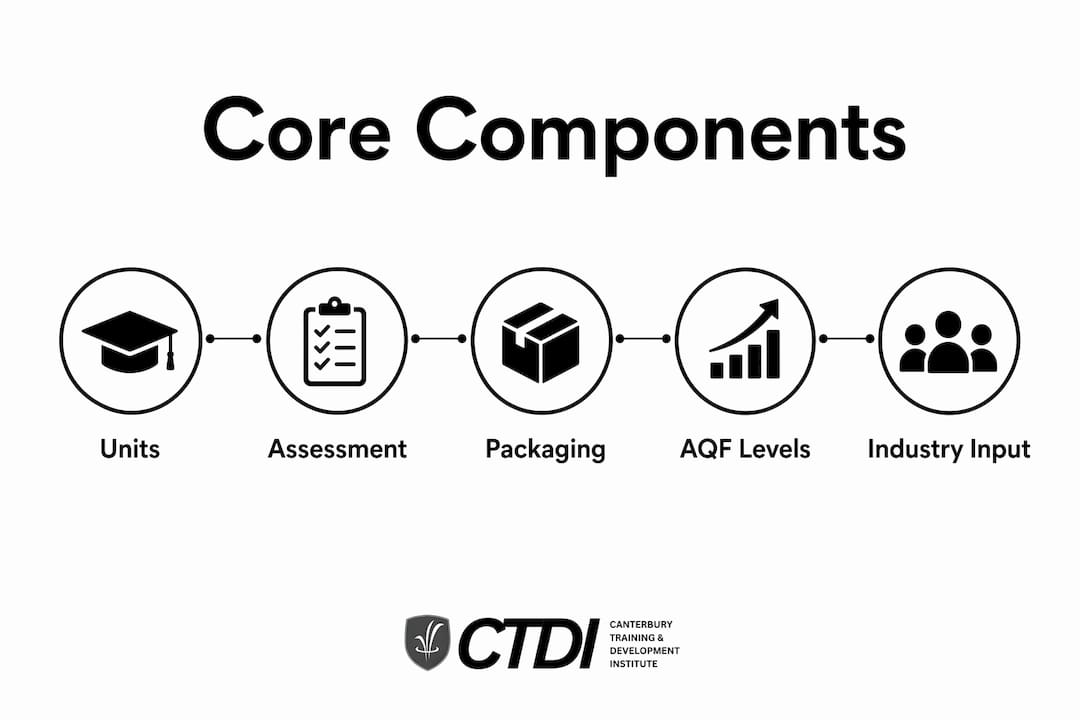
Assessment requirements accompany every unit and specify exactly how competence must be demonstrated. These are not optional guidelines. They set the minimum evidence a learner must produce for an RTO to award competency. This is why competency-based assessment focuses on demonstrated skills rather than exam scores or attendance hours.
Qualification packaging rules dictate which units are core (mandatory) and which are elective, and how many of each a learner must complete to receive the full qualification. Some qualifications also include credit arrangements, allowing learners to apply recognition of prior learning (RPL) or credit from other qualifications toward their current enrolment.
| Component | What it does | Example |
|---|---|---|
| Units of competency | Defines skill and knowledge standards per task | "Manage project scope" in a project management diploma |
| Assessment requirements | Sets evidence standards for each unit | Portfolio, observation, or written assessment |
| Packaging rules | Specifies core and elective unit combinations | 8 core units plus 6 electives for a Diploma |
| AQF alignment | Places qualification at the correct level | Certificate IV = AQF Level 4 |
| Credit arrangements | Allows RPL or cross-qualification credit | Prior work experience counted toward units |
The AQF levels matter practically. A Certificate II prepares someone for supervised work in a defined role. A Diploma signals the ability to apply knowledge with depth and some autonomy. An Advanced Diploma indicates the capacity to manage complex functions. Choosing the right level for your career stage is as important as choosing the right qualification title.
Pro Tip: Before enrolling, download the qualification's packaging rules from training.gov.au and count the core versus elective units. This tells you exactly what you will study and whether elective choices align with your specific job role.
How do training package qualifications differ from accredited courses?
The distinction between training package qualifications and accredited courses is one of the most misunderstood areas of Australian VET. Both result in nationally recognised credentials, but they are built, owned, and regulated differently.
Accredited courses are developed when training needs are not met by existing training package qualifications. They are licensed products with an IP owner, typically an RTO or industry body, and they require a formal accreditation process with associated costs. Training packages, by contrast, are government-funded, industry-endorsed frameworks with no single owner. Any RTO on scope can deliver them without licensing fees.
| Feature | Training package qualification | Accredited course |
|---|---|---|
| Developed by | Industry bodies with government funding | RTOs or industry bodies (privately) |
| Ownership | No IP owner; publicly available | IP owner holds licence |
| Accreditation cost | None for RTOs | Accreditation fees apply |
| National recognition | Automatic across all states | Recognised but less portable |
| Scope of use | Any RTO on scope can deliver | Only licensed providers |
| When used | When occupational standard exists | When a gap in training packages exists |
The portability difference is significant for learners. A training package qualification like a Certificate IV in Work Health and Safety carries the same meaning in Queensland, Victoria, and Western Australia. An accredited course may be recognised nationally but is less likely to be delivered widely, which can limit your options if you move states or change employers.
Choosing between the two comes down to what you need to learn. If a training package qualification covers your target occupation, it is generally the better choice. It offers broader recognition, no extra accreditation costs for the provider, and a clearer pathway to further qualifications. You can explore the differences in course accreditation in more detail if you are weighing up your options.
Pro Tip: Check training.gov.au before assuming a course is a training package qualification. Search the qualification code (e.g. BSB40120) to confirm it is nationally endorsed and not an accredited course with a similar title.
How do training package qualifications operate within the VET system?
Training package qualifications do not exist in isolation. They operate within a regulated system involving ASQA, RTOs, the AQF, and in some cases, state government bodies. Understanding this system helps you choose a provider with confidence.
ASQA is the national regulator for the VET sector. It approves RTOs to deliver specific qualifications and monitors compliance with the Standards for Registered Training Organisations. An RTO can only deliver the training package qualifications and units listed on its scope of registration. This is a hard boundary. If a qualification is not on an RTO's scope, that provider cannot legally award it, even if the qualification exists nationally.
The AQF ensures that every qualification at a given level meets the same depth and complexity standard, regardless of the training package it comes from. This is what allows a Diploma of Information Technology and a Diploma of Nursing to both sit at AQF Level 5 while covering entirely different occupational areas. The framework creates a common language for employers, further education institutions, and government agencies.
Apprenticeships and traineeships add another governance layer. Training packages are mandatory for apprenticeship qualifications, and the NSW Government, for example, uses Industry Training Advisory Bodies (ITABs) to assess whether a training package is suitable for a given apprenticeship pathway. RTOs delivering apprenticeship training must also have a Training Plan in place within 12 weeks of the apprenticeship commencing. This is not optional. It is a regulatory requirement that protects both the apprentice and the employer.
The competency-based model underpins everything. Learners progress by demonstrating competence against unit assessment requirements, not by accumulating study hours or passing written exams. This means a learner with strong prior experience can move through a qualification faster than someone starting from scratch, provided they can produce the required evidence. It also means the qualification signals genuine capability, not just course completion.
- ASQA regulates which RTOs can deliver which qualifications
- AQF levels ensure national consistency in qualification depth
- ITABs assess training package suitability for apprenticeship pathways
- Training Plans are required within 12 weeks for apprenticeships in NSW
- Competency-based assessment replaces hours-based progression
Pro Tip: Use the training.gov.au register to search any RTO's scope of registration before enrolling. Enter the qualification code and confirm the provider is listed. This takes two minutes and prevents enrolment issues later.
What to check before enrolling in a training package qualification
Enrolling in a training package qualification involves more than picking a course title and paying a fee. Several practical checks protect your time, money, and career outcomes.
-
Verify the RTO's scope. RTO scope limitations mean learners must confirm their chosen provider is authorised to deliver the specific qualification and units they want. A qualification being nationally available does not mean every RTO can deliver it. Check training.gov.au and search the provider's registration details.
-
Understand how you will be assessed. Competency-based assessment requires you to demonstrate skills against each unit's assessment requirements. This might involve workplace observations, portfolios, projects, or written assessments. Ask the RTO for its assessment strategy before you enrol so there are no surprises.
-
Check the packaging rules for your career goal. Elective units within a qualification can be chosen to align with a specific job role. A Diploma of Business with electives in human resources looks different on a résumé than the same diploma with electives in operations management. Choose electives deliberately.
-
Understand RPL and credit transfer options. If you have prior work experience or have completed other qualifications, you may be eligible to have units credited without completing full training. Ask the RTO about its RPL process upfront. This can reduce both cost and study time significantly.
-
Confirm the qualification's portability. A training package qualification carries the same meaning across Australia, which means your Certificate IV in Accounting is recognised by employers in every state. This national portability is a core benefit of the training package system, but it only applies if the qualification is genuinely nationally endorsed. Verify the qualification code on training.gov.au.
-
For apprenticeships, understand the Training Plan requirement. If you are entering a traineeship or apprenticeship, your employer and RTO must develop a Training Plan within the required timeframe. In NSW, this is within 12 weeks of commencement. The plan outlines what you will learn, when, and how it will be assessed.
A common misconception is that any provider offering a qualification title is authorised to award it. This is false. Scope of registration is a legal requirement, and enrolments with out-of-scope providers are invalid. Always verify before you commit.
Pro Tip: Ask your RTO for a sample assessment tool before enrolling. A reputable provider will share this willingly. It tells you exactly what evidence you need to produce and whether the assessment approach suits your learning style and work situation.
Key takeaways
Training package qualifications are the backbone of Australian vocational education, providing nationally consistent, competency-based credentials that employers trust because they are built by industry and regulated by ASQA.
| Point | Details |
|---|---|
| Training package definition | An industry-developed framework of units of competency aligned to the AQF, not a standalone course document. |
| Components of qualifications | Every qualification contains units of competency, assessment requirements, and packaging rules specifying core and elective units. |
| Difference from accredited courses | Training packages are publicly owned and portable nationally; accredited courses fill gaps but carry IP ownership and accreditation costs. |
| RTO scope is critical | Learners must verify their provider is authorised to deliver their chosen qualification before enrolling. |
| Competency-based progression | Learners advance by demonstrating skills against unit requirements, not by completing set hours or passing traditional exams. |
Why understanding these qualifications changed how I advise learners
The part of training package qualifications that most people overlook is the scope of registration rule. I have spoken with learners who completed an entire course only to discover the RTO was not authorised to deliver that specific qualification. The credential was worthless. Not because the training was poor, but because the provider had not maintained its scope. That is a devastating outcome for someone who invested months of effort and real money.
The second thing I find consistently misunderstood is the difference between a training package qualification and an accredited course. Learners often assume that any nationally recognised credential is equivalent in portability. It is not. A training package qualification like a Certificate III in Business travels across every state without question. An accredited course, even a well-designed one, may not be delivered outside the state where it was developed. For anyone planning to work across Australia or move cities, this distinction is career-defining.
What I genuinely respect about the training package system is its competency-based foundation. It rewards what you can actually do, not how long you sat in a classroom. A skilled tradesperson with 10 years of experience can move through an RPL process and receive a qualification that reflects real capability. That is a fairer system than one that requires everyone to start from scratch regardless of experience.
The system is not perfect. Training packages are reviewed periodically, but industry moves faster than the review cycle in some sectors. Digital marketing, artificial intelligence, and sustainability are areas where the gap between what packages specify and what employers actually need can widen quickly. This is worth knowing when you choose a qualification. Look at the release date of the training package version you are enrolling in, and ask your RTO how it supplements the package with current industry content.
My advice is straightforward. Treat the training.gov.au register as your first stop, not an afterthought. Verify the qualification code, check the RTO's scope, read the packaging rules, and ask about assessment methods before you sign anything. An informed enrolment decision takes 30 minutes. An uninformed one can cost you months.
— Sam
Start your qualification with CTDI
Canterbury Training & Development Institute (CTDI) is a registered RTO delivering nationally recognised training package qualifications entirely online, with courses designed by industry practitioners for real career outcomes.

CTDI's course catalogue includes qualifications aligned to current training packages across digital marketing, artificial intelligence, and environmental sustainability. Whether you are pursuing an Advanced Diploma of Digital Marketing or a Certificate IV in Environmental Sustainable Management, every course is self-paced and 100% online. Study around your existing commitments without sacrificing the quality of a nationally recognised credential. If you are ready to take the next step, enrol now and speak with a CTDI student adviser about the right qualification for your career goals.
FAQ
What is a training package qualification in Australia?
A training package qualification is a nationally endorsed, competency-based credential developed by industry and aligned to the AQF. It is composed of units of competency and assessment requirements, delivered by RTOs authorised by ASQA.
How does a training package qualification differ from an accredited course?
Training package qualifications are publicly owned, government-funded, and portable across all Australian states. Accredited courses are privately owned, fill gaps not covered by training packages, and may have more limited national portability.
What does competency-based assessment mean for learners?
Competency-based assessment means learners progress by demonstrating skills against each unit's requirements, not by completing a set number of hours or passing traditional exams. Evidence can include workplace observations, portfolios, or projects.
Can any RTO deliver a training package qualification?
No. RTOs can only deliver the qualifications and units listed on their approved scope of registration. Learners should verify an RTO's scope on training.gov.au before enrolling to confirm the provider is authorised for their chosen qualification.
Are training package qualifications recognised across all Australian states?
Yes. A training package qualification holds the same meaning in every state and territory because it is nationally endorsed. A Certificate IV in Accounting, for example, carries identical competency standards whether it is completed in Sydney, Melbourne, or Perth.