

TL;DR:
- Many Australian vocational courses are only officially recognized if delivered by registered RTOs under strict regulatory standards.
- Verifying RTO registration via training.gov.au ensures the qualification's legitimacy, industry relevance, and national portability.
Many students searching for vocational training assume that "nationally recognised" simply means a course is popular, delivered online, or looks good on a résumé. That misunderstanding can be costly. To explain nationally recognised courses properly, you need to understand that the term has a precise legal meaning in Australia, tied to a strict regulatory framework that governs who can issue qualifications, how students are assessed, and what employers can trust. This article breaks down exactly what national recognition means, how to spot legitimate providers, and how to choose the right course to advance your career with confidence.
Table of Contents
- What are nationally recognised courses in Australia?
- How Australian nationally recognised courses assure quality and industry relevance
- Distinguishing Australian nationally recognised courses from US industry-recognised credentials
- How flexible online nationally recognised courses operate in Australia
- How to verify nationally recognised courses and choose the right provider
- Why understanding the nuances of nationally recognised courses matters beyond enrolment
- Explore nationally recognised online courses with CTDI
- Frequently asked questions
Key Takeaways
| Point | Details |
|---|---|
| Definition clarity | Nationally recognised courses in Australia are competencies certified by RTOs regulated by ASQA under AQF standards. |
| Quality assurance | These courses require competency-based assessments and compliance with national training packages to ensure employer confidence. |
| International distinction | Australian national recognition differs from US industry-recognised credentials, so verification should follow Australian regulatory frameworks. |
| Online delivery nuances | Flexible online courses include digital learning but retain mandatory assessments and workplace components to maintain credential integrity. |
| Verification importance | Students must verify RTO registration and course scope through official registers to avoid misleading marketing claims. |
What are nationally recognised courses in Australia?
Nationally recognised courses in Australia are not self-declared or marketing labels. They are vocational qualifications delivered exclusively by organisations that have been formally registered under the national Vocational Education and Training (VET) system. The term carries specific legal weight, and knowing what sits behind it protects you from wasting money on credentials that employers will not accept.
The key player in this system is the Australian Skills Quality Authority, known as ASQA. ASQA is the national regulator responsible for ensuring that training providers meet rigorous quality standards before they can issue any nationally recognised qualification. As the national VET regulator, ASQA requires every training provider to be registered as a Registered Training Organisation (RTO) before it can deliver nationally recognised training and assessment. Some states, including Victoria and Western Australia, have their own regulators, but the principles and standards are consistent nationwide.
An RTO is a training provider that is formally registered in Australia and authorised to deliver nationally recognised vocational education and issue Australian Qualifications Framework (AQF) qualifications. The AQF is the unified framework that classifies every level of education in Australia, from Certificate I through to Doctoral Degrees, ensuring consistency in what each qualification level represents.
Here is what that means in practical terms for you as a prospective student:
- Only registered RTOs can issue AQF qualifications or Statements of Attainment
- A provider without RTO registration can offer training, but it cannot issue nationally recognised credentials
- Non-RTO providers can only give certificates of attendance or completion, which carry no national recognition
- RTO registration is publicly verifiable, meaning you can confirm any provider's legitimacy before you enrol
- RTOs must continuously meet ASQA standards to maintain their registration and keep issuing valid qualifications
Understanding this foundation is your first line of defence against misleading course marketing. You can read more about the landscape of accredited courses in Australia to build on this foundation.
How Australian nationally recognised courses assure quality and industry relevance
Now that you know who regulates nationally recognised courses, it is essential to understand how this regulation translates into assured course quality and national industry relevance. The short answer is that the quality assurance goes well beyond a registration tick. It is embedded in how courses are designed, delivered, and assessed.
Nationally recognised courses follow what are called training packages or accredited courses. Training packages are nationally endorsed documents developed with industry bodies that define exactly what a worker in a given occupation needs to know and be able to do. These are not invented by individual RTOs. They are produced through industry consultation and endorsed at a national level, ensuring that a Certificate IV in Accounting and Bookkeeping studied in Brisbane carries the same occupational meaning as one completed in Perth or Adelaide.
Here is how the quality assurance process works in sequence:
- Industry develops training packages outlining the competency standards required for specific occupations
- RTOs apply to deliver specific qualifications from those training packages, subject to ASQA approval
- Students are assessed using competency-based assessment, meaning they must demonstrate real, observable skills, not just pass a written exam
- RTOs undergo ongoing compliance monitoring by ASQA, including audits, complaints investigations, and performance reviews
- Qualifications are portable, meaning any Australian employer, further education institution, or licensing authority in the country can trust and interpret the qualification consistently
The competency-based model is worth pausing on. Unlike traditional academic assessment that might rely on essays or exams alone, competency-based assessment aligned with national standards means you must show you can actually perform the tasks required in the workplace. This is what gives nationally recognised qualifications their credibility with employers.
"ASQA ensures RTOs comply with the Standards for Registered Training Organisations to maintain the integrity of nationally recognised qualifications, protecting both students and industry confidence in vocational credentials."
The practical implication: when you hold a nationally recognised qualification, employers across every state and territory understand exactly what skills and knowledge you have demonstrated. That portability and consistency is what sets these courses apart from privately issued certificates with no regulatory backing. Explore how vocational course quality standards translate into real outcomes for your career.

Distinguishing Australian nationally recognised courses from US industry-recognised credentials
For those considering vocational courses from Australia or the US, understanding these distinctions is vital to assess course legitimacy and value. International students in particular often encounter terminology that sounds similar but operates under entirely different frameworks.
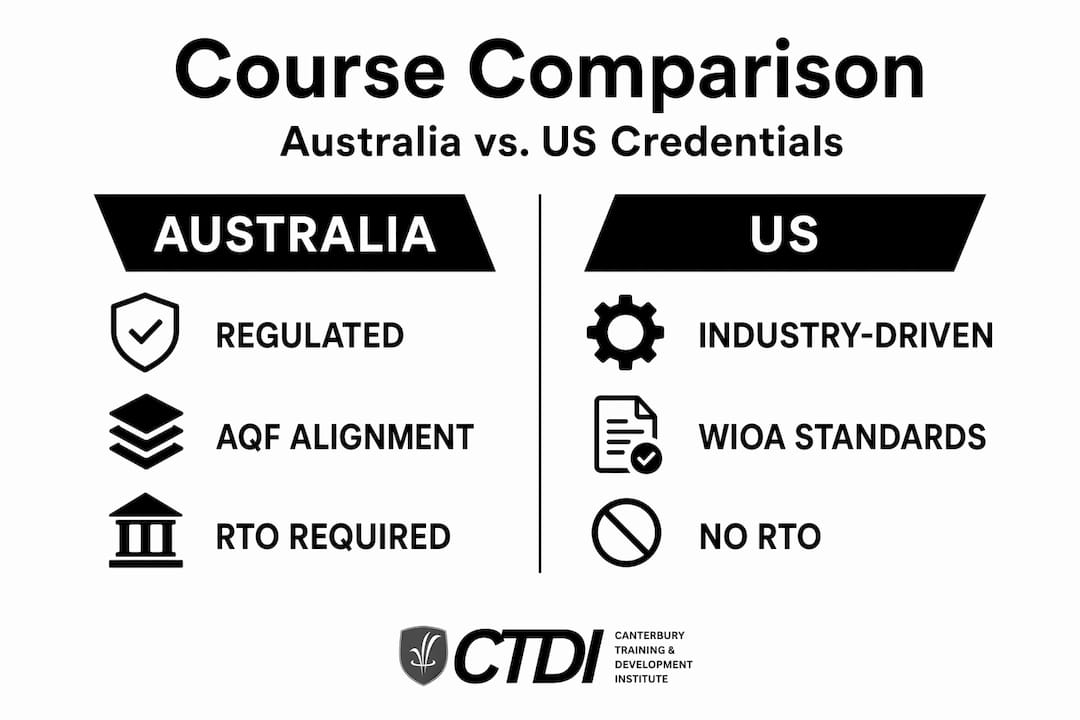
In Australia, the term "nationally recognised" is tied directly to regulation. It refers to AQF-aligned vocational education delivered by RTOs under ASQA oversight. In the United States, a similar-sounding term, "industry-recognised credentials," operates under the Workforce Innovation and Opportunity Act (WIOA). The Australian vs US recognition frameworks differ significantly: Australian national recognition is government-regulated at the provider level, while the US WIOA model relies on third-party validation of credentials by industry bodies, with federal funding mechanisms tied to workforce outcomes.
The table below summarises the key differences:
| Feature | Australian nationally recognised courses | US industry-recognised credentials (WIOA) |
|---|---|---|
| Regulatory authority | ASQA or state regulator | No single federal authority |
| Issuing body | Registered Training Organisations (RTOs) | Varied: industry bodies, vendors, universities |
| Quality assurance mechanism | RTO registration, ASQA audits, national standards | Third-party validation, employer council endorsement |
| Qualification framework | Australian Qualifications Framework (AQF) | No unified national framework |
| Portability within country | Guaranteed nationally | Varies by credential and industry sector |
| International student guidance | Verify RTO registration via training.gov.au | Verify through WIOA-approved credential lists |
The practical consequence is this: a certificate from a US industry body does not automatically carry the same meaning or employer recognition in Australia, and vice versa. Credential value depends on the issuing authority's accountability mechanisms, and those mechanisms differ significantly between the two countries.
Pro Tip: If you are an international student looking to work in Australia after completing a course, confirm your provider holds current RTO registration under the Australian VET system. A qualification from an unregistered provider will not be treated as nationally recognised by Australian employers, regardless of how the course is marketed.
This distinction also matters for students evaluating online courses promoted across borders. A course advertised as "nationally recognised" by a US-based provider is describing something entirely different from the Australian VET definition. Always apply the Australian vs US credentials lens before you enrol.
How flexible online nationally recognised courses operate in Australia
Having clarified what nationally recognised courses mean in theory, it is worth exploring how these courses are delivered in practice, especially through flexible online study options. The growth of online vocational education has created genuine opportunities, but also some common misconceptions about what "online" actually means for assessment and qualification integrity.
Nationally recognised online courses combine flexible digital learning with structured assessment requirements. The learning content, such as readings, videos, interactive modules, and written tasks, can typically be completed anywhere, at any time, on your schedule. That genuine flexibility is what makes online nationally recognised vocational study attractive for working adults, parents, and students in regional areas. However, the flexibility applies to the learning, not the assessment standards.
Here is how online nationally recognised courses typically operate:
- Self-paced learning modules are accessed through a learning management system at times that suit you
- Written and knowledge assessments are submitted online through the same system
- Practical or workplace assessments may require observation by a workplace supervisor or third-party assessor, depending on the qualification
- Student support services including trainer access, technical help, and progression feedback are provided by the RTO
- Assessment decisions are made by qualified assessors against national competency standards, not by algorithms or automated marking alone
The online delivery does not reduce the assessment rigour required. As demonstrated by structured programs like the Certificate IV online model, nationally recognised courses delivered online include learning content online, with assessments and workplace learning structured around competency requirements. The "online" aspect does not remove the need for competency-based assessment and workplace learning where required by the qualification.
Pro Tip: Before enrolling in any online nationally recognised course, ask the provider specifically how competency assessments are conducted and whether there are any workplace or practical placement requirements. A reputable RTO will have clear, written answers to both questions. Explore how online nationally recognised courses are structured to fit your lifestyle without cutting corners on qualification standards.
Understanding what flexible online vocational education genuinely involves helps you plan your study schedule realistically and ensures you enter a programme ready to meet all assessment obligations, not just the self-paced learning components.
How to verify nationally recognised courses and choose the right provider
To benefit fully from nationally recognised courses, you need to know how to assess and select legitimate providers and courses that match your career goals. This is not a complicated process, but it requires a few deliberate steps before you hand over any enrolment fees.
Follow this verification process before committing to any provider:
- Check the national register. The Australian government maintains training.gov.au, the official register of all RTOs and their approved qualifications. Search for the provider by name or RTO number to confirm their registration is current and active.
- Verify the specific course is in scope. An RTO may be registered but not authorised to deliver the specific qualification you want. Confirm the exact course code and title appear within that provider's approved scope on training.gov.au.
- Confirm the provider's assessment model. As discussed, competency-based assessment is non-negotiable. Ask how assessments are structured, who marks them, and what happens if you need to resubmit.
- Review support services. Reputable RTOs offer access to qualified trainers, not just automated course content. Find out how you can contact a trainer and how quickly they respond.
- Scrutinise marketing language carefully. A provider offering a "completion certificate" or "industry certificate" without mentioning RTO registration or AQF qualifications is signalling that their credential is not nationally recognised.
Students should verify a provider's RTO registration and confirm the exact course is within their approved scope, especially if studying online or internationally. This is not optional due diligence. It is the difference between a qualification that opens career doors and a certificate that sits in a drawer.
When comparing providers, also consider course delivery format, whether the RTO has trainers with current industry experience, and how assessment feedback is handled. Price alone is a poor indicator of quality in vocational education. A low-cost course from an RTO with poor audit history or limited trainer access may cost you far more in wasted time than a well-supported programme from a credible provider.
You can choose nationally recognised courses with confidence once you have run through this verification checklist. When you are ready to take the next step, you can enrol in nationally recognised courses through a provider whose RTO registration you have confirmed and whose course scope includes exactly what you need.
Why understanding the nuances of nationally recognised courses matters beyond enrolment
Here is the uncomfortable truth most course marketing will not tell you: enrolling in a nationally recognised course is not the same as benefiting from one. The regulatory framework we have described is only valuable to you if you engage with it actively, not passively.
Many students see the words "nationally recognised" on a course page and assume their work is done. It is not. Marketing may use terms like "nationally recognised," but only RTO registration and assessment compliance guarantee the credential's value and portability. The term is not legally protected in the way that, say, a licensed trade is. A provider can use it loosely in a headline and bury the absence of RTO registration in the fine print.
This matters most in the online space, where course providers from outside Australia can easily target Australian students. A beautifully produced online course from an unregistered provider is simply not a nationally recognised qualification under Australian law, regardless of how it is described. Online delivery without corresponding assessment or workplace learning risks producing certificates of completion with limited employer recognition. That is a significant risk when your goal is career advancement.
The deeper point is about ownership of your own learning investment. Nationally recognised vocational courses are valuable precisely because they are hard to fake. The competency-based assessment model, the ASQA oversight, the industry-aligned training packages: these are not bureaucratic obstacles. They are what make employers trust the credential you hold. When you understand that, you stop treating assessment tasks as hurdles and start recognising them as the thing that makes your qualification worth having.
There is also a strategic career dimension here. Industry alignment in training packages means your qualification reflects what employers actually need right now, not what was relevant a decade ago. Training packages are regularly reviewed and updated with industry input. Choosing a course built on a current, endorsed training package means your skills are contemporary and your qualification reflects today's occupational standards.
Our expert insights on online courses reinforce this point: the trainer's industry currency matters as much as the regulatory framework. An RTO that pairs genuine regulatory compliance with trainers who are working professionals in their field is the combination that produces graduates employers actively seek.
Explore nationally recognised online courses with CTDI
With a clear understanding of nationally recognised courses, you can confidently explore what Canterbury Training and Development Institute (CTDI) has to offer. CTDI is a registered training organisation (RTO 46515) delivering flexible, 100% online vocational qualifications that meet ASQA standards and carry full AQF recognition. Every course is designed with industry relevance at its core, taught by practitioners with real-world experience in their fields.

Whether you are looking to build expertise in the digital marketing diploma or develop skills in environmental sustainability through the Certificate IV in sustainable management, CTDI's programmes are structured to fit your schedule without compromising on assessment integrity or credential quality. Enrolment is open to both domestic and international students, and our support team is here to guide you through every step. Ready to take the next step? Enrol now at CTDI and start building a career-ready qualification on your terms.
Frequently asked questions
What does 'nationally recognised' mean for Australian vocational courses?
It means the course is delivered by a Registered Training Organisation approved by ASQA or a state regulator, meeting national quality standards under the Australian Qualifications Framework (AQF). Only RTOs can issue qualifications that carry this national recognition and portability across Australia.
Can I complete all assessments online for a nationally recognised online course?
While most theory learning is completed online, nationally recognised online courses require competency-based assessments and any applicable workplace learning to be completed to meet national standards. Ask your provider upfront how these are structured before you enrol.
How can I check if a course provider is a legitimate RTO?
You can verify provider registration and confirm your course is within their approved scope by searching the official government training register at training.gov.au. This takes minutes and is the most reliable check you can perform.
Are certificates from non-RTO providers nationally recognised?
No. Providers that are not RTOs cannot issue AQF qualifications or nationally recognised outcomes and may only offer certificates of attendance or completion, which carry no national recognition and are unlikely to satisfy employer or licensing requirements.