

TL;DR:
- Skills recognition in Australia involves officially assessing qualifications and experience against national standards for career or visa eligibility. The process requires precise documentation, correct ANZSCO coding, and thorough duty statements, with a typical turnaround of six to twelve weeks. Recognition of Prior Learning offers a faster pathway by converting work experience into formal credentials, especially for experienced professionals.
Skills recognition is the formal process of evaluating an individual's existing qualifications, work experience, and competencies against recognised Australian standards to confirm eligibility for career advancement or educational pathways. Known formally as skills assessment in the migration and vocational training context, it sits at the intersection of the Australian Qualifications Framework (AQF), ANZSCO occupation codes, and the network of government-approved assessing authorities. Whether you are a skilled migrant pursuing a visa, a professional seeking formal accreditation, or a worker wanting credit for years of on-the-job experience, understanding what is skills recognition is the first step toward getting the validation you deserve.
What is the skills recognition process in Australia?
Skills recognition in Australia is a structured evaluation that confirms whether your qualifications and work history meet the standards of a nominated occupation. Skills assessments confirm qualifications and work history against ANZSCO occupation standards, and they are mandatory for most skilled migration visas including subclass 189, 190, 491, and 482. That makes it one of the most consequential administrative steps a skilled professional can take.
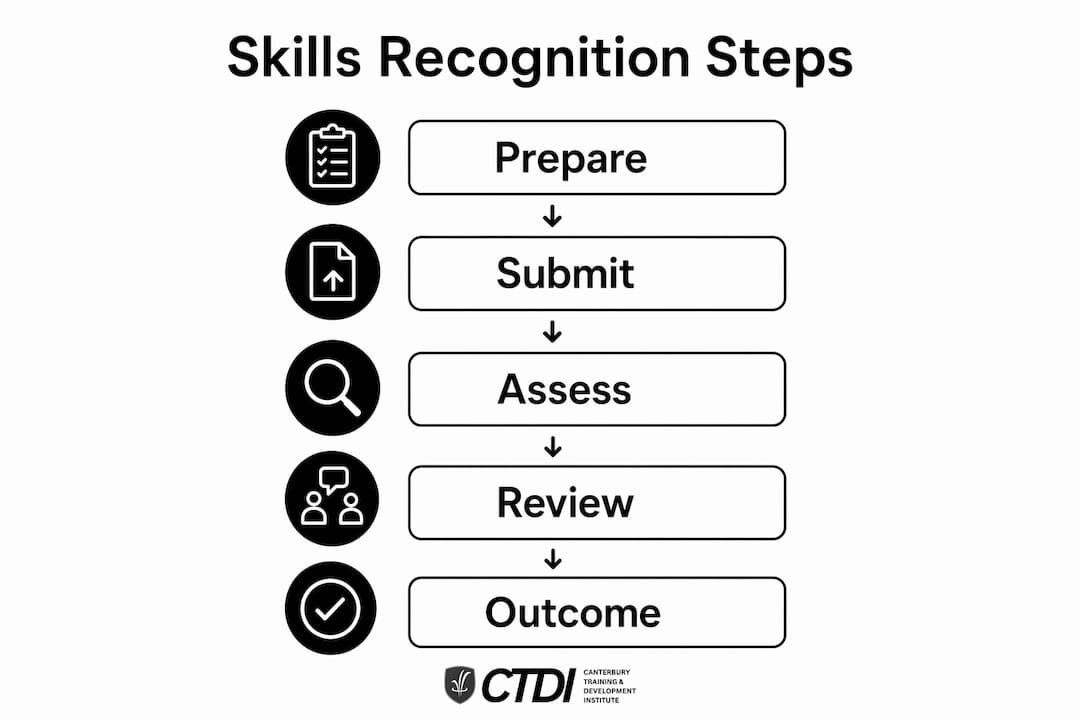
The skills assessment process follows a clear sequence. Each stage has specific requirements, and missing any one of them delays the outcome.
- Identify your ANZSCO occupation code. Your occupation must match an approved code on the relevant skilled occupation list. The code drives everything: which assessing authority you use, what evidence you need, and what duties you must demonstrate.
- Select the correct assessing authority. Choosing the right assessing authority depends on accurate alignment of your duties with the ANZSCO code, not just your job title. Authorities include bodies such as Engineers Australia, the Australian Computer Society (ACS), Trades Recognition Australia (TRA), and the Australian Institute of Management (AIM), among others.
- Gather your documentation. You need certified copies of qualifications, a detailed employment history, and reference letters from employers. Each document must map explicitly to the duties listed under your ANZSCO code.
- Write your duty statement. This is the most critical document in the application. It must describe your actual tasks using the specific terminology of your ANZSCO occupation, not a generic position description copied from an HR template.
- Submit your application and pay the assessment fee. Fees vary by authority and occupation category.
- Wait for the outcome. The skills assessment process takes 6–12 weeks from submission to decision, with positive results generally valid for 3 years. That validity window matters: if your visa application takes longer than expected, you may need to reassess.
If the outcome is negative, you are not without options. Applicants can request a formal review within 60–90 days by providing new supporting evidence. The key word is "new." Simply re-arguing your original submission does not succeed.
Pro Tip: Start collecting employment records and reference letters well before you apply. Retroactively obtaining detailed duty descriptions from former employers is one of the most common delays candidates face.
What is Recognition of Prior Learning (RPL) and how does it relate?
Recognition of Prior Learning, or RPL, is a specific pathway within the broader skills recognition framework. RPL allows individuals to translate informal, lived experience into formal accreditation, often saving time and cost by bypassing redundant coursework. Where a standard skills assessment asks "do your qualifications meet this occupation's requirements," RPL asks "does your experience demonstrate the competencies of this qualification?"
RPL is particularly powerful for professionals who have built deep expertise through years of work but never completed a formal qualification in that field. A project manager who has led large infrastructure programmes for a decade may hold no formal project management diploma. RPL lets them demonstrate competency through evidence rather than sitting through units they already know.
Common RPL assessment methods include:
- Portfolio of evidence: Work samples, reports, client communications, and project documentation that demonstrate specific competency units.
- Challenge assessments: Written or practical tests that assess knowledge without requiring full coursework completion.
- Skills audits: A structured self-assessment mapped against the competency standards of the target qualification.
- Third-party reports: Statements from supervisors or clients confirming observed workplace performance.
RPL connects directly to the nationally recognised qualification system in Australia, where qualifications sit within the AQF and are governed by training packages. A successful RPL outcome grants credit toward or full attainment of a qualification at the relevant AQF level.
Skills recognition is not about what you studied. It is about what you can do, what you have done, and whether the evidence proves it. RPL makes that case on your behalf, turning years of professional experience into a credential that opens doors.
The distinction between skills, talents, and formal certification matters here. A talent is a natural aptitude. A skill is a talent developed through practice and application. Formal certification is the documented proof that a skill meets a defined standard. RPL bridges the gap between the skill you have and the certification you lack. Understanding this distinction helps you present your evidence more effectively, because assessors are looking for demonstrated competency, not just a list of responsibilities.
What are the benefits and challenges of skills recognition?
The benefits of skills recognition are concrete and career-defining. The challenges are equally real, and most of them are avoidable with the right preparation.
Benefits worth knowing
Skills recognition delivers advantages that go well beyond a certificate on a wall. For skilled migrants, a positive assessment is the gateway to visa eligibility. For domestic professionals, it can mean formal recognition of experience that unlocks promotions, higher pay grades, or entry into regulated occupations. For students, RPL reduces the time and cost of completing a qualification by granting credit for prior learning.

Industry accreditation in career growth is well documented: professionals with formally recognised qualifications consistently access higher-level roles and stronger salary outcomes than those with equivalent experience but no formal credential. Skills recognition is the mechanism that closes that gap without requiring years of additional study.
Common challenges and how they trip people up
The most frequent failure point is the duty statement. A detailed duty statement explicitly mapping to ANZSCO terminology is critical. Generic job descriptions lead to rejected applications. This is not a minor administrative issue. Assessors are trained to match your described duties against a defined occupational profile. If your language does not reflect the ANZSCO definition, the assessor cannot confirm the match, regardless of how qualified you actually are.
A second challenge is misidentifying the correct ANZSCO code. Many occupations have closely related codes with different assessing authorities and different duty requirements. Applying under the wrong code wastes time, money, and your 3-year validity window.
| Challenge | Why it matters | How to address it |
|---|---|---|
| Generic duty statements | Assessors cannot match vague descriptions to ANZSCO standards | Use ANZSCO occupation definition as a writing template |
| Wrong ANZSCO code | Routes application to wrong authority, causes delays | Cross-check duties against the full ANZSCO description, not just the title |
| Incomplete documentation | Missing evidence creates gaps assessors cannot overlook | Build a document checklist before submission |
| Undervaluing structural skills | Quiet skills like organising complexity are often omitted | Audit all responsibilities, including coordination and communication roles |
Skills recognition is fundamentally about pattern recognition rather than credentials alone. Structural talents such as system organisation, process design, and communication bridging are highly valuable but frequently overlooked by applicants who focus only on their loudest achievements. If you managed a team, coordinated across departments, or built a reporting system, those are assessable competencies. Document them.
Pro Tip: Read the full ANZSCO occupation description for your code before writing a single word of your duty statement. Every task you describe should echo the language used in that definition.
How to prepare and succeed in your skills recognition application
Preparation is the single biggest predictor of a successful outcome. Candidates who treat the application as a form-filling exercise consistently underperform compared to those who treat it as a structured evidence case.
- Confirm your ANZSCO code before anything else. Read the full occupation description, not just the title. If your duties match two codes, seek professional advice before committing to one. The wrong choice costs you the assessment fee and months of processing time.
- Map every duty to the ANZSCO definition. Take the occupation's listed tasks and write your duty statement as a direct response to each one. This is the most effective way to demonstrate alignment and the clearest signal to an assessor that you understand what they are looking for.
- Collect employment evidence in detail. Reference letters must go beyond "John worked here from 2019 to 2024." They need to describe specific duties, technologies used, team sizes managed, and outcomes achieved. The more specific, the stronger the case.
- Align your qualifications with AQF levels. Academic qualifications and work experience are evaluated against AQF and occupational standards during assessment. Know where your qualification sits on the AQF scale and whether it meets the minimum level required for your occupation.
- Submit early and track your timeline. With a 6–12 week processing window, late submissions create visa application pressure. Build in buffer time for document gathering, translation if needed, and authority-specific requirements.
- Maintain ongoing records. Keep copies of every project, performance review, and employment contract. The professionals who navigate skills recognition most smoothly are those who have been documenting their careers all along, not scrambling to reconstruct them at application time.
If your first application receives a negative outcome, act quickly. The review window of 60–90 days closes fast. Identify what evidence was missing or insufficient, gather genuinely new material, and submit a review that addresses the specific gaps the assessor identified. New substantive evidence is required for a successful review. Repeating the same argument with different words will not change the outcome.
Pro Tip: Keep a running "skills journal" throughout your career. Note specific projects, outcomes, and responsibilities as they happen. When assessment time comes, you will have a detailed, date-stamped record rather than a vague memory of what you did three jobs ago.
The national recognition framework in education and training also means that qualifications and skills assessments completed in one state or territory are recognised across Australia. You do not need to repeat the process if you move or change employers within the country.
Key takeaways
Skills recognition succeeds when candidates align their documented experience precisely with ANZSCO occupation standards, submit complete evidence, and treat the process as a structured professional case rather than a bureaucratic form.
| Point | Details |
|---|---|
| Skills recognition defined | It is the formal evaluation of qualifications and experience against Australian standards for career or visa purposes. |
| ANZSCO alignment is critical | Your duty statement must use ANZSCO occupation language, not generic job descriptions, to pass assessment. |
| RPL fast-tracks qualifications | Recognition of Prior Learning converts informal experience into formal credentials, saving time and study costs. |
| Review window is short | After a negative outcome, you have 60–90 days to submit new evidence. Acting fast is non-negotiable. |
| Structural skills count | Organising complexity, communication bridging, and process design are assessable competencies. Document them. |
Skills recognition as a career strategy, not a compliance exercise
Most applicants approach skills recognition as a box to tick on the way to a visa or a qualification. That framing costs them. The professionals I have seen navigate this process most effectively treat it as a structured audit of their own career value.
The insight that changed how I think about this comes from the way assessors actually work. They are not looking for the most impressive CV. They are pattern-matching your documented experience against a defined occupational profile. That means a candidate with fifteen years of experience in a senior role can fail if their documentation is vague, while a candidate with five years of targeted, well-documented experience can succeed. The evidence is everything.
What strikes me most is how many professionals undervalue their structural skills. The person who keeps a complex project on track, translates between technical teams and business stakeholders, or builds the reporting system that nobody else thought to create is demonstrating exactly the kind of competency assessors want to see. These are not soft skills. They are specific, demonstrable, and directly mappable to ANZSCO occupation definitions. The problem is that most people never write them down because they feel ordinary from the inside.
My strongest advice is this: start treating your career like a portfolio from day one. Document what you do, why it matters, and what the outcome was. When skills recognition time comes, you will not be reconstructing your history. You will be presenting it. That shift from reconstruction to presentation is the difference between a stressful application and a confident one.
Skills recognition is also evolving. As training package qualifications expand and RPL pathways become more accessible, the opportunity to have your real-world expertise formally recognised has never been greater. Use it deliberately.
— Sam
How Edu supports your skills recognition pathway
Edu, the Canterbury Training and Development Institute (CTDI), offers nationally accredited vocational qualifications designed for professionals who want formal recognition of their expertise. CTDI's courses are delivered 100% online and built around industry-relevant competency standards, making them a natural fit for professionals navigating the skills recognition process.

CTDI actively supports Recognition of Prior Learning for eligible students, meaning your existing experience may count toward completing a qualification faster and at lower cost. Whether you are pursuing an advanced diploma in digital marketing, AI, or environmental management, CTDI's expert trainers guide you through the evidence-gathering and assessment process. If you are ready to formalise your skills and advance your career, enrol now and find the right qualification pathway for you.
FAQ
What is skills recognition in Australia?
Skills recognition is the formal process of evaluating qualifications, work experience, and competencies against Australian standards such as the AQF and ANZSCO occupation definitions. It is used to confirm eligibility for skilled migration visas, professional accreditation, and educational credit.
How long does a skills assessment take?
The skills assessment process typically takes 6–12 weeks from application submission to outcome. A positive result is generally valid for 3 years.
What happens if my skills assessment is rejected?
You can request a formal review within 60–90 days of a negative outcome. The review must include new substantive evidence, not a restatement of your original submission.
What is the difference between RPL and a skills assessment?
A skills assessment evaluates your qualifications and work history against a specific ANZSCO occupation code, primarily for migration purposes. RPL assesses your informal and non-formal learning against vocational qualification competency standards to grant formal educational credit.
Which assessing authority do I use for my occupation?
The correct assessing authority depends on your ANZSCO occupation code, not your job title. Different occupations are assessed by different bodies, including Engineers Australia, the Australian Computer Society, and Trades Recognition Australia, among others.