

TL;DR:
- Industry accreditation provides third-party validation that organizational standards of quality and competence are met, enabling wider market recognition. It enhances career prospects by confirming verified competence, unlocking government funding, and improving employability and international mobility. For organizations, accreditation leads to higher resilience, productivity, and macroeconomic benefits, making it a strategic asset for long-term growth.
Industry accreditation is defined as independent, third-party validation that an organisation or educational programme meets established standards of quality, competence, and relevance. The role of industry accreditation extends well beyond a certificate on a wall. For students and professionals in Australia, accreditation determines whether a qualification unlocks government funding, satisfies employer requirements, or earns recognition in international markets. Bodies like NATA (National Association of Testing Authorities) and UKAS (United Kingdom Accreditation Service) set the global benchmark, and 2026 research confirms that accredited organisations outperform their non-accredited peers on productivity, revenue, and long-term resilience.
How does industry accreditation impact career prospects?
Accreditation is the single strongest signal of verified competence that a student or professional can present to an employer. It tells a hiring manager that an independent body, not just the training provider, has confirmed the qualification meets a recognised standard. That distinction matters more than most people realise.

Accredited qualifications within regulated frameworks often qualify for government subsidies and credit toward higher education, unlike many industry credentials. This means a Certificate IV or Diploma completed through an accredited provider in Australia's Vocational Education and Training (VET) system can reduce the cost of further study and count toward formal academic progression. An industry credential from a non-accredited provider, regardless of how well-regarded it is in a particular sector, typically cannot offer those pathways.
The competitive advantage is real and measurable. Professionals holding accredited qualifications regularly win contracts, secure promotions, and pass employer screening filters that unaccredited candidates cannot. In regulated industries like construction, healthcare, and environmental management, accreditation is not optional. It is a legal or contractual requirement.
- Accredited qualifications are recognised by the Australian Skills Quality Authority (ASQA), giving employers confidence in the training standard.
- Government-funded training places in Australia are almost exclusively reserved for accredited programmes, reducing out-of-pocket costs for eligible students.
- Credit transfer and Recognition of Prior Learning (RPL) processes are far more straightforward when the original qualification is accredited.
- Professionals in fields like digital marketing and AI increasingly need accredited credentials to meet client due-diligence requirements.
- Accreditation signals ongoing quality assurance, not just a one-time assessment, because providers must maintain standards to retain their status.
Pro Tip: Before enrolling in any short course or professional development programme, check whether the provider is registered with ASQA and whether the qualification sits on the Australian Qualifications Framework (AQF). If it does not, the credential may not be portable across employers or states.
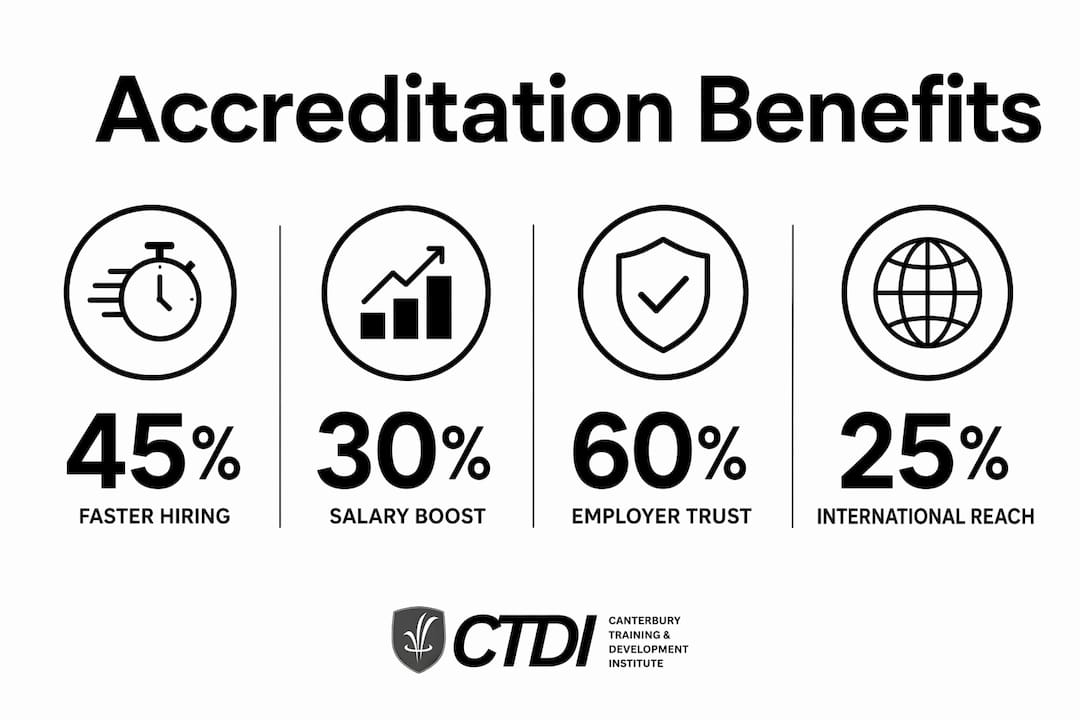
Accreditation serves as a trust badge that separates professionals in competitive markets, leading to rapid career breakthroughs. This is especially true in sectors where employers receive hundreds of applications and need a fast, reliable filter. An accredited qualification does that filtering work for you before you even walk into the room.
What are the economic benefits of accreditation for organisations?
The economic case for accreditation is no longer anecdotal. A 2026 study analysed more than 34,000 ISO 9001 certified firms and over 14,000 ISO 14001 certified firms across two decades in the UK. Firms holding accredited management systems certification report higher revenue and productivity with improved resilience during economic shocks. That resilience finding is particularly significant. Accredited firms do not just perform better in good conditions. They recover faster when conditions deteriorate.
The macroeconomic picture is equally striking. Research from DAkkS (Deutsche Akkreditierungsstelle), Germany's national accreditation body, modelled what would happen if standardised quality infrastructure like ISO 9001 were removed from the German economy. The absence of standardised quality infrastructure leads to severe economic losses, with a hypothetical loss of €200 billion for the German economy alone. That figure illustrates how deeply accreditation is woven into national productivity and trade.
| Region / Body | Key Finding | Impact Area |
|---|---|---|
| UK (UKAS, 2026) | 34,000+ ISO 9001 firms show higher revenue and resilience | Productivity and economic stability |
| Germany (DAkkS, 2026) | €200B hypothetical GDP loss without quality infrastructure | Macroeconomic and trade competitiveness |
| Global (ILAC/IAF) | Accredited lab reports accepted internationally without re-testing | Supply chain efficiency and cost reduction |
| Australia (NATA) | 20+ years of international programmes across 20+ countries | Export readiness and regulatory compliance |
"Accreditation is not a cost of doing business. It is a driver of business performance, market access, and long-term organisational health." — UKAS 2026 Research Summary
Certified organisations experience only modest immediate productivity gains post-certification but enjoy significant long-term resilience and performance improvements. This is a critical point for business leaders who expect instant returns. The payoff from accreditation compounds over time, much like a well-managed investment portfolio. Organisations that treat accreditation as a one-off compliance exercise miss the long-term strategic value entirely.
For Australian businesses competing in export markets, accreditation also opens doors that would otherwise remain closed. Buyers in Europe, North America, and Asia routinely require suppliers to hold accredited certifications before entering procurement processes. Without accreditation, Australian firms are simply not in the conversation.
How do modern accreditation frameworks align with workforce needs?
Accreditation frameworks have moved well beyond box-ticking exercises. Modern accreditation frameworks require structured employer engagement and labour market analytics to ensure curriculum meets workforce needs. This shift means that accredited programmes are continuously updated based on what employers actually need, not what academics or training providers assume they need.
The Accreditation Council for Business Schools and Programs (ACBSP) is a strong example. ACBSP standards from 2022 to 2026 require member institutions to convene employer advisory boards, analyse graduate employment outcomes, and revise curriculum based on labour market data. The result is a qualification that reflects current industry practice rather than outdated theory.
For students, this alignment produces tangible benefits:
- Work-integrated learning components, including internships and industry projects, are built into accredited programmes because accreditation standards require applied skill development.
- Graduates from accredited programmes are more likely to enter employment in their field of study because the curriculum was designed with employer input.
- Accredited providers must demonstrate graduate outcome data, which gives prospective students real evidence of a programme's effectiveness before they enrol.
- Employer advisory boards create direct networks between students and industry, often generating job leads and mentorship opportunities that non-accredited programmes cannot replicate.
Accreditation acts as a strategic tool providing external validation of governance and quality control, which is essential for competitiveness in funding and research contexts. This applies equally to universities, VET providers, and corporate training departments. When an organisation's training programme carries accreditation, it signals to every stakeholder, from government funders to corporate clients, that the programme has been independently verified.
Pro Tip: When evaluating a training provider, ask specifically whether their advisory board includes current industry practitioners, not just academics or retired professionals. Boards with active practitioners produce curricula that reflect real hiring conditions in 2026, not conditions from five years ago.
Accreditation frameworks have evolved to integrate labour market relevance via employer advisory boards and outcome-based assessments. For students choosing between providers, this evolution means the gap between an accredited and non-accredited programme is wider today than it was a decade ago.
What practical advantages does accreditation provide internationally?
International recognition is one of the most underappreciated advantages of holding an accredited qualification or operating an accredited facility. Most people think of accreditation as a domestic credential. The reality is that it functions as a global passport in many sectors.
- Reduced redundant assessments. NATA accreditation programmes have operated for more than 20 years across more than 20 countries, enabling international recognition and eliminating the need for repeated testing of the same products or services in different markets.
- Internationally accepted test reports. Accredited laboratory test reports are accepted internationally without re-testing under ILAC (International Laboratory Accreditation Cooperation) and IAF (International Accreditation Forum) agreements. This cuts both costs and project timelines for exporters and manufacturers.
- Simplified regulatory compliance. When a product or service has been tested by an accredited laboratory, regulators in signatory countries accept those results without requiring additional local testing. This removes a significant barrier to market entry.
- Stronger supply chain positioning. Global procurement teams use accreditation status as a primary filter when selecting suppliers. An accredited supplier skips several rounds of due diligence that non-accredited competitors must complete.
- Faster project timelines. Removing redundant assessments can cut weeks or months from product launch schedules. For industries like pharmaceuticals, food safety, and construction materials, that speed advantage translates directly into revenue.
The practical implication for Australian professionals is straightforward. If you hold a qualification from an accredited course provider whose credentials are recognised under international agreements, your qualification carries weight in Singapore, the UK, Canada, and beyond. That portability is not guaranteed with non-accredited credentials, regardless of the provider's reputation.
Experts increasingly view accreditation as a strategic asset rather than bureaucratic compliance, essential for institutional competitiveness. For professionals planning careers that may span multiple countries or industries, that strategic asset is worth prioritising from the very first qualification they choose.
Key takeaways
Industry accreditation is the most reliable mechanism for converting training into verified, portable, and economically valuable credentials for both individuals and organisations.
| Point | Details |
|---|---|
| Career differentiation | Accredited qualifications pass employer screening filters and unlock government-funded training pathways unavailable to non-accredited credentials. |
| Long-term organisational value | UKAS 2026 research shows accredited firms build resilience over time, not just short-term productivity gains. |
| Workforce alignment | Modern frameworks like ACBSP require employer advisory boards, ensuring accredited curricula reflect actual hiring conditions. |
| International portability | ILAC and IAF agreements mean accredited test reports and qualifications are accepted across 20+ countries without redundant re-assessment. |
| Macroeconomic significance | DAkkS modelling shows the absence of accreditation infrastructure could cost an economy like Germany's €200 billion in GDP. |
Why i think most people underestimate accreditation's strategic value
Most students and professionals treat accreditation as a checkbox. They look for it, confirm it exists, and move on. That approach leaves most of the value on the table.
What I have observed over years of working in vocational education is that accreditation functions more like a network than a certificate. When you complete a qualification through an accredited provider, you gain access to credit pathways, government funding, employer recognition, and international portability simultaneously. Non-accredited credentials might teach you the same skills, but they do not carry that network effect.
The mistake I see most often is professionals choosing a short, cheap, non-accredited course to save time, then spending far more time later trying to prove their competence to employers who do not recognise the credential. The upfront investment in an accredited programme almost always pays off faster than people expect.
There is also a broader point that rarely gets discussed. Accreditation bodies like NATA and UKAS are not static gatekeepers. They update their standards in response to labour market shifts, technology changes, and regulatory developments. When you hold an accredited qualification, you are connected to a living system that keeps your credential relevant. That is not something a one-off industry badge can offer.
My honest recommendation: treat your first accredited qualification as a foundation, not a destination. Use the credit pathways for career growth that accreditation unlocks to build progressively toward higher-level credentials. The professionals who do this consistently outperform those who accumulate a collection of unrelated, non-accredited badges.
— Sam
Start your accredited career journey with Edu
Edu, through the Canterbury Training and Development Institute (CTDI), offers a range of nationally recognised, accredited diplomas and certificates designed for working professionals and career changers across Australia. Courses in AI, digital marketing, and environmental sustainability are built with industry advisory input, delivered 100% online, and aligned with AQF standards that employers and regulators recognise.

CTDI qualifications carry the international recognition that comes with accredited Australian VET credentials, making them valuable whether you are building a career domestically or planning to work abroad. Flexible, self-paced study means you can complete your qualification without pausing your career. Enrol now and take the first step toward a credential that opens doors rather than just filling a gap on your resume.
FAQ
What is the role of industry accreditation for students?
Industry accreditation validates that a qualification meets independently assessed standards of quality and relevance. For students, this means their credential is recognised by employers, eligible for government subsidies, and portable across industries and countries.
How does accreditation impact business performance?
UKAS 2026 research on more than 34,000 certified firms shows that accredited organisations report higher revenue, stronger productivity, and greater resilience during economic downturns compared to non-accredited peers.
Are accredited qualifications recognised internationally?
NATA accreditation programmes operate across more than 20 countries, and ILAC/IAF agreements mean accredited test reports and qualifications are accepted internationally without redundant re-assessment, reducing costs and timelines for exporters.
What is the difference between accredited and industry credential courses?
Accredited qualifications sit within regulated frameworks like Australia's VET system and qualify for government funding and credit transfer. Industry credentials from non-accredited providers may teach relevant skills but typically do not offer those formal pathways.
How do accreditation frameworks stay relevant to the job market?
Modern accreditation bodies like ACBSP require structured employer advisory boards and labour market analytics as part of their standards. This process ensures accredited curricula are updated continuously to reflect current hiring conditions and workforce needs.