

TL;DR:
- National accreditation verifies that educational institutions meet strict quality standards, enabling access to funding, licensure, and employer recognition. It ensures programmes produce industry-relevant graduates while safeguarding credit transfer and industry credibility. Regular review cycles maintain ongoing compliance, making accreditation the most critical factor in choosing quality education pathways.
National accreditation is the formal confirmation that an educational institution or programme meets rigorous national quality standards, making it a prerequisite for federal funding, professional licensure, and employer recognition. The importance of national accreditation extends well beyond a badge on a website. It determines whether your qualification opens doors or closes them. Institutions recognised by accrediting bodies approved by the U.S. Department of Education can access federal student aid programmes distributing $120 billion annually. That figure represents the financial backbone of higher education access. For students and professionals in Australia and globally, understanding accreditation significance is the single most practical step you can take before enrolling anywhere.
What are the key benefits of national accreditation?
Accreditation is not a bureaucratic formality. It is the mechanism that connects your qualification to real-world outcomes, from scholarship eligibility to the right to sit a licensing exam.
Access to funding and financial support
Without accreditation, students cannot access federal grants or loans, which cuts off the primary funding pathway for millions of learners. This is not a minor inconvenience. It is the difference between affording a qualification and not. In Australia, the equivalent gatekeeping function is performed through the Australian Skills Quality Authority (ASQA), which registers training providers under the Australian Qualifications Framework (AQF). Courses delivered by ASQA-registered providers qualify for government funding, VET Student Loans, and employer reimbursement schemes. Choosing an unregistered provider means paying full fees with no safety net.
Eligibility for professional licensure
Accreditation's role in professional licensing is one of its least-discussed but most consequential functions. In the United States, 31 states require nursing pre-licensure programmes to hold national nursing accreditation before graduates can sit licensing exams. This means a nursing degree from an unaccredited school is, in practical terms, a degree that cannot be used. The same principle applies across engineering, teaching, social work, and allied health. Graduating from an accredited programme is not optional in these fields. It is the entry ticket.
Employer recognition and hiring decisions
Employers use accreditation as a proxy for candidate quality, reducing hiring risk by treating the accrediting body's seal as external validation of curricula, facilities, and faculty. This matters most in competitive hiring environments where recruiters screen hundreds of applications. A qualification from an accredited institution signals that an independent body has verified the programme's rigour. Without that signal, your degree competes on reputation alone, which is a much harder argument to make.
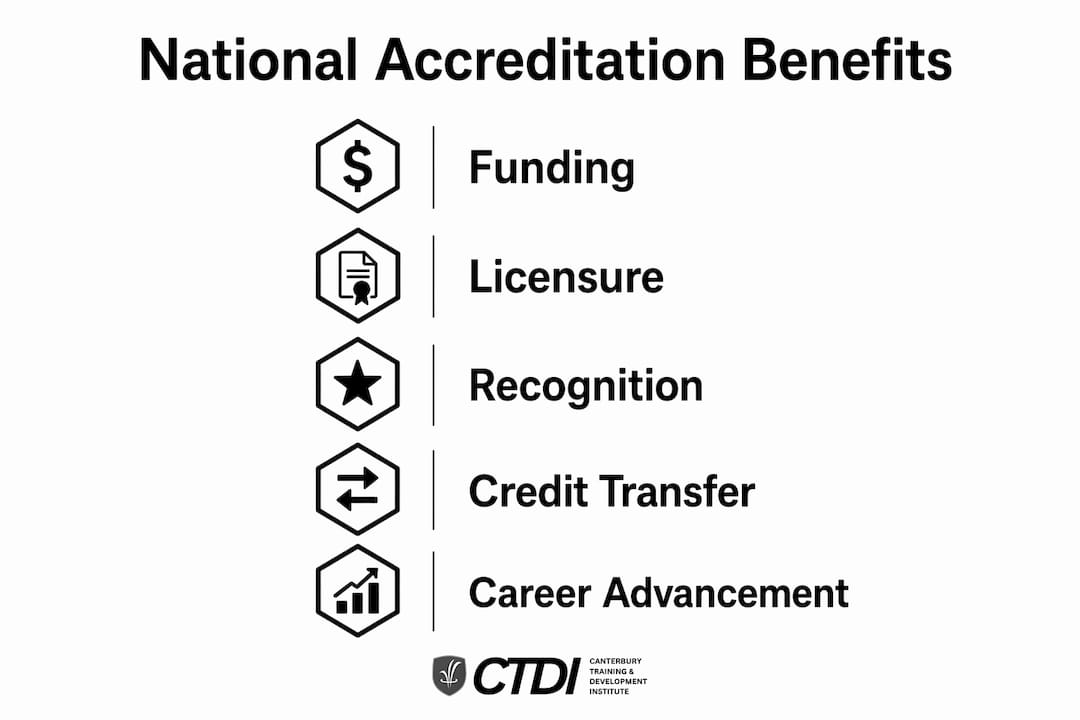
Here is a summary of the core benefits accreditation delivers to students and professionals:
- Federal and government funding access: Accredited programmes qualify for grants, loans, and employer-sponsored tuition support.
- Licensure eligibility: Many professional boards require graduation from an accredited programme before candidates can sit registration exams.
- Employer confidence: Hiring managers treat accreditation as a quality filter, particularly in technical and healthcare sectors.
- Credit transfer: Credits earned at accredited institutions are more likely to be recognised by other accredited providers.
- Graduate study pathways: Most postgraduate programmes require an undergraduate degree from an accredited institution for admission.
- Current, industry-relevant curricula: Accrediting bodies require programmes to update content regularly, keeping graduates competitive.
Pro Tip: Before enrolling in any course, search the provider's name on your national accreditation register. In Australia, use the ASQA training.gov.au database. In the US, use the Department of Education's accreditation database. This takes three minutes and can save years of wasted effort.
How does national accreditation differ from other types?
The distinction between accreditation types is where most students make costly mistakes. Understanding the difference between institutional and programmatic accreditation, and between national and regional models, directly affects credit transfer, licensure, and employer recognition.
Institutional vs programmatic accreditation
Institutional accreditation covers an entire college or university, confirming that the organisation as a whole meets quality standards. Programmatic accreditation, by contrast, evaluates a specific programme within an institution. The Accreditation Board for Engineering and Technology (ABET) accredits individual engineering programmes. The Commission on Collegiate Nursing Education (CCNE) accredits nursing programmes specifically. Programmatic accreditation is especially critical in healthcare and technical professions, where institutional accreditation alone does not satisfy licensing board requirements. A student can attend a fully accredited university and still be ineligible to sit a professional exam if their specific programme lacks programmatic accreditation.
National vs regional accreditation: what changed in 2019
Historically in the US, regional accreditation was considered more prestigious, covering traditional universities, while national accreditation applied primarily to vocational and career-focused schools. In 2019, the Department of Education removed the formal regulatory distinction between the two. Despite this regulatory change, practical credit transfer issues persist, particularly for students moving between vocational providers and traditional universities. Many regionally accredited universities still decline to accept credits from nationally accredited institutions. This asymmetry has affected thousands of students who transferred expecting credit recognition and received none.
The table below clarifies the key differences that still matter in practice:
| Feature | National accreditation | Regional accreditation |
|---|---|---|
| Typical institution type | Vocational, career-focused, for-profit | Traditional universities and colleges |
| Credit transfer | Often limited to other nationally accredited schools | Broadly accepted across accredited institutions |
| Employer recognition | Strong in trade and technical fields | Broadly recognised across most industries |
| Programmatic licensing | Depends on specific programme accreditation | Depends on specific programme accreditation |
| Government funding eligibility | Yes, where applicable | Yes |
The practical lesson here is straightforward. If you plan to transfer credits or pursue postgraduate study at a traditional university, confirm that your provider's accreditation type is compatible with your destination institution before you enrol. Do not assume compatibility. Ask directly.
What does the national accreditation review process involve?
Accreditation is not a one-time approval. It is a cyclical quality assurance process that requires institutions to demonstrate ongoing compliance with national standards at regular intervals.
How the review cycle works
Standard accreditation cycles mandate re-evaluation every five to ten years. This means an institution cannot simply earn accreditation and coast. It must continuously document performance, update curricula, and demonstrate that graduates are achieving meaningful outcomes. The review process typically involves a self-study report prepared by the institution, followed by an on-site evaluation by a team of peer reviewers drawn from the same sector. The peer review model is deliberate. It means practitioners and academics assess each other, bringing sector-specific expertise that a government regulator alone could not provide.
What reviewers actually assess
During a review, accrediting agencies examine curriculum currency, faculty qualifications, physical and digital facilities, student support services, and graduate outcomes. The shift toward outcomes-based assessment is significant. Accrediting agencies now focus increasingly on measuring student achievement, graduation rates, and job placement rather than simply checking that inputs like library holdings or classroom sizes meet minimum thresholds. This shift protects students from investing time and money in programmes that look good on paper but fail to produce employable graduates.
The typical accreditation review follows this sequence:
- Self-study preparation: The institution compiles evidence across all accreditation criteria, often over 12 to 18 months.
- Submission to the accrediting body: The self-study report is submitted for initial review and gap analysis.
- Peer review site visit: An independent team visits the institution to verify claims and interview staff, students, and graduates.
- Accrediting body decision: The agency issues a decision: full accreditation, conditional accreditation, or denial.
- Ongoing monitoring: Annual or biennial reports are submitted between full reviews to flag any significant changes.
- Re-accreditation: The full cycle repeats every five to ten years.
Pro Tip: If a provider's accreditation status is listed as "conditional" or "probationary," treat that as a serious warning sign. It means the institution has failed to meet standards and is under remediation. Enrolment during this period carries real risk, including the possibility that the provider loses accreditation before you complete your qualification.
What happens when accreditation is lost
Losing accreditation has immediate and severe consequences. Students enrolled at the time lose access to government funding. Credits may not transfer. Employers and licensing boards may refuse to recognise qualifications awarded after the accreditation lapse. The independence of accrediting bodies is what makes this process credible. They operate like independent auditors, providing unbiased assessments free from the institutional pressures that might otherwise soften judgements. That independence is the mechanism that gives accreditation its authority.
How does accreditation affect career advancement and industry recognition?
Accreditation's most direct impact on your career is through the three gatekeeping functions it performs: licensing board eligibility, employer screening, and graduate school admission.
Licensing boards in fields including nursing, engineering, teaching, and social work require candidates to have graduated from an accredited programme before they can sit registration exams. This is non-negotiable. No accreditation means no licence, and no licence means no practice. The accreditation and quality assurance connection is maintained through advisory committees that include industry partners, which keeps curricula aligned with current professional standards. Graduates from these programmes arrive in the workforce already familiar with the tools, regulations, and practices their employers use.

Employers in competitive sectors treat accreditation as a screening tool. When a recruiter at a hospital, engineering firm, or government agency reviews applications, an accredited qualification reduces the due diligence they need to perform. They trust that the accrediting body has already verified the programme's quality. Without that external validation, your qualification requires more explanation, more evidence, and more convincing.
The career impact of accreditation is especially pronounced in these sectors:
- Healthcare: Nursing, physiotherapy, and allied health programmes require both institutional and programmatic accreditation for graduates to register with professional bodies such as the Australian Health Practitioner Regulation Agency (AHPRA).
- Engineering: ABET accreditation in the US and Engineers Australia recognition domestically are prerequisites for professional engineer registration.
- Education: Teaching degrees must be accredited by the Australian Institute for Teaching and School Leadership (AITSL) for graduates to obtain teacher registration.
- Business: MBA programmes accredited by AACSB or EQUIS carry significantly stronger employer recognition than unaccredited alternatives.
Accreditation also determines access to career-focused courses that align with industry needs, which is the practical bridge between classroom learning and employment. Graduates from accredited programmes consistently report stronger employment outcomes because the curriculum has been externally validated against what employers actually require.
Why I think accreditation is the most underrated decision you will make
Most students spend more time choosing a laptop than verifying their institution's accreditation status. That imbalance has real consequences, and I have seen it play out repeatedly.
The argument I hear most often against prioritising accreditation is that the course content is what matters, not the stamp of approval. That argument misunderstands how the professional world works. Employers and licensing boards do not have the time or resources to evaluate every qualification individually. They rely on accreditation as a shortcut, and that shortcut is not going away. Choosing an unaccredited programme because the content looks good is like building a house without a building permit. The work might be excellent, but you will struggle to sell it.
What I find genuinely encouraging about the current direction of accreditation reform is the shift toward student outcome measurement. For too long, accreditation focused on inputs: how many books in the library, how many square metres in the classroom. The move toward graduation rates and job placement data is a meaningful improvement. It means accreditation is becoming a better proxy for what students actually care about, which is whether the qualification leads somewhere.
My advice is direct. When you are evaluating a course, check the accreditation status first, not last. Look at whether the specific programme holds programmatic accreditation if you are entering a licensed profession. Confirm credit transfer compatibility if you plan to continue studying. And read the accreditation overview carefully before committing. The five minutes you spend on this check is the highest-return research you will do in your entire enrolment process.
— Sam
Start your accredited career pathway with Edu
Edu, through the Canterbury Training and Development Institute (CTDI), delivers nationally recognised vocational qualifications in Australia across AI, digital marketing, and environmental sustainability. Every course is designed by industry experts and delivered 100% online, giving you the flexibility to study at your own pace without sacrificing quality or recognition.

CTDI's corporate training partnerships with industry leaders keep course content current and directly aligned with employer expectations. Whether you are entering a new field or advancing in your current role, an accredited CTDI qualification gives you the external validation that employers and licensing bodies recognise. Browse the full range of diplomas and enrol now to take the next step in your career.
FAQ
What is national accreditation in education?
National accreditation is a formal quality assurance process in which an independent accrediting body evaluates whether an institution or programme meets established national standards. In Australia, ASQA performs this function for vocational education providers under the AQF.
Why does national accreditation matter for students?
Accreditation determines eligibility for government funding, professional licensure, credit transfer, and employer recognition. Without it, a qualification may be legally valid but practically unusable in licensed professions or competitive hiring environments.
Can I transfer credits from a nationally accredited institution?
Credit transfer from nationally accredited institutions is not guaranteed, particularly when moving to traditionally accredited universities. Despite regulatory changes in the US in 2019, credit transfer issues persist and students should confirm compatibility with their destination institution before enrolling.
How often do accredited institutions get reviewed?
Accrediting bodies conduct full re-evaluations every five to ten years, with ongoing annual or biennial reporting required between cycles. This ensures institutions maintain standards continuously rather than only at the point of initial approval.
Does accreditation affect my ability to get a job?
Employers use accreditation as a quality filter when screening candidates, particularly in healthcare, engineering, and education. Graduating from an accredited institution reduces the due diligence employers must perform and increases confidence in your qualification's rigour.
Key takeaways
National accreditation is the single most consequential quality signal in education, determining funding access, licensure eligibility, employer recognition, and credit transfer for every student who holds a qualification.
| Point | Details |
|---|---|
| Funding access | Accreditation is the gateway to government grants, loans, and employer tuition support in Australia and globally. |
| Licensure eligibility | Many professional boards, including nursing and engineering, require graduation from an accredited programme to sit registration exams. |
| Employer screening | Employers treat accreditation as external validation of a qualification's rigour, directly influencing hiring decisions. |
| Credit transfer risk | National and regional accreditation types are not always compatible; confirm transfer policies before enrolling. |
| Ongoing quality assurance | Accreditation is reviewed every five to ten years, with a growing focus on graduate employment and completion outcomes. |