

TL;DR:
- Accreditation verifies that an educational institution or program meets independent quality standards, impacting career credibility and financial access. It involves a voluntary, evidence-based review process with ongoing renewal requirements, distinct from individual certification. Recognizing the type and credibility of accreditation is essential to choosing qualifications that are respected and nationally recognized.
Accreditation is one of those terms that gets thrown around constantly in education, yet most people have a surprisingly shallow understanding of what it actually means. It is not simply a logo on a website or a framed certificate on a wall. When you ask what is accreditation, the real answer touches on quality assurance, career credibility, financial access, and your long-term professional reputation. Whether you are evaluating a university degree, a vocational diploma, or a short online course, understanding accreditation can be the difference between a qualification that opens doors and one that quietly closes them.
Table of Contents
- Key takeaways
- What accreditation means and how it works
- Types of accreditation and recognising accrediting bodies
- Why accreditation matters for quality, careers, and finances
- How to choose accredited training wisely
- Accreditation in Australia and internationally
- My take on accreditation's real significance
- Start learning with accredited online courses at CTDI
- FAQ
Key takeaways
| Point | Details |
|---|---|
| Accreditation signals quality | It confirms an institution or programme meets independently verified educational standards, not just self-reported claims. |
| Two distinct types exist | Institutional accreditation covers an entire school; programmatic accreditation covers specific courses tied to career outcomes. |
| Career and financial implications | Unaccredited qualifications may be rejected by employers, licensing boards, and credit transfer systems. |
| Australia has its own regulators | TEQSA and ASQA oversee accreditation for higher education and vocational training in Australia, ensuring nationally recognised standards. |
| Verification is non-negotiable | Always check the accreditation status and expiry of any institution or course before you enrol. |
What accreditation means and how it works
At its core, accreditation is a formal quality assurance process in which an independent body evaluates whether an educational institution or programme meets a defined set of standards. Think of it as an external audit conducted by peers and experts in your field, not a rubber stamp issued after paying a fee.
The accreditation process is voluntary and carried out by non-governmental organisations using peer review and self-assessment to encourage continuous improvement. An institution or programme seeking accreditation conducts a thorough self-study, compiles documented evidence of its practices, and then submits that evidence for review by an accrediting body. Reviewers examine everything from curriculum design and faculty qualifications to student outcomes and institutional governance.
One thing that surprises many people is that accreditation is evidence-driven, not certificate-driven. The value lies in the ongoing quality assurance cycle, not in the accreditation document itself. An institution must continuously demonstrate that it maintains the standards it was assessed against, with periodic reviews and renewals built into the process.
Accreditation vs certification
People often confuse accreditation with certification. They are related but distinct concepts. Certification is typically awarded to an individual who has demonstrated a specific skill or competency. Accreditation, by contrast, is awarded to an institution or programme. A nursing certification says you are qualified. Accreditation of the nursing programme says the training you received met independently verified standards.
Here are the core elements that define how accreditation works:
- Self-study: The institution or programme documents its own performance against set standards.
- Peer review: A panel of qualified reviewers evaluates the evidence submitted.
- Site visit: In many cases, reviewers visit the institution to validate findings in person.
- Decision: The accrediting body issues a decision to grant, defer, or deny accreditation.
- Ongoing monitoring: Accreditation is not permanent. Institutions must meet renewal requirements to maintain their status.
Pro Tip: Before you enrol in any course, search the accrediting body's official register to confirm the institution's accreditation is current and has not expired.
Types of accreditation and recognising accrediting bodies
Understanding the different forms of accreditation helps you ask the right questions when evaluating your options. Not all accreditation is created equal, and the type that matters most depends heavily on what you want to do with your qualification.
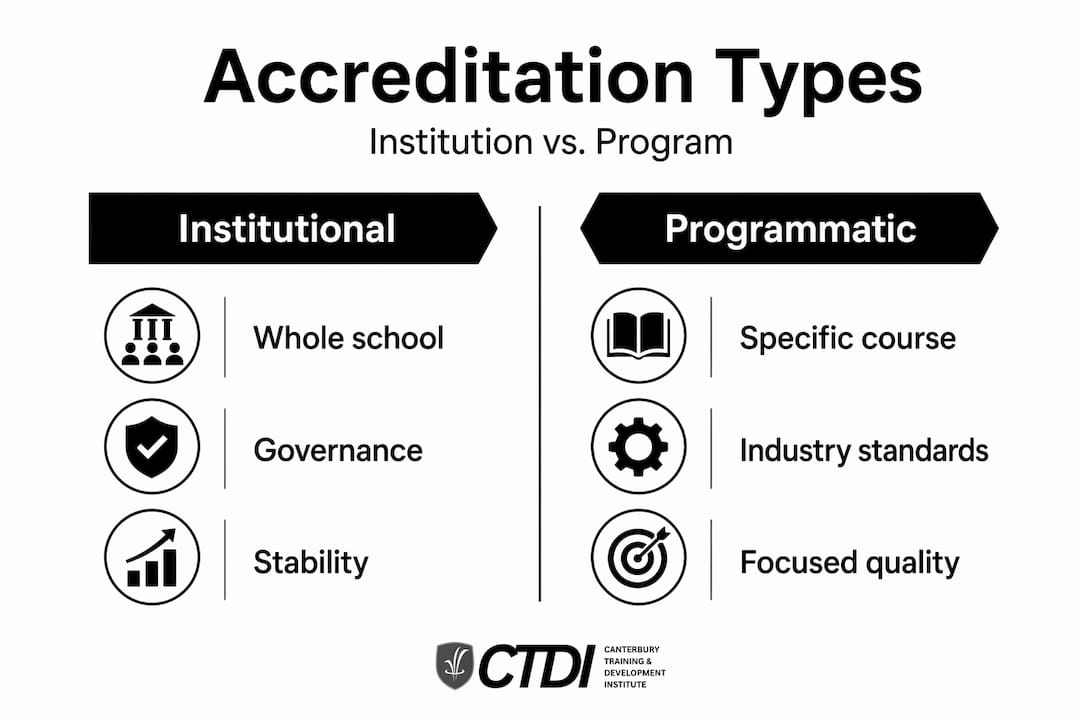
Institutional accreditation covers the whole school, evaluating everything from governance and financial stability to student services and overall educational quality. Programmatic accreditation, on the other hand, focuses on specific academic or professional programmes within an institution. If you are training to become an engineer, a social worker, or a nurse, programmatic accreditation from the relevant professional body is often what employers and licensing boards actually check.
The legitimacy of an accrediting body itself is the second layer of the equation. In the United States, recognised accreditors are reviewed by CHEA or the Department of Education to validate their credibility. In Australia, the equivalent gatekeepers are TEQSA (Tertiary Education Quality and Standards Agency) for higher education and ASQA (Australian Skills Quality Authority) for vocational training. Any accrediting body that operates outside these recognised frameworks should be treated with significant scepticism.
| Type | Scope | Australian example | What to check |
|---|---|---|---|
| Institutional accreditation | Entire institution | TEQSA registration for universities | Registered provider status on TEQSA website |
| Programmatic accreditation | Specific course or discipline | ASQA-approved vocational qualifications | Course listing on training.gov.au |
| Professional body accreditation | Industry-specific programmes | CPA Australia for accounting courses | Membership recognition by the relevant professional body |
| International accreditation | Cross-border recognition | AACSB for business schools | Recognition by the home country's education authority |
Diploma mills are the dark side of this picture. These are organisations that sell degrees or certificates with little to no legitimate educational requirement, often claiming accreditation from bodies that do not appear on any official register. Unaccredited institutions pose real risks to students: the degree may be worthless to employers, unrecognised by other institutions, and potentially damaging to your professional reputation.
Pro Tip: To verify an Australian vocational training provider, search the National Register at training.gov.au. For higher education, check TEQSA's public register at teqsa.gov.au. Both are free and updated regularly.
Why accreditation matters for quality, careers, and finances
Accreditation is not an abstract bureaucratic concept. It has direct, practical consequences for what you can do with your qualification once you have it.

From a quality standpoint, accreditation signals to students and families that a programme provides education they can trust. When a course is accredited, it means an independent body has verified that the curriculum is current, the teaching is qualified, and the outcomes are genuine. That external validation is what separates a credential that commands respect from one that raises eyebrows.
The career implications are significant. Attending accredited institutions affects credential recognition by employers, licensing boards, and other educational institutions. In many regulated professions such as healthcare, engineering, and law, graduating from an accredited programme is not a preference. It is a legal requirement to obtain your professional licence. Choosing an unaccredited programme in these fields means your qualification may not be recognised when it counts most.
"Accreditation is the mechanism by which higher education demonstrates its value to students, employers, policymakers, and the public." — Council for Higher Education Accreditation (CHEA)
There are also serious financial stakes involved. In the United States, eligibility for federal student aid depends on attending an institution accredited by a federally recognised agency. In Australia, accredited vocational qualifications are similarly tied to government funding schemes and student loan access through VET Student Loans. Choosing an unaccredited course could mean paying full fees out of pocket while receiving a credential your future employer does not recognise.
Here is a summary of the practical advantages of accredited qualifications:
- Employer confidence: Hiring managers and HR departments trust credentials from accredited programmes because the standards have been independently verified.
- Credit transfer: Accredited qualifications are far more likely to be accepted for credit recognition when you pursue further study.
- Licensing eligibility: Many professional licences legally require graduation from an accredited programme.
- Financial aid access: Government funding, subsidised loans, and scholarships are typically restricted to accredited courses.
- International mobility: Qualifications from nationally accredited institutions are more likely to be recognised when you work or study abroad.
You can explore how accredited courses in Australia compare in terms of career outcomes to get a clearer picture of the real-world difference this makes.
How to choose accredited training wisely
Knowing that accreditation matters is one thing. Knowing how to choose accredited training that actually suits your goals is where most people need practical guidance.
Follow these steps when evaluating any course or institution:
- Confirm the accreditation status. Do not take the institution's word for it. Go directly to the official register for your country or sector. In Australia, check training.gov.au for vocational courses or the TEQSA register for higher education.
- Check the expiry date. Accreditation is time-limited. An institution may have been accredited five years ago and failed to renew. Always confirm that the status is current.
- Match the accreditation type to your goal. If you want to work in a regulated profession, you need programmatic accreditation from the relevant professional body, not just institutional accreditation. If your aim is general career advancement, institutional accreditation may be sufficient.
- Ask the institution directly. Ask which body accredits the specific course you are considering, when that accreditation was last renewed, and whether the qualification appears on any nationally recognised framework.
- Research the accrediting body itself. Verify that the accrediting organisation is recognised by an official government agency. In Australia, look for ASQA or TEQSA recognition. If the accrediting body is not on an official list, proceed with caution.
- Consider the broader programme quality. Accreditation sets a floor, not a ceiling. Look at the curriculum content, the experience of instructors, flexible delivery options, and student support services to assess whether the programme genuinely serves your learning needs.
A guide to nationally recognised courses in Australia can also help you understand how vocational qualifications are structured within the national framework and what to look for when comparing programmes.
Pro Tip: Ask providers whether their qualification appears on the Australian Qualifications Framework (AQF). AQF-listed qualifications have a consistent, government-endorsed standard that gives both you and your future employer clear expectations about what the credential represents.
Accreditation in Australia and internationally
Australia has a well-structured, government-backed accreditation system that provides genuine consumer protection for students. TEQSA and ASQA are the key regulators responsible for maintaining nationally recognised standards across higher education and vocational training respectively. Their role is to protect students from low-quality providers while also maintaining the international reputation of Australian qualifications.
The following table offers a snapshot of how accreditation systems compare across different contexts:
| Region | Regulatory body | Scope | Recognition outcome |
|---|---|---|---|
| Australia (higher ed) | TEQSA | Universities and private colleges | Nationally recognised degrees |
| Australia (vocational) | ASQA | RTOs, TAFEs, private providers | Nationally recognised training (NRT) |
| United States | CHEA / Dept of Education | Colleges and universities | Federal student aid eligibility |
| United Kingdom | Quality Assurance Agency (QAA) | Universities and higher ed providers | UK degree recognition |
| European Union | ENQA member agencies | Cross-border higher education | European Higher Education Area recognition |
One notable strength of the Australian system is how it supports international recognition. Australian qualifications, particularly those on the AQF, are accepted in many countries and by numerous international employers because the standards that underpin them are transparent and government-enforced.
Globally, accreditation models are evolving. There is growing momentum toward digital credential verification, where a student's accreditation status can be instantly verified by an employer or institution online. Australia is actively participating in these conversations through international agreements that align domestic frameworks with global standards. For students considering international careers, choosing a qualification from an ASQA or TEQSA-regulated provider is a sound starting point.
My take on accreditation's real significance
I have spent years watching people make expensive mistakes with their education choices, almost always because they did not fully understand what accreditation meant or did not bother to verify it before enrolling.
The most common misconception I see is treating accreditation as binary: either a course has it or it does not, and that settles the matter. In reality, the type of accreditation, the credibility of the accrediting body, and the ongoing renewal status all matter just as much. I have spoken with people who enrolled in courses accredited by obscure bodies with no government recognition, only to discover that their qualification was not accepted when they applied for a professional licence or sought credit transfer.
What I have learned is that the accreditation process is genuinely designed to protect you. It exists because education is expensive, time-consuming, and consequential. An evidence-based peer review system that holds institutions accountable is one of the few consumer protections that actually works in this space. But it only works if you use it actively, not passively.
My honest advice: treat the accreditation check like you would a property inspection before buying a home. You would not skip it because the brochure looked good. Do not skip it because a course website looks professional. Verify the status, check the body, and make sure the type of accreditation matches the career path you have in mind. The five minutes of verification can save you months of wasted effort and thousands of dollars.
— Sam
Start learning with accredited online courses at CTDI
If you have done the research and you are ready to invest in a qualification you can trust, Canterbury Training and Development Institute (CTDI) is worth a close look. CTDI is an Australian registered training organisation (RTO) delivering nationally recognised vocational qualifications entirely online, designed for people who need flexibility without compromising on quality.

CTDI's course catalogue includes qualifications in artificial intelligence, digital marketing, and environmental sustainability. Each programme is built by industry experts and structured around practical, employment-focused outcomes. Because CTDI operates as an accredited RTO under the Australian national framework, every qualification you earn is nationally recognised and carries the credibility that employers and further education institutions expect.
You can explore CTDI's academic articulation partnerships to understand how course credits can be recognised towards further study. When you are ready to take the next step, browse the full range of programmes and enrol in an online diploma at CTDI to begin building a career-relevant credential that stands up to scrutiny.
FAQ
What is accreditation in simple terms?
Accreditation is a formal quality assurance process in which an independent body evaluates whether an educational institution or programme meets a defined set of standards. It is voluntary, evidence-based, and subject to periodic renewal.
What is the difference between institutional and programmatic accreditation?
Institutional accreditation covers an entire school, while programmatic accreditation covers a specific course or professional programme. For careers in regulated fields, programmatic accreditation from the relevant professional body is often the one that matters most.
Why does accreditation matter for my career?
Accreditation signals to employers and licensing boards that your qualification meets independently verified standards. In many professions, graduating from an accredited programme is a legal requirement to obtain your licence and practise.
How do I check if a course is accredited in Australia?
For vocational courses, search the National Register at training.gov.au. For higher education, check the TEQSA public register at teqsa.gov.au. Both registers confirm whether a provider and its qualifications are currently recognised under the national framework.
What are the risks of studying with an unaccredited provider?
Unaccredited institutions pose real risks including non-recognition of your qualification by employers, ineligibility for credit transfer, and inability to obtain professional licences. In some cases, the qualification may hold no legal or professional standing whatsoever.