

TL;DR:
- A nationally recognised qualification in Australia is a credential validated against occupational standards by a registered provider, ensuring legitimacy. Recognition depends on third-party assessment and registration on official frameworks like training.gov.au, not marketing labels or attendance certificates. Verified qualifications offer portability, credibility, and protection, supporting career advancement and regulatory compliance nationwide.
Most people assume "nationally recognised qualification" is simply a marketing phrase that training providers attach to any course that sounds credible. It is not. In Australia and across most regulated education systems, what is a nationally recognised qualification is a very specific thing. It means a credential that has been formally validated against occupational or educational standards by an authorised body, not just awarded by the training provider themselves. Understanding this distinction matters whether you are choosing a course, hiring staff, or advising others on career pathways.
Table of Contents
- Key takeaways
- What is a nationally recognised qualification?
- Types of nationally recognised qualifications
- Why nationally recognised qualifications matter
- How to identify and use nationally recognised qualifications
- My perspective on qualification recognition
- Study nationally recognised courses online with CTDI
- FAQ
Key takeaways
| Point | Details |
|---|---|
| Recognition requires third-party validation | A certificate of completion is not a nationally recognised qualification without independent assessment against occupational standards. |
| Frameworks define qualification levels | Systems like the Australian Qualifications Framework classify credentials by level and learning outcomes to support career mobility. |
| Employers look beyond the label | Recruiters assess who set the standards, how assessments were conducted, and whether the credential is registered with a recognised body. |
| Verification is straightforward | You can confirm recognition by checking official registers or national frameworks before enrolling in any course. |
| Online vocational courses can qualify | Nationally accredited courses delivered fully online still carry the same recognition weight as classroom-based study when the provider is registered. |
What is a nationally recognised qualification?
Let's clear up the most common misconception first. The phrase "nationally recognised" does not mean popular, well-regarded, or widely accepted by employers in a general sense. In a regulated context, it refers to a qualification that sits within a formal national framework and has been assessed against defined standards by an authorised third party.
In Australia, this system is managed through the Australian Qualifications Framework, which classifies credentials from Certificate I through to Doctoral Degrees. Every qualification on this framework has defined learning outcomes, assessment requirements, and level descriptors. Providers who deliver these qualifications must be registered with the Australian Skills Quality Authority (ASQA) or a relevant state regulator. That registration is what gives the credential its national standing.
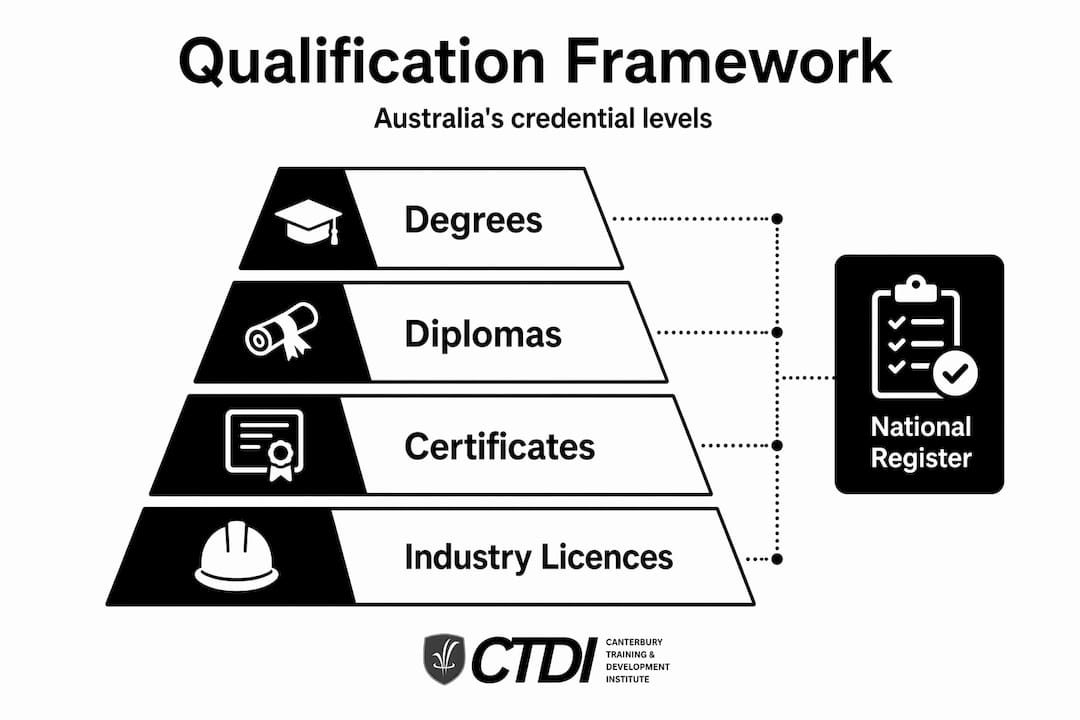
The difference between a nationally recognised qualification and a general certificate of completion is not trivial. Third-party validation against occupational standards is what separates a recognised credential from a simple attendance record. You could complete a 40-hour online course and receive a certificate at the end. Without regulated assessment against a registered qualification standard, that certificate carries no nationally recognised weight at all.
This same principle applies internationally. In England, Ofqual (the Office of Qualifications and Examinations Regulation) maintains a register of regulated qualifications. In 2024 to 2025, Ofqual-regulated qualifications issued approximately 11.8 million certificates, demonstrating the scale and trust placed in regulated credentialing systems. In the Netherlands, the NLQF Act formalises qualification standards to support labour market communication and lifelong learning across the country.
It is also worth distinguishing between three terms that are often used interchangeably but mean different things:
- Accreditation refers to the approval of an institution or programme to deliver recognised qualifications. It is about the provider's quality and systems.
- Recognition refers to the credential itself and whether it holds regulatory, employment, or licensing value.
- Certification refers to confirmation that an individual has met a specific standard, which may or may not sit within a national framework.
Institutional accreditation differs from credential recognition in an important way. Accreditation ensures quality delivery. Recognition determines the credential's hiring and licensing legitimacy. Both matter, but they are not the same thing.
Pro Tip: When evaluating any qualification, ask specifically whether it is listed on a national register or framework. Marketing language like "industry recognised" or "employer preferred" is not the same as nationally recognised in a regulatory sense.
Types of nationally recognised qualifications
Not all nationally recognised qualifications look the same. They span a broad range of credential types, and understanding which category a qualification falls into helps you match it to your goals.
Industry certifications and licences
These are credentials tied to a specific occupation or skill set. In Australia, examples include the Certificate III in Individual Support (for aged care and disability work), the Certificate IV in Work Health and Safety, and trade qualifications in construction, electrical work, and plumbing. Many of these are also mandatory for licencing. You cannot legally work as a licensed electrician in Australia without holding the relevant nationally recognised trade qualification.
In the United States, a comparable framework exists under the Workforce Innovation and Opportunity Act (WIOA). Industry certifications, occupational licences, and apprenticeship certificates are all defined as nationally recognised credentials under that framework, tied to third-party validation and occupational standards.
Diplomas and advanced diplomas
These sit in the middle tier of the Australian Qualifications Framework and are designed for those entering or advancing in technical and professional fields. A Diploma of Business, for example, provides a nationally recognised pathway into management roles. An Advanced Diploma of Digital Marketing or an Advanced Diploma of Leadership and Management signals a higher level of strategic capability recognised by employers across the country.
Graduate certificates and degrees
These are the post-secondary qualifications most people are familiar with. Bachelor Degrees, Graduate Certificates, and Master Degrees issued by registered Australian universities all sit within the national framework. They are regulated by the Tertiary Education Quality and Standards Agency (TEQSA) and carry full national recognition.
Apprenticeships and traineeships
These combine on-the-job experience with formal training delivered by a registered training organisation. The qualification earned at the end of an apprenticeship or traineeship is nationally recognised because it requires verified competency demonstration, not just time served.
Here is a comparison of the main credential types, how they are validated, and who typically benefits from them:
| Qualification type | Validation method | Typical users |
|---|---|---|
| Industry certification | Third-party assessment against occupational standards | Workers seeking role-specific skills or licences |
| Vocational certificate / diploma | Registered training organisation assessment, ASQA oversight | Students entering or advancing in technical careers |
| Apprenticeship / traineeship | Competency-based assessment plus workplace evidence | School leavers and career changers in trade fields |
| University degree | TEQSA-regulated assessment and programme approval | Students pursuing professional or academic careers |
| Completion certificate (non-recognised) | Provider-issued only, no third-party validation | Self-development, no formal occupational recognition |
The last row is where confusion most often arises. Many short courses sold online issue certificates that look professional and carry phrases like "nationally recognised training" without the underlying registration. If the provider is not a registered training organisation and the qualification is not on the national register, the credential does not qualify as nationally recognised regardless of its appearance.
Why nationally recognised qualifications matter
The practical importance of nationally recognised qualifications comes down to three things: portability, credibility, and protection.

Portability means your qualification is recognised by employers, licensing bodies, and education institutions across the entire country, not just in the region where you studied. A Certificate III earned in Queensland carries the same standing as one earned in Victoria. That consistency is only possible because the qualification sits within a national framework with defined standards.
Credibility comes from the regulated assessment behind the credential. Employers look for credentials that provide accurate and consistent information about competencies relative to national standards, not just names or completion certificates. A recruiter who sees a nationally recognised diploma on a CV knows exactly what level of skill and knowledge it represents, because the framework defines it.
Protection means you are not wasting money. Nationally accredited courses require registered providers to meet ongoing compliance standards. If a provider is registered, you have recourse if something goes wrong. If a provider is not registered and not delivering nationally recognised qualifications, you have very little protection and the credential may be worthless to future employers.
Here are the key benefits of pursuing nationally recognised qualifications:
- Career portability across states and territories in Australia, with consistent employer understanding of what your qualification means.
- Pathway access to further study, because national frameworks create defined credit and articulation arrangements between qualifications.
- Employer confidence in your skills, since regulated assessment provides reliable competency signals rather than just seat time.
- Licensing eligibility for many trades and regulated professions that legally require nationally recognised credentials.
- Training investment value for employers, because credential validity tied to third-party certification and occupational standards justifies the training expenditure.
Common pitfalls to avoid include assuming that "accredited" means nationally recognised (it depends on what is accredited and by whom), trusting provider marketing language without checking registers, and purchasing short courses that issue certificates without any regulated assessment behind them.
Pro Tip: Before enrolling in any course, search for the qualification on training.gov.au if you are in Australia. This is the official national register of training packages and qualifications. If the course code and qualification title are listed there, the credential is nationally recognised.
How to identify and use nationally recognised qualifications
Knowing the theory is one thing. Applying it when you are comparing courses, applying for jobs, or advising employees on training is where it counts.
Checking official registers
In Australia, training.gov.au is your primary tool. Every nationally recognised vocational qualification has a unique code, such as BSB50820 for the Diploma of Project Management. You can search by keyword, provider name, or qualification code. If a course is not on that register, it is not delivering a nationally recognised qualification regardless of what the provider claims.
For those looking at verifying credentials in the United Kingdom, the Ofqual Register serves the same purpose. Similar registers exist in most OECD countries. The mechanism of recognition is what matters, not the label.
What to ask a training provider
When you contact a provider about a course, these are the questions that matter:
- Is the provider a registered training organisation with a current registration number?
- What is the full qualification code and title as listed on the national register?
- How is competency assessed? Is it competency-based assessment or just completion of tasks?
- Are there any prerequisites or licensing requirements tied to the qualification?
- What is the credit pathway if you want to continue to a higher-level qualification?
The answers to these questions tell you far more than any course brochure. A legitimate provider will answer all of them clearly and without hesitation.
Understanding qualification levels and career impact
The Australian Qualifications Framework uses ten levels. Certificate I and II are entry-level. Certificate III and IV sit in the skilled trades and technical space. Diplomas and Advanced Diplomas represent technical leadership. Bachelor Degrees and above enter the higher education tier. Understanding where a qualification sits on this scale directly affects which jobs you are eligible for, which further study pathways are open to you, and how your credential is interpreted during recruitment.
For professionals already employed, gaining a diploma or higher-level certificate in your field can shift you from operative to supervisory roles. For employers investing in staff training, nationally accredited courses provide a measurable return because the credential signals a verified uplift in capability, not just course attendance.
If you are considering online study, it is worth understanding that the delivery mode does not affect recognition. A nationally recognised qualification delivered fully online by a registered training organisation carries exactly the same standing as the same qualification delivered in a classroom. What matters is the registration of the provider and the qualification, not where or how you studied.
For a broader view of vocational training pathways and how different credential types map to career goals, it helps to review what options exist before committing to a specific qualification level.
My perspective on qualification recognition
I have spent years watching people make expensive mistakes with their training choices, and almost every mistake traces back to the same misunderstanding. They see a certificate, assume it carries weight, and only find out it does not when a recruiter or licencing board tells them otherwise.
What surprises most people when they first learn about recognition mechanisms is how specific the requirements are. It is not enough for a course to be taught by an expert. It is not enough for the content to be high quality. The recognition lives in the regulatory relationship between the provider, the qualification standard, and the authorised framework. Remove any one of those elements and the credential no longer qualifies.
I have seen employers, particularly in sectors like construction, healthcare, and environmental management, become much more rigorous about credential verification over the past few years. They are not just checking whether someone has a certificate. They are checking provider registration numbers, qualification codes, and whether the assessment method was competency-based or merely attendance-based. That shift reflects a genuine maturity in how credential quality is understood in the labour market.
My honest advice is this: if a course cannot immediately provide its qualification code, its provider registration number, and a link to the national register entry, treat it with caution. Legitimate nationally recognised training providers are proud of those details. They lead with them.
The other thing I would tell anyone choosing a qualification is to think forward. A nationally recognised qualification is not just a credential for your current job application. It is a building block in a framework that connects to higher qualifications, licensing categories, and career transitions you may not have considered yet. That is the real value of studying within a recognised system.
— Sam
Study nationally recognised courses online with CTDI
If you are ready to pursue a qualification that holds genuine national recognition, Canterbury Training and Development Institute (CTDI) delivers fully online, nationally accredited courses designed around real career outcomes.

CTDI is a registered training organisation (RTO 46515) offering qualifications across digital marketing, artificial intelligence, and environmental sustainability. These are not short courses with printed certificates. They are nationally recognised diplomas and certificates listed on the national register, assessed by industry experts, and designed to meet the workforce standards employers actually look for. Whether you are starting your career, changing direction, or advancing into a senior role, you can enrol in a nationally recognised diploma and study entirely online at your own pace. Browse current courses including the Advanced Diploma of Digital Marketing and the Certificate IV in Environmental Sustainable Management to see which qualification fits your goals.
FAQ
What does nationally recognised qualification mean in Australia?
A nationally recognised qualification in Australia is a credential that sits within the Australian Qualifications Framework and is delivered by a registered training organisation. It has been assessed against defined national standards by a regulated provider, giving it consistent value for employment and further study across all states and territories.
Is a certificate of completion a nationally recognised qualification?
No. A certificate of completion issued by a training provider is not a nationally recognised qualification unless the provider is registered and the course is listed on the national register of qualifications. Third-party validation against occupational standards is required for national recognition.
How do I check if a qualification is nationally recognised?
In Australia, search for the qualification on training.gov.au using the course title, code, or provider name. If the qualification appears on that register and the provider holds a current RTO registration, the credential is nationally recognised.
What is the difference between accreditation and recognition?
Accreditation applies to the institution or programme and confirms quality delivery standards are met. Recognition applies to the credential itself and determines whether it holds value for employment, licensing, or further study. Accreditation and recognition are related but distinct concepts.
Can online courses be nationally recognised qualifications?
Yes. Delivery mode does not affect recognition. An online course delivered by a registered training organisation against a nationally recognised qualification standard carries exactly the same standing as classroom-based study. What matters is provider registration and compliance, not the format of delivery.