

TL;DR:
- National recognition officially confirms that a qualification meets the national standards in Australia and is portable across states. It relies on accredited providers and is overseen by authorities like ASQA, ensuring credibility and trust for career advancement. International recognition requires additional assessment, documentation, and understanding of specific country frameworks.
National recognition is formal acknowledgement by a nationally authorised body that confirms the legitimate achievement, qualification, or standing of a person or institution. In education and vocational training, this acknowledgement carries real weight. It signals to employers, universities, and licensing bodies that a qualification meets a defined national standard. Understanding what is national recognition matters most when you are choosing a course, applying for a job, or seeking to practise a profession across state or national borders. Edu's courses at Canterbury Training and Development Institute (CTDI) are built around this principle, offering nationally recognised qualifications that meet Australian industry standards.
What is national recognition and how does it work?

National recognition is the process by which a governing or accrediting authority formally validates that a qualification, award, or achievement meets a country's established standards. The standard industry term in Australian vocational education is "national recognition," which refers specifically to the obligation under the Australian Qualifications Framework (AQF) for registered training organisations to accept qualifications and statements of attainment issued by other registered providers. This is not a courtesy. It is a legal requirement that protects your investment in training.
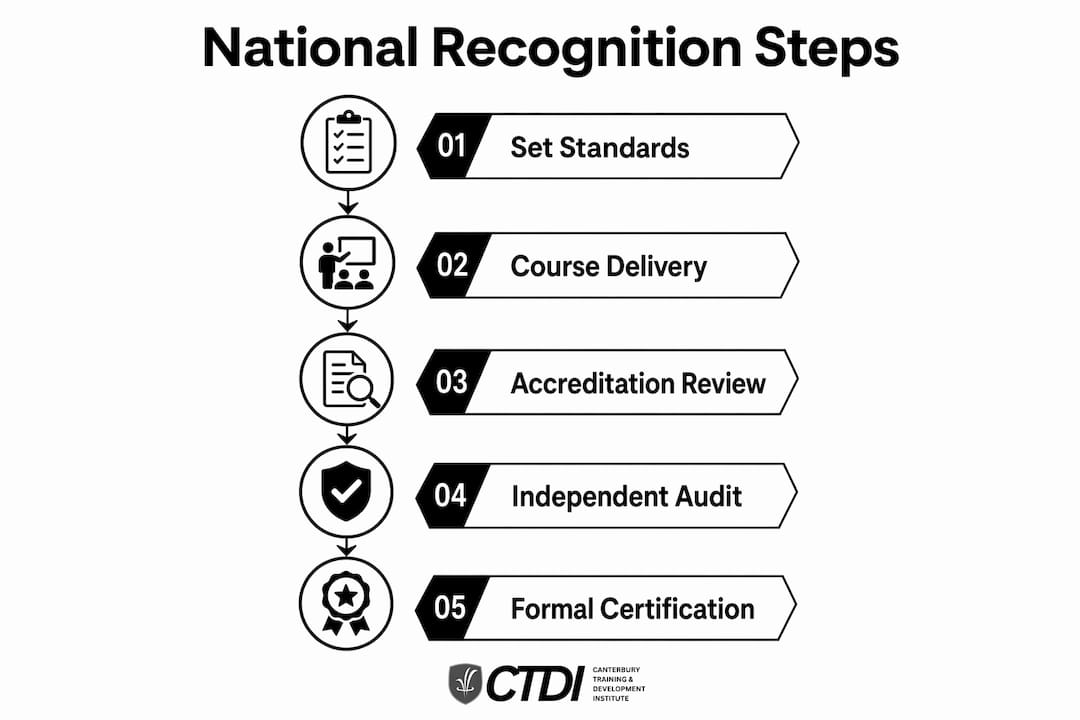
The mechanism works through a chain of authority. A national body sets the standards, registered providers deliver training against those standards, and the resulting qualifications carry portability across the country. In Australia, the Australian Skills Quality Authority (ASQA) oversees this system for vocational education and training. The AQF itself defines ten qualification levels, from Certificate I through to Doctoral Degree, giving every qualification a clear position in a nationally understood hierarchy.
Recognition is not automatic for every course or credential. A qualification only carries national recognition when the issuing institution is registered and the course is accredited under the relevant national framework. This distinction matters enormously. A short course from an unregistered provider may teach useful skills, but it will not carry the same weight with employers or licensing bodies as an AQF-aligned qualification from a registered training organisation.
What are the typical criteria for national recognition?
The criteria for national recognition vary by sector, but they share a common thread: independent, rigorous assessment against a defined standard.
Academic criteria in education
In academic settings, national recognition programmes set clear thresholds. The College Board's National Recognition Program, for example, honoured over 300,000 high-achieving 10th and 11th graders in 2026. That scale reflects how structured and measurable the criteria are. Students must hold at least a B+ GPA (3.3 or above) and score 3 or higher on two AP exams, or rank in the top 10% of specific demographic cohorts. These thresholds exist to protect the integrity of the recognition itself.
Vocational and professional criteria
In vocational training, criteria centre on course accreditation and provider registration. A course must be developed against nationally endorsed training packages or accredited curricula. Assessors must hold the relevant qualifications and follow the Standards for Registered Training Organisations. Professional licensing bodies, such as those governing nursing, engineering, or teaching, add a further layer by specifying which qualifications satisfy their registration requirements.
Demographic-based criteria also exist. The College Board programme includes First-Generation, Rural and Small-Town, and School Recognition award categories. These categories acknowledge that achievement does not occur in a vacuum. They reflect a broader understanding that national recognition should reach underrepresented groups, not just those with the most resources.
Pro Tip: Before enrolling in any course or applying for a recognition programme, check whether the awarding body is independently governed and whether its criteria are published and transparent. Programmes with clear, public standards are far more credible than those with opaque selection processes.
The most credible recognition programmes use third-party judging. Recognition programmes with rigorous, independent judging deliver a 67-percentage-point higher consumer trust level than pay-to-win models. That gap is not trivial. It is the difference between a credential that opens doors and one that raises eyebrows.
What benefits does national recognition provide for career and academic advancement?
National recognition delivers concrete, measurable advantages across three areas: credibility, opportunity, and growth.
Credibility and trust
A nationally recognised qualification or award signals to every stakeholder that an independent authority has verified your achievement. Award-recognised entities report 79% higher perceived legitimacy among consumers and 91% in business-to-business contexts. That credibility translates directly into opportunity. The same research shows recognised entities attract 3.7 times more inbound leads than their unrecognised peers. For a student or professional, the equivalent is more interview calls, stronger scholarship applications, and faster career progression.
Academic and scholarship opportunities
For students, national recognition opens access to selective programmes and financial support. Universities and scholarship committees use nationally recognised credentials as a filtering tool. A qualification from a registered training organisation under the AQF carries weight in credit transfer applications, allowing you to reduce the time and cost of further study. This is a practical financial benefit, not just a symbolic one.
"The value of recognition is closely tied to programme credibility. Independently judged awards retain far more trust and lead to superior career advantages than pay-to-win schemes."
Career and professional mobility
Employers trust nationally recognised qualifications because they know exactly what standard has been met. This trust reduces hiring risk and speeds up onboarding. For professionals who move between states or seek roles in regulated industries, a nationally recognised qualification removes the need to re-prove competency at every step.
National recognition also boosts morale. 73% of award winners reported improved employee engagement and institutional pride after receiving national recognition. That internal effect compounds over time, attracting better talent and reinforcing a culture of high performance.
Pro Tip: Add your nationally recognised qualifications to your LinkedIn profile under the "Licences and Certifications" section, and include the issuing body's name and the AQF level. Recruiters filter by these fields, and specificity signals credibility.
Recognised organisations also gain the right to display official emblems on proposals and marketing materials. Displaying official recognition emblems reduces perceived procurement risk and increases partner confidence. For students and graduates, the equivalent is citing your qualification's registration details on applications, which tells decision-makers exactly what standard you have met.
How does national recognition differ from accreditation and regional recognition?
These three concepts are related but distinct. Confusing them leads to poor decisions about which qualifications to pursue.
| Concept | Scope | Process | Typical use |
|---|---|---|---|
| National recognition | Country-wide | Formal validation by a national authority against national standards | Vocational qualifications, academic awards, professional licensing |
| Accreditation | Institution or course level | Independent review of quality systems and outcomes | Universities, RTOs, hospitals, schools |
| Regional recognition | State or territory level | State-based authority validates qualifications for local practice | Some trades, state-specific licences |
National recognition operates at the broadest domestic level. It confirms that a qualification is valid across the entire country, regardless of where it was issued. Accreditation is a quality assurance process applied to institutions or specific courses. An institution can be accredited without every course it offers being nationally recognised, and vice versa.
Regional recognition is narrower. A qualification recognised in Queensland may not automatically satisfy licensing requirements in Victoria for certain trades. This is why national accreditation matters for anyone who plans to work across state lines or in a nationally regulated profession.
Legal recognition in vocational settings involves state-level acknowledgement of qualifications, which is necessary for restricted professions and cross-border practice. Qualifications do not always transfer automatically between jurisdictions. This is a critical distinction for nurses, engineers, builders, and other licensed professionals who relocate or work across borders.
How is national recognition applied internationally, and what challenges arise?
National recognition becomes more complex when qualifications or achievements cross international borders. The core challenge is that each country sets its own standards, and those standards do not always align.
For immigration purposes, national recognition takes on a specific legal meaning. USCIS in the United States, for example, accepts international acclaim as evidence of national recognition for skilled visa categories. This means citations, awards from international bodies, and peer recognition from professionals in other countries can satisfy the "national scope" requirement. The recognition does not have to originate domestically to count.
Common challenges in international recognition include:
- Qualification equivalency gaps. A Certificate IV in Australia may not map directly to a qualification level in another country's framework, requiring formal assessment by a recognised authority.
- Restricted profession barriers. Doctors, lawyers, and engineers often face the most stringent re-recognition requirements when moving between countries, even when their qualifications are from well-regarded institutions.
- Documentation requirements. Proving national recognition internationally requires official transcripts, registration certificates, and sometimes statutory declarations. Informal evidence is rarely accepted.
- Time and cost. The assessment process for international recognition can take months and involve fees from multiple bodies, including skills assessment authorities and professional associations.
For Australians seeking to have their vocational qualifications recognised overseas, the first step is contacting the relevant skills assessment authority in the destination country. For those coming to Australia, ASQA and the relevant professional licensing body are the starting points. The process is structured, but it requires preparation and documentation.
Pro Tip: If you are planning to work internationally, check whether your qualification is listed on the relevant country's skills shortage list before you apply. Qualifications in high-demand fields often receive faster recognition processing.
How can you maximise the advantages of national recognition?
National recognition only delivers its full value when you use it deliberately. These steps turn a credential into a career asset.
-
Choose programmes with independent assessment. Only programmes with transparent, strict judging and wide geographic reach deliver lasting credibility. Verify that the awarding body publishes its criteria and uses external assessors. This is the single most important filter when selecting a course or award programme.
-
Document everything. Keep your qualification certificates, statements of attainment, and registration details in a secure, accessible format. When applying for jobs, licences, or further study, you will need to produce these quickly and accurately.
-
Present recognition specifically on applications. List the qualification name, the issuing registered training organisation, the AQF level, and the year of completion. Generic descriptions like "completed a marketing course" carry no weight. Specific, verifiable details do.
-
Use recognition to access networks. Many national recognition programmes connect recipients with alumni networks, industry groups, and mentors. These connections often matter more than the credential itself over the long term. Nationally recognised courses frequently include industry-connected trainers who can open doors that a certificate alone cannot.
-
Stack recognitions deliberately. Recognised companies grow revenue by 312% over five years compared to 31% for unrecognised peers. The compounding effect applies to individuals too. Each additional nationally recognised credential or award builds on the last, creating a profile that is progressively harder to overlook.
-
Leverage emblems and credentials in professional materials. Displaying your qualification's registration details or award emblems on proposals, portfolios, and profiles reduces perceived risk for employers and clients. It signals that an independent authority has already done the vetting.
Key takeaways
National recognition in education and vocational training is the formal validation by an authorised national body that a qualification or achievement meets a defined, portable standard.
| Point | Details |
|---|---|
| Definition of national recognition | Formal validation by a national authority confirming a qualification meets country-wide standards. |
| Criteria vary by sector | Academic programmes require GPA and exam thresholds; vocational training requires AQF-aligned accreditation. |
| Credibility drives opportunity | Independently recognised qualifications generate significantly higher trust from employers, universities, and licensing bodies. |
| National differs from regional | National recognition is portable across the whole country; regional recognition may not transfer between states. |
| International portability requires planning | Cross-border recognition involves formal assessment processes, documentation, and sometimes lengthy timelines. |
Recognition has changed. Are you keeping up?
I have watched the value of national recognition shift considerably over the past decade. When I started advising students on vocational pathways, a nationally recognised qualification was largely a compliance checkbox. Employers asked for it, students got it, and that was the end of the conversation. That is no longer how it works.
The shift happened when employers started distinguishing between qualifications from registered training organisations with strong industry connections and those from providers who simply met the minimum registration requirements. The credential itself became a starting point, not a conclusion. What sits behind it, the quality of the training, the relevance of the curriculum, the credibility of the assessors, began to matter just as much.
The data supports this. Independently judged recognition programmes consistently outperform self-nominated or pay-to-win schemes in every measurable outcome. That pattern holds whether you are talking about business awards or vocational qualifications. The mechanism is the same: independent assessment signals that the standard is real, not manufactured.
My advice to anyone choosing a course or recognition programme is to ask one question before anything else: who is doing the assessing, and what are their criteria? If the answer is vague, keep looking. The programmes worth your time are the ones that make their standards public and their assessors accountable. That transparency is what turns a piece of paper into a career asset.
— Sam
Nationally recognised training at CTDI
Canterbury Training and Development Institute (CTDI) delivers vocational qualifications that meet Australian national standards, giving students credentials that employers and licensing bodies recognise across the country.

Edu's courses cover high-growth fields including AI, digital marketing, and environmental management, all delivered 100% online and self-paced. Every qualification is AQF-aligned and issued by a registered training organisation, which means your credential carries weight whether you are applying for a promotion, a university credit transfer, or a professional licence. Students also receive support from industry-connected trainers throughout their studies. Enrol now to build a credential that works as hard as you do, or explore the Advanced Diploma of Digital Marketing for a nationally recognised pathway into one of Australia's fastest-growing fields.
FAQ
What is national recognition in Australian vocational training?
National recognition in Australian vocational training is the legal requirement for registered training organisations to accept AQF qualifications and statements of attainment issued by other registered providers. It ensures your qualification is portable across all states and territories.
Who grants national recognition for qualifications in Australia?
The Australian Skills Quality Authority (ASQA) oversees the registration of training organisations and the accreditation of courses under the AQF. Qualifications issued by ASQA-registered providers carry national recognition automatically.
How do I know if my course is nationally recognised?
Check that the course is listed on training.gov.au and that the provider holds current registration with ASQA. A nationally recognised course will have a national course code and be mapped to an AQF level.
Does national recognition apply when I work overseas?
National recognition does not automatically transfer across international borders. You will need to apply for formal skills assessment in the destination country, and some professions require additional licensing or re-qualification regardless of your Australian credentials.
What is the difference between national recognition and accreditation?
National recognition confirms a qualification is valid and portable across the country. Accreditation is a quality review process applied to an institution or course to confirm it meets defined standards. A course can be accredited without being nationally recognised, though in Australia the two processes are closely linked through the AQF and ASQA registration requirements.