

Yes, prior study often counts toward an Australian university degree, but the receiving university decides on a case-by-case equivalence basis. Diploma and advanced diploma holders commonly receive credit, though the exact amount depends on how closely your units match, how recent your study is, and each institution's own rules. Apply early and have your transcripts and unit outlines ready before you enrol.
Table of Contents
- What's the difference between credit transfer and RPL?
- How much credit can you realistically expect?
- How do universities actually assess your credit?
- How do you apply for credit transfer, step by step?
- VET pathways, articulation agreements and guaranteed credit
- How does credit affect fees, timing and CoE for international students?
- What if you only get partial credit, or none at all?
- How CTDI supports students planning a credit pathway
- Where to check the official rules yourself
- Sources
What's the difference between credit transfer and RPL?
Credit transfer and recognition of prior learning (RPL) solve different problems, and mixing them up wastes time.
Credit transfer, sometimes called advanced standing, recognises formal units you have already completed and passed, so you don't repeat content you've already learned. ASQA's guidance on credit transfer confirms this applies to units from an accredited course, whether at another university, TAFE, or a registered training organisation. RPL works differently. It assesses skills and knowledge you've picked up through work, volunteering, or informal learning, without a formal certificate behind it.
Here's how to sort out which one applies to you:
- Formal prior study (a completed diploma, advanced diploma, or degree unit): pursue credit transfer.
- Workplace experience or self-taught skills with no matching qualification: pursue RPL.
- Both routes need evidence. Credit transfer needs transcripts, unit outlines, and statements of attainment. RPL needs work samples, references, or a skills portfolio.
Get your Unique Student Identifier (USI) and My eQuals records sorted before you apply. Both save weeks of back and forth with admissions.
How much credit can you realistically expect?
National guidance gives a useful benchmark, though it's a guide rather than a promise.
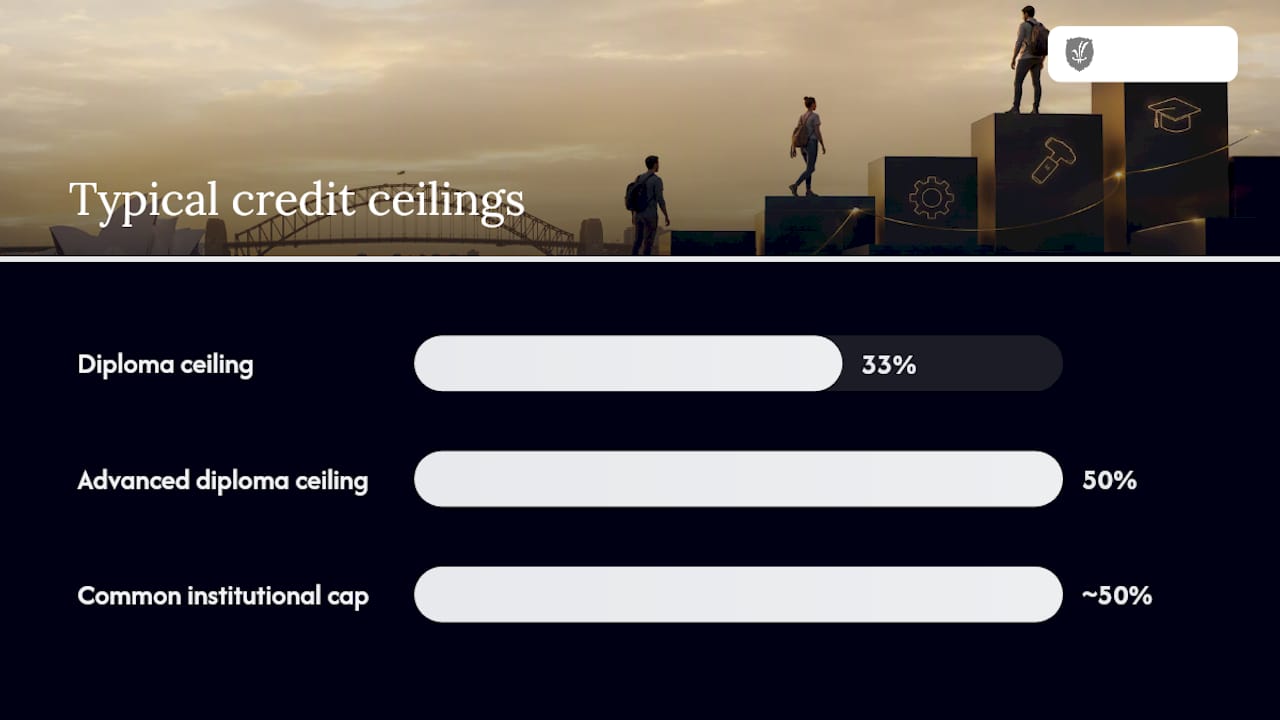
Under Universities Australia and Australian Qualifications Framework guidance, a completed diploma can attract credit toward a three-year bachelor degree, while an advanced diploma can attract credit up to about half of the degree. VTAC's overview of credit transfer confirms these figures but notes they depend heavily on how well your units align and how current your qualification is.
A few things shape what you'll actually get:
- Institutional caps. Many universities set an overall limit, often around 50% of a degree, regardless of how much prior study you bring.
- Core and capstone units. These are rarely exempted, even with a strong qualification behind you, because they're designed to assess degree-specific competencies.
- Currency windows. Most universities only recognise study completed within the last five to ten years, so an old diploma may count for less than a recent one.
Treat the 33% and 50% figures as ceilings, not entitlements. Some universities apply them generously; others treat them as a strict maximum reserved for the closest matches.
How do universities actually assess your credit?
Assessors don't just check if a unit title sounds similar. They compare substance.
TEQSA's guidance note on credit and RPL requires providers to award credit based on genuine equivalence, which protects the value of the degree you're working toward. In practice, that means assessors weigh three things above all else:
- Learning outcomes. What you were actually able to do at the end of the unit, not just the topics covered.
- Volume of learning. Whether the hours and depth of study match what the university unit demands.
- Assessment approach. Whether you were tested through exams, projects, or practical tasks comparable to the university's own methods.
There's also a difference between specified credit, where a prior unit maps directly onto a required core unit, and unspecified credit, where it only counts toward general electives. Specified credit is harder to get and carries more weight in shortening your degree.
Pro Tip: Ask the university who actually signs off on credit decisions before you apply. Some delegate this to a general admissions team; others require sign off from the academic head of the specific program. Knowing which applies to your course tells you how detailed your evidence needs to be.
How do you apply for credit transfer, step by step?
Getting your application right the first time saves you from enrolling in units you'll later drop.
- Check the credit-precedent database first. Most universities publish a searchable list of previously approved credit outcomes for specific VET qualifications. If your diploma appears, you already know roughly what to expect.
- Contact admissions for a pre-assessment. Many universities, as Study Australia's guidance on course credits notes, will give an informal read on your credit chances before you formally enrol.
- Gather your documents. You'll need certified academic transcripts, unit outlines or syllabuses dated to when you studied (not the current version), statements of attainment, and your USI or My eQuals link. If any documents are in another language, get certified translations.
- Declare credit at application, not after. Stating your intent early lets the university factor likely credit into your offer and enrolment load.
- Submit before census dates. Applying after your course has started can mean you're locked into units you didn't need. CTDI's guide on VET credit transfer decisions notes that well-documented applications are often assessed within five to ten business days, though this varies by institution and time of year.
- Expect a formal offer letter update. Once approved, your credit appears on your enrolment plan, and your remaining unit count drops accordingly.
VET pathways, articulation agreements and guaranteed credit
Some VET-to-university routes are more predictable than others because they're already mapped out in advance.
An articulation agreement is a formal arrangement between a VET provider and a university that pre-approves how specific diploma units convert into degree credit. Where these exist, you skip a lot of the equivalence guesswork, because the mapping has already been agreed by both institutions.
- Diploma holders often see credit equivalent to the first year of a related bachelor degree, roughly matching the AQF's guidance of up to a third of the total degree.
- Advanced diploma holders are frequently placed into the second year of a matching degree, consistent with the higher credit ceiling advanced diplomas attract.
- Pathway pages on university websites, often searchable by your specific qualification and RTO, will tell you whether a formal articulation agreement already exists for your course.
If you can't find a listed pathway, that doesn't rule out credit. It just means you're applying for individual assessment rather than a pre-approved arrangement.
How does credit affect fees, timing and CoE for international students?
Universities typically assess credit within a few weeks of receiving a complete application, though busy enrolment periods can stretch this out. Applying before you enrol, rather than after your course starts, gives the university time to factor any approved credit into your study plan and your fees.
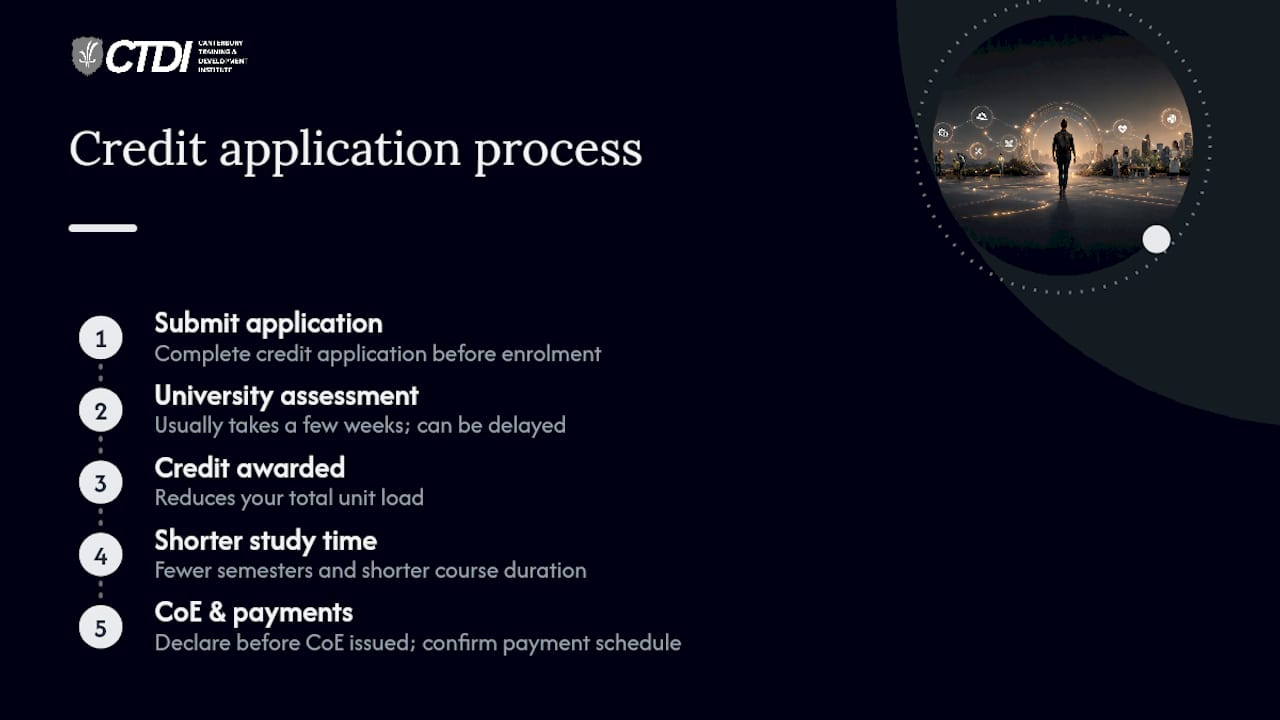
Credit reduces your total unit load, which usually means fewer semesters of tuition and a shorter overall course. For international students, this matters beyond cost. Flinders University's credit transfer guidance notes that awarded credit affects your Confirmation of Enrolment (CoE), since CoE documents state your expected course duration. Declare any anticipated credit before your CoE is issued, and confirm with admissions how the change affects your enrolment and, where relevant, your payment schedule.
What if you only get partial credit, or none at all?
A knockback isn't final, and it's rarely personal. It usually means the equivalence case wasn't strong enough on paper.
- Request a reassessment with more detailed evidence, particularly full unit outlines showing assessment tasks and hours, not just a subject title.
- Ask for the assessor's reasoning. Knowing exactly which criterion you fell short on tells you what to supplement.
- Consider bridging units to close a genuine gap, or apply for RPL if the mismatch is about assessment style rather than content.
- Take unmatched units as electives rather than losing the credit altogether.
- Talk to a course adviser about whether a related degree or a nested qualification gets you further with the study you've already done.
How CTDI supports students planning a credit pathway
Vocational qualifications are only useful for credit transfer if the paperwork behind them is solid, and that's where a lot of VET graduates get caught out. Nationally recognised online diploma courses in artificial intelligence, digital marketing, and environmentally sustainable management are typically structured so students finish with clear unit outlines, assessment records, and statements of attainment, which are documents a university credit assessor wants to see.
If you're planning to use a CTDI diploma as a stepping stone toward a university degree, start collecting your unit outlines and assessment evidence as you go rather than scrambling for them later. CTDI's guide to skills recognition explains how RPL and credit transfer evidence differs, which is worth reading before you approach a university. CTDI cannot guarantee any credit transfer or RPL outcome. That decision always sits with the receiving university. If you're weighing up a flexible, self-paced VET qualification as part of a longer study or career plan, you can view current course options and enrol now to get started.
Where to check the official rules yourself
Before applying, check TEQSA's credit and RPL guidance, the AQF's credit transfer policy, ASQA's student guidance, and your target university's own credit-precedent database.
Sources
- TEQSA guidance note — Credit and recognition of prior learning
- AQF — Credit transfer guidance
- VTAC — credit transfer overview and typical amounts
Recommended
- Vet student loans eligibility: what Australian students need to check
- Vocational training in Australia: how to find accredited courses
- Career pathways in Australia: your 2026 guide
- Decision in 5–10 Days for VET Credit Transfer & RPL, Australia
This article provides general information only. Course requirements, study pathways, credit arrangements and career outcomes may vary. Always confirm current requirements with the relevant education provider or authority.