

You'll owe four things before you can settle into university life in Australia: a deposit to secure your Confirmation of Enrolment (CoE), tuition instalments for each study period, Overseas Student Health Cover (OSHC), and a handful of non-tuition fees. The first move, before you touch a payment portal, is to open your offer letter and find your unique payment reference — every dollar you send needs it attached.
Table of Contents
- How tuition and mandatory fees work in Australia
- What payment methods can you actually use?
- Watch for surcharges, exchange holds and refund traps
- Financial help: what's real and what's a misconception
- Making a payment without it getting lost overseas
- If a provider can't deliver: protection and complaints
- How CanterburyTDI supports international students with payments
- Sources
How tuition and mandatory fees work in Australia
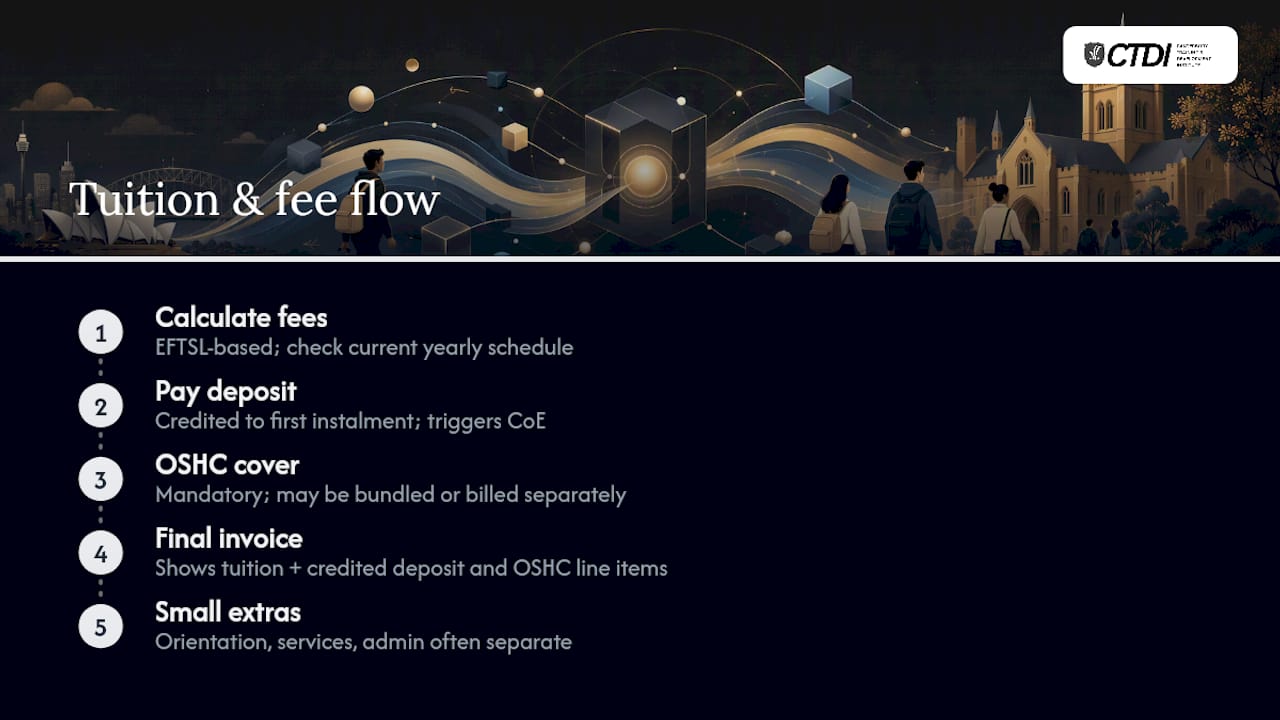
Australian universities generally price courses by subject or discipline band, using a measure called EFTSL (Equivalent Full-Time Student Load) to calculate your annual cost. Fee tables get updated yearly, so the figure you saw during research season isn't guaranteed to match what's on your actual invoice. Always check the current course fee schedule before you budget.
The deposit comes first. It's not a separate charge sitting alongside tuition. It's usually credited straight to your first instalment once the university has confirmed receipt, and that confirmation is what triggers your CoE. The University of Melbourne, for example, lists a minimum international undergraduate deposit, which is credited to the first instalment and required for CoE issuance. Other providers set lower figures, but the mechanism is the same everywhere: pay the deposit, get the CoE, start the visa process.
OSHC is mandatory for most student visa holders, and many institutions arrange it on your behalf, folding the cost into that same initial invoice. It pays to check whether your OSHC premium is bundled into the deposit or billed as a line item of its own, because the two amounts can look identical on a statement if you're not paying attention.
Beyond tuition and health cover, expect smaller charges for orientation materials, student services, or enrolment administration. These rarely show up in the headline "course fee" figure quoted on a university's marketing page.
What payment methods can you actually use?
Providers narrow this down to a short, approved list, and for good reason. UNSW and other universities have been moving students away from informal bank transfers because they're harder to trace and easier to misallocate. Here's how the main options stack up.
- BPAY: free of surcharges if you hold an Australian bank account, and payments allocate quickly once your bank processes them.
- University payment portal with an approved partner (Convera, sometimes branded as Flywire on other providers' sites): built for paying from overseas, and Convera can lock in an exchange rate for a set window so a currency swing doesn't blow out your total between quote and payment. Availability depends on your home country, though. Sanctions or banking restrictions mean Convera isn't usable everywhere, so confirm it covers your country before relying on it.
- Credit or debit card: convenient, but card surcharges apply, and international cards typically attract a higher percentage fee than domestic Australian cards.
- Telegraphic transfer (TT): still accepted by some providers, but slower, prone to bank fees on both ends, and higher risk of your payment landing without a traceable reference. Only use TT if your provider has explicitly given you bank TT details, and attach the reference number every time.
Whichever method you choose, the unique payment reference on your invoice is what tells the university's finance system whose account to credit. Leave it off, or fat finger a digit, and your payment can sit unallocated for weeks while you're assuming it's sorted.
Watch for surcharges, exchange holds and refund traps
Card gateways publish their surcharge bands, and they're worth reading before you hit confirm. International Visa and Mastercard transactions generally sit on a higher surcharge tier than domestic cards, a gap ANU spells out on its payment options page. On a tuition bill running into the tens of thousands, that percentage difference is real money.
If you're using Convera or a similar partner, the locked exchange rate usually only holds for a short quote window, often around 72 hours. Miss that window and you'll be re-quoted at whatever the market rate is on the day, which can work for you or against you depending on currency movement.
Refund policy is the part students skip reading and regret later. Before you pay anything:
- Confirm whether your deposit is refundable, and under what conditions (visa refusal is usually covered; changing your mind generally isn't).
- Check the provider's stated refund timeline; some take weeks to process.
- Confirm the exact AUD amount that will land in the university's account, not just what you're sending.
- Note who absorbs any bank fees along the way, since intermediary banks can shave a transfer down before it arrives.
Pro Tip: Screenshot the exchange rate and fee breakdown at the moment you confirm payment. If a dispute arises later, that screenshot is worth more than your memory of "roughly what I paid."
Financial help: what's real and what's a misconception
Scholarships and institutional bursaries exist, and they're worth chasing, but they're competitive and often tied to specific courses, countries, or academic thresholds rather than open to every applicant. Search your prospective provider's scholarship page directly rather than relying on generic "study abroad scholarship" lists, which are frequently outdated.
Here's the misconception that trips up a lot of students: FEE-HELP will not cover you. FEE-HELP is a government loan scheme built for eligible Australian citizens and certain permanent resident categories. International fee-paying students are excluded from it in almost all cases. If you've seen a forum post claiming otherwise, check StudyAssist directly rather than trusting the thread.
What actually helps when money gets tight mid-course:
- Ask your provider's international student office about emergency hardship grants, which some institutions run quietly and don't advertise widely.
- Budget for cost of living separately from tuition. Rent, groceries, and transport in Australian cities add up fast and catch new arrivals off guard.
- Read the Department of Education's overview of financial assistance for a realistic picture of what's available.
Making a payment without it getting lost overseas
Follow this sequence every time you pay, and you'll avoid the vast majority of allocation headaches international students run into.
- Pay through your provider's approved portal or nominated partner, entering your invoice's unique payment reference exactly as written.
- Save the receipt and take a screenshot of the confirmation screen the moment payment goes through.
- Check your student portal after the provider's stated processing window (commonly a few business days) to confirm the payment has posted to your account.
If the payment hasn't appeared after that window, don't panic and don't resend. Gather your receipt, the transaction ID, and any correspondence, then email the provider's finance office with all three attached. Contact your bank first only if the money never left your account; contact the university finance team if it left your account but hasn't landed on your student ledger.
Pro Tip: Keep the email short: one line stating the amount, the date sent, the reference used, and the receipt attached. Finance teams triage faster requests first.
If a provider can't deliver: protection and complaints
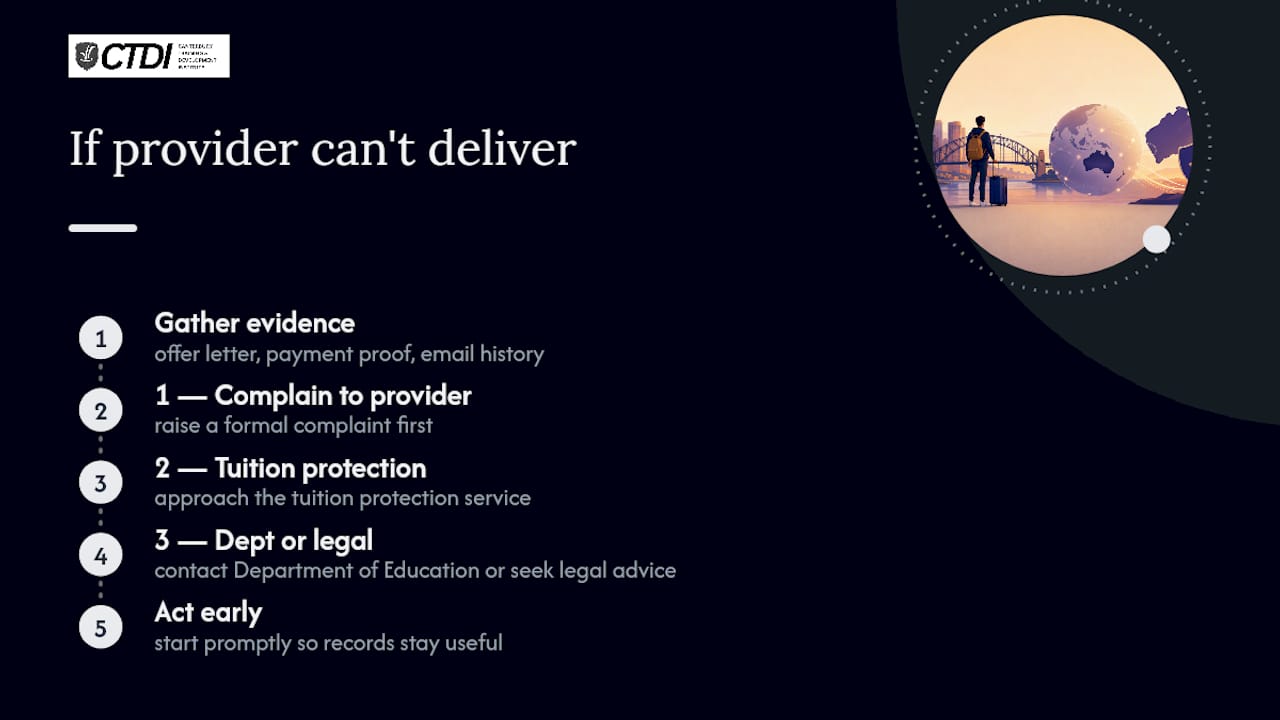
Australia runs tuition protection arrangements designed to look after you if a provider closes down or can't complete your course, and the Department of Education publishes guidance covering how these arrangements work.
If you ever find yourself in that situation, collect your offer letter, every proof of payment, and your full email history with the provider before you do anything else. The escalation path runs in order: raise a formal complaint with the provider first, then approach the tuition protection service if the provider hasn't resolved it, and contact the Department of Education or seek legal advice if you're still stuck. Acting early, before records go cold, makes every one of those steps faster.
How CanterburyTDI supports international students with payments
CanterburyTDI runs nationally accredited online diplomas in AI, digital marketing, and environmentally sustainable management, and payment clarity is part of how we support students from day one. Our blog breaks down study now, pay later options and VET student loan eligibility so you know exactly which schemes actually apply to your situation before you commit money.
Our student support resources cover enrolment questions, including payment queries, and our team can walk you through your specific invoice if something doesn't add up. If you're ready to lock in your course, the enrol now page is the direct route to accredited study with clear, upfront fee information from the outset.
Sources
- Undergraduate fees and payments (international) — University of Melbourne
- International student payment options — Australian National University
- FEE-HELP — StudyAssist
- Financial assistance for international students — Department of Education