

The Genuine Student requirement means your primary reason for coming to Australia must be to study, and it applies to every Student visa (subclass 500) application lodged on or after 23 March 2024. It replaced the old Genuine Temporary Entrant test. You don't need to promise you'll leave Australia forever; you need to show, with evidence, that studying is genuinely why you're applying now.
TL;DR:
- Evidence of financial capacity must support your ability to fund a year of study with about AUD 29,710 and include clear source documentation.
- Your answers should clearly link your course choice and current circumstances to your future career goals, supported by specific documents and explanations.
- Red flags such as inconsistent academic or employment gaps, unrelated course choices, or unexplained financial transactions can lead to visa refusal.
- Selecting a well-structured, outcome-oriented online diploma from a recognized provider like CTDI simplifies your genuine student assessment process.
- Always verify the latest requirements directly with the Department of Home Affairs and provide honest, detailed explanations for any unusual circumstances.
Table of Contents
- What the genuine student requirement Australia actually checks
- The exact questions the online application asks
- The documents that back up your GS answers
- How officers weigh your case and where applications go wrong
- Your step-by-step GS preparation checklist
- Why GS replaced the old GTE test
- Where CTDI fits in your GS preparation
- Enrol in a course that makes your GS answers easier to write
- Where to check the official rules before you lodge
- Sources
What the genuine student requirement Australia actually checks
The Genuine Student (GS) requirement grew out of Australia's Migration Strategy reforms and sits at the centre of every Subclass 500 decision made since 23 March 2024. It applies whether you're applying from offshore or onshore, and it extends to any family members included as GS dependents on your application. The test asks one core question: is study your genuine, primary purpose for coming to or staying in Australia?
Decision makers use Ministerial Direction No. 106 as their working guide when weighing responses. It sets out how officers should approach GS assessments consistently across applications, rather than leaving each case to individual interpretation. That consistency matters for you because it means the questions you answer, and how you answer them, follow a predictable pattern regardless of which post processes your case.
The exact questions the online application asks
The old GTE statement was a single 300 word essay. Under GS, the questions are targeted and specific, asked directly inside ImmiAccount as separate fields rather than one long-form response. Expect to address:
- Your current circumstances and ties to your home country, including family, employment, and community connections
- Why you chose this particular course and this provider in Australia
- How the course will benefit your career when you return home or move forward professionally
- Any previous study in Australia and how this course builds on it
- Any other information relevant to your circumstances
- If you're applying onshore, why you're seeking a new visa now and what's changed since your last one
Each field has a word limit, so treat every answer as a tight professional summary rather than an essay. Vague statements waste the space you've been given.
The documents that back up your GS answers
Officers weigh your claims against what you can prove, so evidence carries more weight than wording. Financial capacity is usually the first thing checked: bank statements covering three to six months, sponsor letters, and a clear explanation of where the money came from.
Financial benchmark: guidance commonly points applicants to the Department's published living cost figure of roughly AUD $29,710 for the primary applicant, used as a reference point for demonstrating you can support yourself for a year of study.
Beyond finances, build your file around:
- Academic transcripts, a CV, and your Confirmation of Enrolment (CoE) with CRICOS course details
- A course outline showing how it connects to your intended career
- Overseas Student Health Cover (OSHC) confirmation
- Police clearance certificates where requested
- Sponsor documentation, including the sponsor's relationship to you and their own financial evidence, if a loan or gift is funding your studies
Unexplained deposits or a sponsor with no clear connection to you are the fastest way to raise questions. Document the relationship and the source of funds together, not as an afterthought.
How officers weigh your case and where applications go wrong
Officers work through four broad areas: your current circumstances, whether the course genuinely suits your background and goals, your immigration history, and any other relevant matters specific to your case. Providers are increasingly doing their own screening before a CoE is even issued. UNSW, for example, runs interviews and sights financial documents for some applicants before enrolment is finalised.
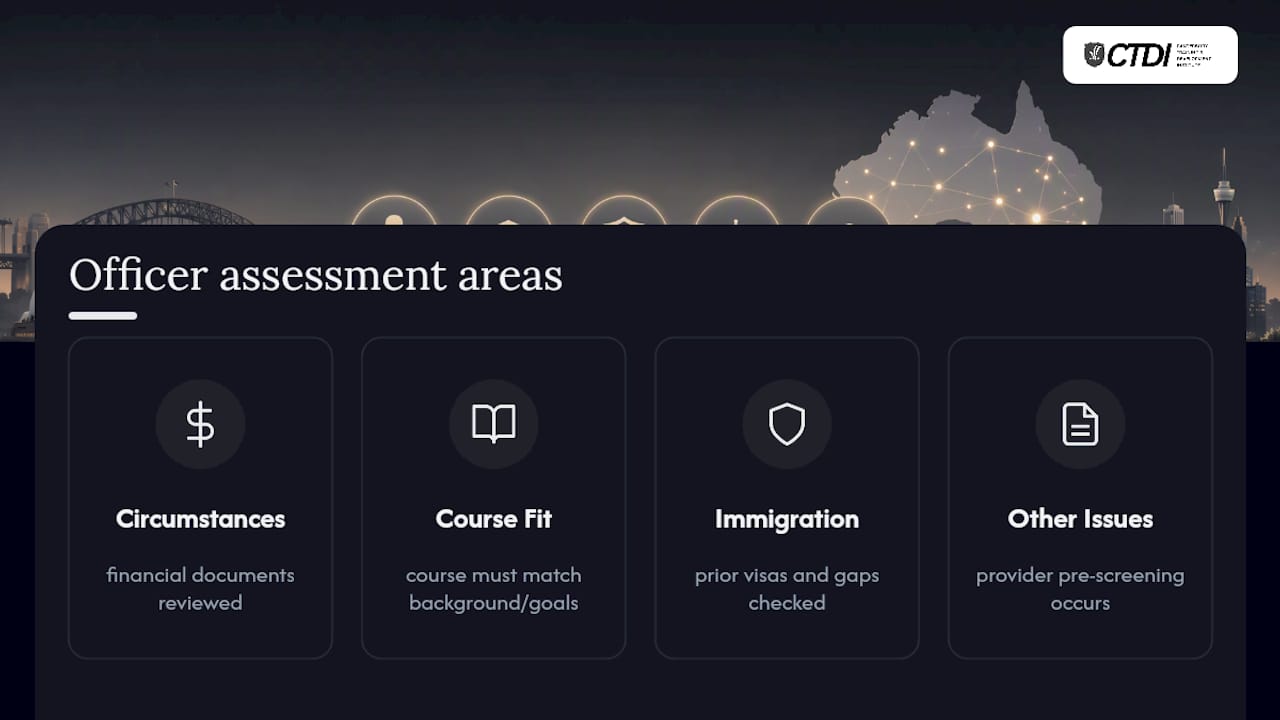
Common red flags include a course that doesn't logically follow your academic or career history, financial evidence that doesn't add up, unexplained gaps in study or employment, and answers that read like a copied template rather than your own circumstances.
Pro Tip: If something about your situation looks unusual on paper, such as a career change or a long study gap, address it directly in your answer and attach documents that explain it. Silence reads as evasion; an explanation reads as honesty.
What convinces an officer is a clear, specific thread: why this course, why now, why this provider, and what happens afterward. Generic answers without that thread rarely survive scrutiny.
Your step-by-step GS preparation checklist
- Map your course to your career. Identify specific units, skills, or outcomes that connect directly to your future employment, not just the qualification title.
- Gather every document early, and get translations certified where your originals aren't in English.
- Draft answers using a claim, evidence, outcome structure. State the point, back it with a document or fact, then explain what it leads to.
- Disclose your visa history honestly, including any prior refusals, and attach paperwork that explains context rather than omitting it.
- Run final checks on your CoE, OSHC policy, English test validity, and that every requested document is actually in the file before you submit.
Working through this in order avoids the common trap of writing polished answers before your evidence is even organised.
Why GS replaced the old GTE test
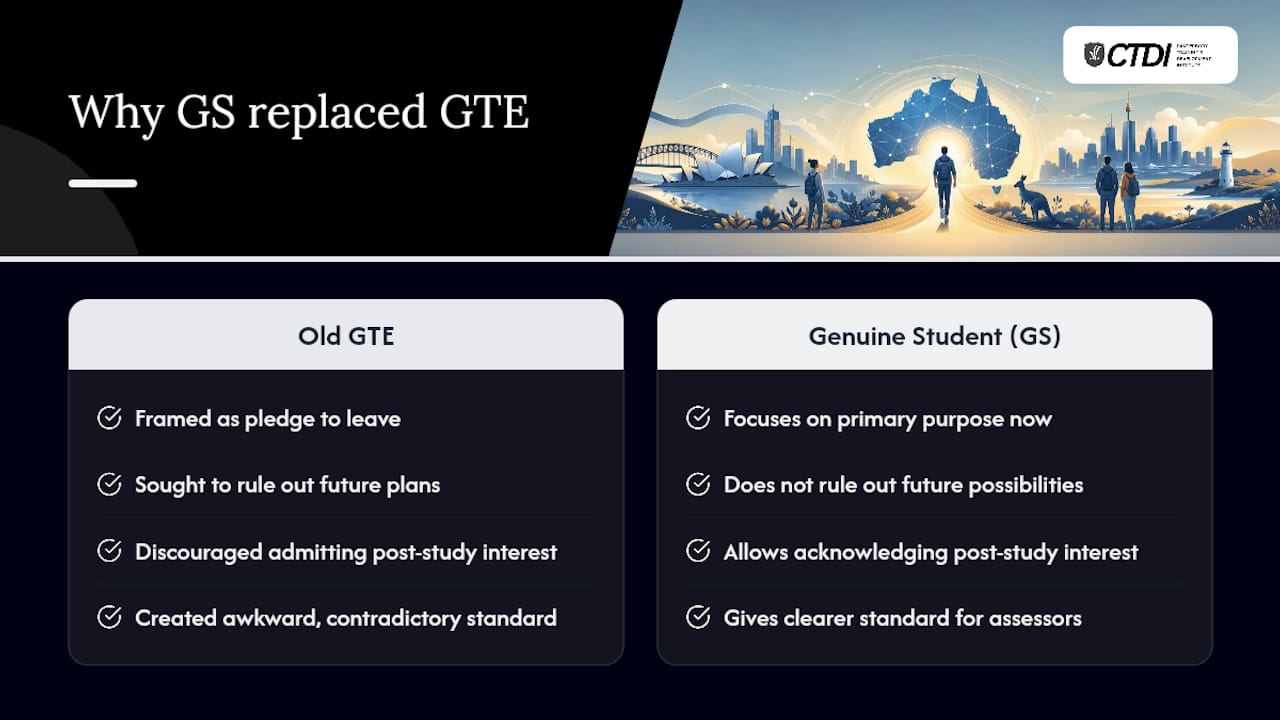
The GTE test forced applicants to essentially pledge they'd leave Australia, which sat awkwardly against the reality that many students hope to work here after graduating. GS drops that framing. It focuses on whether study is genuinely your primary purpose right now, not on ruling out every future possibility.
You can acknowledge an interest in post-study work rights or a graduate visa pathway. What matters to the officer is that your course choice and your current circumstances make sense together. That shift gives decision makers a clearer, less contradictory standard to assess against, and it gives you room to be honest about your plans.
Where CTDI fits in your GS preparation
CTDI supports international students with clear course information, straightforward CoE documentation, and checklists that make gathering evidence less confusing. Our nationally recognised online vocational courses are built around identifiable career outcomes, which gives you something concrete to point to when explaining how your course benefits your future.
— Sam
Enrol in a course that makes your GS answers easier to write
A messy enrolment process makes your GS answers vague by default; a clear one gives you specifics to point to. CTDI's difference is simple: our accredited online diplomas in AI, digital marketing, and environmentally sustainable management come with a defined structure and a straightforward path to your CoE, so you're not scrambling to explain a vague course choice under pressure.
Each diploma is self-paced, delivered fully online, and designed by industry experts around real employment outcomes, which is exactly the kind of course-to-career link officers want to see in a GS response. If you're ready to lock in a course with clear documentation behind it, enrol now and get your enrolment and CoE process moving.
Where to check the official rules before you lodge
Always verify current requirements directly with the Department of Home Affairs before submitting anything. Study Australia's explainer breaks down the question format, and your intended provider's own GS guidance page, such as UNSW's, often adds practical, provider-specific steps worth following.
This article is general information, not a substitute for advice from a qualified lawyer. Consult a qualified legal professional about your own circumstances before acting on anything here.
Sources
- Genuine Student requirement - Immigration and citizenship
- Genuine Student (GS) Requirement | UNSW Sydney