

TL;DR:
- A career-focused training guide links self-assessment, skill gap analysis, and targeted learning to career goals. It emphasizes applying skills within 90-day sprints, with regular reviews to ensure progress and relevance. Visibility and real-world application are essential for translating training into career advancement.
A career-focused training guide is a step-by-step framework for acquiring, applying, and tracking the skills you need to grow professionally or change direction entirely. Unlike a generic course list, a structured vocational development plan ties every learning activity to a specific career outcome. The Career Growth Compass framework identifies four pillars that drive advancement: skills, visibility, relationships, and positioning. Completing courses alone does not move careers forward. This guide shows you how to assess your starting point, build a realistic learning plan using flexible online programmes, and track progress through 90-day sprints that produce measurable results.
What does a career-focused training guide actually cover?
A career-focused training guide covers every stage from self-assessment through to active job readiness, not just the courses you take. The full career change process spans 6 to 18 months, moving through phases that include initial assessment, skill building, and job search. That timeline matters because it sets realistic expectations and stops you from abandoning a plan too early.
The guide you build for yourself should address three core questions: Where are you now? Where do you want to be? What skills and credentials close that gap? Answering these questions with specificity is what separates a plan that produces results from a wishlist. Professional development resources like structured vocational frameworks help you move from vague ambition to concrete weekly actions.
Employability skills training has shifted significantly in recent years. Employers now expect candidates to demonstrate applied competency, not just course completion. A well-designed skills training programme connects formal learning to real work tasks, so the credential you earn reflects genuine capability.
How do you assess your current career position and identify skill gaps?
Self-assessment is the foundation of any effective professional development plan. Start with a skills inventory: list every technical and transferable skill you use regularly, then rate your confidence in each one. This process reveals both strengths you can build on and gaps that are holding you back.

Building a skills inventory
Write down every role you have held and the specific tasks you performed in each. Group those tasks into skill categories such as data analysis, project coordination, client communication, or digital marketing. Once you have the list, compare it against job descriptions for the roles you are targeting. The gaps between what you have and what those roles require become your training priorities.
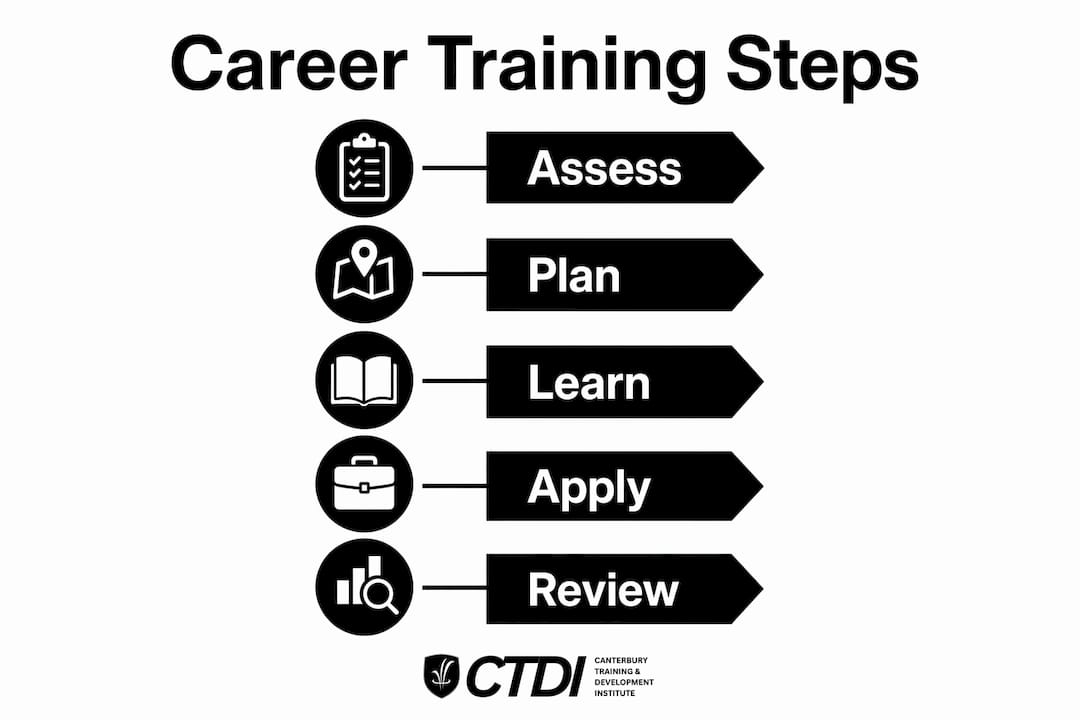
Focus on two to three key skills per development phase rather than trying to fix everything at once. Spreading effort too thin produces shallow competency across many areas instead of genuine mastery in the ones that matter most for your next role.
Using frameworks to guide gap analysis
The Mirrai Careers framework structures gap analysis around five elements: mapping tensions in your current role, identifying skill gaps, building a learning plan, setting weekly behaviours, and defining a long-term vision. Working through each element gives you a complete picture of where targeted training will have the greatest impact.
Pro Tip: Cross-reference your skill gaps against the internal promotion criteria at your current employer, not just external job descriptions. Internal promotions often prioritise demonstrable readiness for specific requirements over general certifications, so aligning your training to those criteria gives you a direct advantage.
How do you design a personalised learning plan with flexible online programmes?
A personalised learning plan translates your skill gap analysis into a weekly schedule you can actually follow. The most practical starting point for full-time professionals is 5 hours per week, split into 2 hours of structured learning and 3 hours of hands-on practice. That ratio matters because passive instruction without application produces very little lasting competency.
The 70-20-10 learning model
The 70-20-10 model allocates 70% of learning time to on-the-job practice, 20% to social learning through mentors and peers, and 10% to formal instruction. Applied to a 5-hour weekly schedule, this means roughly 3.5 hours of practice, 1 hour of peer discussion or mentoring, and 30 minutes of structured coursework. Most learners invert this ratio and wonder why their skills do not transfer to real work situations.
Flexible online programmes support this model well because they let you complete formal instruction at any time, freeing your working hours for application. Self-paced courses from accredited providers allow you to move faster through content you already partially understand and slow down where the material is genuinely new.
Choosing the right training format
Different learning formats suit different stages of skill development. The table below compares the three main approaches:
| Format | Best for | Key advantage |
|---|---|---|
| Self-paced online | Building foundational knowledge | Complete on your own schedule |
| Instructor-led online | Complex topics needing feedback | Direct access to expert guidance |
| Blended (self-paced + live sessions) | Applied skill development | Combines flexibility with accountability |
Selecting the right format for each skill gap reduces wasted time. A foundational digital marketing module suits self-paced delivery. A complex data analysis project benefits from instructor feedback. Knowing the difference stops you from choosing a format out of habit rather than fit.
Pro Tip: Block your 2 hours of structured learning at the same time each week. Consistency in scheduling reduces the mental effort of deciding when to study, which is one of the main reasons learners fall behind. Check Edu's online learning guide for practical tips on building a sustainable weekly routine.
- Audit your current subscriptions and free resources before purchasing new courses.
- Align every course you enrol in to a specific skill gap, not general interest.
- Schedule application tasks immediately after each learning session while the content is fresh.
- Review your plan every four weeks and drop any activity that is not producing visible progress.
How do you execute and track progress through 90-day career development sprints?
The 90-day sprint is the most effective unit for career development planning. Career plans structured in 90-day cycles with mid-point reviews at 45 days produce better outcomes than annual reviews because they allow rapid adjustment to changing priorities. Annual plans become irrelevant within months. A 90-day plan stays current.
The five elements of a 90-day career plan
- Map tensions. Identify what is frustrating or limiting you in your current role. These tensions point directly to the skills or positioning changes that will have the most impact.
- Conduct a skill gap analysis. Use your skills inventory from the assessment phase to define the two or three competencies you will build during this sprint.
- Build your learning plan. Assign specific courses, practice tasks, and social learning activities to each week of the 90-day period.
- Set weekly behaviours. Define the specific actions you will take each week, such as completing one module, applying a new technique at work, or having one mentoring conversation.
- Define your long-term vision. Connect this sprint to a 12-month career goal so each 90-day cycle builds on the last.
Midpoint reviews and outcome metrics
At the 45-day mark, review your progress against the weekly behaviours you set at the start. The 45-day review is not a performance assessment. It is a calibration check. If a skill is taking longer than expected, adjust the timeline rather than abandoning the goal. If you have moved faster than planned, add a stretch task.
Outcome metrics should be specific and observable. "Completed three modules" is an activity metric. "Applied new data visualisation technique in two client reports" is an outcome metric. Track both, but weight your assessment toward outcomes.
Pro Tip: Set a calendar reminder for your 45-day review on the first day of each sprint. Learners who schedule reviews in advance are far more likely to complete them than those who plan to review "when they have time."
Career development strategies built on 90-day sprints also give you a clear narrative for performance conversations with managers. You can point to specific skills you have built, projects where you applied them, and the results they produced. That specificity is what makes career development strategies visible to decision-makers inside your organisation.
What are the most common challenges in career training, and how do you fix them?
The biggest mistake professionals make is treating training as a private activity. You complete courses, build skills, and then wait for someone to notice. That approach rarely works. Growth stalls when visibility and positioning are neglected despite strong skills. The Career Growth Compass framework is explicit on this point: skills are one pillar, not the whole structure.
Career satisfaction improves more by gaining versatile meta-skills than by chasing a perfect job fit. Professionals who build adaptable capabilities, such as critical thinking, communication, and project management, outperform those who specialise narrowly without developing broader professional competencies. The goal is not to find the right role and stop growing. The goal is to build the kind of capability that makes you valuable across multiple roles and contexts.
Source: 80,000 Hours Career Guide
Common pitfalls and practical fixes
- Passive learning without application. Completing a course and moving on without using the skill within two weeks significantly reduces retention. Applying new knowledge within two weeks increases mastery far more than course completion alone. Schedule an application task before you even start the module.
- Vague goals that cannot be measured. "Get better at marketing" is not a goal. "Complete the digital marketing diploma and run one paid social campaign by the end of the quarter" is a goal. Specific, measurable strategies drive real progress where vague advice fails.
- Ignoring workplace visibility. Share what you are learning with your manager. Volunteer for projects that let you apply new skills publicly. The value of a professional certificate multiplies when others in your organisation can see the competency it represents.
- Skipping the networking component. The 20% social learning element of the 70-20-10 model is the most commonly dropped. Find one mentor or peer who is already doing the work you want to do and have a monthly conversation with them.
- Treating the plan as fixed. A career development plan is a living document. If your industry shifts or a new opportunity appears, update the plan. Rigidity is not discipline. It is a failure to respond to new information.
Professionals who advance fastest treat their workplace upskilling as a visible, applied, and social process rather than a solitary course-completion exercise.
Key takeaways
A career-focused training guide works when it combines structured skill assessment, a realistic weekly learning plan, 90-day execution sprints, and deliberate workplace visibility.
| Point | Details |
|---|---|
| Start with a skills inventory | Map your current competencies against target role requirements to find your two or three priority gaps. |
| Use the 5-hour weekly rule | Split 5 hours into 2 hours of structured learning and 3 hours of hands-on application each week. |
| Run 90-day sprints with 45-day reviews | Short cycles with midpoint calibration produce better outcomes than annual planning. |
| Apply learning within two weeks | Using new skills on real work tasks within two weeks significantly improves long-term retention. |
| Build visibility alongside skills | Share progress with managers and apply new skills on visible projects to accelerate advancement. |
What I have learned about career training that most guides miss
The advice I see repeated most often is "identify your skill gaps and take a course." That is not wrong, but it is incomplete in a way that costs people months of wasted effort.
The professionals I have watched advance quickly share one habit: they treat their training plan as a work project, not a personal hobby. They set deadlines, report progress to someone else, and connect every learning activity to a specific outcome they can point to in a performance review. The ones who struggle treat training as something they do in private and hope someone eventually notices.
The 70-20-10 model is the clearest evidence of this. Formal instruction is only 10% of effective learning. The other 90% happens through doing and talking with people who are already skilled. Most learners invert this completely. They spend 90% of their time in courses and 10% applying what they learned. Then they wonder why their skills feel theoretical.
The other thing most guides skip is the emotional side of career transitions. A career change spanning 6 to 18 months is a long time to stay motivated without visible progress. The 90-day sprint structure solves this problem practically. Each sprint ends with a review, and that review almost always surfaces progress you did not notice while you were in the middle of it. Seeing that progress is what keeps you going.
My honest recommendation: pick one skill, build a 90-day plan around it, apply it to real work within the first two weeks, and tell your manager what you are doing. That single cycle will teach you more about how to advance your career than any amount of passive reading.
— Sam
Edu's online diplomas for career-focused professionals
Edu, the Canterbury Training and Development Institute, offers nationally recognised online diplomas designed for professionals who need flexibility without sacrificing quality. Programmes in AI, digital marketing, and sustainability are built by industry experts and delivered entirely online at your own pace.
Each diploma aligns directly with the skill gap analysis and 90-day sprint framework covered in this guide. You can complete structured learning modules around your existing work schedule, then apply new skills immediately in your current role. Whether you are building credentials for an internal promotion or preparing for a full career change, Edu's online diploma programmes give you an accredited, practical pathway to get there. The Advanced Diploma of Digital Marketing is a strong starting point for professionals targeting growth in one of Australia's fastest-moving fields.
FAQ
What is a career-focused training guide?
A career-focused training guide is a structured framework that connects self-assessment, skill gap analysis, and targeted learning to specific career outcomes. It differs from a generic course list by tying every activity to a measurable professional goal.
How long does a career development plan take to show results?
A typical career change or advancement process spans 6 to 18 months, with early results visible within the first 90-day sprint. Consistent weekly effort and regular reviews accelerate progress significantly.
How many hours per week should I spend on career training?
Full-time professionals benefit most from 5 hours per week, split into 2 hours of formal instruction and 3 hours of hands-on practice. This ratio builds applied competency rather than passive knowledge.
Why are 90-day sprints better than annual career plans?
90-day career plans with 45-day midpoint reviews allow faster adjustment to changing priorities than annual plans. Shorter cycles keep goals relevant and maintain motivation through visible progress checkpoints.
Do online courses alone advance a career?
Online courses build the skill foundation, but advancement also requires visibility and positioning within your organisation. Applying new skills to real projects and sharing progress with decision-makers is what converts training into career outcomes.