

If you have finished a nationally recognised VET course, your registered training organisation (RTO) must issue your certificate or statement of attainment within 30 calendar days of completing your assessment, provided you have paid all agreed fees. That is a regulatory requirement, not a courtesy. At CTDI, our Diploma of Artificial Intelligence, Advanced Diploma of Digital Marketing and Certificate IV in Environmentally Sustainable Management are all delivered online, and this is the timeframe any RTO is held to.
The sections below explain when the 30 days start, what must be in place first, how delivery works, and what to do if the time passes.
Table of Contents
- The 30-day rule
- What must happen before the clock starts
- Certificate or statement of attainment: which will you get?
- If you withdraw
- Who receives it, and how
- Records you can come back to
- Why a fast, correct issue is a good sign
- What to do if your certificate is late
- Studying with CTDI
- Frequently asked questions
- Sources
The 30-day rule
The rule sits in clause 9(2) of the NVR Compliance Standards Instrument 2025, which took effect on 1 July 2025. It says an RTO must issue AQF certification documentation within 30 calendar days from completion of the assessment. AQF means the Australian Qualifications Framework, the national system that sets out qualification levels. "Certification documentation" covers a qualification (called a testamur) with its record of results, or a statement of attainment.
Two points about the wording matter:
- Calendar days, not business days. Weekends and public holidays count.
- The clock starts at assessment, not enrolment or your last login. It runs from the day your assessment is finalised.
The Explanatory Statement says the aim is to get certification to eligible students in a reasonable time, so providers hand over documents students are entitled to and have paid for.
What must happen before the clock starts
An RTO can only issue documentation to a person it has assessed as meeting the requirements of the training product, under clause 9(1) of the same instrument. In practice, four things need to be in place:
- Competency in every requirement. You have been assessed as competent across the whole qualification, or across the units on a statement of attainment.
- Fees paid. The 30 days apply once you have paid all agreed fees.
- A valid USI. Unless an exemption applies, an RTO can only issue a qualification or statement of attainment after it has verified your Unique Student Identifier (USI) or applied for one on your behalf. Your USI also gives you an online record of VET results from 1 January 2015 onwards.
- Identity confirmed. ASQA lists failing to verify that the enrolled student is the person who completed the assessment as a known compliance risk, so expect identity checks to be part of finalising results.
A missing or mistyped USI is the most common reason a student's paperwork stalls, and it is easy to fix. Check yours when you enrol.
Certificate or statement of attainment: which will you get?
The document depends on what you have completed, and the distinction matters when you show it to an employer.
| Situation | Document issued |
|---|---|
| You complete every unit required for the qualification | Testamur (the qualification certificate) plus record of results |
| You leave the program with some units complete | Statement of attainment listing the units |
| You are still studying in the same program | No statement of attainment as a progress report |
ASQA states that RTOs must give a certified testamur and record of results when you finish the required units, and a statement of attainment when you leave a program whether or not you completed it. A statement of attainment cannot be issued as a progress statement to someone continuing the same program.
These are different from a certificate of completion for a short course or a vendor certification. Those may be valuable, but they are not AQF documents and are not covered by this rule. A nationally recognised VET qualification is issued by an RTO and sits at a defined AQF level. Our guide to AQF levels explains how the levels work.
If you withdraw
You do not need to finish a whole qualification to be entitled to documentation. The rule also covers students who completed one or more units and then withdrew, once fees are paid.
The usual starting point is still completion of assessment. ASQA's Integrity of NRT practice guide adds that if you withdraw and no assessment was completed in the previous 30 calendar days, it is acceptable to issue within 30 calendar days of the date you requested withdrawal. The provider must be able to show both dates, so make your withdrawal request in writing and keep a copy.
Who receives it, and how
Providers can only issue AQF certification documentation to the student directly. ASQA's 2025 Standards FAQs say a copy may be sent to another party, such as your employer, if you give prior written consent, which the provider must be able to demonstrate.
There is a further integrity safeguard. Under clause 17, a third party delivering services on an RTO's behalf is prohibited from issuing AQF certification documentation. The RTO itself must issue it. That is one reason to confirm who your provider is before you enrol: our checklist on how to verify an RTO using ASQA, USI and ABN shows how.
Records you can come back to
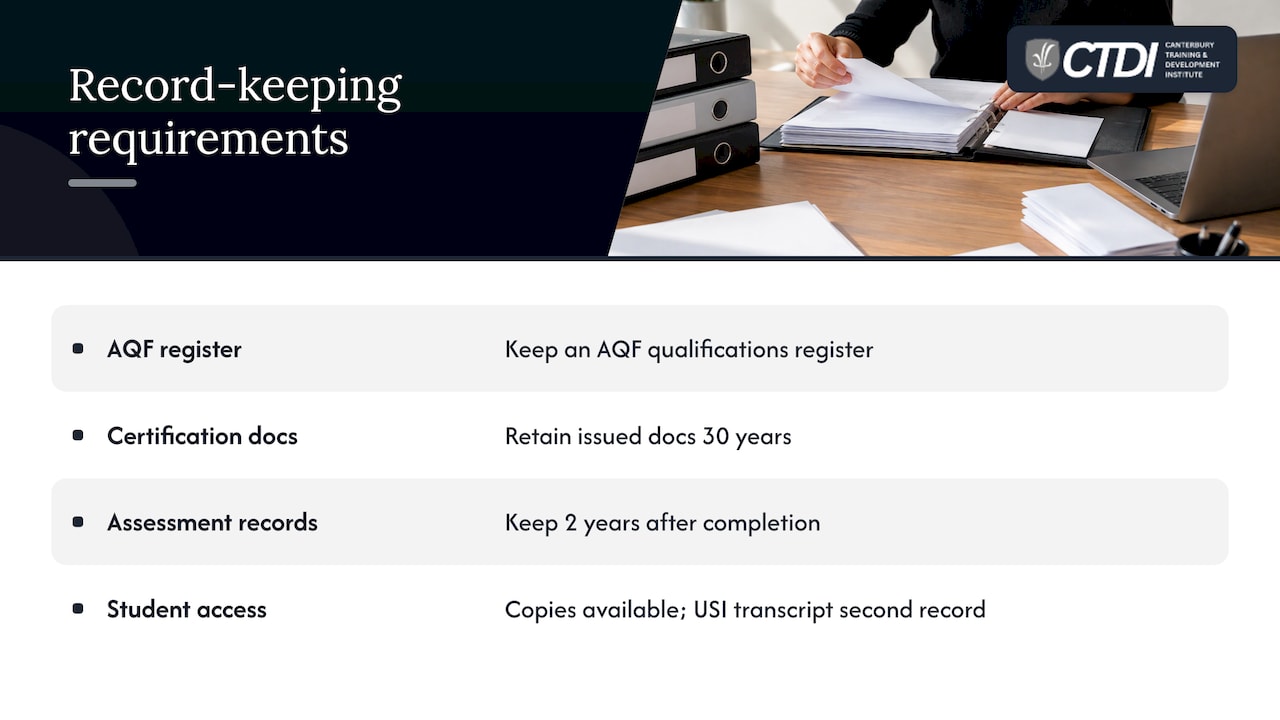
Issuance is not a one-off event. Under clause 10, RTOs must keep an AQF qualifications register, retain records of all certification documentation issued for 30 years, keep assessment records for 2 years after you complete, and let students, including former ones, access copies of their documentation. If you lose your certificate years later, you can ask your RTO for a copy, and your USI transcript offers a second record.
Why a fast, correct issue is a good sign
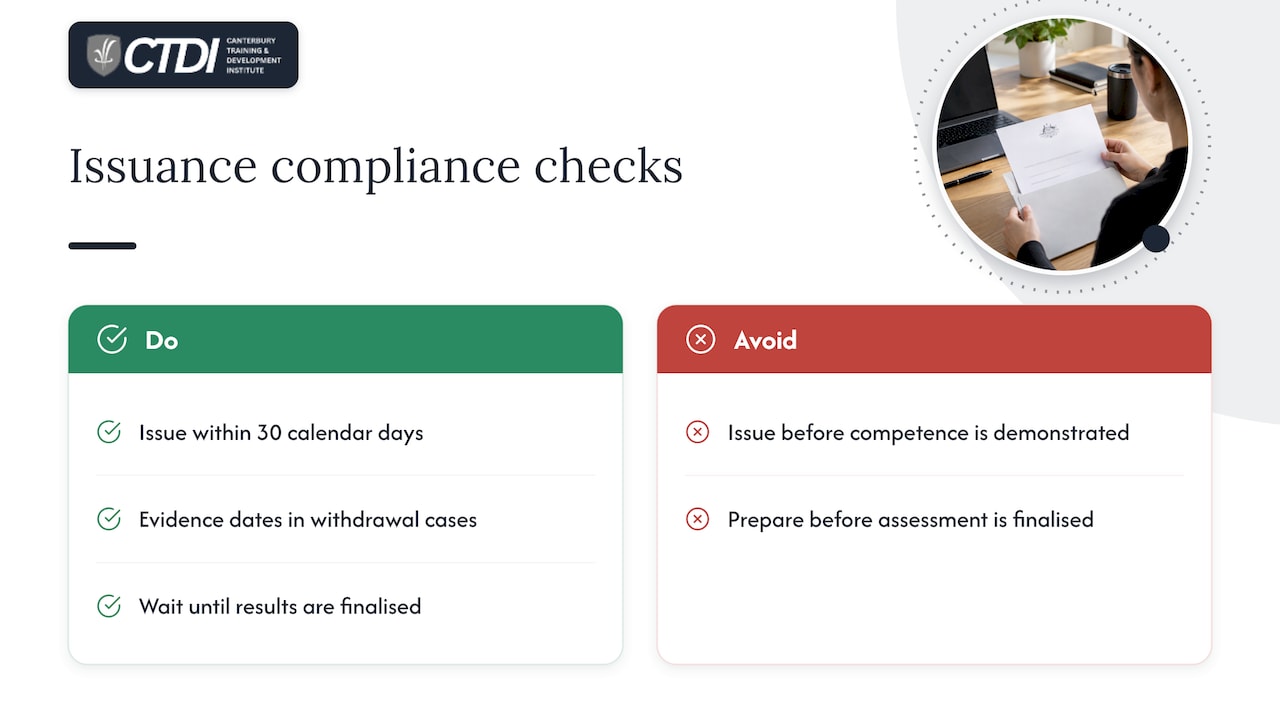
ASQA's guidance stresses that providers must be able to demonstrate compliance, for example by consistently issuing within 30 calendar days and evidencing dates in withdrawal cases. The same guidance lists issuing documents before a student has shown competence in every requirement, or preparing them before assessment is finalised, as compliance risks. A certificate that arrives quickly but before your assessment is complete is not what you want. A certificate that arrives on time, after your results are finalised, is.
The broader standards are summarised in our ASQA standards summary, and if you are comparing providers, the pre-enrolment check on Standard 2 covers what to confirm first.
What to do if your certificate is late
Work through these steps in order:
- Check your side. Confirm every unit is marked competent, fees are paid and your USI is verified.
- Work out the dates. Count 30 calendar days from the date your final assessment was finalised, or from your written withdrawal request if that applies.
- Write to your provider. Ask for the issue date and give your student number and USI.
- Use the complaints process. ASQA's Users' Guide to the Standards for RTOs says RTOs must have public complaints and appeals policies, acknowledge complaints in writing and finalise them as soon as practicable. If more than 60 calendar days are needed, they must tell you in writing, with reasons, and give regular updates.
- Ask for an independent review. If the provider's process does not resolve it, you can request review by an appropriate party independent of the RTO. ASQA itself cannot act as that reviewer.
Studying with CTDI
CTDI offers nationally accredited, self-paced online courses: the Diploma of Artificial Intelligence, the Advanced Diploma of Digital Marketing and the Certificate IV in Environmentally Sustainable Management. They are built around practical skills and flexible online study for working adults and career changers, with student support alongside. Details on the enrolment fee are on the enrolment page.

A qualification does not guarantee a job, promotion or credit toward further study, but a properly issued, nationally recognised document is the record you can present to employers and other education providers.
Frequently asked questions
How long does it take to get my certificate in Australia?
An RTO must issue AQF certification documentation within 30 calendar days of completing your assessment, provided you have been assessed as meeting the requirements and have paid all agreed fees. Delivery time depends on how the provider sends it, but the issue deadline is fixed.
When will I receive my certificate if I finished a single unit?
If you completed one or more units and then withdrew, you are entitled to a statement of attainment under the same 30-day rule. If no assessment was completed in the previous 30 days, the period can run from your withdrawal request date.
Can my certificate be sent to my employer?
Providers issue documentation to the student directly. A copy can go to an employer only if you give prior written consent, which the provider must be able to show.
Do I need a USI before I get a certificate?
Yes, unless an exemption applies. The RTO must verify your USI or apply for one on your behalf before issuing a qualification or statement of attainment.
Sources
- NVR Compliance Standards Instrument 2025
- Explanatory Statement, NVR Compliance Standards Instrument 2025
- NVR Compliance Standards Instrument 2025, clause 17 (epub)
- ASQA: Testamurs and statements of attainment
- ASQA: Integrity of nationally recognised training practice guide
- ASQA: Practice Guide, Integrity of NRT
- ASQA: 2025 Standards FAQs, Version 2
- ASQA: Users' Guide to the Standards for RTOs
Recommended
- Digital Badge vs Certificate: What Each Proves in Australia
- Choosing Accredited Courses in Australia: A Practical Guide
- How to get accredited in Australia: your 2026 guide
This article provides general information only. Course requirements, study pathways, credit arrangements and career outcomes may vary. Always confirm current requirements with the relevant education provider or authority.