

Start with a practical diploma or a short project that builds performance and analytics skills, then back it with a two or three project portfolio. That combination is the fastest, evidence-backed route into digital marketing hiring right now, because employers in 2026 are prioritising AI fluency, automation and analytics over generalist experience. The roles growing fastest sit in performance marketing, CRM, e-commerce and AI-adjacent specialisms, so your first study or project decision should point toward one of those.
Table of Contents
- What does the digital marketing career ladder actually look like?
- Which roles and specialisms are growing fastest right now?
- What skills should you develop at each career stage?
- Should you study a VET diploma, a degree, or a short course?
- How do you build a portfolio that actually gets you hired?
- How do you specialise and move into senior, higher-paid roles?
- How does CTDI's approach align with these career steps?
- How do you network effectively in the Australian digital marketing industry?
- Where can you find ongoing professional development and industry support?
- Where do internships and entry-level roles actually sit in Australia?
- Ready to build the skills employers are actually hiring for?
- Sources
What does the digital marketing career ladder actually look like?
Most careers move through four broad levels, though titles vary between agencies, in-house teams and platforms. Understanding what each level actually does helps you target the right next step rather than chasing a job title that sounds impressive but doesn't fit your experience.
- Coordinator/assistant: Executes campaigns, schedules content, pulls basic reports. Typically, the first 1–2 years.
- Specialist: Owns a channel (SEO specialist, paid media specialist, social/content specialist, CRM executive). Usually 2–4 years' experience, accountable for channel performance.
- Manager: Runs a team or a bigger budget, sets strategy across channels, reports on commercial outcomes. Often 5+ years.
- Director/head of marketing: Owns revenue targets, budget allocation and cross-functional strategy.
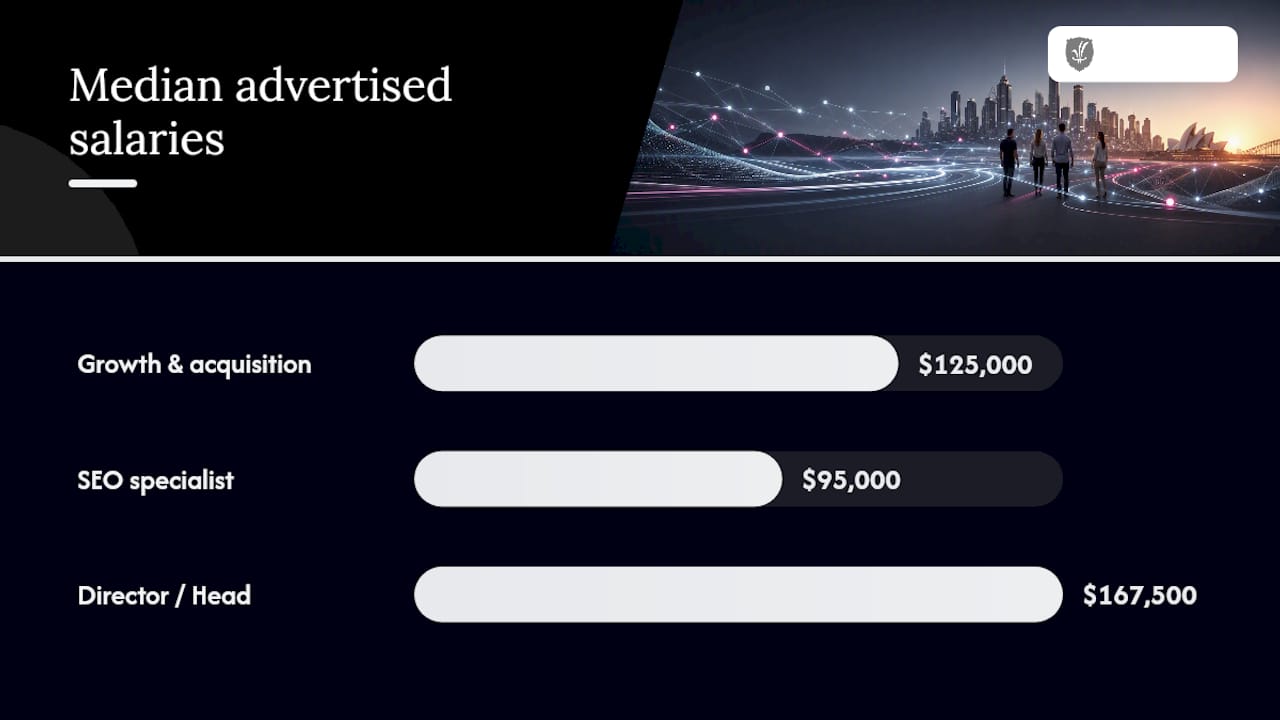
The shift between levels is really a shift in accountability: from executing tasks, to owning a channel's numbers, to owning the strategy behind the numbers. Kindred Talent's salary guide shows this progression reflected in pay, with growth and acquisition roles carrying a median advertised salary of 125,000, SEO sitting at a median of 95,000, and director-level roles reaching a median of 167,500. These are advertised medians, not guarantees, and individual outcomes depend on experience, location and the employer.
The harder truth is that the bottom rung has narrowed. IAB Australia's 2026 industry talent review found entry-level vacancies have fallen to a very small share of open roles, while many vacancies now ask for more than six years' experience. That doesn't mean entry is impossible. It means you need to move quickly from "assistant" to "specialist with evidence," which is exactly what a focused study and portfolio strategy is designed to do.
Which roles and specialisms are growing fastest right now?
The job market has cooled in raw volume terms but not evenly. Digital Digest's marketing jobs index shows listings sitting below 2022 levels overall, yet the salary premium has shifted hard toward systems and revenue-tied roles rather than generalist marketing positions.
AI-related roles now appear in more live job listings than SEO roles, and CRM and e-commerce management roles carry among the highest shares of advertised salaries over $100k.
That single data point tells you where to focus if pay progression matters to you. Roles worth watching closely include:
- CRM manager and marketing automation specialist, both showing strong $100k+ salary shares.
- E-commerce manager, tied directly to revenue and therefore commercially visible to leadership.
- Performance marketing specialist, covering paid search, paid social and increasingly AI-assisted bid management.
- AI-adjacent marketing roles, a newer category but already outnumbering SEO in live listings.
Most of this demand concentrates in Sydney and Melbourne, though remote and hybrid hiring has widened access for candidates outside the major capitals, particularly for CRM, automation and analytics roles where output matters more than physical presence.
What skills should you develop at each career stage?
The most employable marketers in 2026 are what recruiters call T-shaped: broad enough to understand every channel, deep enough in one area to be genuinely trusted with it. Depth without breadth makes you replaceable in a small team; breadth without depth makes you hard to hire for a specific role. Build both, but sequence your effort.
At entry level, prioritise:
- GA4 fundamentals and basic custom reporting
- Setting up and monitoring paid campaigns (Google Ads, Meta Ads Manager)
- Clear, structured reporting in spreadsheets
- Writing and testing basic ad or content copy
At specialist level, go deeper into:
- Performance marketing metrics like ROAS and CAC
- Marketing automation and CRM platforms (HubSpot or equivalent)
- Technical SEO and answer-engine optimisation
- Attribution modelling and multi-channel analytics
At senior level, the skills shift from technical to commercial:
- Translating campaign data into revenue narratives for leadership
- Governance, budget ownership and vendor management
- Building an AI strategy rather than just using AI tools
IAB Australia makes the point plainly: AI fluency is now table stakes, but the marketers who get promoted are the ones who connect AI output to commercial decisions, not just the ones who know the tools.
Pro Tip: Don't collect platform badges as a substitute for skill. A stack of certificates from ad platforms looks thin next to one dashboard you built that shows a real campaign's cost-per-acquisition improving over eight weeks. TalentWeb's 2026 hiring analysis found employers consistently rate data interpretation skills above platform certification lists.
Should you study a VET diploma, a degree, or a short course?
These three study paths solve different problems, and picking the wrong one wastes time and money. A university degree gives broad theoretical grounding over several years, useful if you're starting a career from scratch with no work experience to draw on. A nationally recognised VET qualification, like a Diploma or Advanced Diploma under the Australian Qualifications Framework, delivers structured, practical skills over a shorter timeframe, often with assessment tasks that double as portfolio material. Short courses and platform certifications (Google, Meta, HubSpot) are fast and cheap, but work best as a top-up to an existing skill base, not a stand-alone career foundation.
- Choose a Diploma or Advanced Diploma when you want structured learning, industry-relevant course design, and assessable projects you can point to in interviews.
- Choose short courses when you already have a role and need to plug a specific gap, like learning GA4 reporting or a new ad platform.
- Combine both where possible: a VET qualification for structure and depth, short courses or platform certificates layered on top for currency.
Structured vocational study paired with portfolio projects tends to offer a more reliable path into employment than a scattered pile of short-form certificates with no connecting thread, according to CTDI's own career guidance. Course length, cost and any credit-transfer arrangements vary by provider and by your existing qualifications, so check current course guides directly rather than assuming a standard timeframe or outcome.
How do you build a portfolio that actually gets you hired?
Two or three well-documented projects beat a dozen vague claims on a resume. Each project should show a goal, the channel you used, the KPIs you tracked, and a clear before-and-after result, even if the "before" is a rough baseline from a volunteer project or your own test campaign.
- Pick projects with measurable outcomes. A small business's social account where you improved engagement, or a test Google Ads campaign with a documented cost-per-click drop, both count.
- Present the evidence cleanly. Annotated dashboard screenshots and a one-page case study with clear numbers work better than a long narrative.
- Apply to fewer roles, more precisely. Research around 20 employers that genuinely fit your specialism, then tailor each application with the project that matches their business type.
Pro Tip: A recruiter scanning applications spends seconds, not minutes, on each one. Lead your resume and cover note with the single strongest metric from your best project, before your job history.
CTDI's guidance on career progression backs this targeted approach over mass applications, noting that a small number of well-matched applications with real evidence consistently outperforms a scattershot approach.
How do you specialise and move into senior, higher-paid roles?
Choosing a specialism comes down to three questions: where's the demand, where's your natural aptitude, and where can you show measurable impact fastest? Systems-heavy roles like CRM, automation and e-commerce tend to offer the clearest path to visible commercial impact, because their metrics are already tied to revenue.
- Volunteer to own a channel internally, even informally, before you have the title.
- Look for secondments, contracting work, or fractional roles that let you go deep on one specialism quickly.
- Take on cross-functional projects that put you in front of budget decisions, not just execution.
The clearest signal you're ready to move up isn't tenure. It's whether you're already running tests that change how budget gets allocated, or mentoring someone more junior than you.
How does CTDI's approach align with these career steps?
CTDI's Advanced Diploma of Digital Marketing is an nationally recognised VET qualification, delivered 100% online with a curriculum designed by industry practitioners. The course structure maps directly onto the skills priorities above: performance marketing fundamentals, analytics and reporting, and AI-related marketing skills sit alongside practical assessment tasks that double as portfolio evidence. That combination of structured, accredited study with demonstrable project work is the same pairing this article recommends throughout, whether you study with CTDI or elsewhere. Course details, current fees and study duration are available directly through CTDI's course pages, and outcomes depend on the effort and evidence you put into your own portfolio alongside the coursework.
How do you network effectively in the Australian digital marketing industry?
Digital marketing hiring in Australia still runs heavily on referrals and industry visibility, not just job boards. Joining industry bodies gives you access to events, mailing lists and sometimes mentoring programs where hiring managers are actively present, which matters more in a tighter entry-level market.
Local meetups and city-based marketing groups in Sydney, Melbourne and Brisbane offer low-cost ways to meet specialists in CRM, SEO or performance marketing before you need them for a job lead. LinkedIn remains the most practical daily tool: commenting thoughtfully on posts from marketers in the specialism you want, rather than just connecting, tends to get noticed. Contributing genuinely useful analysis, even a short breakdown of a campaign result, builds a visible track record that recruiters sometimes check before an interview.
Freelance and small-business projects double as networking. Delivering measurable results for a local business owner often leads to a referral into their network, which in a specialism like e-commerce or CRM can move faster than a cold application. Treat every project, paid or unpaid, as a chance to build both evidence and a relationship.
Where can you find ongoing professional development and industry support?
Two bodies dominate the Australian professional landscape: the Australian Marketing Institute (AMI), which offers professional certification, events and a broader marketing community beyond digital-only roles, and IAB Australia, which focuses specifically on digital advertising and publishes the kind of talent and industry data referenced throughout this article. Both are useful for staying current on where the industry is heading, not just where it's been.
Beyond formal bodies, government-backed resources like Jobs and Skills Australia publish labour market data relevant to marketing and technology roles, useful for checking demand trends before committing to a specialism. Industry newsletters, podcasts and webinars from platforms like Google and Meta also offer free, regularly updated technical training, though these work best as a supplement to structured study rather than a replacement for it.
Ongoing development matters because the skills that got you hired won't necessarily keep you promoted. AI tools, attribution models and platform algorithms change fast enough that a marketer who stops learning after their first qualification tends to plateau within a few years.
Where do internships and entry-level roles actually sit in Australia?
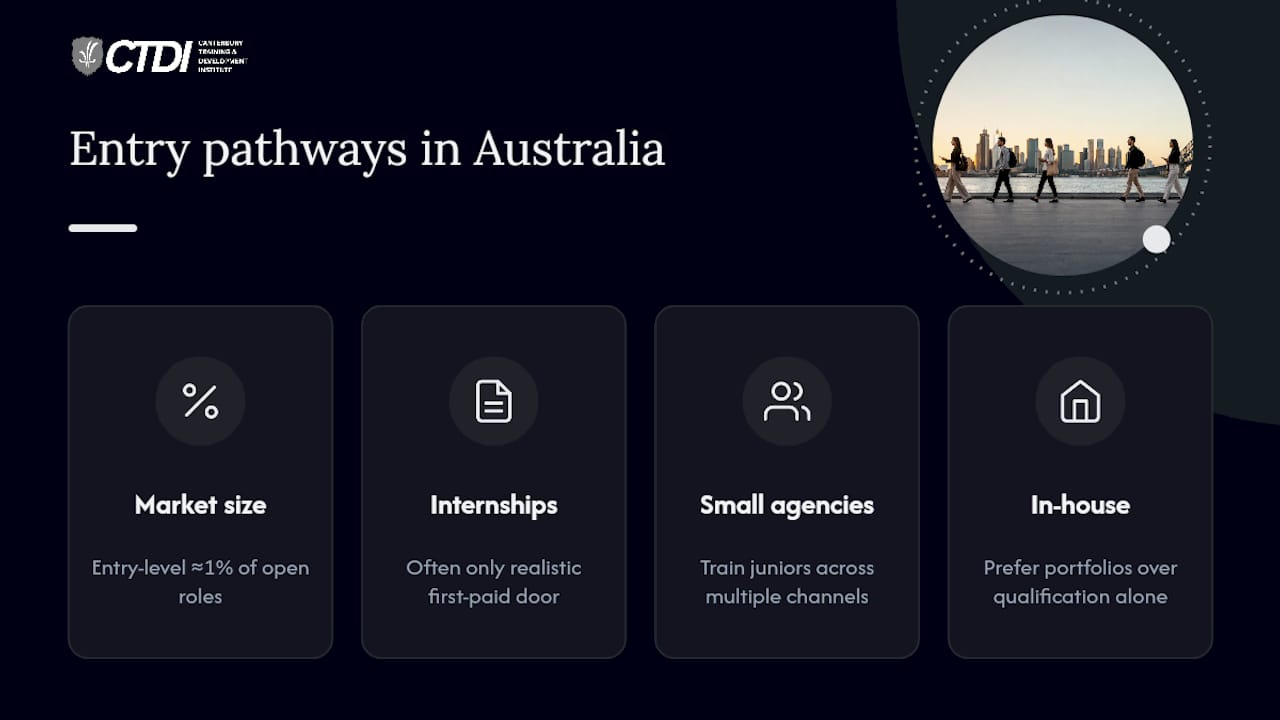
Genuine entry-level digital marketing vacancies have become scarce, sitting at roughly 1% of open roles according to IAB Australia's 2026 talent review. That scarcity means internships, structured graduate programs and small-agency junior roles carry more weight than they used to, because they're often the only realistic door into a first paid role.
Agencies remain a common entry point, particularly smaller ones willing to train junior staff across multiple channels rather than one specialism. A digital marketing agency's published capabilities give a useful sense of the breadth junior staff are typically expected to support, from campaign delivery through to reporting. In-house teams at retailers and service businesses also hire coordinators, often prioritising candidates who've already built a small portfolio over those with a qualification alone and no evidence to back it.
Government-run programs and some university career services also list internship opportunities specifically for marketing graduates, though availability shifts by state and by season. Given how tight the entry-level pipeline is, treating an internship or junior contract role as a stepping stone toward a documented portfolio, rather than as a long-term destination, tends to be the more realistic strategy.
Ready to build the skills employers are actually hiring for?
If you're weighing up a scattered mix of short courses against something more structured, an nationally recognised VET diploma gives you both the accredited qualification and a body of assessed project work you can point to in an interview, without the years-long commitment a university degree requires. CTDI's Advanced Diploma of Digital Marketing is delivered 100% online and self-paced, built specifically for working adults who need to study around a job rather than instead of one.
The course content is designed by industry practitioners and maps to the performance, analytics and AI skills covered throughout this article, with practical tasks along the way that double as portfolio evidence. If you want to see how the modules line up with your current experience and career goals, you can enrol now or request a course guide to review the full unit breakdown before you commit.
Sources
- Australian digital advertising talent pipeline under pressure — IAB Australia
- Marketing jobs index — Digital Digest
- Digital marketing salary guide Australia 2026 — Kindred Talent
Recommended
- What does a digital marketing certificate cost in Australia?
- Vocational training in Australia: how to find accredited courses
This article provides general information only. Course requirements, study pathways, credit arrangements and career outcomes may vary. Always confirm current requirements with the relevant education provider or authority.