

TL;DR:
- Digital marketing is a high-demand Australian field with clear career progression from coordinator to director roles and substantial salary increases. Success depends on developing key skills like performance marketing, analytics, and full-funnel strategy, supported by nationally recognized training and a strong portfolio. Building results-driven experience in small businesses or agencies accelerates career growth and aligns with evolving employer preferences for demonstrated capability over formal titles.
Digital marketing is one of Australia's most in-demand career fields right now, yet many people who want to break in have no idea where to start. You might have the enthusiasm and even a few self-taught skills, but without a clear roadmap, it's easy to spend months spinning your wheels. Entry-level salaries start around $50,000 to $60,000 AUD, climbing well past $95,000 in Sydney for experienced specialists. This guide walks you through the real career path, the skills that actually matter in 2026, how to choose the right training, and what it takes to land your first role and move up fast.
Table of Contents
- Mapping the digital marketing career path in Australia
- Essential skills and methodologies for 2026
- How to choose the best training, courses, and credentials
- Landing your first digital marketing role and advancing quickly
- What most career guides miss about digital marketing success
- Next steps: get qualified and accelerate your digital marketing career
- Frequently asked questions
Key Takeaways
| Point | Details |
|---|---|
| Clear career pathways | Digital marketing in Australia offers well-defined roles with attractive salary progression for skilled candidates. |
| Skill demand in 2026 | Performance marketing, analytics, SEO, and AI are the most desirable skills for employers now. |
| Practical training matters | Accredited courses with hands-on projects make the biggest impact in getting hired. |
| Results beat credentials | Portfolios that highlight ROI and real outcomes often outweigh titles or degrees during hiring. |
| Ongoing upskilling | Staying current through online training and certifications accelerates advancement in digital marketing. |
Mapping the digital marketing career path in Australia
Before you invest time and money into training, it pays to understand exactly what the Australian digital marketing job market looks like. The roles aren't interchangeable, and salary jumps can be dramatic when you move between levels or specialisations.
The main career levels follow a fairly predictable structure in most Australian organisations:
- Digital marketing coordinator (entry level): You're assisting with scheduling content, compiling reports, and learning how tools like Google Ads and Meta Ads Manager work. Salaries sit between $50,000 and $65,000 AUD depending on the city and industry.
- Digital marketing specialist (mid level): You own specific channels or campaigns, often with a focus like SEO, paid search, or email. Salaries range from $75,000 in Adelaide to $95,000 in Sydney.
- Digital marketing manager (senior): You lead a team or manage the full digital strategy for a business. Expect $100,000 to $120,000 AUD.
- Digital marketing director or head of digital (advanced): Strategy, team leadership, and revenue accountability. $130,000 and above is common in large organisations.
| Role | Entry salary | Mid salary | Senior salary |
|---|---|---|---|
| Digital marketing coordinator | $50,000 | $58,000 | $65,000 |
| Digital marketing specialist | $65,000 | $80,000 | $95,000 |
| Digital marketing manager | $90,000 | $105,000 | $120,000 |
| Digital marketing director | $120,000 | $135,000 | $160,000+ |
The marketing salary guide for 2026 confirms that starting through certifications, online courses, and internships before specialising in areas like PPC or SEO remains the most reliable route to a manager-level income of $110,000 or more. The market is competitive, so employers want proof that you can drive measurable results, not just theoretical knowledge.
One thing the guide also notes is that small-to-medium businesses with monthly ad budgets under $5,000 to $10,000 often manage digital marketing in-house, while larger organisations and those spending heavily on paid media tend to hire agencies or senior specialists. This means your early career might look different depending on whether you start in an SMB, a corporate environment, or a marketing agency.
Generalist vs. specialist: what works in 2026?
There is real debate about whether to be a generalist or a specialist. The emerging answer is neither, exactly. Employers in 2026 are gravitating towards what's called a "T-shaped marketer": someone with broad knowledge across all digital channels, but deep expertise in one or two areas. Think of someone who understands SEO, social media, paid ads, and email marketing at a working level, but truly excels in performance marketing and analytics.
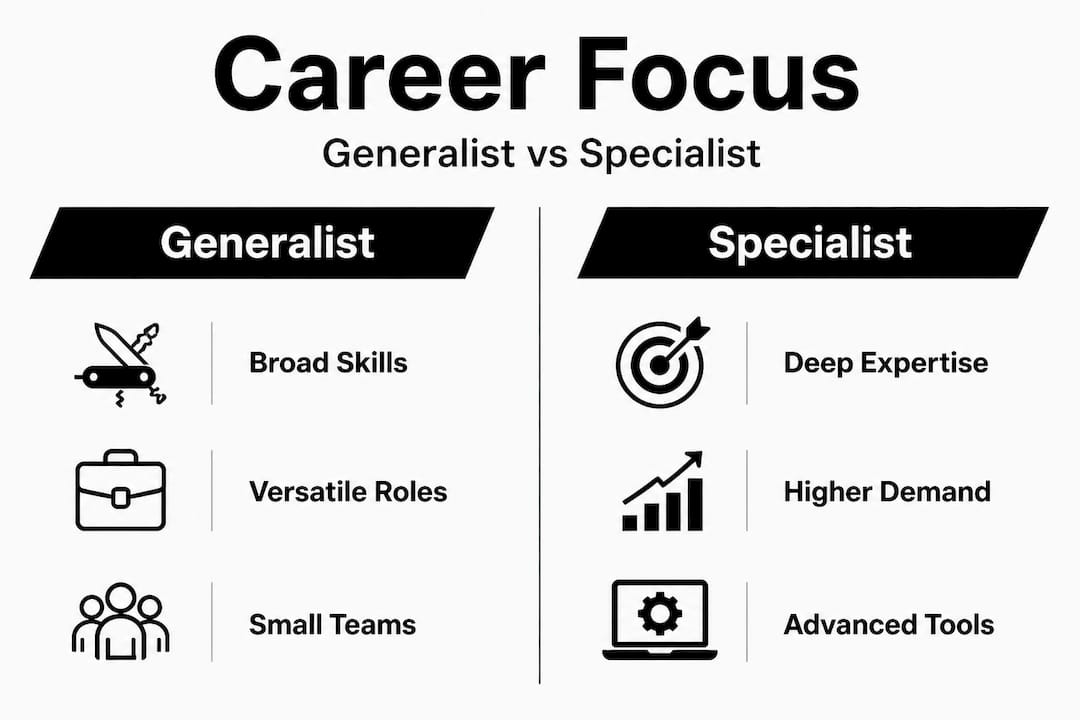
You can find more digital marketing career insights on building this T-shaped approach as you progress. For a more structured walkthrough, the step-by-step career guide is a strong starting reference.
Pro Tip: Build your portfolio before you need it. Even before landing a paid role, run a small Google Ads campaign for a local business, optimise a friend's website for SEO, or grow a social media account to a meaningful audience. Documented results, even at small scale, are far more convincing to employers than a blank work history.
Essential skills and methodologies for 2026
Knowing the career structure is one thing. Knowing exactly which skills to build is what separates the people who land jobs quickly from those who stay stuck.
The top skills Australian employers are hiring for right now include a focused set that has shifted noticeably from five years ago. According to research on employer hiring priorities, the most valued areas in 2026 are:
- Performance marketing and attribution (understanding where revenue comes from, not just clicks)
- AI and automation tools, particularly HubSpot, Salesforce, and Google's suite
- GA4 analytics and data-driven decision making
- SEO and AEO (Answer Engine Optimisation, which covers visibility in AI-driven search)
- Omnichannel strategy, connecting the customer experience across social, search, email, and display
These are not just nice-to-haves. Roles that require these skills pay 15 to 20 per cent more than general digital marketing positions according to current job listings.
The full-funnel methodology is the strategic framework most Australian marketing teams now operate within, and understanding it puts you ahead of candidates who only know how to run individual campaigns. A full-funnel strategy works like this:
- TOFU (top of funnel): Creating awareness through SEO, content marketing, and social media. This is where people first discover the brand.
- MOFU (middle of funnel): Nurturing interest through email sequences, retargeting ads, and comparison content. These are people who are considering their options.
- BOFU (bottom of funnel): Converting intent into sales through PPC, landing pages, and promotional offers. These are people ready to act.
The same framework also incorporates revenue-first planning, where you work backwards from a revenue target to determine how much budget to assign to each stage. A practical allocation is 40 to 60 per cent to proven channels, 20 to 30 per cent to optimisation of existing campaigns, and 10 to 20 per cent to testing new ideas. This kind of structured thinking is exactly what managers want to see in a job interview.
| Skill area | 2021 priority | 2026 priority | Trend |
|---|---|---|---|
| Social media management | Very high | Moderate | Declining as standalone skill |
| Performance marketing/attribution | Moderate | Very high | Rising fast |
| SEO/AEO | High | Very high | Expanding scope |
| AI and automation tools | Low | High | Rapid rise |
| GA4 analytics | Low (GA4 new) | Very high | Essential now |
| Email marketing | High | High | Stable |
Creating your personal learning plan doesn't have to be complicated. Work through this sequence:
- Audit your current skills honestly. List what you can do today versus what the job ads are asking for.
- Prioritise the gaps with the highest salary impact first, which in 2026 means performance marketing and analytics.
- Choose one structured course to build foundational knowledge before layering on certifications.
- Set a timeline of three to six months to build practical experience through real or simulated campaigns.
- Document every result you produce, even small wins. Screenshots, data exports, and brief written case studies become your portfolio.
The advanced diploma in digital marketing covers the full range of these skills in a structured, nationally recognised format. For a broader look at how to approach mastering digital marketing skills as a continuous habit, the CTDI blog offers practical guidance.
Pro Tip: Every piece of work you do, whether it's a real client campaign or a practice project, should be written up with three elements: what you did, what the measurable outcome was, and what you would do differently. This "results-first" framing is exactly what employers mean when they ask for a portfolio.

How to choose the best training, courses, and credentials
The training market for digital marketing in Australia is crowded. There are free YouTube tutorials, short online courses from global platforms, Google and Meta certifications, private online providers, and nationally recognised diplomas. Knowing which ones to prioritise saves you time and money.
What to look for in a quality course:
- National recognition: Courses listed on the Australian Qualifications Framework (AQF) carry weight with employers and can count toward future study pathways. A diploma or advanced diploma from a registered training organisation (RTO) is the standard benchmark.
- Industry-relevant content: Look for courses that include current tools like GA4, Meta Business Suite, and AI-assisted marketing platforms. Courses that still teach Universal Analytics or don't mention AI automation are already out of date.
- Practical assessment: The best courses include real-world projects, campaign simulations, or portfolio-building tasks rather than multiple-choice exams alone.
- Trainer credentials: Instructors should have actual industry experience, not just academic backgrounds. Check their LinkedIn profiles if you can.
- Student support: Particularly for online, self-paced courses, responsive support teams and structured check-ins make a significant difference in completion rates.
- Flexibility: If you're working while studying, fully online and self-paced delivery is often the only practical option.
Online vs. on-campus vs. hybrid:
The 2026 salary guide confirms that employers care far more about what you can demonstrate than how you earned your credential. Online courses have removed the stigma they once carried, especially when they result in a nationally recognised qualification or a strong portfolio of real-world results.
On-campus courses offer networking opportunities and direct face time with instructors, but they require location and schedule flexibility that not everyone has. Hybrid programmes split the difference but are less common in vocational digital marketing training. For most Australians building or changing careers, 100 per cent online delivery remains the most practical and accessible route.
Certifications that matter to employers:
Free certifications from Google (Google Ads, Google Analytics), Meta, and HubSpot are widely recognised and worth having. They signal initiative and current knowledge. However, they work best when layered on top of a formal qualification rather than treated as a replacement. Recruiters will notice if your resume shows three short certifications but no structured training.
You can explore marketing certification options to understand which credentials align with your career goals. If you're researching top courses for 2026, CTDI's list covers the high-demand fields worth prioritising.
For graduates entering the workforce, career pathway tips highlight the importance of bridging formal study with workplace-ready skills as early as possible.
Pro Tip: When comparing courses, ask providers directly: "Can I see examples of student projects or portfolios from this course?" If they can't show you real student work, the practical component may be weaker than advertised.
Landing your first digital marketing role and advancing quickly
Training done. Now you need a job. This is where a lot of candidates stall, usually because they treat the job search the same way everyone else does. Here's a sharper approach.
Step 1: Build a portfolio before applying. A resume with no portfolio in digital marketing is like a graphic designer applying without showing any designs. Your portfolio should include two or three documented campaigns or projects with clear metrics: traffic growth, conversion rates, cost per lead, or return on ad spend.
Step 2: Optimise your resume for results. Instead of writing "managed social media accounts," write "grew Instagram engagement by 34% in 90 days by shifting from promotional content to educational short-form video." Every bullet point should answer the question: "So what?"
Step 3: Use LinkedIn strategically. In Australia, LinkedIn remains the primary professional network for marketing roles. Post your project results, comment on industry articles, and connect with marketing managers in your target companies. Engage genuinely rather than blasting connection requests.
Step 4: Target your applications. Mass applications rarely work. Twenty targeted applications with tailored cover letters and relevant portfolio links outperform two hundred generic ones. Research the company, reference their specific marketing challenges, and explain how your skills address them.
Step 5: Network in person and online. AIMIA, the Australian Marketing Institute, and local digital marketing meetups in Melbourne, Sydney, Brisbane, and Perth hold regular events. One conversation at an event can open doors that months of online applications don't.
"Australian employers in 2026 are increasingly adopting skills-first hiring, evaluating candidates on demonstrated capability rather than job title history. At the same time, Australian digital marketers must demonstrate awareness of local data privacy obligations and GEO-targeting practices, which differ from overseas markets."
This point about skills-first hiring is worth taking seriously. It means that a well-documented portfolio of results can outweigh a degree from a prestigious institution in many hiring decisions. The catch is that you need to be able to articulate your process and your results clearly in an interview.
What to expect in your first year:
An entry-level digital marketing salary in Australia typically sits between $50,000 and $60,000 AUD. That is the realistic starting point. Within two to three years, specialists with demonstrable results in performance marketing or analytics regularly move into the $80,000 to $110,000 range. The fastest movers are those who take ownership of campaigns early, seek out additional training, and make their results visible to decision makers.
The career growth learning tips on the CTDI blog go deeper into how to structure your ongoing professional development once you're employed.
Pro Tip: In your first role, volunteer for projects that involve reporting and analytics, even if they fall outside your official duties. Being the person who can explain campaign performance in revenue terms makes you invaluable, and it accelerates salary progression faster than almost anything else.
What most career guides miss about digital marketing success
Here is the honest take that most career guides leave out: following the prescribed path perfectly is not what separates thriving digital marketers from those who plateau.
The standard advice to "keep upskilling" and "build your personal brand" is technically correct but practically incomplete. A lot of people rack up certifications and still struggle to advance because they've built wide knowledge without ever becoming genuinely excellent at anything specific. That's the real problem with the generalist approach in 2026.
The T-shaped model matters, but most people get it backwards. They try to become broad first and deep later. The marketers who move fastest typically go deep in one area early, whether that's paid media attribution, technical SEO, or marketing automation, and use that depth as their entry point. Breadth follows naturally once you're inside an organisation and working across teams.
There's also an uncomfortable truth about AI tools. Marketers who use AI to scale unstrategic campaigns don't get better results. They get worse results faster. AI tools require clean data, clear strategy, and a marketer who understands what good looks like before the automation starts. Otherwise the system just amplifies mediocre thinking at scale.
The same applies to agency reliance. Agencies are excellent for complex, high-budget campaigns where their infrastructure and expertise justify the $2,000 to $4,000 per month management fee. But for businesses with ad spends under $10,000 per month, an in-house marketer with solid fundamentals often delivers better return on investment. This is actually great news for people early in their careers, because it means SMBs are a legitimate place to build real skills with real autonomy.
What actually opens doors is a portfolio that proves you can generate revenue, not just activity. A candidate who can say "I ran a campaign that delivered $8 in return for every $1 spent, and here's how I structured the attribution" will get hired over someone with three more years of experience but no documented outcomes.
Our view on authentic networking is similarly straightforward. Sending fifty connection requests a week with generic messages is digital noise. One thoughtful comment on a marketing director's LinkedIn post, showing genuine expertise, does more than all fifty requests combined. Play a longer game.
For a broader look at the future of marketing careers in the age of AI, the CTDI blog explores what's actually changing versus what's hype.
Next steps: get qualified and accelerate your digital marketing career
The strategies in this guide only work if you back them up with structured, credible training that Australian employers recognise.
At CTDI, our Advanced Diploma in Digital Marketing is designed by industry practitioners, delivered entirely online, and structured to give you both the strategic knowledge and the practical portfolio that 2026 employers want. You study at your own pace, with expert trainers and dedicated student support available throughout. Whether you're starting fresh or looking to formalise your existing skills, the programme covers performance marketing, analytics, AI-assisted tools, SEO, and full-funnel strategy in a nationally recognised format. Ready to move from interested to qualified? Explore our online digital marketing courses or speak with a course adviser today to find the right pathway for your goals.
Frequently asked questions
What is the average starting salary for a digital marketing specialist in Australia?
Entry-level digital marketing roles typically offer starting salaries around $50,000 to $60,000 AUD, rising to the mid-seventies as you build demonstrated campaign experience.
Are online digital marketing courses recognised by Australian employers?
Many employers value accredited online courses, particularly when paired with a portfolio of practical results. Research on T-shaped specialists confirms that certifications matter most when they demonstrate real-world outcomes.
Which digital marketing skills are most in demand in 2026?
Performance marketing, GA4 analytics, SEO/AEO, and AI and automation tools are the top priorities for Australian employers hiring digital marketers in 2026.
Do I need an agency job, or can I start in a small business or freelance?
You can build a strong skills base through small business, freelance, or agency roles. As the marketing salary guide notes, SMBs often manage smaller budgets in-house, making them excellent environments for gaining broad, hands-on experience early in your career.
Recommended
- Step-by-step digital marketing guide for career growth
- Advanced Diploma Digital Marketing Australia | AI-Powered Marketing Career | CTDI — Canterbury Training and Development Institute
- Mastering the digital marketing learning process: career growth
- Mastering the digital marketing learning process: career growth — Canterbury Training and Development Institute
- Digital Marketing Agency for Small Business: The Complete Guide to Growth - City Web Company | Digital Marketing Agency
- Digital Marketing Workflow Guide for Optimizing Campaigns