

A digital marketing certificate in Australia typically costs anywhere from free to around $5,000 AUD, with most short courses and bootcamps landing in that range. For most learners, the practical sweet spot sits in the mid-tier price range. That bracket buys enough structure, tutor access and assessment to actually finish and use what you've learned, without the price tag of a full diploma.
- Free tier: vendor micro-credentials, zero cash cost, high time cost
- Sweet spot: $300–$1,500, structured, assessed, suits most small business owners and career switchers
- Premium: $1,500 upwards, includes nationally accredited diplomas from providers such as CTDI
Diploma-level programs and TAFE courses run higher again, often between $4,000 and $15,000, depending on the credential level and how much support is bundled in.
TL;DR:
- Most mid-tier courses costing between $300 and $1,500 offer structured content, tutor support, and a completion certificate suitable for professionals and small business owners.
- Higher-cost accredited diplomas and diplomas from providers like CTDI often exceed $1,500, delivering nationally recognized credentials essential for career changers and job seekers.
- The total cost includes not only the headline fee but also expenses for assessment resits, software subscriptions, materials, and opportunity costs of time invested.
- Funding options like FEE-HELP and employer sponsorship can significantly reduce out-of-pocket expenses, but eligibility and covered items vary.
- Choosing the right course depends on your specific goals, desired credential type, schedule, and whether verified employer recognition or basic skills development is your priority.
Table of Contents
- Digital marketing certificate cost by tier: free, budget, mid, premium
- What actually drives the price of a digital marketing course?
- Is the course fee actually worth it?
- How can you fund a digital marketing certificate?
- Why CTDI is worth comparing at this price point
- How do certificates compare with workshops, bootcamps and self-study?
- What extra costs come with a digital marketing certificate?
- Ready to enrol in a nationally recognised digital marketing course?
- Key Takeaways
- Sources
Digital marketing certificate cost by tier: free, budget, mid, premium
Course fees don't move randomly. They cluster into four fairly predictable tiers, and knowing which one you're looking at tells you what you're actually paying for.
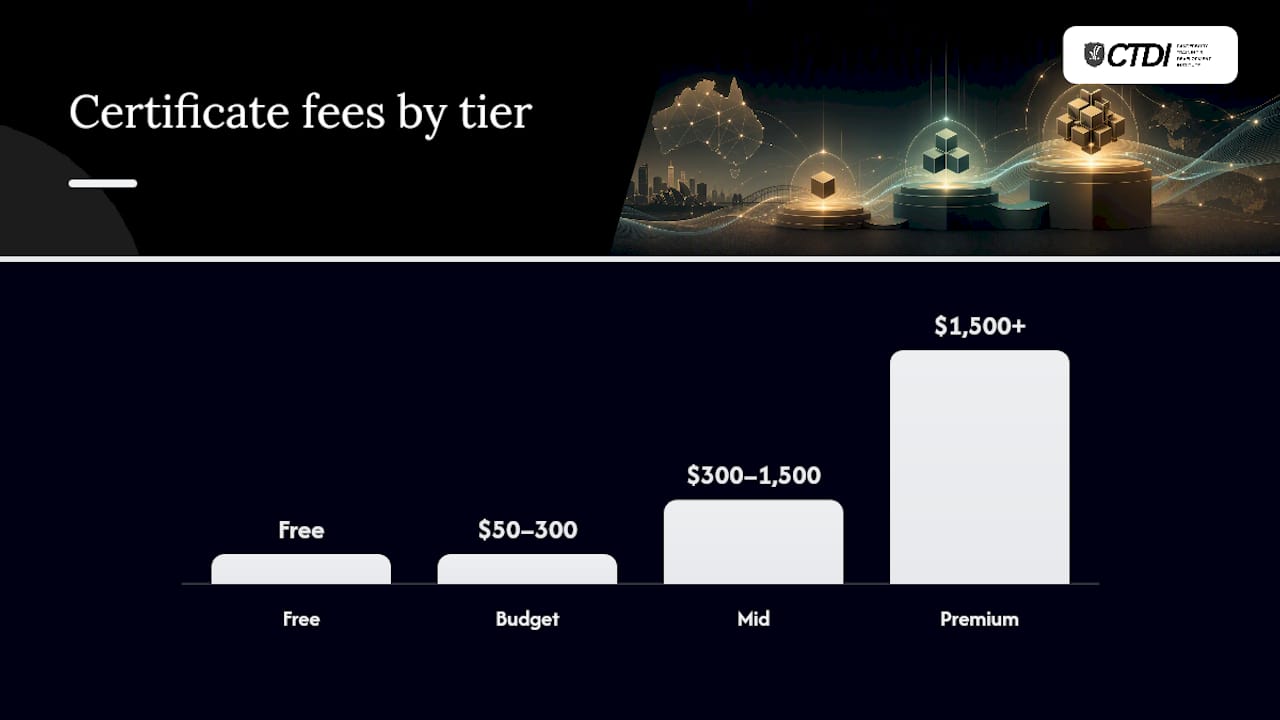
Free courses exist mainly as vendor lead-generation tools. Google's own digital marketing and e-commerce certificate is a good example. No fee, but no tutor either, and you're on your own for accountability. That's fine if you're disciplined and just need a foundation.
Budget courses ($50–$300) are usually self-paced mini-courses or short workshops. Independent providers commonly charge AU$97 to AU$997 for these, aimed squarely at small business owners who want one skill (say, running Facebook ads) rather than a full marketing education.
Mid-tier courses ($300–$1,500) bring structured modules, some tutor contact, and usually a certificate of completion rather than a nationally recognised qualification. This is where most working professionals land, and for good reason: it's enough investment to force follow-through, without the multi-thousand-dollar commitment of a diploma.
Premium courses ($1,500+) cover nationally accredited certificates, advanced diplomas, and university short courses. Some published short-course fees sit around $1,900 to $3,000 for a handful of weeks, while full accredited diplomas can run well beyond that. This tier suits people changing careers or needing a formal credential employers recognise.
| Tier | Typical price (AUD) | What you get |
|---|---|---|
| Free | free | Self-paced vendor modules, no tutor support, no formal credential |
| Budget | $50–$300 | Single-skill mini-courses, light structure, minimal support |
| Mid | $300–$1,500 | Multi-module courses, some tutor access, completion certificate |
| Premium | $1,500+ | Nationally accredited certificates/diplomas, full tutor and career support |
Two costs rarely show up in the headline price: your own time, and assessment. A free course that takes 40 hours has a real opportunity cost that can exceed what you'd pay for a short paid course that gets you there faster. Exam resits, verification fees, and required software can also add to the final bill, especially at the premium end.
Pro Tip: Work out your hourly value before comparing a free course against a paid one. If your time is worth $40 an hour and the free course eats 40 hours you don't have, it's not actually the cheaper option.
What actually drives the price of a digital marketing course?
The advertised fee reflects a handful of concrete factors, not marketing spin. Once you know what they are, you can tell whether a price is fair or inflated.
- Credential level: a certificate costs less than a diploma, which costs less than a graduate-level qualification, because each step adds assessment depth and recognised standing.
- Accreditation: nationally recognised training carries compliance and quality costs that self-published courses skip entirely.
- Delivery mode: live cohort-based teaching with a trainer costs more to run than pre-recorded, self-paced content.
- Tutor and mentor support: any course with real human feedback on your work sits higher in price than one that's just video and quizzes.
- Assessment and verification: exams, marked assignments and formal verification of your final result all add cost on top of the base tuition.
Duration matters too, but not in a straight line. A 20-hour course and a 200-hour course don't just differ by content volume, they differ by how much guided learning time you're paying someone to deliver. More provider-observed short courses run tight, high-intensity formats over a few weeks precisely because that keeps the price down while still delivering a credential.
Before you enrol anywhere, check the provider's course page for what's actually included. Some fees cover materials, software access and assessment; others charge those separately. That distinction is often buried well below the headline price.
Is the course fee actually worth it?
Price alone tells you very little. Value comes from matching the fee to your specific goal, and there's a simple way to check that before you hand over any money.
- Define your goal first. A single new skill (running paid ads) needs a different course than a full career pivot into marketing.
- Check the credential type. Is it a certificate of completion, or a nationally recognised qualification an employer can verify?
- Compare time commitment against your schedule. A course that assumes 15 hours a week won't work if you're employed full-time.
- Verify assessment and career support are included. Some fees stop at content delivery and charge extra for feedback or job-search help.
- Look at alumni outcomes, if the provider publishes them, rather than taking course descriptions at face value.
- Calculate a rough payback period. If the course helps you land freelance clients or a pay rise, how many months of that benefit covers the fee?
As a rule of thumb, a mid-tier structured course often delivers the best return for small business owners: enough depth to be useful, low enough cost to not sting if one module doesn't land. Career changers chasing a formal credential for job applications are usually better served paying more for a premium, accredited option, because the qualification itself is what opens doors.
Pro Tip: If a course won't tell you its total assessment structure or refuses to specify whether the certificate is nationally accredited, treat that vagueness as your answer. Legitimate providers publish this detail without you having to ask.
Red flags worth walking away from: no published curriculum, no verifiable accreditation number, testimonials with no names attached, and pricing that only appears after you hand over your email and phone number.
How can you fund a digital marketing certificate?
FEE-HELP is worth checking before you rule out a higher-fee course purely on sticker price. It's a government loan scheme that can cover tuition for eligible students, and it changes the monthly cash-flow equation more than most people expect, since you're not paying the full fee upfront out of pocket.
- Confirm your own eligibility directly at studyassist.gov.au before assuming a course qualifies.
- Ask providers about payment plans, which spread a $1,500 fee into manageable instalments rather than one lump sum.
- Ask your employer whether they'll fund or partially subsidise training tied to your current role.
- Check for early-bird discounts, which some providers offer for enrolling ahead of an intake date.
Domestic and international student fees can differ significantly, and not every subsidy or loan applies to every student type. Always check the fine print against your own status before budgeting around a scheme you might not actually qualify for.
Why CTDI is worth comparing at this price point
CTDI sits in the premium tier for good reason: it delivers a nationally recognised vocational qualification, not just a completion certificate. Courses run 100% online and self-paced, built by industry practitioners rather than generic content teams, with student support available throughout.
What that gets you in practice:
- A qualification an employer can actually verify, not a private badge.
- Flexible, self-paced delivery that fits around a job or business you're already running.
- Curriculum designed around current industry skills, including AI-assisted marketing techniques.
- Ongoing student support rather than a one-off video library.
Exact fees, payment plan options and current intake details sit on the Advanced Diploma of Digital Marketing course page. If you're weighing this against a mid-tier course, start there:
- Review the course outline and published fee on the course page.
- Ask about payment plans if the upfront figure is a stretch.
- Check FEE-HELP eligibility for your situation before deciding.
How do certificates compare with workshops, bootcamps and self-study?
A one-day workshop might cost $200–$600 and teach a single skill well, but it won't give you a credential or ongoing support once the day ends. Bootcamps sit closer to $2,000–$8,000, compress a lot of content into a few intense weeks, and suit people who learn fast under pressure but want more structure than a workshop offers.
Self-study, using free resources and vendor certificates, costs the least in dollars but the most in discipline. There's no external deadline pushing you forward, no marked feedback telling you where you're actually weak, and no recognised credential at the end unless you sit a separate exam.
A nationally accredited certificate or diploma sits above all three on price, but it's the only option in this comparison that gives you a qualification an employer can independently verify. If your goal is a job application or a formal career change, that verification is what a workshop or self-study path simply can't replicate, regardless of how much content you absorb. If your goal is a single practical skill for a business you already run, a workshop or mid-tier course is the more efficient spend.
What extra costs come with a digital marketing certificate?
The advertised course fee is rarely the whole bill. Course pages sometimes exclude assessment resits, printed materials or external exam charges, and those gaps only become obvious once you're enrolled.
Common extras to budget for:
- Assessment resits: if you don't pass a module first go, some providers charge again for a second attempt.
- Software subscriptions: courses that teach specific platforms (email tools, ad managers, analytics dashboards) sometimes expect you to hold your own paid account.
- Verification or certificate issuance fees: a small charge to formally issue or verify your final credential.
- Materials: printed workbooks or supplementary resources beyond the core online content.
None of these individually breaks a budget, but stacked together they can add several hundred dollars to what looked like a fixed price. Ask directly whether the quoted fee is truly all-inclusive before you enrol, and get the answer in writing if it matters to your decision.
Author's perspective: when paying more actually makes sense
Paying more only makes sense when you need the credential itself, not just the skill. A career changer applying for marketing roles needs verifiable accreditation; a business owner running their own ads mostly needs the technique. Match the spend to which of those you actually are.
— Sam
Ready to enrol in a nationally recognised digital marketing course?
If you've weighed workshops, bootcamps and self-study and landed on wanting an actual qualification, CTDI gives you that outcome without requiring you to relocate, attend fixed class times, or take a career break. Everything runs 100% online and self-paced, so you study around a job or business you're already managing, and the credential is nationally recognised rather than a private completion badge.
Whether you're switching careers into marketing, upskilling out of a related role, or want formal training to back the marketing you already do for your own business, the Advanced Diploma of Digital Marketing covers the practical ground employers expect, including current AI-assisted marketing methods. Check the course page for the published fee and payment plan details, then head to enrol now to lock in your place or ask a question about intake dates first.
Key Takeaways
Most digital marketing certificates in Australia cost between free and $5,000, and the $300–$1,500 mid-tier bracket delivers the strongest value for most business owners and career switchers.
| Point | Details |
|---|---|
| Price ranges by tier | Free foundation courses, $50–$300 budget, $300–$1,500 mid-tier, $1,500+ for accredited diplomas. |
| Time is a real cost | A 40-hour free course can cost more in opportunity than a shorter paid one. |
| Check what's excluded | Assessment resits, software subscriptions and materials often sit outside the headline fee. |
| Funding can change the maths | FEE-HELP and employer-funded training can lower out-of-pocket cost for eligible students. |
| CTDI for formal credentials | CTDI's Advanced Diploma of Digital Marketing suits learners who need a nationally recognised, verifiable qualification. |
Sources
- Courses for Digital Marketing Cost AU 2026 — 20 Minute Marketing
- How much does it cost to study digital marketing in Australia? — Pathway to Aus
- FEE-HELP — StudyAssist