

TL;DR:
- Environmental professionals must develop a repeatable management cycle of skills, including strategy, audits, and compliance, to effectively manage environmental risks. Mastery of ISO 14001:2026 standards and digital literacy is essential for audit readiness and modern risk monitoring, while communication and stakeholder engagement are vital governance skills. Tailoring skill development to career stage ensures growth in areas like compliance, strategy, and digital tools, fostering a balanced and sustainable environmental career.
Environmental management professionals juggle a wider range of demands than most careers require. From auditing operational controls to communicating risk to communities, the environmental management skills list you build will define both your effectiveness and your career trajectory. Yet many professionals and students struggle to identify which competencies matter most and how they fit together. This article cuts through that uncertainty by organising the most critical skills as a repeatable management cycle, grounded in real occupation standards, ISO 14001:2026 requirements, and the communication and digital capabilities that modern roles demand.
Table of Contents
- Key takeaways
- 1. The environmental management skills list: core competencies
- 2. EMS standards knowledge and ISO 14001:2026 fluency
- 3. Environmental impact assessment skills
- 4. Auditing and internal EMS assessment
- 5. Communication and stakeholder engagement skills
- 6. Critical thinking and regulatory interpretation
- 7. Digital and data literacy
- 8. Prioritising skills by role and career stage
- My perspective on building an environmental career that lasts
- Ready to build your environmental management skills?
- FAQ
Key takeaways
| Point | Details |
|---|---|
| Skills form a management cycle | Frame environmental skills as a repeatable workflow of strategy, audits, assessment, and compliance rather than isolated abilities. |
| ISO 14001:2026 fluency is non-negotiable | Clause-by-clause knowledge of the standard is foundational for EMS roles and audit readiness. |
| Communication is a governance skill | Plain language, accessibility, and transparent risk communication build stakeholder trust and are not optional extras. |
| Digital and AI literacy is rising fast | Embedding data tools and AI in risk monitoring is now a core professional expectation, not a bonus capability. |
| Prioritise skills by career stage | Entry-level professionals should anchor on compliance and auditing, while senior managers invest in strategy and stakeholder engagement. |
1. The environmental management skills list: core competencies
The Australian occupation profile for Environmental Managers confirms that the role spans strategy development, pollution control coordination, waste management, auditing, impact assessment, and negotiating environmental service agreements. That breadth is the first thing to understand. You are not just a compliance officer. You are a multi-discipline professional whose competencies need to work together as a system.
Skills for environmental management are best framed as a repeatable management cycle involving strategy, audits, assessments, training, and compliance operations. Thinking in cycles rather than checklists changes how you approach your own development. When you improve your auditing skills, you simultaneously sharpen your strategy skills because every audit generates data that feeds back into planning.
The core categories in a well-structured environmental management skills list include:
- Strategic and policy development: designing environmental strategies, setting targets, and translating legislation into organisational policy
- Pollution control and waste management: coordinating operational controls that reduce emissions, manage hazardous materials, and meet discharge standards
- Environmental auditing and performance reporting: planning and executing audits, documenting findings, and presenting performance data to leadership and regulators
- Environmental impact assessment (EIA): scoping, predicting, and evaluating the environmental consequences of proposed projects or changes
- EMS standards and compliance: understanding and applying ISO 14001:2026 requirements clause by clause, using readiness checklists to identify system gaps
Pro Tip: Build your own personal environmental competency framework by mapping which skills from this list you currently practise and which you have only studied theoretically. The gap between the two is your professional development plan.
2. EMS standards knowledge and ISO 14001:2026 fluency
No environmental management career guide is complete without addressing the Environmental Management System standard that underpins the entire profession. ISO 14001:2026 provides a clause-by-clause structure covering context, leadership, planning, support, operations, performance evaluation, and improvement.
An EMS readiness checklist structured around these clauses helps organisations identify exactly where their systems fall short before an external audit. Professionals who can work through this process independently are extraordinarily valuable. They do not wait to be told where the gaps are. They find them first.
Clause-by-clause fluency means understanding not just what each clause requires but what evidence satisfies it. Clause 6.1, for example, requires the organisation to determine environmental aspects and their associated impacts. The competent professional knows that this means documented procedures, a complete aspects register, and a methodology for determining significance. Knowing the clause header is not enough.
This skill also involves advising leadership on how changes to operations affect EMS compliance. If a facility installs a new manufacturing process, a skilled environmental manager identifies the new aspects, updates the register, reviews associated controls, and checks whether permits need amendment.
3. Environmental impact assessment skills
Conducting an EIA requires a different cognitive mode than compliance auditing. It demands predictive thinking. You are not evaluating what has already happened. You are forecasting what could happen and designing safeguards in advance.
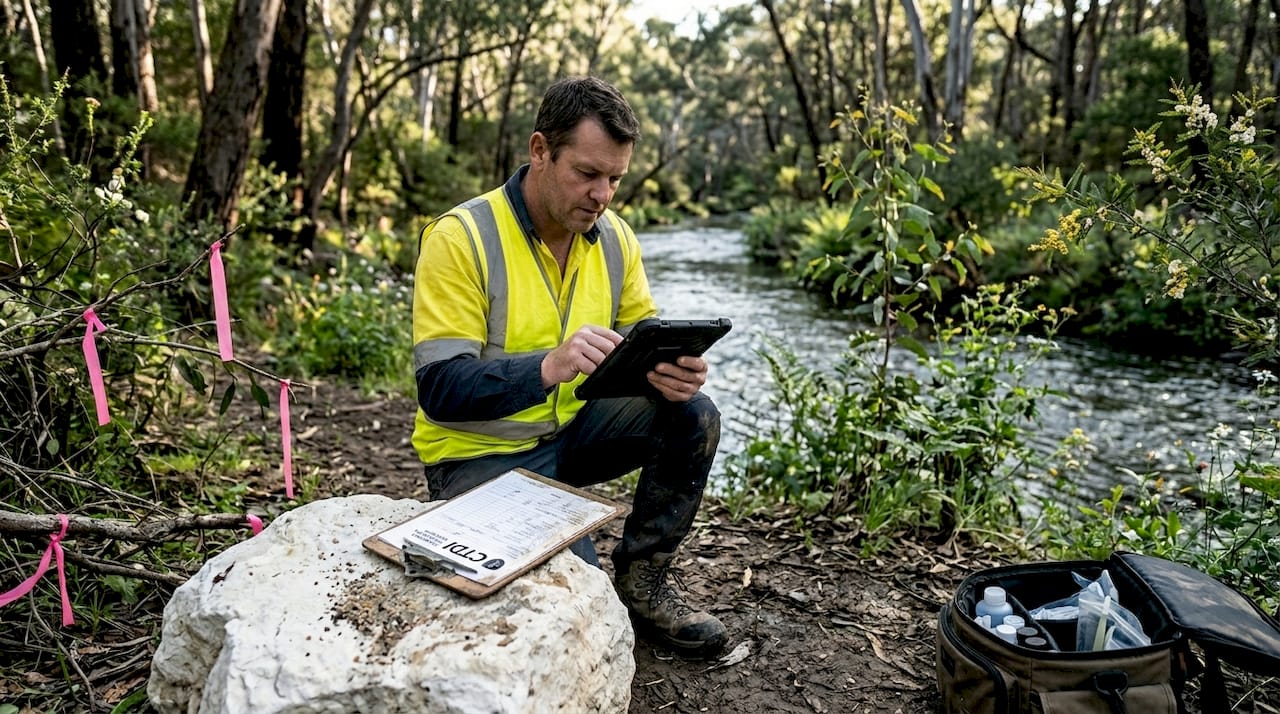
A well-executed EIA requires scoping to define the spatial and temporal boundaries of the assessment, baseline data collection to characterise existing conditions, impact prediction using quantitative and qualitative methods, mitigation design, and residual impact evaluation. Each step requires both technical knowledge and disciplined judgement.
On large infrastructure projects, EIAs involve coordinating input from ecologists, hydrologists, air quality specialists, and social impact practitioners. Your role as an environmental manager is often to synthesise that technical input into a coherent assessment narrative that decision-makers and community members can understand. That synthesis skill is rare and worth developing deliberately.
The EIA skills in your environmental management skills list should also include familiarity with the specific legislative triggers in your jurisdiction. In Australia, major projects may require assessment under both state environment protection acts and the Commonwealth Environment Protection and Biodiversity Conservation Act 1999.
4. Auditing and internal EMS assessment
Internal auditing is where environmental management skills meet practical accountability. ISO 14001 internal audits typically cover 50 to 75 verification points addressing policy, aspect identification, legal compliance, operational controls, emergency preparedness, monitoring, and continual improvement. That is not a light undertaking.
The audit skill set involves four stages:
- Planning: defining scope, selecting the audit team, reviewing previous findings, and preparing the question framework
- Execution: gathering objective evidence through document review, observation, and interviews with personnel at all levels
- Reporting: documenting nonconformities, observations, and positive findings in clear, evidence-referenced language
- Follow-up: verifying that corrective actions are implemented and effective within agreed timeframes
A gap many professionals overlook is the difference between auditing for compliance and auditing for continual improvement. Compliance auditing asks: does this system meet the standard? Improvement auditing asks: does this system actually work as intended? The second question is harder and more valuable.
Using internal gap analysis tools before seeking certification prevents last-minute evidence scrambling and surfaces weaknesses early when they are still easy to address.
| Audit stage | Key skill required | Common gap |
|---|---|---|
| Planning | Scope definition and protocol design | Scope too narrow, missing high-risk areas |
| Execution | Evidence gathering and interviewing | Over-reliance on documents, insufficient observation |
| Reporting | Clear, evidence-based finding descriptions | Vague language that impedes corrective action |
| Follow-up | Corrective action verification | Closure recorded without effectiveness check |
Pro Tip: When preparing for an EMS audit, interview frontline operators, not just supervisors. The gap between documented procedures and actual practice is almost always visible at the operational level first.
5. Communication and stakeholder engagement skills
Communication sits at the intersection of every other skill on this list. You can have technically excellent audit findings, a perfectly scoped EIA, and a fully compliant EMS. If you cannot communicate that work clearly to regulators, community groups, executives, and the public, its value is severely diminished.
Environmental communication must be planned and embedded in management systems to deliver consistent, accessible messaging across project lifecycles. That means writing project summaries in plain language, producing accessible versions of technical reports for community audiences, and structuring stakeholder engagement around the organisation's strategic priorities rather than ad hoc relationship management.
Risk communication is its own discipline within this space. Effective risk communication requires timely, credible, transparent messaging that acknowledges uncertainty without either minimising or exaggerating risks. The EPA's Seven Cardinal Rules of Risk Communication codify this approach. They include disclosing information early even when it is incomplete, using plain language, listening actively to stakeholder concerns, and phasing messages as understanding develops.
Ethical and transparent risk communication is not technique. It is fundamental governance behaviour that determines whether stakeholders trust an organisation at all.
"Proactive planning enables credible, accessible stakeholder engagement and consistent messaging." — Environmental Standards Scotland Communications and Engagement Plan
Accessibility competence is a specific sub-skill here. Producing easy-read documents, alt-text for figures, and multilingual summaries of environmental information reflects both legal obligations and professional integrity. Environmental professionals who treat accessibility as a communications default rather than an afterthought consistently build stronger community relationships.
6. Critical thinking and regulatory interpretation
Critical thinking in environmental management is not a soft skill in the abstract sense. It is the capacity to evaluate competing evidence, identify assumptions in risk assessments, challenge the adequacy of proposed controls, and make decisions under conditions of incomplete information.
In practice, this means reading a contractor's pollution management plan and spotting the gaps in spill containment logic. It means reviewing monitoring data and distinguishing between a genuine trend and random variation. It means questioning whether a legal compliance checklist actually reflects the current version of the relevant regulation.
Regulatory interpretation is the applied form of critical thinking. Australian environmental legislation changes frequently, and the relationship between commonwealth, state, and local requirements creates genuine complexity. Professionals who can navigate that complexity, identify inconsistencies, and advise on compliance pathways are among the most sought after in the field.
7. Digital and data literacy
The UK Environment Agency's 2026 business plan explicitly positions digital capability and AI integration as institutional assets for improved environmental risk anticipation and regulatory decision-making. That framing reflects a global shift. Digital literacy is no longer a specialist add-on. It is part of the baseline expectation for environmental management roles.
The digital and data skills relevant to this environmental management careers list include:
- Environmental monitoring platforms: using sensor networks, remote sensing data, and GIS tools to track environmental conditions over time
- Data analysis and visualisation: interpreting monitoring datasets, producing trend analyses, and presenting findings in accessible visual formats
- AI-assisted risk anticipation: using predictive modelling tools to identify emerging environmental risks before they become incidents
- Regulatory reporting systems: operating government reporting portals, submitting licence returns, and maintaining digital compliance records
- Documentation and records management: maintaining audit trails, version-controlled procedures, and evidence libraries that support external verification
Continuous professional development in digital tools is not optional anymore. The skills and career gains from structured upskilling in environmental data platforms translate directly into better job performance and expanded career options.
8. Prioritising skills by role and career stage
Not every environmental professional needs to be equally strong across all skill categories. Where you focus your development depends on your current role, your career stage, and the types of organisations you want to work with.
| Skill category | Best suited for | Key challenge |
|---|---|---|
| Strategy and policy | Senior managers and team leads | Translating broad legislation into operational reality |
| EMS auditing | All levels, especially early-career | Maintaining objectivity and evidence rigour |
| EIA and impact assessment | Project and programme officers | Managing multidisciplinary input coherently |
| Communication and engagement | All levels | Adapting technical language for non-expert audiences |
| Digital and data literacy | All levels, increasingly mandatory | Keeping pace with rapidly evolving tool ecosystems |
| ISO 14001 standards knowledge | EMS practitioners and auditors | Clause-by-clause depth, not just headline understanding |
Entry-level professionals should anchor their development on compliance fundamentals, EMS auditing basics, and clear technical writing. Mid-career professionals benefit most from deepening their stakeholder engagement skills and expanding into digital platforms. Senior environmental managers should focus on strategic policy development, AI-assisted risk tools, and mentoring others within a structured environmental competency framework.
My perspective on building an environmental career that lasts
I've spent years watching environmental professionals underestimate the communication and stakeholder engagement side of this work. They invest heavily in technical standards knowledge, which is entirely the right foundation. But I've seen technically brilliant auditors struggle because they couldn't explain a nonconformity clearly to a site manager, or because a community meeting went sideways due to poorly framed risk messaging.
What I've learnt is that the environmental management skills list that actually advances careers is not the one with the most technical depth. It's the one where technical and interpersonal skills are balanced and deliberately cultivated together. The professionals I've seen grow fastest are those who treat communication as a technical discipline in its own right, complete with its own standards and evidence base.
I also think the shift toward digital and AI literacy is arriving faster than most training programmes reflect. The Certificate IV in Environmental Sustainable Management at CTDI is one of the few vocational programmes I'd point people toward because it integrates those digital capabilities directly into the curriculum rather than treating them as electives.
My strongest advice: build your personal competency framework, be honest about your gaps, and commit to structured development rather than hoping experience alone will fill the holes.
— Sam
Ready to build your environmental management skills?
If this skills list has clarified where you want to develop, the next step is finding the right training pathway to get you there. At Edu, we've designed our environmental management courses specifically for Australian professionals and students who want nationally recognised qualifications they can complete online at their own pace.
Whether you're entering the field or expanding your capabilities as an experienced practitioner, our courses cover EMS standards, auditing practice, sustainability strategy, and digital tools in one structured programme. For organisations looking to upskill teams across multiple roles, our corporate training partnerships offer tailored solutions aligned to industry needs. Explore your options today and take a concrete step toward a more capable environmental career.
FAQ
What skills are most important for environmental managers?
The most critical skills include EMS auditing, environmental impact assessment, regulatory compliance, stakeholder communication, and digital data literacy. These competencies function best when developed as an integrated management cycle rather than separate capabilities.
How does ISO 14001:2026 relate to environmental management skills?
ISO 14001:2026 provides a clause-by-clause framework that defines what competencies an environmental management system requires. Professionals with fluency in its requirements can identify system gaps, plan internal audits, and advise organisations on compliance readiness.
What are common environmental management job examples?
Common roles include Environmental Manager, EMS Auditor, Environmental Impact Assessment Officer, Sustainability Coordinator, and Pollution Control Officer. Each role draws on a different combination of the skills listed above, with auditing and communication appearing consistently across all of them.
Why is risk communication a core environmental management skill?
Risk communication determines whether stakeholders trust the information environmental professionals provide. Transparent, timely, and accessible messaging is a governance responsibility, not just a presentation technique, and it directly affects how communities and regulators respond to environmental incidents.
How should students prioritise building their environmental management skills?
Students should start with EMS fundamentals and compliance knowledge, then build technical writing and communication capabilities alongside them. Pursuing a nationally recognised vocational qualification that integrates digital tools and industry standards gives you the most employment-ready foundation.
Recommended
- Certificate IV Environmental Sustainability Australia | Green Career Online | CTDI — Canterbury Training and Development Institute
- Why pursue professional development: skills and career gains
- What are practical skills and why they matter
- What Will Happen to Digital Marketing Jobs in the Age of AI? | CTDI — Canterbury Training and Development Institute