

TL;DR:
- Practical skills involve applying tangible capabilities to real-world tasks, surpassing theoretical knowledge for measurable results. Employers now prioritize adaptability, critical thinking, and soft skills, which foster workforce resilience amid rapid AI-driven change. Effective training emphasizes hands-on practice, immediate feedback, and reflection to truly develop and showcase genuine capability.
Most people assume that collecting qualifications automatically translates into career success. It does not. What are practical skills, really? They are the hands-on, applicable capabilities that let you perform real tasks in real situations, from writing a marketing brief and analysing data to welding a joint or managing a project under pressure. Unlike theoretical knowledge, which lives on paper, practical skills live in your hands, your judgement, and your habits. With AI-exposed jobs changing skills 55% faster than other roles, the gap between knowing and doing has never mattered more.
Table of Contents
- Key takeaways
- Why practical skills matter more than ever
- Types of practical skills with examples
- How practical skills training actually works
- How to develop and showcase your practical skills
- My take: capability over credentials
- Build your practical skills with CTDI
- FAQ
Key takeaways
| Point | Details |
|---|---|
| Practical skills go beyond knowledge | They are applied capabilities that produce measurable results in real-world situations, not just understanding of concepts. |
| Employers want adaptability, not credentials | Top employers in 2026 prioritise communication, critical thinking, and problem-solving over static technical qualifications. |
| Three skill types define the modern worker | Hard skills, soft skills, and digital literacy each serve a distinct role and must be developed together. |
| Hands-on training beats passive learning | Active manipulation, immediate feedback, and reflection are the pillars of effective practical skills training. |
| Certifications support but don't replace capability | Demonstrated ability in real tasks carries more weight than credentials alone when advancing your career. |
Why practical skills matter more than ever
The job market has shifted in ways that catch most professionals off guard. Employers are no longer looking purely for people who know things. They want people who can do things, adapt quickly, and solve problems they have never encountered before.
There is a useful distinction worth making here. Competence is what you reliably know and can do right now. Capability is your ongoing capacity to adapt, learn, and perform in new contexts. Competence is a floor. Capability is what keeps you rising. In an economy where entire job categories are being reshaped by automation and AI, relying only on what you already know is a risky strategy.
"The most valuable professionals are not those who know the most, but those who can learn, adapt, and apply new knowledge faster than the problems in front of them change."
The numbers back this up. Analytical thinking, communication, collaboration, and adaptability consistently top employer demand lists in 2026. These are not abstract ideals. They are practical skills. You either demonstrate them in the work you produce, or you do not.
The importance of practical skills also shows up in how careers actually progress. Research analysing over 1,000 occupations and 70 million job transitions found that individuals with strong human skills learn new technologies faster and advance more frequently than those relying on technical knowledge alone. Technical skills open doors. Practical human skills determine how far you walk through them.
Practical skills create workforce resilience, allowing professionals to remain valuable as technology and job roles evolve. This is not a soft observation. It is the defining career reality of the next decade. The role of practical skills in employment is not supplementary. It is central.
Understanding how AI reshapes required skills helps clarify exactly which human capabilities are growing in value and which are most at risk.
Types of practical skills with examples
Not all practical skills look the same. Grouping them into three clear categories makes it easier to identify where your gaps are and what to prioritise.
| Skill type | Definition | Examples |
|---|---|---|
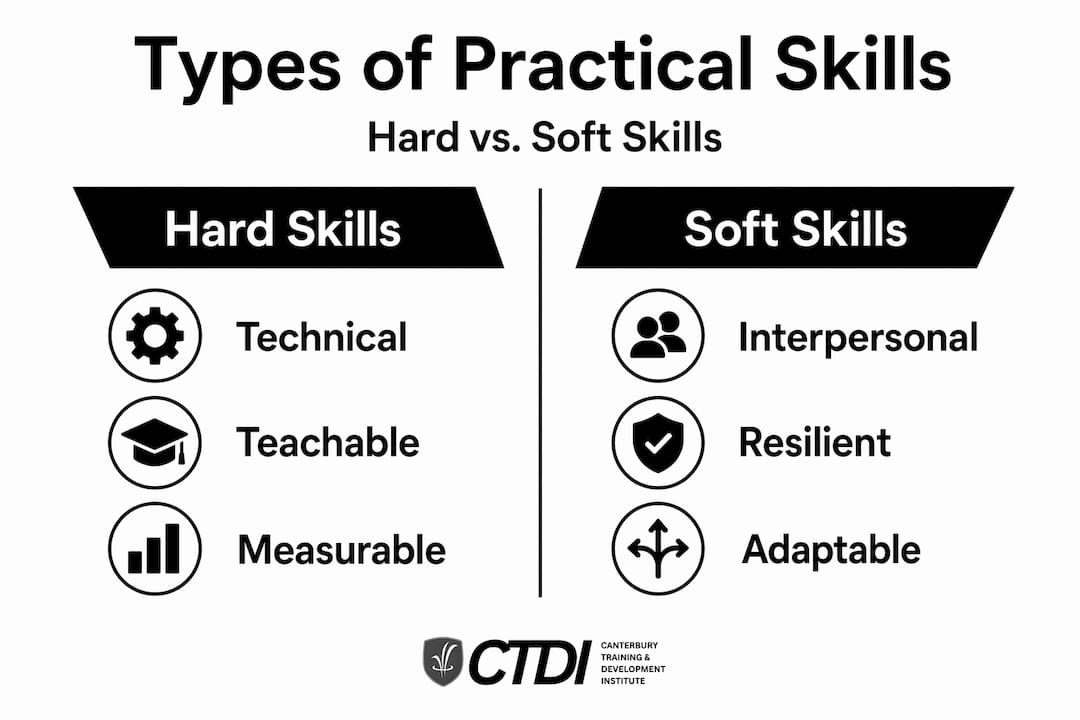
| Hard skills | Task-specific, teachable, and measurable | Coding, digital marketing, welding, bookkeeping, data analysis |
| Soft skills | Interpersonal and self-management capabilities | Communication, leadership, emotional intelligence, time management |
| Digital literacy | Ability to use, evaluate, and adapt to digital tools | AI prompt writing, data visualisation, cybersecurity basics, cloud platforms |
Hard skills are what people typically think of when asked about practical skills for life or work. They are specific, trainable, and verifiable. A welder demonstrates competency by passing a pressure test. A digital marketer shows results in campaign data. There is no hiding from the outcome.

Soft skills are harder to quantify but arguably more durable. Human skills resist automation in ways that technical tools do not. You can automate invoice processing. You cannot automate the judgement a project manager uses to de-escalate a team conflict on a Thursday afternoon with a deadline looming Friday.
Digital literacy is the new baseline. It is no longer a specialisation. Professionals across every industry now need at least a functional understanding of AI tools, digital workflows, and data literacy. AI-skilled roles have grown 151% in three years, which means digital fluency is no longer optional in any serious career plan.
The best practical skills to learn are not necessarily the newest ones. Judgement, structured problem-solving, and clear communication have been valuable for a century and will remain so long after current software tools become obsolete.
- Identify one hard skill directly tied to your current or target role
- Identify one soft skill where feedback from colleagues or managers suggests room for growth
- Assess your digital literacy honestly, particularly around AI and data tools
- Build a development plan that addresses all three, not just the most comfortable category
Pro Tip: When assessing which skills to develop, ask yourself: "Would this skill still be relevant if the software I use today disappeared?" If yes, prioritise it.
How practical skills training actually works
Understanding what practical skills are is one thing. Knowing how they are developed properly is another, and most people get this wrong.
Passive learning, reading a textbook, watching a lecture, skimming an online module, builds awareness. It does not build capability. True skill development requires something different entirely. Hands-on learning involves active participation, direct tool manipulation, immediate feedback, and reflective practice. These are not optional enhancements. They are the mechanism by which knowledge becomes skill.
This is why vocational training models are increasingly recognised as superior for building job-ready capability. Vocational training is competency-based, designed around specific skill outcomes and measurable job readiness rather than academic credit accumulation. A nursing assistant programme, for example, does not just require students to pass exams. It requires them to complete 160 to 200 supervised clinical hours before graduating. The credential only follows demonstrated performance.
The same logic applies across industries. Practical skills training in digital marketing means running actual campaigns, not reading about campaign theory. In AI, it means prompting, testing, and iterating with real tools. In environmental management, it means conducting site assessments and interpreting regulatory frameworks in context.
Here is what effective practical skills training looks like in practice:
- Define a real outcome. Not "understand digital marketing" but "plan and execute a Google Ads campaign that achieves a target cost per click."
- Work with the actual tools. Simulations are useful stepping stones. Real tools in real environments build real confidence.
- Get immediate feedback. Whether from a trainer, a live system, or a peer, feedback must come fast enough to correct before bad habits form.
- Reflect deliberately. After each task, ask: what worked, what did not, and what would you do differently? This step is skipped constantly and its absence explains most skill plateaus.
- Repeat under varied conditions. Mastery comes from applying a skill across different contexts, not from repeating the same task in the same environment.
Expert trainers play a decisive role in this process. The quality of feedback a learner receives directly determines how quickly and accurately their skills develop.
Pro Tip: If your training programme does not include tasks where you can make, observe, and correct real mistakes in a safe environment, it is building knowledge, not skill.
How to develop and showcase your practical skills
Knowing what is practical skills training and why it matters is only useful if you act on it. The following guidance is for anyone ready to build, deepen, or demonstrate their practical capabilities.
Acquiring practical skills starts with choosing the right learning format. Self-paced online courses with project-based assessments, vocational qualifications, apprenticeships, and mentorship under an experienced practitioner all develop real capability. The key is that learning must produce a tangible output you can review, improve, and show to others.
Online education has expanded access to vocational training significantly, allowing professionals to upskill without leaving their current roles. This flexibility matters enormously for people who need to build practical skills for life while managing existing responsibilities.
- Look for courses assessed on real tasks, not multiple-choice tests alone
- Seek out programmes that include industry feedback or workplace simulation components
- Track your outputs, completed projects, campaigns run, reports written, problems solved, as evidence of growing capability
- Ask for stretch assignments in your current role that push you outside your comfort zone
- Review emerging skill demands in your industry every six months and adjust your development plan accordingly
Showcasing practical skills is where many people underperform. A resume that lists skills without evidence is unconvincing. Employers want proof.
Use your resume to describe specific outcomes. Not "experienced in project management" but "managed a four-person team to deliver a $180,000 infrastructure project three weeks ahead of schedule." Portfolios, GitHub repositories, campaign reports, and case studies are all forms of evidence that carry weight well beyond a certification name.
Certifications from career-focused training programmes absolutely add credibility, particularly nationally recognised qualifications. But they work best as validation of demonstrated capability, not a substitute for it.
Pro Tip: Before your next job interview, prepare two or three specific stories that show a practical skill in action. Use the format: the situation, the action you took, and the measurable result.
The importance of practical skills also extends to personal life. Financial literacy, basic first aid, digital security habits, and negotiation skills all have direct, daily impact. Why pursue practical skills beyond your career? Because self-sufficiency and informed decision-making improve every area of life, not just your professional one.
My take: capability over credentials
I have spent years watching talented people stall professionally. And the pattern that comes up most consistently is not a lack of qualifications. It is a gap between what they know and what they can actually do under pressure.
We have built an education system that rewards memorisation and penalises uncertainty. But real work is full of uncertainty. The professional who thrives is not the one who has the most information. It is the one who can make a sound decision with incomplete information, communicate it clearly, and adapt when things do not go to plan.
What I have seen shift most meaningfully in career trajectories is not a new degree. It is a sustained commitment to developing practical capability, one real task at a time. Learning a tool matters less than developing the habit of figuring out new tools quickly. Completing a project matters less than building the discipline to reflect on what went wrong and do better next time.
The uncomfortable truth is that most professional development activity feels productive without being transformative. Watching a webinar is not skill development. Reading an industry report is not skill development. These things inform. They do not build. Real capability comes from getting your hands on a hard problem and staying with it long enough to get through to the other side.
If you are serious about building skills for career growth, stop collecting content and start completing challenges. The credential can follow. Capability comes first.
— Sam
Build your practical skills with CTDI
If this article has clarified what you are missing and what you want to build next, the Canterbury Training and Development Institute (CTDI) is a practical next step worth considering.
Edu offers nationally recognised, 100% online vocational qualifications designed specifically for working adults and career changers across Australia. The programmes are built around real-world skill outcomes, assessed on applied tasks, and delivered by trainers with genuine industry experience. That means you are not just learning about digital marketing or environmental management. You are practising it.
CTDI's current course catalogue includes an Advanced Diploma of Digital Marketing, which integrates AI-powered marketing tools with foundational strategy, and a Certificate IV in Environmental Sustainable Management, designed for professionals pursuing careers in sustainability. Both programmes are self-paced and structured around the skill outcomes employers are actually requesting in 2026.
If you are ready to move from understanding what practical skills are to genuinely developing them, explore your enrolment options and find the programme that fits your goals.
FAQ
What are practical skills, exactly?
Practical skills are applied capabilities that allow you to perform real tasks and solve problems in specific contexts. They go beyond theoretical understanding to produce measurable, observable outcomes in everyday or professional situations.
What are some examples of practical skills?
Examples include digital marketing, coding, welding, project management, financial literacy, communication, data analysis, and AI tool usage. The best practical skills to learn depend on your industry and career goals, but skills combining technical execution with human judgement are consistently in demand.
Why pursue practical skills over purely academic knowledge?
Academic knowledge provides conceptual foundations, but practical skills are what employers directly measure and reward. Adaptability, critical thinking, and communication consistently rank above static credentials in employer surveys, particularly in fast-changing industries.
What is practical skills training and how does it differ from traditional study?
Practical skills training is competency-based, focused on achieving defined task performance under realistic conditions rather than accumulating academic credits. It uses hands-on tasks, real tools, and immediate feedback to build genuine capability rather than passive knowledge.
How do I develop practical skills effectively?
Choose learning programmes assessed on real outputs rather than recall tests. Seek immediate feedback, reflect deliberately after each task, and track your results as portfolio evidence. Applying skills across varied conditions, not just repeating one task, is what builds lasting mastery.