

The right online course in Australia is one that matches your goal, is delivered by a registered provider and leads to a qualification you can verify. Start with fit, then confirm recognition, then compare content, support and cost. At Canterbury Training & Development Institute (CTDI) we deliver nationally accredited, self-paced online courses in artificial intelligence, digital marketing and environmentally sustainable management, and the checks below are the ones we would run ourselves before enrolling anywhere.
The Australian Skills Quality Authority (ASQA), the national regulator for vocational education and training (VET), frames course choice as a fit question before a cost question: your career goals, any licence you need, how you like to learn, and what support you will need. That order matters. A cheap course that does not lead where you want to go is the most expensive option.
Table of Contents
- Check 1: Define what the course must do for you
- Check 2: Know what kind of credential you are buying
- Check 3: Verify the provider and the course on the national register
- Check 4: Compare what you will actually learn
- Check 5: Look at how the provider supports you online
- Check 6: Add up the real cost and read the refund terms
- Check 7: Think about where the qualification leads
- Which course fits which goal
- A note for overseas students
- Your pre-enrolment checklist
- FAQ
- Sources
Check 1: Define what the course must do for you
Before you open a single provider's site, write down the job the course has to do. Typical jobs look like this:
- Move into a new field. You need a qualification employers recognise and skills you can show in practice.
- Step up in your current field. You need depth in a specific area, such as using AI tools in your workplace.
- Meet a licence or regulatory requirement. You need the exact qualification the licence names, so check the licensing body first.
- Prepare for further study. ASQA notes that VET qualifications can help students qualify for a new career, return to the workforce, upskill or enter university.
No provider can guarantee a job, a pay rise, a promotion or a university place, and you should be wary of any that does. What a good course can do is build skills you can apply and a credential you can point to.
Also think about how you study best. Self-paced study suits people who work shifts, care for family or travel. It asks for self-discipline, so decide honestly how many hours a week you can protect.
Check 2: Know what kind of credential you are buying
Online offerings in Australia fall into very different categories, and the names can look similar.
| Type | What it is | Government quality assured? |
|---|---|---|
| Nationally recognised VET qualification | A certificate, diploma or advanced diploma delivered by a registered training organisation (RTO) | Yes |
| Statement of attainment | Recognition of completed units from a nationally recognised course | Yes |
| University degree or higher education award | Delivered by a university or registered higher education provider | Yes |
| Short course, micro-credential or certificate of completion | Proof you finished a program, often from a company or platform | Not as an AQF qualification |
The Australian Qualifications Framework (AQF) is the national system that sets the levels and standards of qualifications. The AQF states that a genuine AQF qualification carries the AQF logo or a statement that it is recognised within the framework. Non-AQF qualifications are not government quality assured and should not use AQF titles.
Short courses can be useful for a specific skill. But if you need a formal qualification for employment, licensing or credit towards further study, choose a nationally recognised one. Our guide to choosing accredited courses in Australia goes deeper on the difference.
Check 3: Verify the provider and the course on the national register
Only RTOs can deliver nationally recognised training and issue nationally recognised qualifications or statements of attainment, according to ASQA. There are about 4,000 RTOs in Australia, so the label alone tells you little. You need to confirm the specific provider and the specific course.
The tool is training.gov.au, the National Training Register. It holds the nationally recognised qualifications, units and accredited courses, and the RTOs approved to deliver them. NSW Fair Trading also advises you search for your provider there before enrolling.
Here is a quick routine:
- Find the course code and title on the provider's page.
- Search the code on training.gov.au and confirm the course exists and is current.
- Search the provider's name and confirm it is registered and that the course is on its scope of registration, meaning the list of courses it is approved to deliver.
- Confirm which regulator oversees it. ASQA regulates most RTOs, while the Victorian Registration and Qualifications Authority and the Western Australian Training Accreditation Council cover providers operating only in those states, as the AQF explains.
For a step-by-step version, see our seven checks to verify an RTO. Our own courses carry the codes 11287NAT, 11266NAT and 11130NAT, so you can look them up the same way.
Check 4: Compare what you will actually learn
Similar course names can hide quite different content. The Australian Careers Service suggests comparing the actual core units and assessment methods rather than the title. Ask to see:
- the list of core and elective units
- how you are assessed (written tasks, projects, workplace tasks, quizzes)
- the expected study hours and the time allowed to finish
- any practical or workplace component
The Victorian Government makes the same point, advising you to check what you will do in the course, how you will be assessed, how long it takes and how online and in-person options work.
For a working professional, the most useful test is simple: could you use the skills in your job next month? Our courses are designed by industry experts around practical skills in areas employers are hiring for. The Diploma of Artificial Intelligence, for example, is built for people who want to understand and apply AI in a work context, not just talk about it.
Check 5: Look at how the provider supports you online
Online study is only as good as the support behind it. Self-paced delivery gives you freedom, but you still need to reach a trainer when you are stuck. ASQA lists what providers must make clear before you enrol: delivery methods, duration, support services, student rights, complaints and appeals processes, and refund eligibility.
Read the pre-enrolment information and ask yourself:
- Is it clear who trains and assesses you?
- Are the support services described, and can you reach them while you study?
- Do you know what technology you need, such as a computer, a reliable connection or particular software?
- Is the complaints process written down?
Support matters most in the first month, when most self-paced learners decide whether they can keep going. We pair flexible, self-paced delivery with dedicated student support so you are not studying alone. Our ASQA standards guide explains what the regulator expects of providers on student information and support.
Check 6: Add up the real cost and read the refund terms
Providers set their own fees, so prices vary widely. The Victorian Government advises you to request an itemised fees statement, details of concessions or refunds and the census date, which is the date after which you are liable for fees. Government-subsidised places, such as Skills First or Free TAFE in Victoria, may be available for some courses and eligible students, so check your state's rules.
When you compare, count more than the headline tuition fee:
- enrolment or administration fees
- textbooks, software or materials
- the cost of any reduced work hours while you study
- how long the course will take you to finish
Queensland Fair Trading advises you to discuss total cost and payment methods, ask what protections apply to pre-payments over $1,500, including what happens if the provider closes, and get cancellation and refund terms in writing. That is good practice whatever you study.
CTDI's tuition fees are positioned to be lower than comparable online providers, and the one-off enrolment fee is set out on our enrolment page. Fees are published there rather than quoted here, so you always see the current amount.
Check 7: Think about where the qualification leads
A qualification is a step, not a destination. Ask what it opens up and what you could do afterwards.
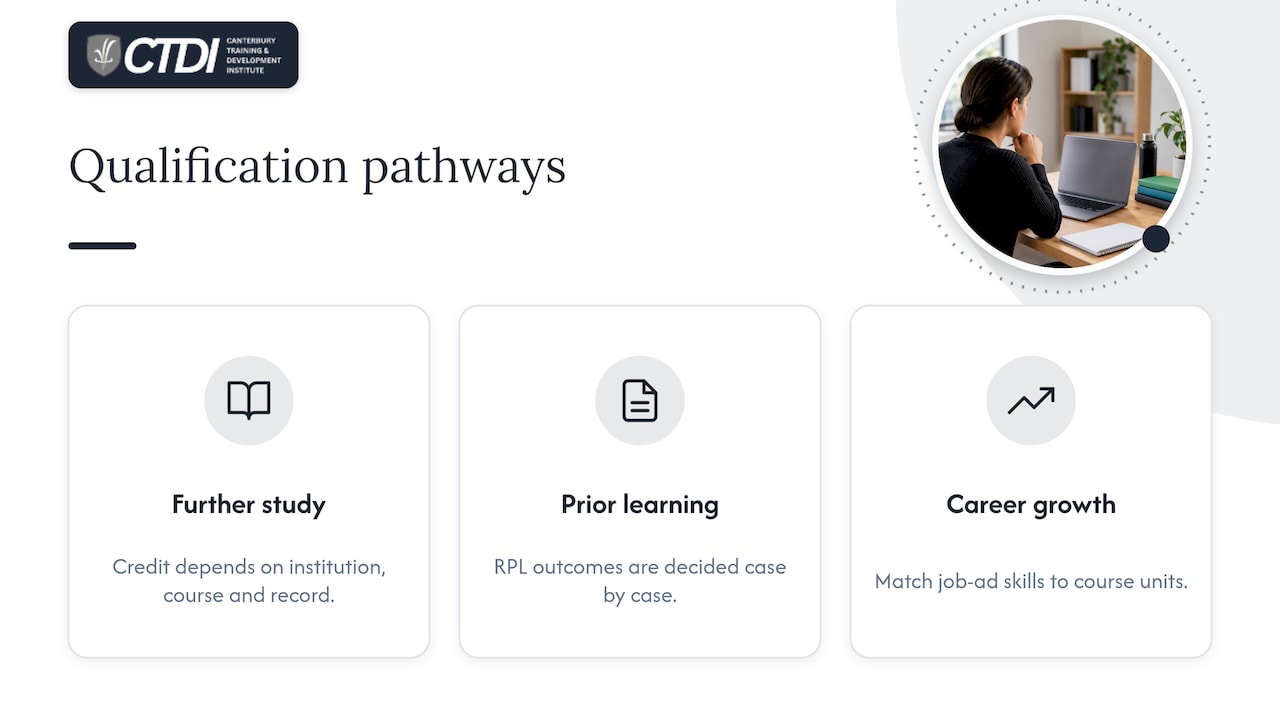
Further study. Some VET qualifications may give credit towards higher-level study. Whether you receive credit depends on the receiving institution, the course and your own record, and nobody can promise it in advance. Our guides on RPL versus credit transfer and credit transfer from VET to university explain how each works.
Recognition of prior learning (RPL). If you already have years of experience, ask whether a provider assesses it. ASQA lists RPL eligibility among the things to consider when choosing. Outcomes are decided case by case.
Career progression. Look at the role you want and what the job advertisements ask for. Match those skills to the course units rather than to the qualification title. Our piece on career growth through online learning covers this in more detail.
Which course fits which goal
If your answers to the checks above point to one of these fields, here is how our courses line up. Each is nationally accredited, fully online and self-paced.
| Your goal | Course | Focus |
|---|---|---|
| Apply AI in your work or move into AI-related roles | Diploma of Artificial Intelligence (11287NAT) | Practical AI skills for industry |
| Lead or advance in marketing | Advanced Diploma of Digital Marketing (11266NAT) | Digital marketing at an advanced level |
| Work in or manage sustainability | Certificate IV in Environmentally Sustainable Management (11130NAT) | Environmental and sustainability management |
These programs were designed by industry experts to build skills for in-demand areas. They suit working professionals who need to study around a job, and career changers who want a recognised qualification in a new field. When you are ready, you can enrol online.

A note for overseas students
If you plan to study in Australia on a student visa, different delivery rules apply. The National Code of Practice says a provider must not deliver a course exclusively online to an overseas student and must limit online units to one-third. NSW Fair Trading also says to check that your provider is registered for overseas students and listed on CRICOS, the Commonwealth Register of Institutions and Courses for Overseas Students. Check the rules that apply to your situation with the provider and the Department of Home Affairs before you commit.
Your pre-enrolment checklist
Before you pay, you should be able to tick every line:
- I know what I want the course to do for me.
- I know whether it is a nationally recognised qualification or a short course.
- I have found the course and the provider on training.gov.au.
- I have read the units and the assessment methods.
- I know what support is available and how to reach it.
- I have the total cost and the refund terms in writing.
- I know what study or career options it could lead to, without assuming any guarantee.
Our seven-check guide to choosing an online course and the six quick RTO checks give you printable versions of this routine.
FAQ
How do I know an online course in Australia is nationally recognised?
Search the course code and the provider on training.gov.au, the National Training Register. A nationally recognised course will be listed there, and the provider must be an RTO approved to deliver it. If the provider is not listed, or the course is not on its scope, it is not nationally recognised training.
Is a certificate of completion the same as a VET qualification?
No. A certificate of completion shows you finished a program, but it is not an AQF qualification and is not government quality assured. A VET qualification is issued by an RTO and sits within the Australian Qualifications Framework. If you need a credential for employment, licensing or further study, choose the nationally recognised option.
What should I ask about fees before enrolling in an online course?
Ask for an itemised fees statement, the refund and cancellation terms in writing, any extra costs for materials, and the census date. For large pre-payments, ask what happens to your money if the provider closes. Check whether any government funding applies in your state.
Can an online diploma lead to university study?
It may, but there is no guarantee. Credit towards a degree is decided by the university, based on the course content and your record. Ask the institution you hope to enter what it recognises before you enrol.
Sources
- Choose a course & provider | ASQA
- About providers | ASQA
- Accreditation and certification of qualifications | AQF
- National Training Register
- Education and training | NSW Government
- Study, University & Training Guides Australia | Australian Careers Service
- Explore TAFE and training provider options | vic.gov.au
- Training courses | qld.gov.au
- National Code of Practice for Providers of Education and Training to Overseas Students | legislation.gov.au
Recommended
- Land an Australian Job: Use 10–15 Ads to Pick the Right Online Course
- Choosing Accredited Courses in Australia: A Practical Guide
- 6 Quick RTO Checks for Adults Choosing Training Providers in Australia
- Online Study Support in Australia: What to Expect
This article provides general information only. Course requirements, study pathways, credit arrangements and career outcomes may vary. Always confirm current requirements with the relevant education provider or authority.