

TL;DR:
- Aligning education with industry needs ensures graduates are workplace-ready and reduces skills gaps. Deep, institutionalized collaborations improve curriculum relevance and graduate employment outcomes through shared design, ongoing review, and embedded practice. AI accelerates industry-informed curriculum updates, but human judgment remains essential for ethical and effective implementation.
Industry relevance in education is the purposeful alignment of academic programmes with current and future industry needs to equip students with workplace-ready skills. When this alignment fails, graduates enter the workforce underprepared, and employers are left filling skills gaps at their own cost. A Gallup survey of 2,000 US employers found a persistent mismatch between the qualifications graduates hold and the skills employers actually need. That gap is not a minor inconvenience. It costs organisations time, money, and competitive ground. For students, educators, and working professionals, understanding how education industry alignment works, and how to strengthen it, is the most direct path to better career outcomes.
What is industry relevance in education, and why does it matter?
Industry relevance in education is also known as curriculum-workforce alignment, the recognised term used by vocational training bodies and higher education researchers. The concept goes beyond simply adding a workplace module to an existing course. It means designing programmes from the ground up with input from employers, industry bodies, and working professionals, so that graduates leave with skills the market actually values.
The stakes are clear. Employers consistently urge higher education institutions to better align credentials with economically relevant skills, particularly as labour markets grow more volatile. That pressure is not new, but its intensity has increased sharply as automation and AI reshape entire job categories. Institutions that ignore this signal produce graduates who struggle to find work in their field of study, regardless of their grades.
For educators, the practical meaning of curriculum-workforce alignment is straightforward. It requires knowing what skills are needed in education and in the sectors graduates will enter, then building those skills into assessments, projects, and learning outcomes. For students, it means choosing programmes that reflect real industry needs, not just academic tradition. Understanding what industry-relevant education looks like in practice is the starting point for both groups.
How do industry collaborations shape relevant curricula?
Deeper, institutionalised industry collaborations lead to more frequent curriculum updates and improved graduate employment outcomes. Analysis across 25 vocational institutions confirms that integrated training models and co-developed curricula increase skill relevance in measurable ways. That finding matters because it shifts the conversation away from one-off guest lectures and advisory panels toward something more structural.
The most effective collaboration models share several features:
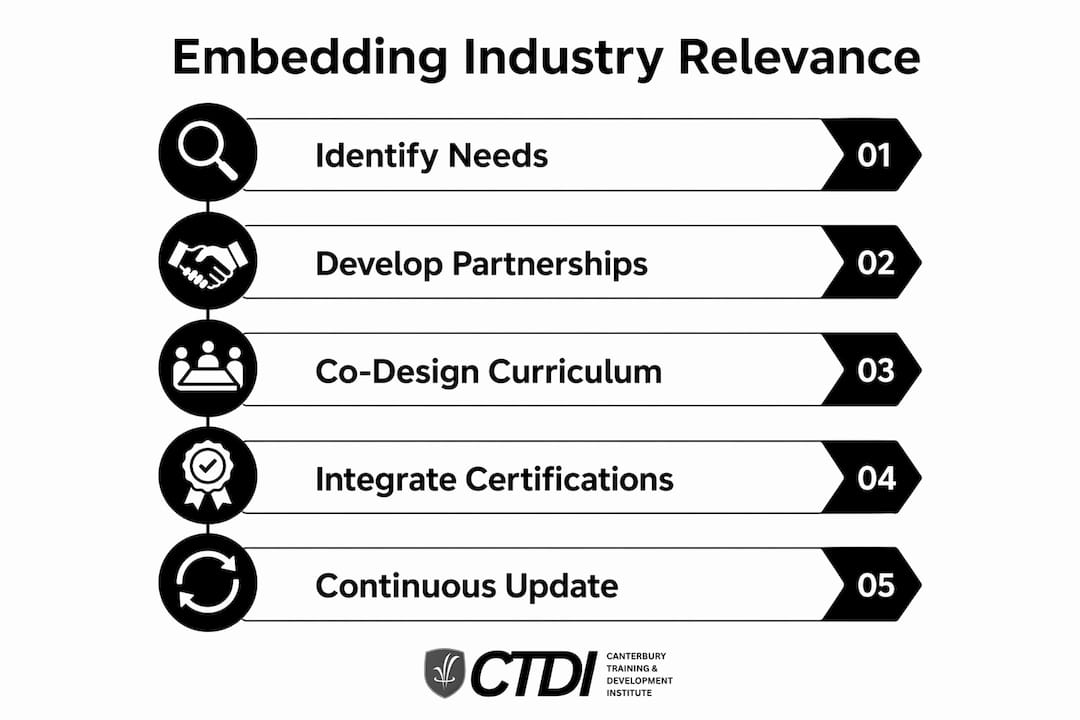
- Co-developed curricula: Industry partners and educators design units together, ensuring learning outcomes map directly to workplace competencies.
- Shared instructional roles: Practitioners teach alongside academics, bringing current tools, terminology, and workflows into the classroom.
- Integrated training models: Sectors including manufacturing, healthcare, and digital technology embed work placements and simulated environments within the programme itself.
- Continuous review cycles: Curriculum content is reviewed at least annually with industry input, rather than on a five-year academic cycle.
- Sector-specific regulatory navigation: Institutions build dedicated processes for managing compliance differences between academic accreditation and industry certification requirements.
Sustained, institutional collaborations consistently outperform episodic or advisory partnerships in promoting relevant education and graduate success. A guest speaker series or an occasional industry panel adds colour but rarely changes what students can do when they graduate. The institutions seeing the strongest results are those that have made industry engagement a structural feature of how they operate, not a supplementary activity.
The main barriers are resource gaps and sector-specific regulations. Small institutions often lack the staff capacity to manage ongoing partnerships, and some industries have strict rules about who can teach or assess their content. These are real obstacles, but they are solvable with the right governance frameworks.
Pro Tip: Start with one deep partnership in your highest-enrolment programme before scaling. A single well-managed collaboration with a major employer in your sector will produce more curriculum improvement than ten shallow advisory relationships.
What benefits do students gain from industry-relevant education?
Students who study in industry-aligned programmes gain more than technical skills. A study with 535 students found that university-industry knowledge collaborations improve interpersonal skills, personal management, career planning, and perceived employability. Student engagement mediates these outcomes, meaning the more actively students participate in industry-connected learning, the greater the benefit.
The specific gains students report fall into four categories:
- Interpersonal and communication skills. Working alongside industry professionals, even in simulated or project-based settings, builds the ability to communicate across hierarchies, manage feedback, and collaborate under real deadlines.
- Career planning and self-awareness. Exposure to actual workplace environments helps students identify which roles suit them before they graduate, reducing costly career changes in the first two years of employment.
- Perceived employability. Students in industry-connected programmes report higher confidence in their readiness for work. That confidence is not unfounded. Employers notice the difference in interviews and during onboarding.
- Transferable skills. Critical thinking, creativity, and adaptability gained through industry involvement remain valuable regardless of how technology reshapes specific job roles. These are the skills that protect graduates from displacement.
The transferable skills point deserves emphasis. Technical knowledge has a shelf life. The ability to think critically, adapt quickly, and work well with others does not expire. Industry-relevant education builds both, which is why graduates from well-aligned programmes tend to perform better across their entire careers, not just in their first role.
For working professionals returning to study, the benefit is more immediate. Programmes designed with current industry input mean the content you study this year reflects what employers want next year, not what they wanted a decade ago. That currency is the difference between a qualification that opens doors and one that sits on a shelf.

How is AI advancing industry relevance in education?
AI acts as a mediating infrastructure, connecting labour market intelligence directly to curriculum reform while preserving human-centred teaching. That framing, drawn from AI-driven curriculum frameworks, is more precise than the common claim that AI will "transform" education. What AI actually does is speed up the feedback loop between what industries need and what institutions teach.
Traditionally, curriculum review is slow. A programme might be updated every three to five years, by which time the skills it was designed to teach are already shifting. AI changes this by pulling real-time labour market data, including job posting trends, emerging role titles, and declining skill demand, and feeding that intelligence into curriculum design processes. Institutions using these frameworks can identify skill gaps months earlier than those relying on manual review.
"AI should not replace educators but complement them, updating curricula and assessment continuously through feedback loops, with ethical governance and professional judgment remaining central to educational innovation." This position, articulated by researchers working on AI-driven education integration, reflects the consensus among practitioners who have actually implemented these systems.
The practical implication is significant. AI handles the data-intensive work of tracking labour market shifts. Educators retain the work that requires human judgement: deciding which skills matter most, how to teach them effectively, and how to assess them fairly. Essential AI skills are themselves becoming part of the curriculum, not just a tool used to design it.
The ethical dimension cannot be ignored. AI-driven curriculum systems must be governed carefully to avoid encoding existing labour market biases into educational programmes. Institutions need clear policies on how AI recommendations are reviewed, challenged, and overridden by human educators. The technology is a powerful tool. It is not a decision-maker.
Practical steps for educators to embed industry relevance
Embedding industry relevance into a programme requires deliberate design, not incremental adjustment. The most effective institutions treat it as a structural commitment, not a feature they add at the end of curriculum development.
Integrating professional certifications into academic transcripts is one of the most direct ways to signal industry alignment. When a diploma includes a recognised industry credential alongside the academic qualification, graduates carry proof of competency that both employers and accreditation bodies accept. This approach also protects against the risk of AI-driven cognitive offloading, where students use AI tools to complete assessments without developing genuine understanding.
Embedding practice-based learning throughout the curriculum, rather than confining it to a single placement unit, increases student exposure to organisational contexts and market-relevant skills. The research is clear: density of industry collaboration within a programme produces better outcomes than a single high-intensity experience at the end.
The table below compares three common engagement models by structure and outcome:
| Engagement model | Structure | Primary outcome |
|---|---|---|
| Advisory panel | Occasional meetings with industry representatives | Curriculum awareness, limited change |
| Project-based learning | Students complete real briefs set by industry partners | Applied skills, employer visibility |
| Co-developed programme | Industry and educators design units together | Systemic curriculum alignment, credential recognition |
Building strong, institutionalised partnerships takes time. The payoff is a programme that updates itself continuously rather than requiring a full redesign every few years. Institutions that invest in workforce development partnerships early find that industry partners become advocates for their graduates, creating a direct pipeline from study to employment.
Pro Tip: Map every learning outcome in your programme to a specific industry competency standard before your next curriculum review. If you cannot name the workplace skill a unit develops, the unit needs redesigning.
The uncomfortable truth about industry-education alignment
I have spent years watching institutions announce industry partnerships with great fanfare, only to see those partnerships quietly dissolve within eighteen months. The pattern is consistent. A senior leader champions the collaboration. A memorandum of understanding is signed. A few guest lectures happen. Then the champion moves on, the industry contact changes roles, and the partnership evaporates without leaving any trace in the curriculum.
The honest lesson is that most industry-education partnerships fail not because the idea is wrong, but because they are built on personal relationships rather than institutional systems. When the relationship depends on two specific people staying in their roles, it is fragile by design. The institutions that get this right build the partnership into governance structures, curriculum review processes, and staff performance expectations. The collaboration survives personnel changes because it is embedded in how the institution operates.
I am also cautious about the AI enthusiasm in this space. AI can genuinely accelerate curriculum alignment by processing labour market data faster than any human team. But I have seen institutions use AI-generated skills reports as a substitute for actual conversation with employers. That is a mistake. The data tells you what skills are being requested. It does not tell you why, or whether those requests reflect genuine need or short-term hiring trends. Human judgement, informed by real industry relationships, remains irreplaceable.
The equity dimension also gets underplayed. Smaller institutions in regional areas often cannot access the same industry networks as urban universities. If curriculum-workforce alignment becomes a resource-intensive arms race, it will widen the gap between well-funded institutions and those serving students who most need relevant education. Policymakers and institutions alike need to address this directly, not assume the market will solve it.
— Sam
How Edu supports industry-aligned learning in Australia
Edu, the Canterbury Training and Development Institute, builds its programmes around the principle that education must reflect what industries actually need, not what they needed five years ago.
Edu's online diplomas in AI, digital marketing, and environmental management are designed by industry experts and updated to reflect current workforce demands. Each programme is delivered 100% online and self-paced, making it accessible for working professionals who cannot pause their careers to study. For organisations looking to upskill their teams, Edu's corporate training partnerships provide structured, accredited pathways that align staff development with business goals. Students and employers ready to act can enrol or partner with Edu through a straightforward process designed to get people into relevant training without unnecessary delay.
FAQ
What is industry relevance in education?
Industry relevance in education is the alignment of academic programmes with current and future workforce needs, so graduates develop skills employers actually value. It is also called curriculum-workforce alignment in vocational and higher education research.
How do industry partnerships improve student outcomes?
University-industry collaborations improve interpersonal skills, career planning, and perceived employability, with student engagement mediating the strength of these gains.
What role does AI play in keeping curricula current?
AI connects real-time labour market data to curriculum design, enabling institutions to identify emerging skill demands faster than traditional review cycles allow. Educators retain responsibility for interpreting and acting on that intelligence.
How can educators embed industry relevance into their programmes?
Educators can embed industry relevance by co-developing units with industry partners, integrating professional certifications into transcripts, and replacing single placements with practice-based learning distributed across the whole programme.
Why do some industry-education partnerships fail?
Most partnerships fail because they depend on personal relationships rather than institutional systems. When key contacts change roles, the collaboration collapses. Sustained partnerships are built into governance structures and curriculum review processes, not individual relationships.
Key takeaways
Sustained, institutionalised industry partnerships produce the most significant improvements in curriculum relevance, graduate employability, and student skill development.
| Point | Details |
|---|---|
| Define alignment clearly | Industry relevance means designing programmes with employer input, not adding workplace content to existing courses. |
| Prioritise deep partnerships | Institutionalised collaborations with shared teaching roles outperform advisory panels and one-off guest lectures. |
| Build transferable skills | Critical thinking, adaptability, and communication gained through industry exposure protect graduates across their entire careers. |
| Use AI as a tool, not a decision-maker | AI accelerates curriculum review by processing labour market data, but human judgement must govern all curriculum decisions. |
| Embed credentials in transcripts | Integrating professional certifications into academic qualifications creates credentials recognised by both employers and accreditation bodies. |