

TL;DR:
- Industry-relevant education combines academic knowledge with practical skills aligned to current industry needs. It features ongoing curriculum updates, work-based learning, and industry partnerships to ensure graduates are job-ready from day one.
Industry-relevant education is defined as learning designed and continuously updated in partnership with industry to equip students with practical skills directly applicable to current job markets. Known formally as career-oriented learning or vocational education and training (VET), it blends structured academic knowledge with applied technical skills and real-world experience. Each additional year of education beyond secondary school increases future earnings by approximately 10%, making the quality and relevance of that education a financial decision, not just an academic one. Institutions like Canterbury Training and Development Institute (CTDI) build programmes around this principle, aligning every course to what employers actually need in 2026.
What is industry-relevant education and what makes it different?
Industry-relevant education is the integration of academic learning with skills and knowledge aligned to current industry demands. The term covers a wide range of formats: nationally recognised vocational qualifications, short-form certificates, registered apprenticeships, and online diplomas in fields like AI, digital marketing, and environmental sustainability. What separates it from general education is the deliberate, ongoing connection between what is taught and what employers require.
Education's core value lies in access to structured bodies of knowledge, not just generic skills. That distinction matters. Career-oriented learning does not abandon theory. It anchors theory to application, so graduates can transfer what they know into real workplace contexts from day one.
The false dichotomy between liberal arts and technical training is outdated. Critical thinking, communication, and civic reasoning sit alongside data analysis and AI literacy in the strongest programmes. This integration is what produces adaptable workers rather than narrowly trained technicians.
What are the key components of industry-relevant education?
Industry-specific training works because it combines several elements that traditional programmes often treat as separate. When these components appear together, the result is a qualification that holds real weight with employers.

Structured knowledge paired with applied skills
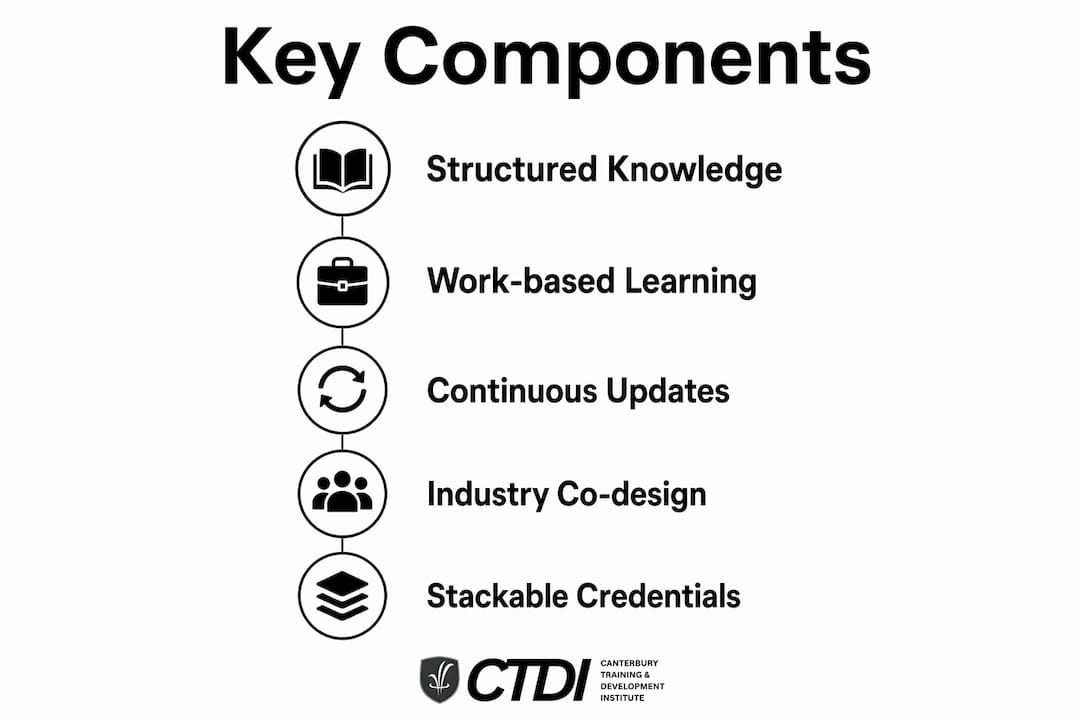
The strongest programmes give you a theoretical foundation and then require you to use it. A digital marketing diploma, for example, covers consumer psychology and then applies it through live campaign briefs. Neither element works without the other.
Work-based learning
Internships, apprenticeships, and industry placements are not optional extras. They are the mechanism through which classroom knowledge becomes workplace competence. As of february 2025, 7,300 workers enrolled in registered apprenticeships across 1,800 companies in high-growth sectors. That scale reflects how seriously employers treat structured work-based learning as a recruitment pipeline.
Continuous curriculum updates
Embedding modern tools such as data visualisation and AI into curricula each semester keeps content current. Static, textbook-driven programmes fail to prepare students for rapidly evolving industries. A course that was relevant in 2022 may already be outdated in 2026 without active revision.
Industry co-design
Curriculum relevance is maintained through continuous feedback loops with industry partners. Co-designed modules ensure the skills taught match current and future market requirements. CTDI's corporate industry partnerships model is built on exactly this principle.
Stackable credentials and modular pathways
Stackable credentials allow learners to build skills incrementally, providing immediate value and clear career pathways. You can complete a short certificate, enter the workforce, and return later to stack additional qualifications toward a full diploma. This structure suits professionals who cannot pause their careers for multi-year study.
Pro Tip: Before enrolling, ask the institution directly: "When was this curriculum last reviewed, and who from industry was involved?" A confident, specific answer is a strong signal of genuine industry alignment.
How does industry-relevant education differ from traditional education?
The differences between career-oriented learning and conventional academic education are significant in practice, not just in theory.
| Feature | Industry-relevant education | Traditional academic education |
|---|---|---|
| Primary goal | Employability and career mobility | Academic mastery and disciplinary depth |
| Curriculum updates | Continuous, co-designed with industry | Periodic, driven by academic review cycles |
| Learning format | Work-based, applied, and modular | Classroom-based, lecture-driven |
| Credential structure | Stackable, short-form to full qualification | Sequential degrees, multi-year commitment |
| Employer recognition | Direct alignment with job requirements | Varies by field and employer preference |
| Flexibility | Self-paced, online, part-time options | Predominantly fixed timetables |
The most important difference is speed of adaptation. When AI tools reshape a marketing role, an industry-aligned programme updates its content within a semester. A traditional university degree may take years to reflect the same shift. For students entering high-growth fields, that lag is costly.
Traditional education still holds value. Deep disciplinary knowledge, research skills, and critical reasoning are genuine assets. The strongest career outcomes come from programmes that combine both approaches rather than treating them as opposites.
What are the benefits of practical education for students and professionals?
The benefits of practical education are measurable and career-specific. They show up in hiring rates, salary levels, and the speed at which graduates move into roles that match their training.
- Higher earning potential. Human capital explains 50% of income per capita differences between nations. Education aligned to high-demand skills amplifies that return significantly.
- Faster employment. Graduates from industry-aligned programmes enter the workforce with skills employers can use immediately. They do not require the same onboarding investment as graduates from purely theoretical programmes.
- Access to high-growth sectors. Fields like AI, advanced manufacturing, and environmental management are actively seeking qualified workers. Industry-specific training in these areas positions you directly in the path of growing demand.
- Flexibility for working professionals. Modular, online formats let you upskill without leaving your current role. CTDI's self-paced online diplomas in AI and digital marketing are built specifically for this group.
- Lifelong adaptability. Programmes that teach you how to learn within a specific industry context prepare you to keep updating your skills as that industry changes. That adaptability is the most durable career asset you can build.
The importance of relevant education becomes clearest when you compare outcomes over a decade. Professionals who invest in industry-aligned qualifications early tend to move faster through career stages and maintain higher earning trajectories than those who rely on general credentials alone.
Pro Tip: Look for programmes that include access to current industry tools as part of the course, not just theory about them. If the course teaches Google Analytics, Canva, or AI platforms by name and version, that is a strong indicator of genuine currency.
How do you choose the right vocational programme?
Choosing the right programme is the most consequential decision in this process. A well-chosen qualification accelerates your career. A poorly chosen one costs you time, money, and momentum.
-
Assess curriculum relevance. Read the unit descriptions, not just the course title. Look for specific tools, technologies, and industry contexts named in the content. Vague descriptions like "communication skills" without context are a warning sign.
-
Check industry partnerships. Ask whether the institution has formal relationships with employers in your target sector. CTDI's industry partnerships page lists active collaborations that directly inform course content.
-
Confirm work-based learning components. Internships, industry projects, and applied assessments are non-negotiable for genuine career readiness. A programme without them is closer to traditional academic study than to vocational training.
-
Evaluate support services. Comprehensive support systems including stipends, transport, and equipment help learners focus entirely on skill acquisition. When choosing a programme, ask what support is available beyond the course content itself.
-
Look at credential stackability. A certificate that counts toward a diploma, which counts toward an advanced diploma, gives you flexibility. You can exit at any point with a recognised qualification and return later to continue.
-
Consider delivery format. Online, self-paced delivery suits professionals with existing work commitments. Fixed-schedule programmes suit those who benefit from structured deadlines. Neither is universally better. Match the format to your actual life, not your ideal version of it.
-
Research career outcomes. Ask the institution for employment data from recent graduates. Reputable providers publish this information. If it is not available, that absence tells you something.
Pro Tip: Check whether the qualification is nationally recognised under Australia's Australian Qualifications Framework (AQF). AQF-aligned credentials carry consistent weight with employers across every state and territory.
The future skills guide for 2026 published by CTDI maps specific skill shortages to qualifications, which makes it a practical starting point for matching your goals to market demand.
What is the future of industry-relevant education and workforce readiness?
The direction of career-oriented learning in 2026 is clear: faster integration of emerging technologies, deeper industry collaboration, and greater government investment in sector-specific training.
| Trend | What it means for students |
|---|---|
| AI and data literacy embedded in all fields | Every qualification will require some level of AI competency, regardless of sector |
| Registered apprenticeships scaling in high-growth sectors | More structured pathways into advanced manufacturing, energy, and tech roles |
| Government grants funding sector training | More subsidised options in AI, manufacturing, and sustainability-focused programmes |
| Hybrid liberal arts and technical models | Programmes combining critical thinking with applied skills will produce the most adaptable graduates |
| Continuous industry feedback loops | Curricula will update faster, reducing the gap between what is taught and what is needed |
The US Department of Labor awarded $86 million in grants to support workforce needs in AI, manufacturing, and nuclear energy. That level of government investment signals where the global skills agenda is heading. Australia's own VET funding priorities follow a similar pattern, with growing support for digital skills and sustainability qualifications.
Successful programmes integrate emerging technologies like AI, blockchain, and machine learning into coursework each semester to maintain relevance. The institutions that do this well will produce graduates who are genuinely ready for the workforce. Those that rely on static content will fall behind. For students, the practical implication is straightforward: choose providers who update their content visibly and regularly, and who can show you the evidence.
The role of online courses in workforce development is also expanding. Flexible delivery is no longer a compromise. For many professionals, it is the only format that makes continuous upskilling possible alongside full-time work.
Key takeaways
Industry-relevant education combines structured knowledge, applied technical skills, and continuous industry collaboration to produce graduates who are genuinely ready for the workforce from day one.
| Point | Details |
|---|---|
| Core definition | Industry-relevant education integrates academic knowledge with practical, job-ready skills aligned to current employer needs. |
| Curriculum currency | Programmes must update content continuously, embedding tools like AI and data visualisation each semester to stay relevant. |
| Work-based learning | Internships, apprenticeships, and industry placements are the mechanism that converts classroom knowledge into workplace competence. |
| Stackable credentials | Modular qualifications let you enter the workforce sooner and return to build further credentials without starting over. |
| Programme selection | Check curriculum specificity, industry partnerships, support services, and AQF recognition before enrolling. |
Why I think most students underestimate the curriculum question
The question students ask most often is "Will this qualification get me a job?" The question they rarely ask is "Was this curriculum written with anyone who currently works in the industry?"
Those two questions are not the same. A qualification can be nationally recognised and still teach tools that were replaced two years ago. I have seen graduates from well-regarded institutions arrive in workplaces without knowing the platforms their teams use daily. The credential was real. The currency was not.
The programmes that consistently produce work-ready graduates share one visible characteristic: they can name the industry partners who shaped the content, and they can tell you when the curriculum was last revised. That transparency is not a marketing claim. It is evidence of a genuine feedback loop between educators and employers.
The other thing students consistently underestimate is the value of support services. Completing an intensive, skills-focused programme while managing work and life commitments is genuinely hard. Programmes that provide logistical support, whether that is equipment access, financial assistance, or flexible scheduling, produce better completion rates and better outcomes. That is not a soft consideration. It is a practical one.
My honest advice for 2026: prioritise currency over prestige. A newer qualification from a provider with active industry relationships will serve your career better than a legacy credential from an institution that has not updated its content in five years. The job market rewards what you can do, not where you studied.
— Sam
Industry-aligned courses worth considering at CTDI
Canterbury Training and Development Institute offers nationally recognised online qualifications built around exactly the principles covered in this article. Courses in AI, digital marketing, and environmental sustainability are co-designed with industry partners and updated to reflect current market demands.
Every programme is delivered 100% online and self-paced, which means you can upskill without pausing your career. CTDI's advanced diploma in digital marketing and Certificate IV in Environmental Sustainable Management are two strong entry points for professionals targeting high-growth sectors. Student support services are built into every enrolment. If you are ready to choose a qualification that connects directly to where the job market is heading, view current enrolments and find the programme that fits your goals.
FAQ
What is industry-relevant education in simple terms?
Industry-relevant education is training designed with input from employers to teach skills that are directly usable in current jobs. It combines structured knowledge with applied, practical learning rather than theory alone.
How does vocational education differ from a university degree?
Vocational education focuses on job-ready skills and faster entry into the workforce, while university degrees prioritise academic depth and research. The strongest career outcomes often come from combining elements of both.
What are stackable credentials and why do they matter?
Stackable credentials are short qualifications that count toward larger ones, letting you enter the workforce sooner and build further qualifications over time. They are particularly useful for professionals who cannot commit to multi-year study upfront.
How do I know if a vocational programme is genuinely industry-aligned?
Check whether the curriculum names specific tools and technologies, whether the institution has formal industry partnerships, and when the content was last updated. AQF recognition confirms the qualification carries national weight with Australian employers.
What industries benefit most from industry-specific training in 2026?
AI, advanced manufacturing, digital marketing, and environmental sustainability are the highest-growth sectors actively seeking qualified workers. Government funding and employer investment in these fields make them strong targets for vocational training in 2026.