
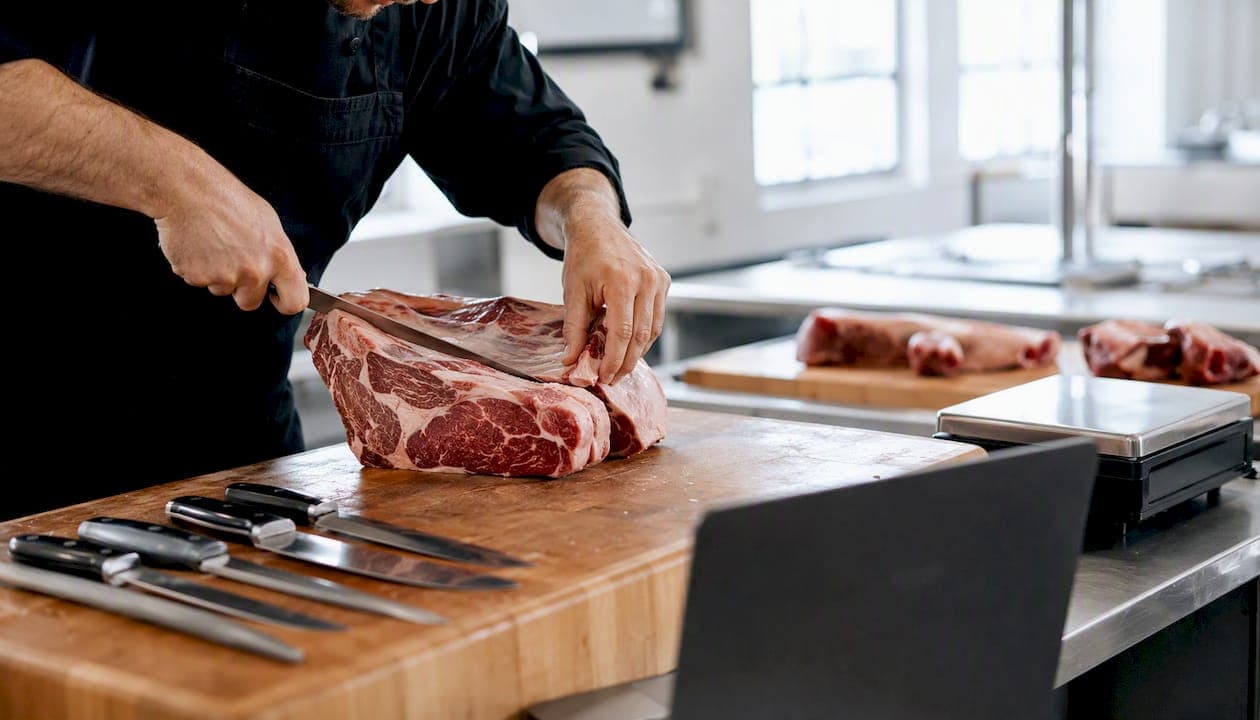
Quality online butchery training is genuinely available to Australian learners, and the right course depends entirely on what you want to do with the skills. Hobbyists get the most from self-paced video platforms like ButcherCraft, which offers two structured tracks taught by industry instructors. Chefs looking to upskill should target nationally recognised units such as SITHCCC036, which covers portioning, trimming, deboning and barding across multiple meat types. Anyone pursuing a trade qualification needs a blended pathway that includes workplace assessment, with TAFE NSW's Certificate III in Meat Processing (AMP30815) being the clearest Australian route.
- Hobbyist: Self-paced video courses with downloadable cut charts and community support.
- Chef upskill: Nationally recognised cookery units (SITHCCC036 and related) packaged into hospitality qualifications.
- Trade pathway: Blended or TAFE-delivered Certificate III in Meat Processing (AMP30815), requiring workplace assessment hours.
Key takeaways
Choosing the right online butchery course comes down to matching your goal to the correct course type, verifying accreditation, and planning for the hands-on hours that no online platform can replace.
| Point | Details |
|---|---|
| Match course type to goal | Hobbyists suit self-paced platforms; chefs suit nationally recognised units; trade students need blended Certificate III pathways. |
| Verify AQF accreditation | Check the provider's RTO number on training.gov.au before enrolling; "industry recognised" is not the same as nationally recognised. |
| Plan for practical hours | Certificate III (AMP30815) requires supervised workplace assessment; confirm placement arrangements before you commit. |
| Prioritise SOPs and cut charts | Downloadable references outlast video content as on-the-job tools; treat their absence as a red flag. |
| Build progressively | Start with a self-paced enthusiast course, then move to structured upskilling, then blended workplace assessment for a trade outcome. |
Table of Contents
- What does "online butchery course" actually mean?
- Australian-accessible providers worth knowing about
- How does Australian accreditation work for butchery skills?
- What skills should a good online butchery course actually teach?
- What does an online butchery course cost, and how long does it take?
- How do you choose the right course for your goal?
- How do you make online butchery learning stick in practice?
- What does a realistic learning path from beginner to butcher look like?
- Why online butchery fits modern vocational learning, but only up to a point
- Sources
What does "online butchery course" actually mean?
The phrase covers four very different things, and confusing them wastes time and money.
-
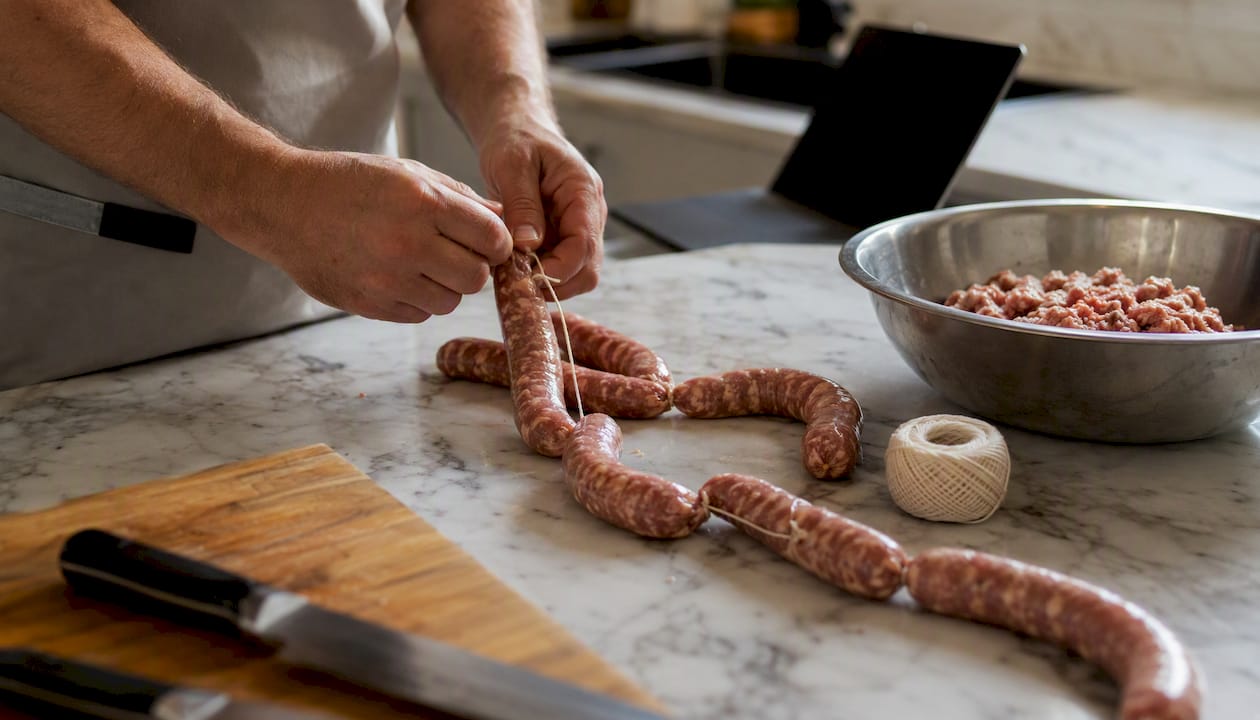
Self-paced video micro-modules. Short, topic-specific lessons (knife sharpening, one primal cut, sausage-making basics) delivered entirely online. Time commitment is typically a few hours to a few weeks. No formal assessment. Suits hobbyists and home cooks who want a specific skill, not a credential.
-
Instructor-led enthusiast tracks. Structured multi-module courses with video lessons, downloadable SOPs, and community forums. ButcherCraft's two-track model is a clear example: an enthusiast basic track and a butcher training track, both taught by working industry professionals. These suit home cooks wanting depth, or retail staff building confidence before formal study.
-
Blended certificate programmes. Online theory and video content combined with mandatory on-site or workplace practical hours. The Certificate III in Meat Processing (AMP30815) through TAFE NSW sits here. Theory can be completed remotely; competency sign-off requires supervised hands-on work. Suits aspiring retail butchers and meat processing workers.
-
Full AQF-accredited qualifications. Formal Australian Qualifications Framework credentials that carry national recognition. These involve declared practical hours, workplace assessment tasks, and trainer-assessed competency. They open employment and further study pathways that informal courses cannot.
The gap between model one and model four is enormous. A hobbyist who enrols in a Certificate III expecting a relaxed video series will be surprised by the workplace hours requirement. An aspiring butcher who buys a micro-module course expecting a trade credential will be equally disappointed.
Australian-accessible providers worth knowing about
Three provider categories cover most of what's realistically available to learners in Australia.
ButcherCraft (Butcher Magazine)
ButcherCraft delivers self-paced video courses across two tracks: a foundational enthusiast track and a more advanced butcher training track. Instruction comes from working master butchers, and the course includes downloadable documentation and community access. There is no formal AQF accreditation, so it does not lead to a nationally recognised credential. It suits home cooks, food enthusiasts, and retail staff who want structured, expert-taught content without the commitment of a formal qualification. The community component is a genuine differentiator: peer feedback and instructor interaction help correct technique in a way that solo video watching cannot.
Online course marketplaces (Elevify-style platforms)
Aggregator marketplaces list butchery and meat preparation modules from multiple providers, often at accessible price points. Quality varies considerably. The useful ones include syllabus details, trainer credentials, and learner reviews. The weaker ones are video libraries with no assessment and no support. When browsing these platforms, filter specifically for courses that list a named trainer with industry credentials, include downloadable resources, and offer some form of completion certificate. A certificate from an unaccredited marketplace course has no formal standing with employers or RTOs, but it can still demonstrate initiative.
TAFE NSW — Certificate III in Meat Processing (AMP30815)
This is the clearest nationally recognised pathway for Australians pursuing a retail butcher career. The qualification sits within the Australian Meat Industry Training Package and requires both online/theory components and supervised workplace assessment. Prospective students can contact TAFE NSW directly to confirm current enrolment arrangements, practical hour requirements, and assessment modes. It suits school leavers, career changers, and meat industry workers seeking formal recognition.
Provider category comparison
| Category | Who it suits | Accreditation | Practical requirement | Delivery | Duration | Price band | Skills covered | Assessment |
|---|---|---|---|---|---|---|---|---|
| Enthusiast platform (e.g. ButcherCraft) | Hobbyists, home cooks | None (no AQF) | None mandatory | Self-paced video | Weeks to months | Low–mid | Knife skills, primal cuts, sausages, charcuterie | Completion certificate only |
| Online marketplace (e.g. Elevify-style) | Beginners, retail staff | Varies; mostly none | None | Self-paced video | Hours to weeks | Low | Topic-specific modules | Varies; often none |
| TAFE / blended (e.g. AMP30815) | Aspiring butchers, trade students | Nationally recognised (AQF) | Yes — workplace hours required | Blended online + on-site | Months to 1+ year | Mid–high | Full trade competencies, food safety, processing | Workplace assessment, trainer sign-off |
How does Australian accreditation work for butchery skills?
The Australian Qualifications Framework (AQF) is the national system that governs what a qualification actually means. A course that sits within the AQF carries a unit code, declared practical hours, and competency-based assessment. One that does not is simply a training product, regardless of how it is marketed.
For meat-related skills, two credential types matter most:
- Certificate III in Meat Processing (AMP30815): The core trade qualification for retail butchers in Australia. Delivered through RTOs (Registered Training Organisations) including TAFE NSW. Requires workplace assessment and a declared number of supervised practical hours.
- Nationally recognised cookery units (e.g. SITHCCC036): Embedded within hospitality and cookery qualifications. The SITHCCC036 unit covers portioning, trimming, barding, deboning and mincing across beef, lamb, pork and poultry. It appears in Certificate III and IV in Commercial Cookery and related hospitality qualifications. Victoria University's unit page shows how it sits inside broader hospitality programmes.
Trust signals to check before enrolling:
- A nationally recognised unit code (e.g. SITHCCC036, units from AMP30815)
- Declared practical hours and workplace assessment requirements
- Trainer credentials (industry experience, Certificate IV in Training and Assessment or equivalent)
- RTO registration number (verifiable on training.gov.au)
- Syllabus listing specific competencies, not just topic headings
The difference between "nationally recognised" and "industry recognised" is significant. The latter is a marketing phrase with no regulatory meaning. Only AQF-registered units and qualifications carry formal standing with employers, licensing bodies, and further education providers. Understanding how course accreditation works before you commit saves considerable frustration later.
What skills should a good online butchery course actually teach?
A well-structured meat preparation course covers both technique and the food safety knowledge that underpins safe handling. Here is what to expect from a thorough syllabus:
- Knife skills and sharpening: grip, blade angle, honing and sharpening technique, choosing the right knife for each task
- Carcass breakdown: primal and sub-primal cuts for beef, lamb, pork and veal; bone structure and muscle groups
- Portioning and trimming: yield management, fat cover standards, portion weight consistency
- Poultry processing: spatchcocking, jointing, breast and thigh portioning, trussing
- Charcuterie and sausage-making: emulsification, seasoning ratios, casing selection, fermentation basics
- Curing and smoking: dry and wet cure ratios, smoke profiles, temperature control
- Food safety and hygiene: HACCP principles, cross-contamination prevention, cold chain management, traceability
The SITHCCC036 unit provides a useful benchmark: if a course's syllabus does not at minimum cover the techniques listed in that nationally recognised standard, it is probably surface-level content.
Programmes like Niagara College's Professional Butchery Techniques show what full professional depth looks like: lab-based whole-animal breakdown, meat science, and value-added production. That level of hands-on lab work is not replicable online, which is why blended delivery exists.
Pro Tip: Prioritise courses that include downloadable SOPs and cut charts alongside video content. A well-made SOP becomes a permanent on-the-job reference; a video you have to re-watch every time is not.
What does an online butchery course cost, and how long does it take?
Costs and timeframes vary sharply by course type.
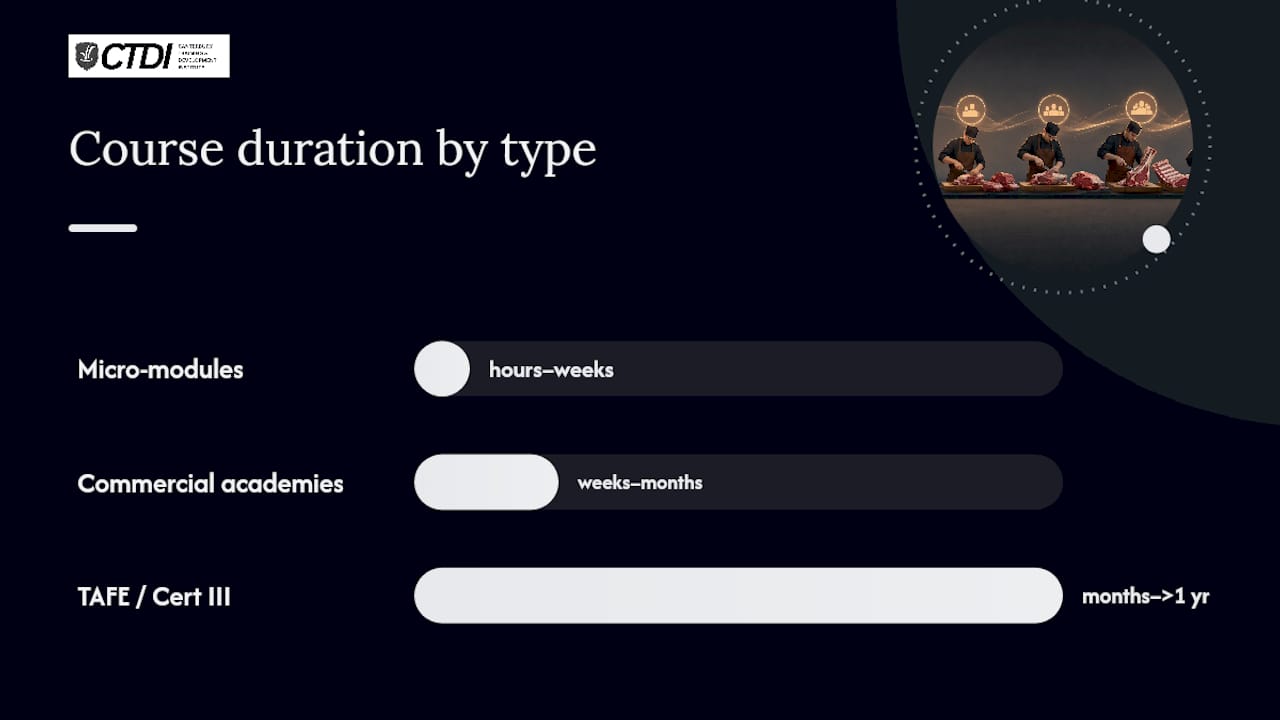
- Micro-modules and enthusiast platforms: typically low-cost, with self-paced completion in a few hours to several weeks. PRIME Education's introductory meat processing programme (University of Nebraska Extension) illustrates this model: modular, low-cost, covering safety, equipment, fabrication and labelling fundamentals. Good for testing interest before committing to a longer course.
- Commercial online academies: Range® Meat Academy publishes priced certificate-style packages for meat clerk and meat cutter pathways, with step-by-step videos, downloadable charts and competency badges. These sit in a mid-range price band and can be completed in weeks to a few months.
- TAFE / blended Certificate III programmes: higher cost, longer duration (typically several months to over a year), and include mandatory workplace hours. Fees vary by RTO and funding eligibility; some learners access government subsidies through Smart and Skilled (NSW) or equivalent state programmes.
Practical requirements to clarify before you enrol:
- Ask the provider exactly how many supervised practical hours are required and whether they can be completed at your current workplace.
- Confirm whether block placements are available if you do not have an existing industry employer.
- Check whether the provider has partner butcheries or industry contacts for placement support.
- Ask what evidence format assessors accept (video logs, photo portfolios, signed competency checklists).
The online learning vs classroom comparison is worth reading before committing to a blended programme, particularly if your work schedule makes fixed on-site blocks difficult to arrange.
How do you choose the right course for your goal?
Start with a single honest question: do you need a credential, or do you need a skill? The answer determines everything else.
Decision checklist:
- Define the outcome. Hobby skill, chef portfolio, retail employment, or trade qualification? Each maps to a different course type.
- Check accreditation status. Search the provider's RTO number on training.gov.au. If there is no RTO number, the course is not nationally recognised.
- Verify trainer credentials. Look for named instructors with industry experience and a Certificate IV in Training and Assessment (TAE40122 or equivalent) for accredited courses.
- Assess practical requirements. Can you meet the workplace hours? Do you have access to a suitable practice environment?
- Review the syllabus in detail. Does it list specific competencies, or just broad topic headings? Vague syllabuses usually mean shallow content.
- Check student support. Is there a community forum, direct trainer access, or a dedicated support contact? Isolation is the main reason learners drop out of online courses.
- Understand the refund policy. Particularly for higher-cost blended programmes, know the terms before you pay.
Questions to ask providers directly:
- What is your RTO registration number, and which units does this course deliver?
- How are workplace assessment hours arranged for students without an existing employer?
- Can you provide evidence of graduate employment outcomes?
- What equipment or materials do I need to source independently?
Engaging with Australian college partnerships can also open doors to employer-connected pathways that purely commercial platforms cannot offer.
How do you make online butchery learning stick in practice?
Online content gives you the theory and the visual model. Skill retention requires repetition with real materials, and safe repetition requires a proper setup.
Setting up for safe practice:
- Dedicate a single, easy-to-clean surface (food-grade polyethylene board minimum) for all meat work.
- Invest in a quality sharpening stone before your first practical session. Blunt knives cause more injuries and more technique errors than any other single factor.
- Use cut-resistant gloves rated to EN 388 or equivalent for initial practice sessions.
- Keep a separate, labelled container for bones and trim to maintain a clean workspace throughout.
Documenting practice for assessors:
- Photograph or video each session, noting the cut, the technique used, and the outcome.
- Keep a written log with dates, meat type, weight, and self-assessed yield.
- Ask a local butcher, chef, or industry mentor to observe and sign off on technique periodically.
Food safety is not optional. Cross-contamination, cold chain management, and correct sanitation of surfaces and tools are competency requirements in any accredited programme, and they are the areas where home practitioners most commonly cut corners.
Pro Tip: A short block placement at a local butchery, even unpaid, gives you supervised practice hours, assessor-ready evidence, and industry contacts that no online course can replicate. Approach independent butchers directly; many are willing to accommodate a motivated learner for a few days.
What does a realistic learning path from beginner to butcher look like?
The progression is straightforward, but the timeline is honest: becoming a qualified retail butcher takes time regardless of how good the online content is.
-
Months 1–2: Foundation skills. Complete a self-paced enthusiast course (ButcherCraft or equivalent). Focus on knife skills, basic primal cuts, and food safety fundamentals. Practice at home with accessible cuts: whole chickens, lamb shoulders, pork belly.
-
Months 3–6: Structured upskilling. Move to a more structured online programme with downloadable SOPs and competency assessments. If you are a chef, target SITHCCC036 through a registered hospitality RTO. If you are aiming for retail butchery, begin researching Certificate III providers and workplace placement options.
-
Months 6–12: Blended or workplace-based study. Enrol in a blended Certificate III programme. Complete online theory units while arranging supervised workplace hours. Document all practice sessions for assessment evidence.
-
12+ months: Trade qualification and employment. Complete workplace assessment sign-offs and submit your portfolio. With AMP30815 completed, you are eligible for retail butcher roles and can pursue further specialisation in charcuterie, smallgoods, or wholesale processing.
Learners who skip step one and jump straight to a Certificate III without any prior exposure often struggle with the pace of workplace assessment. The career growth benefits of online learning are real, but they compound fastest when each stage builds on genuine hands-on practice from the stage before.
Why online butchery fits modern vocational learning, but only up to a point
Online butchery training has genuinely matured. The best courses now offer structured curricula, master-butcher instruction, downloadable references, and community feedback that were simply not available to distance learners a decade ago. For hobbyists and chefs, the online format is often sufficient for the outcomes they actually need.
Where it gets complicated is the trade pathway. Butchery is a physical trade. Whole-animal breakdown, knife control under fatigue, and reading a carcass for yield are skills that require repetition with real material, not just video observation. The most honest thing any online course provider can tell a trade-pathway student is: the online component gets you ready to learn faster on the floor, not ready to work without it.
That is not a limitation unique to butchery. It is the same reality that applies to any hands-on vocational trade, and it is why blended delivery exists. The online component handles theory, terminology, and visual modelling efficiently. The workplace component handles everything else.
For learners who want the flexibility of online study combined with a genuinely accredited outcome, the model that works is: strong online theory, rigorous workplace assessment, and a provider who has real industry connections to support placement. That combination is what separates a credential that employers respect from a certificate that sits in a drawer.
Sources
Before enrolling in any butchery or meat preparation course, check these sources directly to confirm unit content, accreditation status, and practical requirements.
- SITHCCC036 - Prepare meat dishes
- ButcherCraft: Butchery Course Online - Butcher Magazine
- Range® Meat Academy – Online Meat Cutting & Clerk Training
- Prime Education: Introduction to Butchery and Meat Processing | Department of Animal Science | Nebraska
- Professional Butchery Techniques Program | Niagara College
Recommended
- Master the professional development process for online growth
- Enrol Now — Online Diplomas in AI, Marketing & Sustainability | CTDI — Canterbury Training and Development Institute
- How to upskill online: a practical 2026 guide
- Master the professional development process for online growth — Canterbury Training and Development Institute