

The ten skills that separate high-performing sales professionals from the rest are: active listening, discovery questioning, qualification (MEDDPICC/BANT), consultative selling, objection handling, negotiation and closing, account research, multi-threading, stakeholder mapping, CRM and AI fluency, and data literacy. According to SyncGTM's B2B sales skills guide, the modern B2B skill set blends these classic and technical capabilities, with AI fluency and data-driven pipeline management now clear differentiators for top performers.
The ten skills at a glance:
- Active listening — engineer the buyer to talk; measure your talk-to-listen ratio
- Discovery questioning — diagnose before you pitch
- Qualification — MEDDPICC or BANT frameworks to filter real opportunities
- Consultative selling — lead with insight, not product features
- Objection handling — reframe resistance as diagnostic information
- Negotiation and closing — tie value to outcomes, not discounts
- Account research — know the business before the first call
- Multi-threading — engage multiple stakeholders to protect the deal
- CRM and AI fluency — keep your pipeline clean and use AI to work faster
- Data literacy — read your own numbers and act on them
Pro Tip: Record a mock discovery call right now, even on your phone's voice memo app. Play it back and count how many seconds you spoke versus the "buyer." That ratio tells you more about your current skill level than any self-assessment.
Table of Contents
- What are the core skills for sales and how do you practise them?
- Advanced and technical sales skills employers expect
- How do you show sales skills on your CV and in interviews?
- How do you practise and build sales skills week by week?
- What learning pathways are available in Australia?
- Why do active listening and data literacy matter most?
- Key takeaways
- The publisher's perspective on training outcomes
- Useful sources and further reading
What are the core skills for sales and how do you practise them?
These six foundational capabilities underpin every sales role in Australia, from SDR through to enterprise account executive. Each one has a clear definition, a reason it matters in modern selling, and a drill you can start today.
Active listening and discovery
Active listening is not passive silence. It is the deliberate act of asking a question, then staying quiet long enough for the buyer to reveal something they did not plan to say. Top sellers use call intelligence tools to measure their talk-to-listen ratio and consistently aim to speak less than half the time on discovery calls.
Drill: Record a 15-minute mock discovery call with a colleague. Transcribe it (free tools like Otter.ai handle this in minutes). Count your words versus theirs. If you spoke more than half the time, rewrite your opening three questions and run it again.
Written and verbal communication
Clear, precise communication is the skill that closes more deals than any persuasion tactic. In writing, that means a subject line that earns the open and a follow-up email that fits on a phone screen. Verbally, it means matching the buyer's vocabulary and pace rather than defaulting to product jargon.
Drill: Take your last three follow-up emails and cut each one by 30%. If the meaning survives, the original was too long.
Qualification: MEDDPICC and BANT basics
Qualification is the skill of deciding quickly whether an opportunity is worth pursuing. BANT (Budget, Authority, Need, Timeline) is the entry-level framework. MEDDPICC (Metrics, Economic Buyer, Decision Criteria, Decision Process, Identify Pain, Champion, Competition) is what enterprise sellers use to manage complex deals. Neither framework matters if you treat it as a checklist rather than a conversation guide.
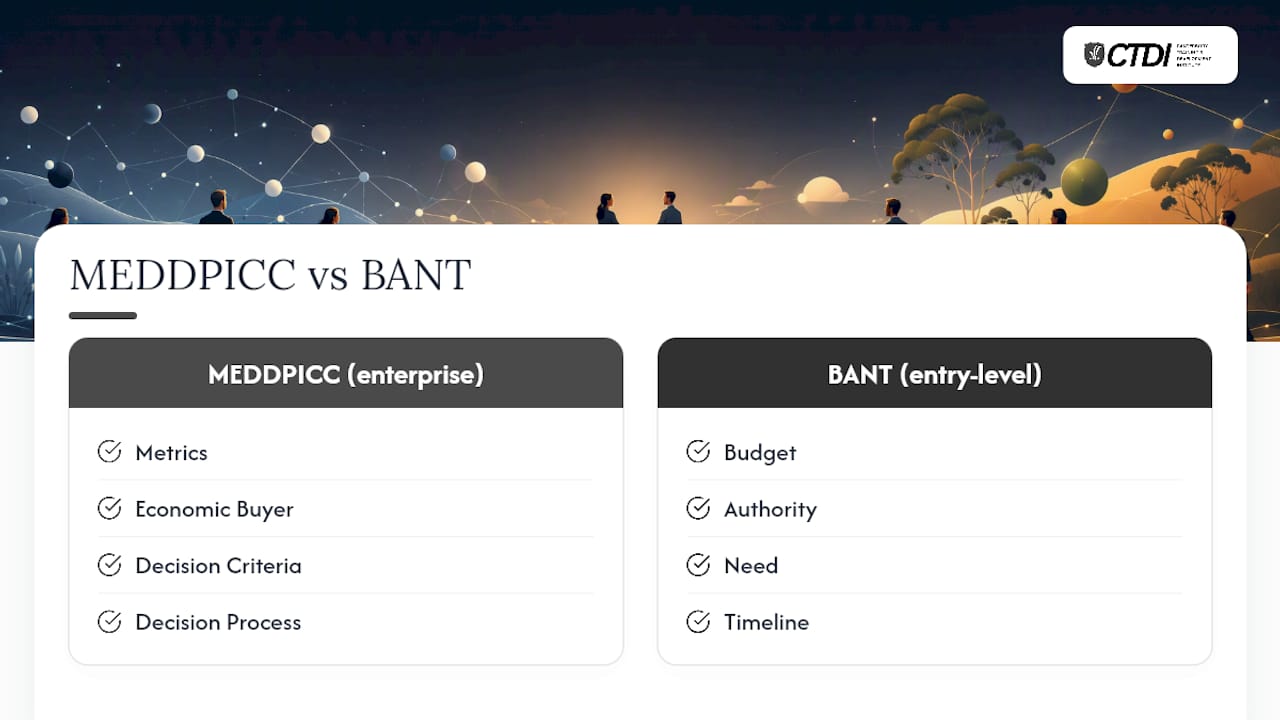
Drill: Take a live opportunity in your pipeline and write one sentence answering each MEDDPICC letter. Any blank is a gap to close on the next call.
Relationship building and rapport
Rapport is not small talk about the footy. It is the accumulated trust that makes a buyer choose you over an equally priced competitor. Gartner's research on the B2B buying journey shows that buying committees have grown significantly, which means rapport must extend beyond a single contact. Building it at scale requires consistent follow-through on small commitments, personalised outreach, and genuine curiosity about the buyer's business.
Drill: After every call, send one piece of genuinely useful content (an article, a benchmark, a case study) that you found specifically for that person's problem. Do this for 30 days and track whether your reply rates improve.
Objection handling
The instinct to rebut an objection immediately is almost always wrong. Sales research supports diagnosing objections before responding — treating resistance as a signal that something in the discovery was incomplete. The most effective response to "we're happy with our current provider" is a question, not a counter-argument.
Drill: Write down the five objections you hear most often. For each one, write a diagnostic question that uncovers the real concern beneath the surface objection. Practise delivering them until they feel natural.
Negotiation and closing
Closing is the natural conclusion of a well-run sales process, not a high-pressure moment at the end. When discovery is thorough and value is clearly tied to the buyer's specific outcomes, asking for the business feels like a logical next step rather than a push. Diagnostic selling and value-tied negotiation consistently outperform hard-closing tactics in complex B2B deals.
Drill: Role-play the final 10 minutes of a deal conversation with a peer. The peer's job is to introduce one late objection. Your job is to handle it without discounting.
Pro Tip: The fastest way to improve your objection handling is to stop practising responses and start practising questions. Write one diagnostic question for each of your five most common objections and memorise them before your next call.
Advanced and technical sales skills employers expect
Hiring managers in Australia increasingly screen for technical competency alongside interpersonal skills. These are the capabilities that separate candidates who can do the job from those who can demonstrate they have done it.
CRM proficiency and pipeline hygiene
Employers expect you to maintain a clean CRM without being asked. That means accurate close dates, correct deal stages, and notes that a colleague could act on. The minimum bar is knowing how to build a filtered pipeline view, run a basic forecast report, and flag stalled deals. Salesforce and HubSpot are the two platforms that appear most often in Australian job descriptions, though the underlying discipline transfers across any CRM.
KPI to target: 90% of open opportunities updated within the last seven days.
Steps to get started:
- Complete the free Salesforce Trailhead "Sales Representative" trail or HubSpot Academy's CRM certification (both available online, both free)
- Audit your current pipeline and close every opportunity that has had no activity in 60 days
- Build one custom report showing your pipeline by stage and review it every Monday morning
Sales methodologies: SPIN, MEDDIC and Challenger
SPIN, Challenger and Sandler each fit different deal sizes and buyer contexts. SPIN Selling (Situation, Problem, Implication, Need-payoff) works well for mid-market deals where the buyer needs help articulating their problem. The Challenger Sale suits complex enterprise deals where the seller brings an insight the buyer has not considered. Sandler is useful when you need to qualify hard and early to avoid wasting time on deals that will never close.
You do not need to master all three. Pick the one that matches your deal type and build a repeatable play around it.
KPI to target: A qualification conversion rate (qualified opportunities to closed-won) that you can state and explain in an interview.
Pipeline metrics and data literacy
Data literacy in sales means reading your own funnel numbers and knowing which lever to pull. That includes win rate by stage, average deal cycle, pipeline coverage ratio (typically 3x–4x quota), and activity-to-outcome ratios. Modern sales playbooks prioritise precision targeting and fewer, higher-quality touches over high-volume spray-and-pray outreach, which means your data has to tell you where to focus.
Steps to get started:
- Pull a 90-day pipeline report and calculate your win rate at each stage
- Identify the stage with the highest drop-off and run one experiment to address it
- Read one data literacy resource (Google's free "Data Analytics" course on Coursera covers the fundamentals)
Multi-channel outreach and social selling
Multi-channel sequencing means coordinating email, phone, LinkedIn, and sometimes video across a defined number of touches. The goal is not volume — it is relevance at each touchpoint. Social selling on LinkedIn specifically means publishing content that demonstrates expertise, commenting meaningfully on buyer posts, and using connection requests that reference something specific about the person's work.
KPI to target: Reply rate on outbound sequences. A well-targeted sequence to a defined ICP (ideal customer profile) should outperform generic bulk outreach.
AI-assisted research and automation
AI fluency for sales professionals means using AI tools to research accounts faster, draft personalised outreach, summarise call notes, and identify intent signals. The CTDI blog on AI skills and career development covers how these capabilities map to specific roles. The minimum competency employers look for is the ability to use an AI assistant to prepare for a call in under 10 minutes and to draft a follow-up email that does not read like a template.
Steps to get started:
- Use an AI assistant to research a target account before your next call: company news, recent hires, stated priorities
- Draft your next follow-up email with AI assistance, then edit it until it sounds like you
- Read the 2026 AI skills career guide for a structured pathway to building these skills
Research highlight: Gartner's data on the B2B buying journey shows that buying groups for complex solutions typically include six to ten decision-makers. Sellers who engage only one contact are statistically more likely to lose the deal, which is why multi-threading is now a core competency rather than an advanced tactic.
How do you show sales skills on your CV and in interviews?
The structure of an effective sales CV bullet is: metric + action + outcome. Vague claims ("responsible for new business development") tell a hiring manager nothing. Specific ones get interviews.
Six CV bullet examples for Australian sales roles
- Solution Seller: — Reduced average sales cycle duration by introducing a structured discovery framework and executive business review process.
LinkedIn headline and summary patterns
Your LinkedIn headline should state your role, your speciality, and one outcome. For example: "Enterprise Account Executive | SaaS | Helping Australian manufacturers reduce procurement costs."
In your summary, lead with a two-line statement of what you do and who you do it for, then add two lines of evidence. Avoid generic phrases like "results-driven professional" — they appear on hundreds of thousands of profiles and register as noise.
Interview answer templates
Discovery question prompt ("Tell me about your discovery process"): "I open with a question about the business outcome they're trying to achieve, not the product they think they need. I use a MEDDPICC framework to qualify as I go, and I measure success by whether I can articulate their pain in their own words by the end of the call."
Objection handling prompt ("Give me an example of handling a difficult objection"): "When a prospect told me they were happy with their current provider, I asked what 'happy' meant to them specifically. That question revealed they had a significant gap in reporting capability they hadn't connected to the product category. We closed the deal three weeks later."
Stakeholder influence prompt ("Tell me about a time you influenced a senior stakeholder"): "I identified that the economic buyer wasn't in our original deal thread. I asked my champion to arrange a 20-minute executive briefing, prepared a one-page business case tied to their stated FY goals, and used that meeting to get verbal commitment before the formal proposal."
Evidence checklist for hiring conversations
- At least three CV bullets with a specific metric, action, and outcome
- A LinkedIn profile with a headline that names your speciality and one result
- Two or three short case study notes (one paragraph each) you can reference in interviews
- A pipeline screenshot or activity report (anonymised) that shows your process
- A call recording or roleplay video you can share if asked for a practical demonstration
Business Queensland's selling skills guidance is a useful reference for structuring your evidence around the competencies Australian employers look for.
How do you practise and build sales skills week by week?
Skill development in sales compounds when it is structured and measured. A weekly plan with clear checkpoints beats an occasional training day every time.
Roleplay scoring rubric
Score each roleplay session from 1–5 on four dimensions:
| Dimension | 1 (Needs work) | 3 (Developing) | 5 (Strong) |
|---|---|---|---|
| Question quality | Closed, product-led questions | Mix of open and closed | Open, diagnostic, buyer-led |
| Listening ratio | Seller talks >60% | Roughly equal | Buyer talks >60% |
| Discovery depth | Surface-level pain only | Some implication explored | Full MEDDPICC mapped |
| Objection response | Immediate rebuttal | Partial diagnostic | Question before response |
Pro Tip: Run an A/B test on your outreach subject lines. Send the same sequence to two matched segments of 20 contacts each, with one variable changed (subject line, opening sentence, or call-to-action). After two weeks, the reply rate difference tells you something no training course can.
On-the-job experiments to run
- Test two discovery script variants across 10 calls each and compare qualification conversion rates
- Try a three-touch sequence versus a five-touch sequence on the same ICP and measure reply rates
- Add one piece of social proof (a case study reference, a relevant metric) to your email follow-up and track whether it changes response time
Practical guidance on multi-channel sequencing and intent-signal stacking shows how precision targeting and structured experimentation improve reply rates and qualification efficiency.
What learning pathways are available in Australia?
Three tiers of study suit different situations, and the right choice depends on how much time you have and what level of credential you need.
Three pathway tiers
Quick upskill (hours to weeks): Free or low-cost online modules, vendor certifications (HubSpot Academy, Salesforce Trailhead, LinkedIn Learning), and short workshops. No formal credential, but useful for building a specific skill fast. Cost: typically free to $200 AUD.
Vocational micro-credential (weeks to months): Short accredited courses that build a specific skill cluster and may contribute to a larger qualification. Useful for professionals who need a credential without committing to a full diploma. Cost: varies widely by provider and government funding eligibility.
Nationally recognised diploma (months): A formal Australian Qualifications Framework (AQF) qualification that carries weight with employers and can be listed on a CV as a verified credential. Relevant diplomas for sales professionals include digital marketing, business, and AI-related qualifications. Cost: varies by provider and whether you are eligible for government-subsidised training.
Pathway decision guide
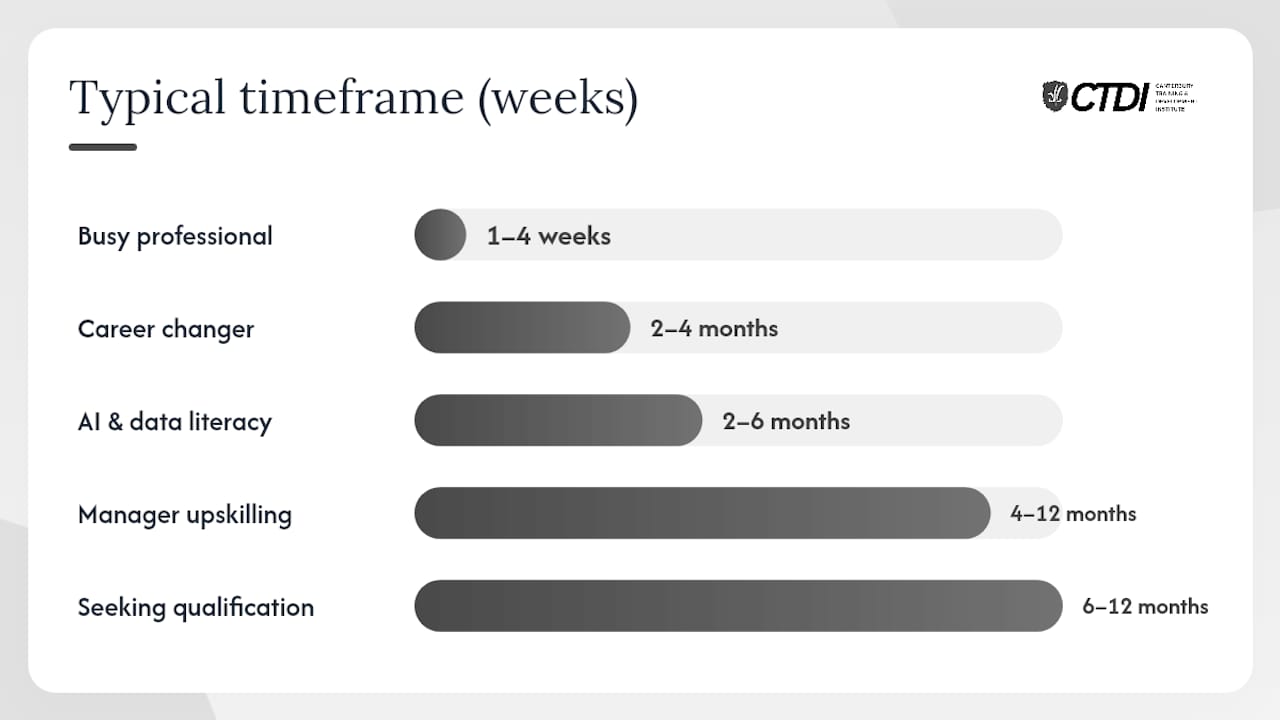
| Your situation | Recommended pathway | Typical timeframe |
|---|---|---|
| Busy professional, one skill gap | Vendor certification or short online course | 1–4 weeks |
| Career changer entering sales | Vocational micro-credential in digital marketing or business | 2–4 months |
| Manager upskilling a team | Nationally recognised diploma or blended programme | 4–12 months |
| Seeking formal qualification for a CV | AQF-accredited diploma | 6–12 months |
| Building AI and data literacy for sales | Accredited AI or digital marketing course | 2–6 months |
For Australian professionals specifically, Business Queensland's selling skills resources provide a practical starting point for identifying which competencies to prioritise before choosing a course.
Edu (Canterbury Training & Development Institute) offers nationally accredited online courses in AI, digital marketing, and related disciplines, delivered self-paced so they fit around a full-time sales role. These are particularly relevant for professionals building the technical skills covered in the advanced section above: CRM and AI fluency, data literacy, and digital selling. CTDI's online course options cover the range of available study formats and entry points.
Why do active listening and data literacy matter most?
Active listening is the single skill that most directly determines whether a seller uncovers real buyer pain or spends the call pitching at a problem they assumed existed. The evidence for this is consistent across sales research: sellers who ask more diagnostic questions and talk less close more complex deals. Consultative selling, diagnostic discovery, and embedded coaching all point to the same conclusion — the seller's job is to understand before they advise.
Data literacy matters for a different reason. It is the skill that makes every other skill measurable. Without it, you cannot tell whether your discovery is improving, whether your outreach is working, or whether your pipeline is healthy. The 2026 B2B sales skills landscape places data-driven pipeline management alongside active listening as a top differentiator for high performers.
Research highlight: Gartner's B2B buying journey research shows that buying committees for complex solutions typically include six to ten people. Sellers who engage only a single contact face a structurally higher risk of losing the deal when that contact changes roles, loses internal support, or simply cannot drive consensus alone.
Supporting evidence from the research:
- SyncGTM's B2B skills guide identifies multi-threading, AI fluency, and data literacy as the skills that most clearly differentiate top performers from average ones in 2026.
- Supered's analysis of sales call data supports the shift away from high-pressure closing toward diagnostic questioning, with evidence drawn from Rackham's SPIN research and the Challenger Sale.
- Teamleader's methodology comparison shows that SPIN and Challenger outperform transactional approaches in complex, multi-stakeholder deals.
Pro Tip: When you reference research in an interview, name the source. "Gartner's buying journey research shows six to ten decision-makers in complex deals, which is why I always map the full buying committee" is a more credible answer than "I've heard that buying groups are bigger now." It signals that you read, you think, and you apply evidence.
Key takeaways
The most effective approach to building skills for sales is to combine active listening and diagnostic discovery with technical competencies like CRM hygiene, data literacy, and AI fluency, then evidence each skill with specific metrics on your CV and in interviews.
| Point | Details |
|---|---|
| Prioritise active listening first | Measure your talk-to-listen ratio on recorded calls; aim to speak less than half the time. |
| Use MEDDPICC to qualify | Map every open opportunity against the framework; any blank is a call objective, not a gap to ignore. |
| Build technical skills with free tools | Salesforce Trailhead and HubSpot Academy certifications are free and recognisable on an Australian CV. |
| Evidence skills with metrics | Every CV bullet needs a metric, an action, and an outcome; vague claims do not get interviews. |
| Edu for accredited upskilling | CTDI offers nationally recognised online courses in AI and digital marketing that map directly to the technical sales skills employers expect. |
7/30/90 action plan
Next 7 days:
- Record and transcribe one mock discovery call; calculate your talk-to-listen ratio
- Audit your pipeline and update every open opportunity in your CRM
- Rewrite two CV bullets using the metric + action + outcome structure
- Complete one free vendor certification (HubSpot Academy or Salesforce Trailhead)
First 30 days:
- Run three structured roleplays per week using the scoring rubric above
- Run one A/B outreach experiment (subject line or opening sentence) across two matched segments
- Map one live deal against the full MEDDPICC framework and identify the gaps
- Build a LinkedIn headline that names your speciality and one measurable outcome
First 90 days:
- Complete a short accredited course in digital marketing or AI to build your technical credentials
- Assemble a hiring evidence pack: three metric-backed CV bullets, two case study notes, and one anonymised pipeline report
- Track your qualification conversion rate for the full quarter and be able to state it in an interview
- Identify one advanced methodology (SPIN, Challenger, or Sandler) that fits your deal type and build a repeatable play around it
Evidence checklist for hiring conversations:
- Three or more CV bullets with specific metrics
- LinkedIn headline naming speciality and one outcome
- Two short case study notes (one paragraph each)
- One anonymised pipeline or activity report
- One call recording or roleplay video (optional but differentiating)
The publisher's perspective on training outcomes
The employers Edu works with are consistent about one thing: they do not hire on qualifications alone, but a nationally recognised credential changes the conversation. It signals that a candidate has committed time and effort to structured learning, not just accumulated experience. What moves a candidate from shortlist to offer is usually the combination of a credential and demonstrable outcomes — a metric-backed CV, a case study they can speak to, a qualification they can name.
At CTDI, courses are designed by industry practitioners and assessed against real workplace tasks. That means students build a portfolio of evidence as they study, not just a certificate at the end. For sales professionals, the most relevant pathways are in digital marketing and AI, where the technical skills covered in this article (data literacy, AI-assisted research, digital selling) map directly to course outcomes.
If you are a manager upskilling a team, the self-paced format means staff can study without taking time away from their pipeline. If you are a career changer, the nationally recognised qualification gives you a credential that stands on its own merits in an Australian hiring market.
Useful sources and further reading
- What Skills Are Needed for B2B Sales: 2026 Guide | SyncGTM | SyncGTM
- Gartner — B2B buying journey (sales insights)
- The 10 Best Sales Techniques for B2B Sellers in 2026
- Sales Techniques That Work (and Some to Retire) — Supered
- Sales Techniques: 47 Proven Methods — FirstSales.io
- Sales techniques: 5 highly effective modern sales methods | Teamleader
- Improving sales skills — Business Queensland
Recommended
- 2026 career trends list: what Australian professionals need to know
- Essential workplace skills list for career success in 2026
- Why pursue professional development: skills and career gains — Canterbury Training and Development Institute
- Skills gap in 2026 explained: what Australian businesses need to know