

TL;DR:
- By 2026, Australia's skills gap mainly affects AI, data analysis, leadership, and communication skills.
- Organizations must shift to continuous, skill-based development and leverage online, practical training.
By 2026, the skills gap has become the defining workforce problem for Australian enterprises. It is the mismatch between the capabilities organisations need to compete and what their current workforce can actually deliver. That gap now spans two distinct dimensions: technical skills like AI model development and data analysis, and human-centric skills like leadership, critical thinking, and communication. Analytical thinking and resource management rank among the skills with the highest importance and proficiency gaps globally, according to the World Economic Forum's Future of Jobs Report 2025.
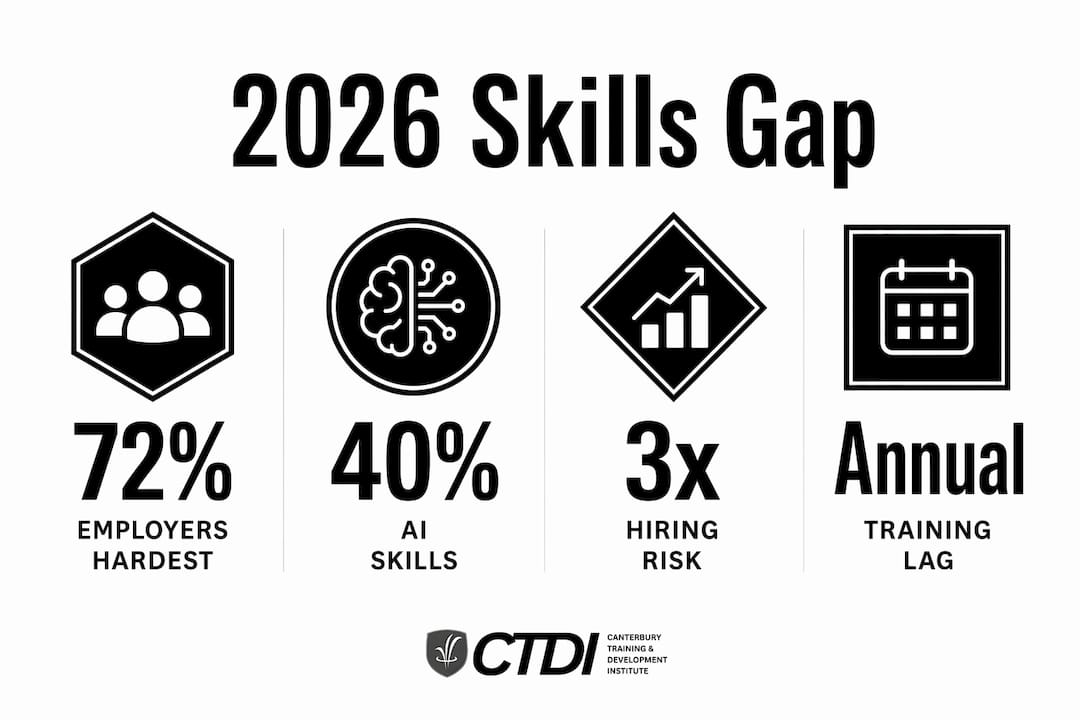
The scale is hard to ignore. 72% of employers report difficulty hiring for AI roles in 2026, with AI model development and AI literacy topping the list of hardest-to-fill capabilities worldwide. For Australian HR professionals and workforce planners, the picture is equally pressing across construction, healthcare, digital, and clean energy sectors.
Key dimensions of the 2026 skills gap:
- Technical skills: AI literacy, data analysis, cybersecurity, software development
- Human-centric skills: leadership, critical thinking, communication, adaptability
- Operational skills: resource management, quality control, project coordination
- Emerging hybrid skills: roles requiring both manual dexterity and technological fluency
Why the skills gap has become a critical business challenge in 2026
A large majority of CEOs now view unaddressed skills gaps as their biggest people-related business risk. That is not hyperbole. When the capabilities your workforce holds diverge from the capabilities your business model demands, productivity stalls, transformation projects fail, and competitive advantage erodes.
The financial exposure is real across sectors. The table below shows where Australian industries face the sharpest shortages and the nature of the capability deficit driving them.
| Industry | Primary skill deficit | Severity |
|---|---|---|
| Technology and digital | AI development, cybersecurity | Critical |
| Construction and infrastructure | Trades, project management | High |
| Healthcare and aged care | Clinical specialisations, digital health | High |
| Clean energy | Engineering, installation, compliance | High |
| Financial services | Data analytics, regulatory technology | Moderate to high |
The hardest skills to hire for in 2026 are no longer traditional engineering or IT roles. AI model development and AI literacy now top global skill shortages, with 72% of employers globally reporting difficulty hiring for AI roles, according to ManpowerGroup's 2026 Talent Shortage Survey.
Most organisations compound the problem by relying on annual training and hiring cycles that simply cannot keep pace with how quickly skill needs shift. Continuous, real-time monitoring of skill needs is now the recommended standard, not periodic review. Businesses that still treat workforce capability as an annual HR agenda item are already behind.
What is actually driving the 2026 skills gap?
The gap does not have a single cause. Several forces are converging at once, and each one accelerates the others.
- AI adoption outpacing training: Organisations are deploying AI tools faster than they can build the internal capability to use them well. The result is technology investment that underperforms.
- Retiring experienced workers: Senior employees carry niche expertise that rarely gets documented. Organisations often lack formalised knowledge transfer programmes, and when those workers leave, that knowledge goes with them.
- Education systems lagging behind: Vocational and university curricula update slowly. Graduates arrive with credentials that reflect the job market of three years ago, not the one they are entering.
- One-time training events: A two-day workshop or annual compliance module does not build durable capability. Skills acquired in isolation, without reinforcement or application, fade quickly.
- Short-term workforce planning: Only 12% of European organisations look beyond three years in workforce planning, according to McKinsey. Australian enterprises face a similar short-termism problem, leaving them reactive rather than prepared.
Pro Tip: Run a predictive skill mapping exercise now, not at your next annual review. Map the skills your business will need in 18 months against what your current workforce holds, and identify the gaps before they become vacancies.
Why traditional hiring models fail to close the gap

Posting a job advertisement and waiting for the right candidate made sense when skill requirements were stable. In 2026, that approach is too slow and too expensive to be the primary strategy.
The core problem is credential bias. Most hiring processes still filter on degrees, job titles, and years of experience rather than on demonstrated capability. That approach misses candidates with high potential and filters out people who have built relevant skills through non-traditional pathways. ManpowerGroup CEO Jonas Prising has pointed to hiring for potential, rather than credentials alone, as a key source of workforce advantage in 2026.
The limitations stack up quickly:
- Slow timelines: Recruiting for specialised AI or data roles can take months, during which capability gaps widen.
- High cost: External recruitment for senior technical roles carries significant direct and indirect costs, including onboarding time and lost productivity.
- No internal development: Hiring externally without investing in existing staff creates resentment, increases turnover, and leaves the underlying capability deficit unresolved.
- Credential mismatch: Roles requiring AI literacy or data fluency rarely have a clear credential equivalent, making traditional screening criteria unreliable.
What a skill-based workforce model actually looks like
A skill-based workforce model organises people around what they can do, not what their job title says. Instead of hiring for a role and hoping the person grows into it, organisations map the specific capabilities each function requires and build or acquire those capabilities deliberately.
The benefits are tangible. Internal mobility and upskilling existing employees reduce recruitment costs by 60% and improve overall employee retention. That is a significant shift in the economics of workforce management.
Key features of a skill-based model:
- Capability profiles replace or supplement traditional job descriptions
- Internal talent marketplaces match employees to projects based on skills, not seniority
- Learning is tied directly to role requirements and business outcomes
- Skills data informs succession planning, not just performance reviews
- Progression is based on demonstrated capability, not tenure
| Outcome metric | Traditional model | Skill-based model |
|---|---|---|
| Time to fill capability gaps | Weeks to months | Days to weeks |
| Recruitment cost per role | High | Reduced by up to 60% |
| Employee retention | Lower | Higher |
| Workforce agility | Low | High |
| Learning relevance | Generic | Role-specific |
The Wharton-Accenture Skills Index reinforces this shift. Their research confirms that skill value is role-specific, not universal. A capability that commands a wage premium in one function can be correlated with reduced compensation in another. Blanket upskilling programmes that treat all skills as equally valuable are, by that measure, a waste of investment.
How Australian enterprises can shift to a skill-based workforce
The transition is practical, not theoretical. Organisations that have moved fastest share a few common approaches.
- Start with a skills audit: Map current capabilities against projected role requirements. Identify where surpluses exist alongside deficits, because both matter for redeployment decisions.
- Build continuous learning into the workflow: Microlearning tied directly to performance goals reduces time to proficiency by 40% compared to traditional training, according to LinkedIn Learning 2026 data. Short, targeted modules beat multi-day workshops for retention and application.
- Create internal mobility pathways: Give employees visibility into roles and projects that match their developing skills. This retains talent and builds capability simultaneously.
- Formalise knowledge transfer: Before senior workers retire, document their expertise through structured mentoring, process documentation, and cross-training. This is especially critical in regulated industries where niche knowledge is hard to replace.
- Involve managers in skill development: Capability building fails when it sits entirely in HR. Line managers need to understand the skill requirements of their teams and actively support development plans.
- Measure progression, not just participation: Track whether skills are actually being applied and improving, not just whether employees completed a module.
Canterbury Training & Development Institute (CTDI) offers a practical model for how structured, accredited learning can support this transition. Their nationally recognised online diplomas in AI, digital marketing, and environmental management are designed specifically for working professionals who need to build role-relevant skills without pausing their careers. For HR teams building upskilling programmes for 2026, CTDI's self-paced format means employees can learn in the flow of work rather than in a separate training event.
"Across industries, advanced AI is fundamentally changing how work gets done, and which skills matter most. Leaders need more than intuition; they need evidence." — Wharton-Accenture Skills Index
How the 2026 skills gap is hitting Australian industries
Australia's exposure to the skills shortage is concentrated in sectors driving the government's economic priorities. Clean energy, construction, digital infrastructure, and healthcare are all projecting demand growth that the current education pipeline cannot meet alone.
The clean energy transition is a clear example. Roles in solar installation, grid management, and compliance engineering require a blend of trade qualifications and digital literacy that few workers currently hold. Construction faces a similar problem, with project management and trades shortages compounding infrastructure delivery timelines. In healthcare, the combination of an ageing population and digital health adoption is creating demand for clinical staff who can also navigate data systems and telehealth platforms.
For digital and technology roles, the pressure is most acute. AI skills have surpassed traditional engineering and IT skills as the hardest-to-fill capabilities globally. Australian tech employers are competing with international markets for the same thin pool of AI-literate talent, and remote work has made that competition borderless.
Long-term implications for workforce planning and competitiveness
Organisations that treat the skills gap as a short-term hiring problem will keep solving the same problem every year. The long-term implication is structural: if your workforce planning horizon is less than three years, you are always reacting to a gap that formed years earlier.
The competitive risk compounds over time. Businesses that build continuous learning into their operating model accumulate capability faster than those that rely on periodic recruitment. That gap in organisational capability becomes a gap in market performance. Leaders who shift to data-driven, multiyear skills strategies outperform those with reactive approaches, per McKinsey research. For Australian enterprises, the practical implication is to treat skills data with the same rigour applied to financial data: measure it, report on it, and plan against it.
Which technologies are reshaping skill requirements most sharply?
Generative AI is the most disruptive force, but it is not the only one. Automation, cloud computing, and data analytics are each reshaping what roles require, often simultaneously.
The IMF's analysis of advanced economies found that roughly 1 in 10 job vacancies now demands at least one new skill, with a growing share linked to AI. That figure is lower in emerging markets, but the direction is consistent globally. Generative AI specifically is reducing demand for routine cognitive tasks while increasing demand for judgement, coordination, and domain expertise. The practical effect is that roles once considered stable, including mid-level analytical and administrative positions, are evolving faster than their occupants can adapt without deliberate upskilling.
For Australian workers and employers, AI literacy is no longer optional. It is the baseline capability that determines whether an employee can work effectively alongside AI tools or be displaced by them. Embedding AI literacy into workforce development programmes is now a core responsibility for HR leaders, not a future consideration.
Enterprises that have closed the gap: what worked
The most effective enterprise responses share a common thread: they stopped treating skills development as a cost centre and started treating it as a capability investment.
Organisations in financial services that introduced internal AI literacy programmes ahead of regulatory technology changes found they could redeploy existing analysts into new roles rather than recruiting externally. The result was faster implementation, lower cost, and higher retention among staff who felt their development was being invested in.
In the construction sector, firms that formalised apprenticeship-to-digital-skills pathways, pairing trade training with project management software and BIM (Building Information Modelling) literacy, reduced their skills-related project delays. The key was integrating the technical and digital training rather than treating them as separate programmes.
Healthcare organisations that built structured knowledge transfer programmes before their senior clinical staff retired preserved institutional expertise that would otherwise have been lost. Cross-generational mentoring, combined with documented clinical protocols, gave incoming staff a foundation that recruitment alone could not provide.
What government and policy can do to address the shortage
Australian government policy is moving in the right direction, but the pace needs to match the urgency. The Skills England annual report (a useful international benchmark) found that more than a quarter of job vacancies are hard to fill due to skills shortages, and that the education pipeline alone will be insufficient to meet employer demand in priority sectors.
For Australia, the policy priorities are clear. Funding for vocational education and training needs to be tied to actual employer demand, not historical enrolment patterns. Apprenticeship and traineeship frameworks need to expand into digital and AI-adjacent roles, not just traditional trades. Industry-led skills councils that can update qualification frameworks faster than the standard review cycle would close the lag between what employers need and what training providers deliver.
Employer investment in training has also declined over the past decade. Public funding cannot compensate for that withdrawal. Tax incentives for employer-funded training, particularly in priority sectors like clean energy and digital, would encourage the private investment that workforce capability requires. Organisations like CTDI, which deliver nationally recognised qualifications aligned to current industry needs, are well positioned to support both individual learners and enterprise training partnerships.
Key takeaways
The 2026 skills gap in Australia is a structural capability mismatch driven by AI adoption, demographic change, and short-term workforce planning, and closing it requires a shift from credential-based hiring to continuous, skill-based development.
| Point | Details |
|---|---|
| AI skills are the hardest to fill | 72% of employers globally report difficulty hiring for AI roles, with AI literacy and model development topping shortages. |
| Skill-based models cut recruitment costs | Internal mobility and upskilling reduce recruitment costs substantially and improve retention. |
| Microlearning accelerates proficiency | Learning tied to performance goals reduces time to proficiency compared to traditional training. |
| Long-term planning is the differentiator | Organisations with multiyear skills strategies outperform those with reactive, short-term approaches. |
| Edu supports accredited upskilling | CTDI offers nationally recognised online diplomas in AI, digital marketing, and sustainability for working professionals. |
The skills gap demands a different kind of leadership
The conventional wisdom on the 2026 skills gap tends to focus on what organisations are missing. The more useful question is why they keep missing it, year after year, despite knowing the gap exists.
The answer is usually not a lack of training budget. It is a lack of integration between skills data and business strategy. HR teams run capability assessments. Finance teams run headcount models. Neither feeds directly into the other, and neither is updated frequently enough to catch a gap before it becomes a crisis. The organisations closing the gap fastest are the ones where workforce capability sits on the executive agenda alongside revenue and risk, not as a separate HR report.
There is also a cultural dimension that policy and technology cannot fix. Embedding learning into work, rather than separating it into scheduled training events, requires managers who see development as part of their job. That shift does not happen through a learning management system rollout. It happens when leaders model it, measure it, and reward it.
AI literacy deserves specific attention here. The risk is not that AI replaces workers wholesale. The IMF's analysis shows the real pressure falls on occupations with high AI exposure and low complementarity, where tasks are automatable rather than augmented. Building AI literacy across your workforce is not about making everyone a developer. It is about ensuring your people can work with AI tools effectively, question their outputs critically, and apply human judgement where it counts. That capability is what separates organisations that use AI well from those that use it badly.
Upskill your workforce with Edu's accredited online courses
Closing the skills gap starts with the right training partner. Edu, the Canterbury Training & Development Institute, offers nationally recognised online diplomas built around the capabilities Australian employers are actively seeking in 2026: AI, digital marketing, and environmental sustainability.
Every course is 100% online and self-paced, so your team members can build skills without stepping away from their roles. Programmes are designed by industry experts and aligned to current workforce demands, not last decade's job descriptions. Whether you are an HR leader building an enterprise upskilling programme or a professional investing in your own career development for 2026, Edu gives you a practical, accredited pathway. Enrol now and start building the capabilities your organisation needs before the gap widens further.