
Five capabilities move the needle for career growth right now: systems thinking, data literacy tied to emissions measurement, ESG and regulatory fluency, stakeholder engagement combined with project delivery, and the adaptability to keep learning as rules shift. Employers are already paying for it, with RMIT Online research showing a notable premium for managers who bring green skills to leadership roles. Accredited VET qualifications and short courses, including options through CanterburyTDI, offer practical ways to build these skills alongside real workplace projects.
Table of Contents
- Why sustainability skills matter for your career right now
- Top 10 sustainability skills to build for career growth
- Practical pathways: accredited qualifications, microcredentials and workplace projects
- How employers evaluate and reward sustainability capability
- Six-step action plan to build and demonstrate sustainability skills
- Networking and mentorship opportunities in sustainability careers
- How CanterburyTDI can help you build these skills
- Sources
- FAQ
Why sustainability skills matter for your career right now
Regulation is the obvious driver, but it's not the only one. Investors want emissions data before they'll back a supplier. Customers ask procurement teams for sustainability credentials before signing contracts. Boards want directors who understand climate risk, not just balance sheets. All of that pressure lands on individual employees who now have to answer questions their job description never mentioned five years ago.
The labour market is responding to that shift. The World Economic Forum forecasts a global increase of more than 25% in sustainability specialist roles by 2030, driven by the broader green transition reshaping entire industries rather than a handful of niche departments. That growth isn't confined to standalone sustainability officer roles either. It's showing up inside finance, procurement, operations, and marketing teams, where someone who already understands the business is now expected to also understand its environmental footprint.
The pay signal is real and specific. RMIT Online's research found employers are willing to pay a premium, roughly $13,000 a year, for managers who bring green skills into leadership positions. That premium tends to concentrate in roles with budget authority and reporting responsibility, not entry-level positions.
Most professionals building sustainability capability aren't leaving their current job to do it. They're adding a layer of skill to a role they already hold. A finance manager who learns to read a carbon disclosure statement doesn't become a sustainability officer. They become a finance manager whose analysis employers trust more, because they can connect emissions data to financial risk without waiting for someone else to translate it. RMIT Online's analysis of upskilling patterns backs this in as the more common and often faster route than a full career pivot.
Top 10 sustainability skills to build for career growth
Some of these skills take a semester of structured study. Others you can pick up through a short course and a single workplace project. Here's what actually gets used on the job, ranked roughly by how often employers ask for it.
1. Systems thinking
This is the ability to see how a decision in one part of a business ripples through supply chains, cost structures, and environmental outcomes elsewhere. Employers value it because sustainability problems rarely sit inside one department. A supply chain manager who understands systems thinking can spot that switching to a cheaper packaging supplier might cut costs this quarter while creating a compliance headache next year when new packaging waste levies apply.

2. Data literacy and impact measurement
Reading and interpreting sustainability data, energy use, water consumption, waste volumes, is now a baseline expectation in many operational roles. Employers want people who can turn a spreadsheet of consumption figures into a decision, not just a report. A facilities coordinator who can measure and track a building's energy intensity over twelve months gives management something concrete to act on, rather than a vague sense that "we should probably use less power".
3. Carbon accounting and climate risk
This covers measuring greenhouse gas emissions across an organisation's operations and supply chain, and understanding how climate risk shows up on a balance sheet. It matters because more companies now face mandatory or investor-driven climate disclosure. An accountant who can prepare a basic Scope 1 and Scope 2 emissions inventory brings a skill that used to require an external consultant.
4. ESG and regulatory knowledge
Environmental, social, and governance reporting frameworks are becoming standard reference points for procurement, finance, and risk teams. Employers need people who can read a regulatory update and translate it into a checklist their team can follow. A compliance officer who understands how ESG reporting obligations intersect with existing financial reporting saves the business from scrambling every time a new disclosure requirement lands.
5. Sustainable procurement and circularity
This is choosing suppliers and materials based on lifecycle impact, not just unit price. It matters most in procurement and operations, where sourcing decisions have long tails. A procurement officer applying circularity thinking might redesign a tender to favour suppliers who can take back packaging at end of life, cutting landfill costs and strengthening the tender's ESG scoring.
6. Stakeholder engagement and communications
Sustainability work only sticks if people outside the sustainability function actually buy in. This skill is about explaining technical environmental information to a board, a customer, or a factory floor team in language each group understands. A marketing manager who can accurately communicate a product's sustainability credentials without overstating them builds trust with customers who are increasingly sceptical of vague green claims.
7. Project management for sustainability
Running a sustainability initiative, an energy efficiency retrofit, a waste reduction program, a supplier audit, requires the same discipline as any other project: scope, budget, timeline, and stakeholder sign off. An operations lead who can deliver a sustainability pilot on schedule and within budget demonstrates the initiative works as a business project, not just a good intention.
8. Sector technical skills
Every industry has its own sustainability technicalities. In the built environment, that might mean understanding embodied carbon in construction materials. In food services, it might mean managing food waste diversion and supplier sourcing standards. In finance, it might mean understanding green bond frameworks. Employers rarely want generic sustainability knowledge, they want it applied to their sector.
9. Leadership and change management
Sustainability initiatives usually meet resistance, whether it's cost concerns, scepticism, or simple inertia. Leading change means building a case that survives scrutiny from finance and operations, not just from people already convinced. A team leader who can get buy-in for a pilot project from a cost-conscious CFO has demonstrated a leadership skill that outlasts any single initiative.
10. Adaptability and continuous learning
Regulatory frameworks, reporting standards, and technology all keep shifting. The professionals who stay useful are the ones who treat sustainability knowledge as something to keep updating rather than something they finished learning once.
Pro Tip: Don't try to master all ten at once. Pick the two or three skills most relevant to your current role, build genuine competence there, and let the rest develop as your responsibilities grow.
A few of these skills tend to cluster together depending on function:
- Finance and risk roles lean on carbon accounting, ESG knowledge, and data literacy.
- Procurement and operations roles lean on sustainable procurement, systems thinking, and project management.
- Marketing and communications roles lean on stakeholder engagement and regulatory knowledge, particularly around green claims.
Practical pathways: accredited qualifications, microcredentials and workplace projects
Three main routes exist for building sustainability capability, and picking the right one depends on how much time you have and how formal a credential you need.
Nationally accredited qualifications sit at the top of the credibility ladder. The 11130NAT Certificate IV in Environmentally Sustainable Management covers units around energy auditing, waste management, and sustainability planning at an operational level, and appears on training.gov.au, the federal government's authoritative register for nationally recognised VET qualifications. The MSS50122 Diploma of Sustainable Operations sits a level higher, with units covering emissions measurement and energy auditing that map directly to tasks employers actually need done, such as measuring and reporting a carbon footprint. Both are distinct from certificates of completion or short courses, which don't carry the same nationally recognised status.
CanterburyTDI's Certificate IV in Environmental Sustainable Management is one option worth checking against the training.gov.au listing if you're weighing up a fully online, self-paced accredited pathway.
Microcredentials and short courses move faster. If you need a specific competency, say, ESG reporting basics or a sustainability communications skill, within weeks rather than months, a targeted short course usually gets you there without the time commitment of a full qualification. CanterburyTDI's blog on ESG certifications breaks down how different certifications line up against different career goals, which is worth a read before committing time to any single course.
Workplace projects turn either of the above into evidence an employer can actually see. A qualification proves you understand the theory. A project proves you can apply it. RMIT Online's research on upskilling points to blended routes, short structured training paired with a real workplace task, as often enough to move someone from beginner to genuinely useful on a specific sustainability function.
When choosing a route, weigh up:
- How much time you can realistically commit over the next three to six months.
- Whether your role needs a recognised qualification code or just demonstrable skill.
- Whether your employer will support study time or a pilot project, which changes the calculus significantly.
CanterburyTDI's comparison of green skills training routes walks through how VET qualifications, microcredentials, and short courses differ in scope and typical study load, useful if you're still deciding which path fits your situation.
How employers evaluate and reward sustainability capability
Hiring managers and internal promotion panels look for specific, checkable evidence, not just a course completion certificate sitting on a CV. What tends to stand out:
- A quantified result: "reduced site energy use by measurable amount over six months" carries more weight than "led sustainability initiatives".
- Cross-functional delivery: proof you worked with finance, operations, or external suppliers to get something done, not just within a sustainability silo.
- Verified training: a qualification code from training.gov.au or a named microcredential provider, rather than a vague "completed sustainability training".
- Governance experience: any involvement in ESG reporting, audit preparation, or board-level sustainability updates.
When you're writing this up for a CV or talking through it in an interview, structure matters. State the project title, the scope (what you owned, what you didn't), and the metric you moved. "Coordinated a departmental waste audit across three sites, identifying a recycling contamination issue that was corrected within the quarter" tells a hiring manager far more than "involved in sustainability projects".
The pay premium tends to show up where responsibility does. RMIT Online's data on the 13% (roughly $13,000) premium for green-skilled managers points specifically to leadership and managerial roles, where sustainability capability gets paired with budget and reporting authority. It's less pronounced at entry level, which is a reason to aim your evidence at demonstrating leadership potential, not just task completion.
Framing sustainability work around commercial outcomes, cost avoided, risk reduced, compliance secured, tends to land better with hiring panels than framing it purely as environmental achievement. Both are true. Only one usually gets budget approved.
Six-step action plan to build and demonstrate sustainability skills
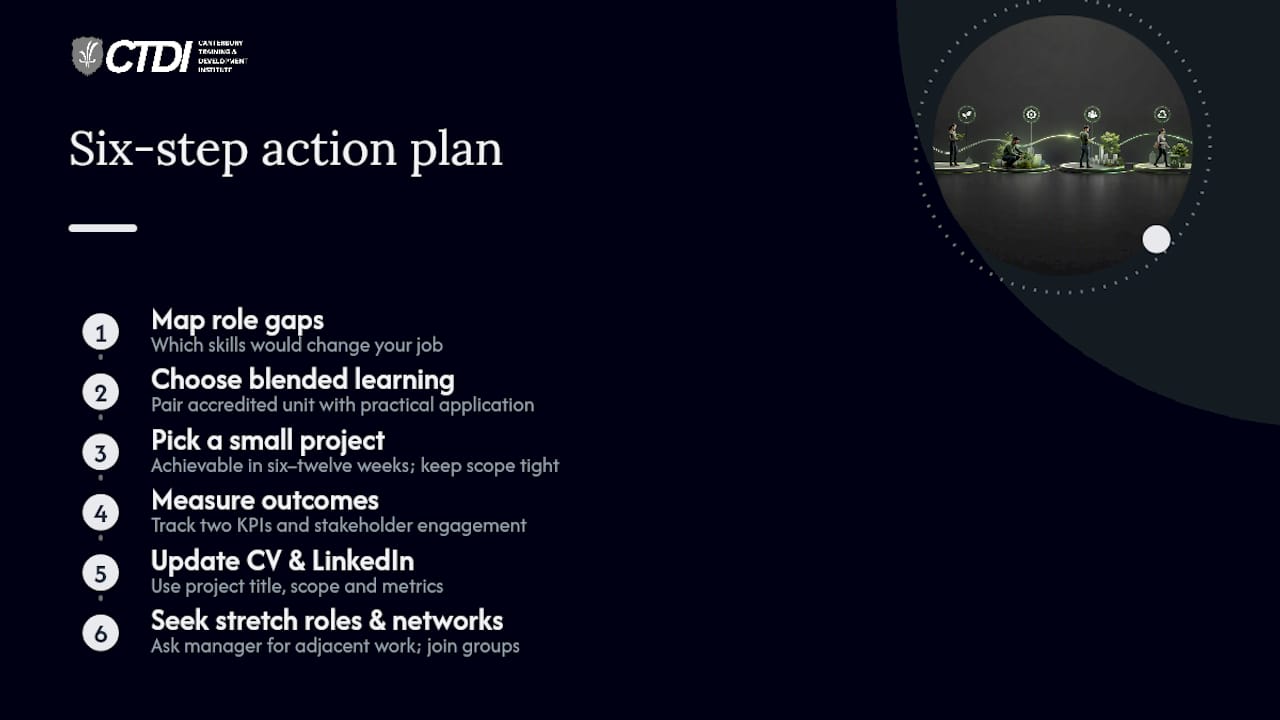
1. Map your role-specific gaps. Look at your current job description and ask which of the ten skills above would change how you do your job, not which sound impressive.
2. Choose a blended learning route. Pair a microcredential or accredited unit with a practical application. A single accredited unit covering something like an emissions audit, paired with a short course in data presentation, covers both technical skill and the communication skill needed to present it.
3. Identify a small workplace project. Pick something achievable in six to twelve weeks: an energy audit of one site, a supplier sustainability review, a waste diversion trial. Keep the scope tight enough to finish.
4. Measure and document outcomes. Track two KPIs from the start, something like cost or resource use before and after, and a stakeholder engagement measure like sign off from another department. Numbers you didn't record during the project are numbers you can't use afterward.
5. Update your CV and LinkedIn. Use the project title, scope, and metric structure. Don't wait for a performance review to surface this work.
6. Seek stretch roles and professional networks. Ask your manager about taking on adjacent sustainability responsibilities, and connect with others doing similar work through industry groups.
Pro Tip: Getting employer buy-in for a pilot project is far easier if you frame it around a cost or risk metric your manager already cares about, rather than pitching it as a standalone environmental initiative.
Networking and mentorship opportunities in sustainability careers
Sustainability roles cross so many functions that the usual networking playbook, sticking to your own department or industry vertical, tends to miss most of the opportunity. Some of the most useful connections come from people solving similar problems in completely different sectors: a supply chain manager in manufacturing and a procurement lead in hospitality both wrestling with supplier sustainability audits have more to teach each other than either might expect.
Professional associations linked to specific accredited qualifications, industry sustainability networks, and alumni groups from VET providers all offer practical entry points. Internal mentorship matters too. If your organisation has anyone working in ESG reporting, governance, or environmental compliance, even informally, ask them how they built their capability. Most people who've done this work are generous with what they learned, partly because the field moves fast enough that yesterday's expert knows how quickly things change.
Conferences and industry events focused on specific sectors, such as infrastructure workforce planning, tend to offer more targeted mentorship opportunities than generic sustainability summits, because the conversations get specific fast. Mentors who work in your actual industry can tell you which skills your employer will pay for, and which ones sound good on paper but rarely move a hiring decision.
How CanterburyTDI can help you build these skills
If you've read this far and want a structured way to build the technical foundation, rather than piecing it together from short courses and hoping it adds up, that's exactly the gap a nationally accredited qualification is designed to close.
CanterburyTDI's Certificate IV in Environmental Sustainable Management is designed around the practical skills employers are asking for: environmental management fundamentals, resource efficiency, and sustainability reporting, built by industry experts and delivered fully online at your own pace. It suits working professionals who need to study around existing job commitments rather than pause their career to attend a campus. These courses are positioned around flexible, self-paced online learning with student support, offered with transparent tuition fees rather than fixed timetables and higher costs typical of on-campus alternatives.
This course won't guarantee a job title or a pay rise. What it does give you is a nationally recognised credential you can pair with the workplace project approach covered earlier in this article, turning study into evidence a hiring manager can actually assess. If you're ready to look at the details, check the course page or head to enrolment information to see the one-off enrolment fee and next intake dates.
Sources
FAQ
What are sustainability skills?
Sustainability skills are the practical capabilities professionals use to reduce environmental impact, manage regulatory risk, and communicate sustainability performance within a business. They include systems thinking, carbon accounting, ESG reporting, sustainable procurement, and stakeholder engagement, applied within an existing role rather than requiring a separate job title.
What are the five C's of sustainability?
There's no single, universally agreed "five C's" framework for sustainability. Definitions vary across industries and training providers, so treat any specific five C's list you encounter as one organisation's version rather than a fixed standard.
What are 5 examples of sustainability skills in practice?
Five practical examples are measuring a site's energy use to identify savings, preparing a basic carbon emissions inventory, running a supplier sustainability audit, communicating a product's environmental credentials accurately to customers, and leading a workplace waste reduction pilot. Each applies inside an existing role like finance, procurement, marketing, or operations.
What are the pillars of sustainability?
Sustainability is commonly discussed across environmental, social, and economic dimensions, sometimes called the triple bottom line. Environmental management, resource efficiency, and stakeholder communication, all covered in accredited courses like the Certificate IV in Environmental Sustainable Management, sit largely within the environmental pillar.
Does a sustainability qualification guarantee a pay rise or promotion?
No qualification can guarantee a specific job outcome, pay rise, or promotion. What the evidence does show is that employers are willing to pay more for demonstrated green skills in leadership roles, with RMIT Online research citing a premium of up to 13%, so building and evidencing these skills improves your positioning rather than securing a fixed result.
Recommended
- 2026 career trends list: what Australian professionals need to know
- Why upskill in Australia: your 2026 career guide
- Best ESG certifications in Australia: which one suits your career?
This article provides general information only. Course requirements, study pathways, credit arrangements and career outcomes may vary. Always confirm current requirements with the relevant education provider or authority.