

TL;DR:
- Digital marketing in recruitment now covers employer branding, SEO, content, CRM, and paid media to attract passive candidates and build reputation. Effective strategies lead to higher quality applications, lower costs, and faster hiring, with measurement focusing on outcomes like pipeline contribution. Challenges include AI bias, digital skills gaps, and inequality, but building the right skills and infrastructure offers long-term competitive advantages.
Most recruiters think digital marketing means posting a job ad on LinkedIn and waiting. That framing misses almost everything that matters. The role of digital marketing in recruitment has expanded far beyond job listings into a discipline that shapes how organisations build reputations, attract passive candidates, and convert interest into hires. Recruiters who treat it as advertising are losing top talent to organisations that treat it as strategy. This guide unpacks the tools, benefits, real challenges, and proven practices that separate reactive hiring from a genuine recruitment marketing operation.
Table of Contents
- Key takeaways
- The role of digital marketing in recruitment today
- Digital tools and platforms shaping recruitment
- How digital marketing improves recruitment outcomes
- Challenges in digital recruitment strategies
- Best practices for implementing digital recruitment
- My take on digital marketing and recruitment
- Build the digital marketing skills your recruitment career needs
- FAQ
Key takeaways
| Point | Details |
|---|---|
| Digital marketing goes beyond job ads | Effective recruitment marketing spans employer branding, SEO, content, CRM, and paid media working together. |
| Employer brand drives candidate quality | A strong employer brand yields 50% more qualified applications and cuts cost-per-hire by 43%. |
| AI saves time but requires oversight | AI tools save recruiters roughly 14 hours weekly, though unchecked bias in screening is a real governance risk. |
| Measurement must go beyond clicks | Track cost-per-qualified-candidate and pipeline contribution, not just impressions or ad spend. |
| Skills investment pays off long-term | Recruiters who build digital marketing proficiency gain compounding returns through content authority and better candidate pipelines. |
The role of digital marketing in recruitment today
Recruitment has always been about connecting the right person to the right opportunity. What has changed is where that connection starts. Candidates now research employers the way consumers research products. They read Glassdoor reviews, watch company culture videos on TikTok, check LinkedIn activity, and scroll careers pages before they ever click "apply." The impact of digital marketing on hiring is measurable across the entire funnel, from first impression to signed offer letter.
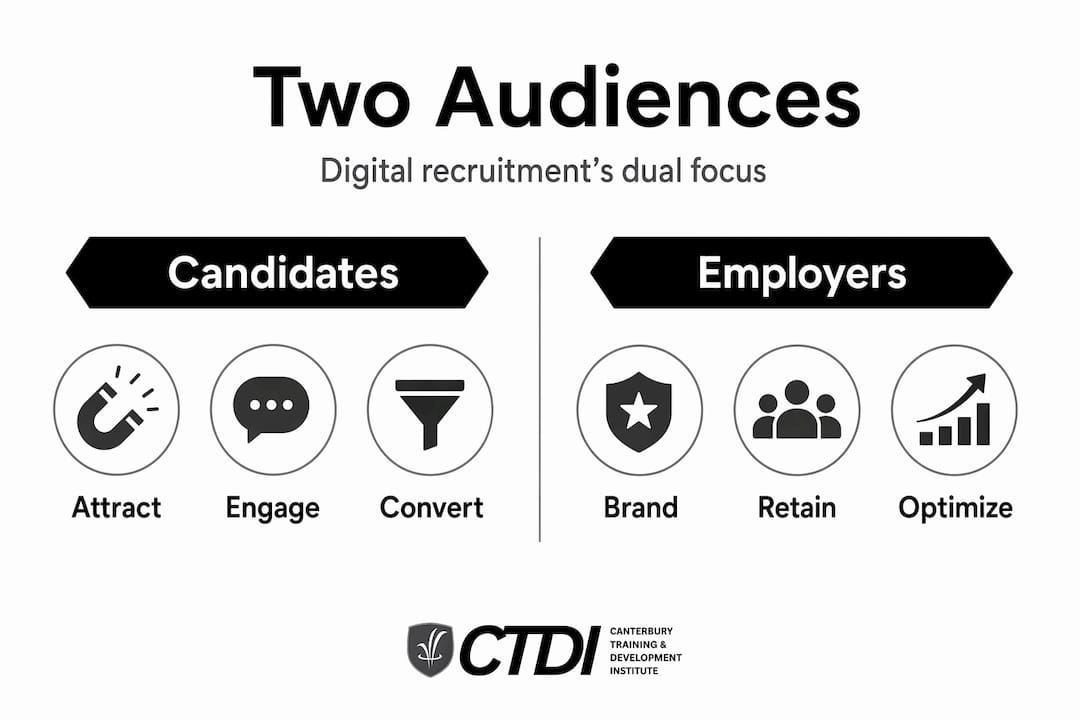
What makes this more complex is that digital recruitment strategies must actually serve two distinct audiences. As one recruitment marketing analysis points out, candidate and client marketing require separate strategies. Collapsing them into a single campaign reduces the effectiveness of both. A recruiter running a generic "we're hiring" campaign is not doing recruitment marketing. They are doing broadcasting, which rarely attracts the calibre of candidate that a targeted, multi-channel approach delivers.
The shift matters because talent markets are competitive. Organisations that understand how digital marketing influences recruitment are not waiting for candidates to find their ads. They are building audiences, managing reputation, and nurturing passive talent well before a role opens up.
Digital tools and platforms shaping recruitment
The modern recruiting technology stack is broader than most HR teams realise. Effective recruiting draws on a range of digital tools across every stage of the hiring lifecycle, and gaps in that stack create bottlenecks that slow hiring and damage the candidate experience.
Here is a breakdown of the core categories:
- Applicant tracking systems (ATS): The backbone of any digital recruitment operation. An ATS centralises job postings, applications, and candidate records, and connects to downstream tools for communication and reporting.
- AI sourcing and screening tools: These platforms scan resumes, score candidates against role requirements, and surface passive candidates from talent databases. Done well, they surface candidates a human reviewer might overlook.
- Social media platforms: LinkedIn remains the dominant professional network, but TikTok, Instagram, and Facebook each serve distinct talent audiences. TikTok in particular has become a genuine recruitment channel for roles targeting younger workers.
- Career websites and landing pages: A purpose-built careers page with clear employer value proposition content significantly outperforms a generic "jobs" tab on a corporate website.
- CRM platforms for recruitment: Candidate relationship management tools let recruiters build and maintain pipelines of passive candidates, track touchpoints, and personalise outreach at scale.
- Analytics and reporting dashboards: Without visibility into which channels deliver quality candidates, recruiters are spending budget on instinct rather than evidence.
The key to making these tools work together is integration. Hiring tech stacks that integrate ATS, sourcing, scheduling, assessments, and analytics into one connected system allow automation to flow without manual handoffs breaking the process.
Pro Tip: When evaluating recruitment marketing platforms, look for native CRM integration and multi-channel campaign management as your first two requirements. Platforms that lack these force recruiters into manual workarounds that defeat the purpose of the technology.
Mobile compatibility is non-negotiable. Top recruitment platforms in 2026 prioritise mobile-friendly design and multi-channel campaign management as core features, not optional extras. A candidate who starts an application on their phone and hits a non-responsive form will abandon it.
How digital marketing improves recruitment outcomes
The evidence for the effectiveness of digital recruitment is no longer anecdotal. A systematic review of 30 peer-reviewed studies found that digital marketing tools improve hiring efficiency across multiple dimensions, including time-to-hire, budget, screening accuracy, and employer branding. These are not marginal gains.
| Outcome | Impact of digital marketing |
|---|---|
| Time-to-hire | Automation and targeted sourcing reduce time-to-hire significantly across industries |
| Cost-per-hire | AI screening and programmatic job advertising reduce average cost-per-hire by up to 30% |
| Candidate quality | Data-driven screening improves match rates, reducing early attrition after hire |
| Employer brand reach | 75% of job seekers research employer brand before applying |
| Application volume (qualified) | Strong employer brand generates 50% more qualified applications |
Employer branding is where many organisations leave the most value on the table. Job seekers now behave like consumers. They look at culture content, read employee testimonials, and check how companies respond to negative reviews. A strong employer brand paired with consistent content marketing creates a compounding effect: over time, sector-focused SEO content builds authority that generates inbound candidate traffic without ongoing ad spend.

Analytics are what make improvement possible. When recruiters can see exactly which channel delivered a candidate who made it to offer stage, they can redirect budget away from sources that generate volume but not quality. This is the difference between measuring activity and measuring outcomes.
Pro Tip: Set up conversion tracking from your job postings back to your career page and ATS. If you cannot trace a hire back to a specific channel, you are making budget decisions in the dark.
The candidate experience benefit is often underestimated. Personalised communication during the recruitment process, whether through automated but contextually relevant email sequences or timely status updates, reduces candidate drop-off and builds a positive association with your employer brand even among applicants who are not selected.
Challenges in digital recruitment strategies
Acknowledging what can go wrong is not pessimism. It is the foundation of responsible implementation.
AI bias and fairness risks
AI sourcing and screening tools introduce genuine concerns around bias and privacy. Algorithms trained on historical hiring data can replicate and amplify past patterns of discrimination, particularly around gender, ethnicity, and educational background. This is not a hypothetical risk. It has occurred in documented cases at major organisations. Any AI screening tool deployed without regular bias auditing is a governance liability.
Digital skills gaps in HR teams
Many HR professionals have deep people skills and limited digital marketing proficiency. The result is that organisations invest in recruitment technology but lack the internal capability to configure, interpret, or optimise it. Governance and ethical issues around digital recruitment adoption are compounded when teams cannot critically assess what their tools are actually doing.
Technology inequality
Not every candidate has seamless access to the digital channels recruiters favour. Prioritising platforms like LinkedIn for all roles implicitly disadvantages candidates from lower socioeconomic backgrounds, regional areas, or industries where digital presence is not a norm. This is a particular consideration for roles in trades, logistics, and care sectors.
Other practical challenges include:
- Information overload for candidates navigating multiple platforms
- Data privacy obligations under Australian law that restrict how candidate data is stored and used
- Over-reliance on automation at the expense of the human judgement that still determines cultural fit
- Difficulty attributing pipeline quality to specific marketing channels without proper tracking infrastructure
Balancing automation with human insight is not a philosophical preference. It is a practical necessity. Recruitment marketing must measure outcomes that reflect candidate quality and pipeline contribution. Tools that generate clicks without producing hires are not effective regardless of their usage metrics.
Best practices for implementing digital recruitment
Knowing the tools and challenges is useful. Knowing how to apply them well is what actually shifts hiring outcomes. These practices are drawn from what works in organisations that treat recruitment as a marketing function rather than an administrative one.
-
Build your employer brand before you need it. The worst time to start building an employer brand is when you have an urgent vacancy. Start with a careers page that clearly articulates your employee value proposition, and back it up with authentic content including team stories, day-in-the-life posts, and culture insights. This content should live on your website and be shared across social channels consistently.
-
Segment your candidate audiences. Graduates, experienced professionals, passive candidates, and career changers each respond to different messages and platforms. A 45-year-old operations manager and a 22-year-old data analyst are not reading the same content or spending time on the same platforms. The importance of social media in recruitment lies partly in its ability to target precisely by role, experience level, location, and interest.
-
Optimise your paid search campaigns with tight audience targeting. Generic job titles in paid search attract high volume and low quality. Write job ad copy for the specific candidate you want, use negative keywords to exclude irrelevant searches, and send traffic to a dedicated landing page rather than a generic jobs listing.
-
Use CRM tools to manage passive candidates. Most quality candidates are not actively looking. A talent CRM lets you build relationships over time through relevant content, event invitations, and periodic check-ins. When a suitable role opens, you have a warm pipeline rather than starting from zero.
-
Personalise candidate communication throughout the process. Automated does not have to mean impersonal. Sequence-based email tools allow you to send role-specific content, preparation resources, and timely updates that reflect where each candidate sits in the process.
Here is how two common approaches compare when measured against real recruitment outcomes:
| Approach | Activity focus | Outcome focus |
|---|---|---|
| Job board posting only | High volume applications | Variable quality, high screening workload |
| Integrated digital strategy | Targeted multi-channel reach | Higher candidate quality, lower cost-per-hire |
| Employer branding content | Impressions and page views | Long-term inbound candidate traffic |
| Paid search with landing pages | Click-through rates | Qualified leads from specific candidate segments |
| CRM and nurture sequences | Email open rates | Warm pipeline with passive candidates |
Understanding the latest digital marketing trends also gives recruiters an edge when assessing which emerging channels and tactics are worth testing. What worked in 2023 is not necessarily what works now.
My take on digital marketing and recruitment
I have watched HR teams invest heavily in recruitment technology and still struggle to improve their hiring outcomes, and the pattern is almost always the same. The tools are there. The strategy is not.
The mistake I see most often is treating digital recruitment activity as a proxy for progress. Organisations count job ad impressions, measure time spent on their careers page, and report on social media follower growth. None of those numbers tell you whether you are finding better candidates faster. Recruitment marketing outcomes like cost-per-qualified-candidate and pipeline-to-hire rate are what actually matter, and most teams are not tracking them.
My experience is that the recruiters who get the most out of digital marketing are not necessarily the most technical. They are the ones who ask "what decision does this data help me make?" before they invest in another platform or campaign. That question keeps measurement honest and prevents technology from becoming an end in itself.
On AI, I would caution against the optimism that treats a 14-hour weekly saving as a licence to reduce human involvement in screening. AI in recruitment workflows creates time. What you do with that time determines whether the quality of your hires improves or just your throughput does.
The long-term opportunity is real. Organisations that build recruitment marketing infrastructure now will see compounding returns as their content drives inbound traffic, their talent pipelines mature, and their employer brand becomes a genuine competitive asset. That is not an overnight shift. It is a strategic investment worth making.
— Sam
Build the digital marketing skills your recruitment career needs
If this article has highlighted a gap between where your recruitment practice is and where it could be, the next step is building the skills to close it. At Edu, Canterbury Training and Development Institute, the Advanced Diploma of Digital Marketing is designed for professionals who want to apply marketing expertise to real business challenges, including talent acquisition and employer branding. The course covers AI-powered marketing tools, data analytics, content strategy, and campaign management. It is delivered 100% online and self-paced, so you can upskill without pausing your career. Explore the course or enrol today to start applying digital marketing strategy to your recruitment practice.
FAQ
What is the role of digital marketing in recruitment?
Digital marketing in recruitment encompasses employer branding, SEO, paid media, social media, content strategy, and CRM to attract, engage, and convert quality candidates. It extends well beyond job advertising into a full candidate acquisition and relationship management function.
How does digital marketing reduce recruitment costs?
AI-powered screening and programmatic advertising reduce cost-per-hire by up to 30%, while a strong employer brand can cut it by 43% through generating higher volumes of qualified inbound applications without proportional increases in ad spend.
What are the biggest risks of digital recruitment strategies?
The main risks include AI bias in screening tools, data privacy obligations, digital access inequality among candidate groups, and over-reliance on automation at the expense of human judgement in assessing cultural fit.
Why does employer branding matter so much in digital recruitment?
Research shows 75% of job seekers research employer brand before applying, and a strong brand yields 50% more qualified applications. In a competitive talent market, how your organisation appears online directly determines who chooses to apply.
Which digital marketing skills do recruiters need most?
Recruiters benefit most from proficiency in data analytics, content marketing, paid search campaign management, CRM tools, and employer brand strategy. These skills translate directly into measurable improvements in candidate quality and hiring efficiency.