

If you need job-ready skills fast, at lower cost, VET is usually the stronger fit. If your goal involves a regulated profession, research work, or long-term progression into management, higher education tends to serve you better. The AQF and NCVER both confirm these aren't rival tracks. You can mix them, using a VET qualification now and a degree later, or the other way round.
Table of Contents
- VET vs higher education: what actually separates them?
- How do you choose between VET and higher education?
- Can a VET qualification lead into a university degree?
- What signals a quality VET provider?
- Where to verify the facts yourself
- Sources
- FAQ
VET vs higher education: what actually separates them?
The core difference is purpose, not prestige. Vocational education and training (VET) is built around competency: can you do the task, to an industry-set standard, right now? Higher education is built around knowledge and inquiry: can you analyse, research, and apply theory across situations you haven't seen before?
That distinction plays out across the Australian Qualifications Framework (AQF), the single national structure spanning ten levels from Certificate I through to doctoral degrees. VET generally issues Certificates I through IV, diplomas and advanced diplomas (AQF levels 1 to 6). Higher education starts around associate degree and bachelor level (AQF 6 to 7) and runs up through masters and doctoral qualifications (AQF 8 to 10). Levels 5 and 6, diploma and advanced diploma, are where the two sectors genuinely overlap, and either a TAFE, a registered training organisation (RTO), or a university can issue a qualification at that level.
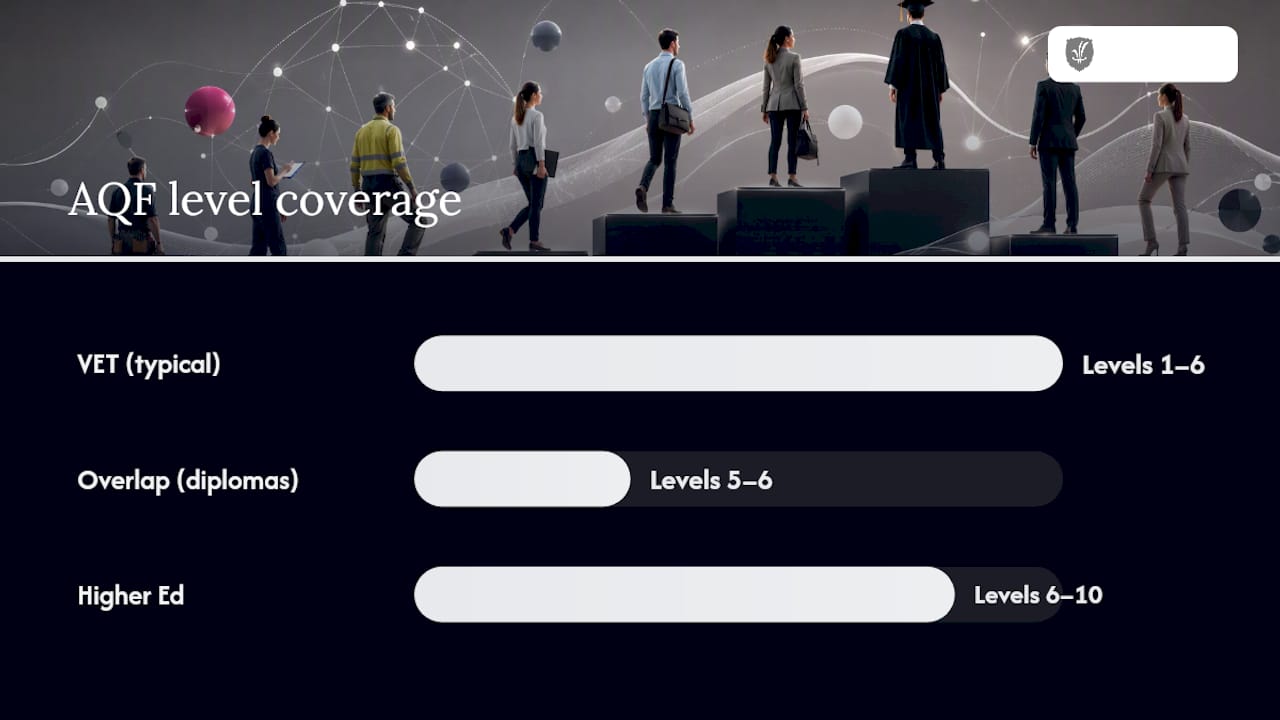
Time and cost follow the same logic. A Certificate III or IV typically runs six months to a year full time; diplomas often take one to two years. A bachelor's degree usually takes three to four years, with postgraduate study adding one to three years on top. Course fees vary widely by provider and subsidy eligibility, so always check the specific institution rather than assume a sector-wide figure.
Assessment style differs sharply too. VET uses competency-based assessment: you're marked "competent" or "not yet competent" against a defined skill, not graded against your classmates. Higher education leans on graded, norm-referenced assessment, essays, exams, research projects, where performance is scored on a scale and often benchmarked against cohort standards. That cultural gap matters more than most people expect when it comes to transitioning between sectors, since it shapes what evidence a university will actually accept for credit.
On employment outcomes, the picture is more nuanced than "one sector wins."
- NCVER research shows VET graduates often report similar initial full-time employment rates and job satisfaction to higher education graduates working in the same occupation.
- Longer-term NCVER analysis finds that completing a VET qualification improves full-time employment prospects and lifts the likelihood of permanent work compared with having no post-school qualification at all.
- Comparative research into VET and higher education pathways finds that in the same occupation, VET and degree holders often start with similar tasks and pay, but degree holders are more likely to move into supervisory roles and earn more over the longer run.
None of this means a degree guarantees promotion or a diploma guarantees a job. It means the two pathways tend to produce different long-term shapes: VET gets you working sooner, higher education tends to open more doors later, particularly in fields with formal management or research tracks.
How do you choose between VET and higher education?
Work through these questions in order, and the right pathway usually becomes obvious by question three or four.
- Is the occupation regulated? Check the professional body, the ANZSCO classification for the role, and real job ads. Nursing, teaching, engineering and law generally require a specific degree; trades, IT support, digital marketing and many technical roles often accept a VET qualification or relevant experience.
- How much time and money can you commit right now? Be honest about whether you can sustain three to four years of study, or whether you need income sooner.
- Do you want to build deep practical skill, or explore theory and research? Some people thrive doing; others thrive analysing. Neither is better, but ignoring the mismatch leads to dropped courses.
- What's the long-term goal, not just the first job? A Certificate IV might get you into a role this year. A later diploma or degree might get you into management in five years.
- Check the course itself, not just the sector. Compare the AQF level, the scope of what's taught, how current the industry content is, whether placements are included, the assessment method, and confirm the provider's registration status with ASQA for VET or TEQSA for higher education.
Once you've shortlisted a course or two, contact the providers directly. Ask about credit transfer arrangements, request actual unit outlines rather than marketing summaries, and ask who their industry partners are.
Pro Tip: Don't just compare course titles. Two "Diplomas of Marketing" from different providers can sit at different AQF levels or cover completely different unit sets. Always ask for the training package code or course accreditation number before enrolling.
Can a VET qualification lead into a university degree?
Yes, and this is where the AQF earns its keep. Because diploma and advanced diploma qualifications (AQF levels 5 and 6) can be issued by either sector, many universities have formal articulation agreements that grant credit for a completed VET diploma toward a related bachelor's degree.

That doesn't mean automatic or full credit. Every university sets its own articulation table, and credit is typically assessed unit by unit against how closely your VET learning outcomes match the degree's first-year content. Some students get a full year of advance standing; others get a handful of exempted subjects. Recognition of Prior Learning (RPL) works on the same principle, matching documented skills and experience against specific learning outcomes, not a blanket sign-off.
If you're planning this route, start collecting paperwork early:
- Your full academic transcript, not just the qualification certificate.
- Unit or subject outlines showing what was actually taught and assessed.
- Any RPL evidence, such as workplace assessments or a skills portfolio.
- A clear timeline, since some universities only process credit applications at set intake points each year.
A detailed paperwork checklist can save weeks of back-and-forth with admissions staff.
What signals a quality VET provider?
Before enrolling anywhere, check these basics:
- Scope of registration with ASQA, confirming exactly which qualifications and AQF levels the provider is authorised to deliver.
- Trainer expertise, ideally current industry practitioners, not just qualified educators.
- Student support services, including academic help and, for online study, genuine responsiveness rather than a generic help desk.
- Industry-relevant units and work placement opportunities, where the course includes them.
- Assessment methods and RPL policy, spelled out clearly, not buried in fine print.
CanterburyTDI (CTDI) publishes its scope, course structure and trainer backgrounds on each course page, which is the standard you should expect from any accredited VET provider. Whichever RTO you're considering, ask directly about credit transfer arrangements, RPL evidence requirements and graduate outcomes before you commit.
Where to verify the facts yourself
Cross-check any claim against government sources: TEQSA regulates higher education providers, ASQA regulates VET providers, the AQF sets qualification levels, and NCVER publishes the labour-market data behind most VET outcome claims. Study Australia is a useful starting point for course structures.
If your goal is practical, industry-aligned skills you can apply quickly, CanterburyTDI's online courses are built around that outcome. The Diploma of Artificial Intelligence suits people moving into AI-adjacent roles without a four-year computer science degree. The Advanced Diploma of Digital Marketing targets marketers who want a recognised qualification behind skills they may already use day to day. For those drawn to sustainability work, the Certificate IV in Environment Sustainable Management offers a faster entry point than a science degree. All three are delivered online, self-paced, with a one-off enrolment fee payable when you enrol, and none of them close the door on further study later, given the AQF pathways already outlined above. For a broader view of how these routes fit together over a working life, CanterburyTDI's guide to career pathways in Australia is worth a read, alongside independent tools like Alloquy's work on managing career credentials, which is useful once you start holding multiple qualifications across sectors.
Sources
- VET graduates in demand — NCVER media release
- Australian Qualifications Framework — TEQSA
- VET and higher education pathways – do outcomes differ for the same occupation?
FAQ
Does completing VET boost your ATAR?
No. VET units studied while still at school can count toward your Senior Secondary Certificate and, in some states, contribute to your ATAR calculation depending on the subject and your state's rules, but VET itself is a separate qualification pathway, not an ATAR-boosting shortcut. Check with your school and your state's tertiary admissions centre for the exact rules that apply to you.
What's the difference between VCE and VET?
VCE (Victorian Certificate of Education, or its equivalent in other states) is the general senior secondary certificate most students complete in their final years of secondary school. VET, when studied at school, is vocational training embedded within that certificate, giving students a nationally recognised qualification alongside their secondary schooling. They're not competing options. VET subjects sit inside your senior secondary program.
Is a veterinary career in demand in Australia?
Veterinary work is a registered profession requiring a specific higher education degree, not a VET qualification, and falls outside this comparison. If you're asking about vocational education (VET) generally rather than veterinary science specifically, NCVER data shows solid demand for VET graduates across trades and technical occupations.
Do VET courses count toward your ATAR?
Some VET programs studied during senior secondary school contribute toward ATAR calculation, depending on the subject, your state's education authority, and whether the course has a scored assessment component. This varies by state, so confirm directly with your school or state curriculum authority rather than assuming a blanket rule.
Can I switch from VET to a university degree later?
Yes, this is a well-established pathway in Australia. Because the AQF links both sectors, a completed VET diploma or advanced diploma can attract credit toward a related bachelor's degree, though the amount of credit depends on each university's articulation agreement and how closely your units match.
Recommended
- 10 AQF Levels Explained: RPL and Credit Transfer for Australian Adults
- Career Pathways in Australia: Your 2026 Guide
- Up to 50% Credit: Paperwork Checklist for VET Graduates in Australia
This article provides general information only. Course requirements, study pathways, credit arrangements and career outcomes may vary. Always confirm current requirements with the relevant education provider or authority.