
TL;DR:
- Environmental management involves systematically controlling human activities to reduce environmental harm and ensure regulatory compliance through frameworks like ISO 14001. Its core principles emphasize prevention, continual improvement, and integration into daily operations to achieve genuine environmental performance. Successful implementation relies on leadership commitment, accurate aspects and impacts identification, and proactive regulatory compliance.
Environmental management is the structured process of overseeing human activities to minimise their impact on the natural environment while meeting regulatory obligations and advancing sustainable development. At its core, the practice centres on an Environmental Management System (EMS), most commonly structured around the ISO 14001 international standard, which gives organisations a repeatable framework for planning, implementing controls, monitoring performance, and driving continual improvement. Whether you are a professional entering the sustainability field or an organisation seeking compliance, understanding environmental management principles is the foundation for every decision that follows.
What is environmental management and why does it matter?
Environmental management is defined as the systematic administration of activities that interact with the natural environment, with the goal of reducing harm, meeting legal requirements, and supporting sustainable development goals such as biodiversity protection and resource conservation for present and future generations. The definition matters because it shifts the focus from reactive cleanup to proactive control. You are not managing the environment itself. You are managing the human activities that affect it.

This distinction is more than semantic. Environmental management emphasises prevention through planning and control rather than pollution remediation after the fact. A manufacturing plant that identifies its wastewater discharge as a significant environmental aspect, then designs a treatment process before the discharge occurs, is practising environmental management correctly. One that waits for a regulator's notice is not.
The role of environmental management extends across every sector. Industries including manufacturing, oil, and transport use EMS frameworks to manage environmental impacts and satisfy increasingly strict regulations. This breadth means the principles apply equally to a small logistics company reducing fuel consumption and a multinational mining operation managing tailings storage. The scale changes; the process does not.
What are the core principles and components of environmental management?
The environmental management process is built on four sequential stages known as the Plan-Do-Check-Act (PDCA) cycle, which forms the backbone of ISO 14001 and most credible EMS frameworks. Each stage has a specific function, and skipping any one of them produces gaps that regulators and auditors will find.
Plan requires identifying your environmental aspects, which are the elements of your activities that interact with the environment, and their associated impacts, which are the changes those interactions cause. Burning diesel fuel is an aspect; the resulting carbon dioxide emissions are the impact. Once aspects and impacts are ranked by significance, the organisation sets objectives and targets to address the most material ones.
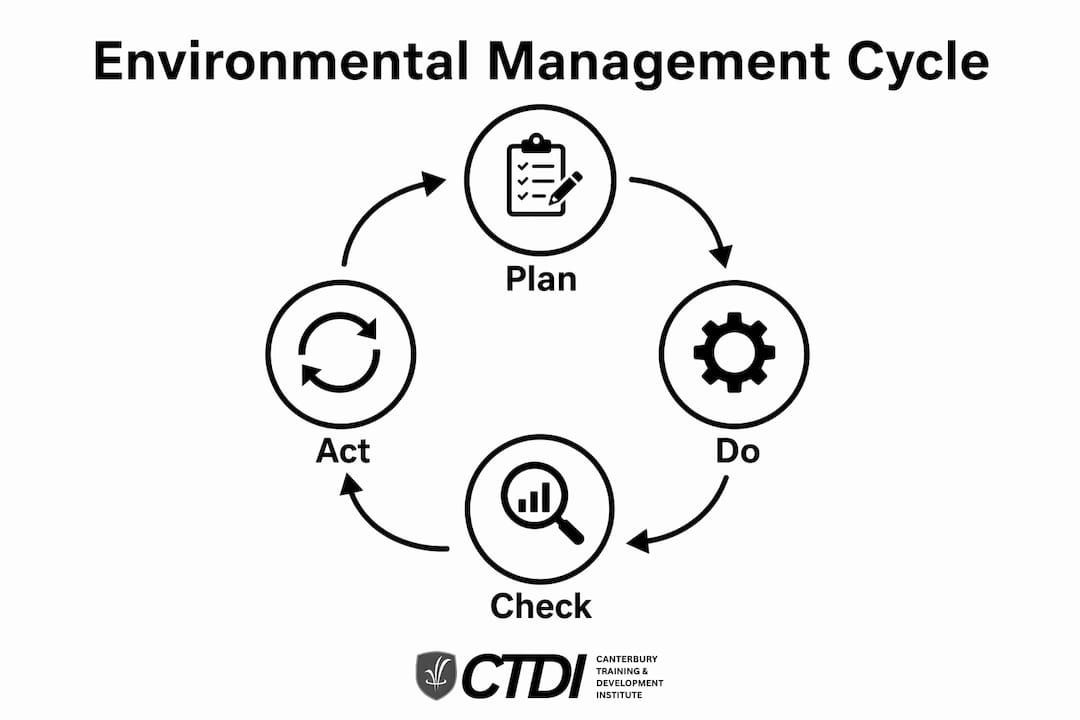
Do is the implementation phase. This is where operational controls, documented procedures, staff training, and emergency preparedness measures are put in place. EMS implementation translates identified aspects into documented procedures, training programmes, and contingency planning rather than attempting to control nature directly.
Check covers monitoring, measurement, and compliance evaluation. Organisations track performance against their objectives, conduct internal audits, and assess whether legal obligations are being met. This stage generates the evidence base that supports management review.
Act closes the loop. Findings from the Check stage feed into corrective actions, updates to procedures, and revised objectives. This is the continual improvement mechanism that distinguishes a functioning EMS from a static policy document.
A critical supporting element is the legal compliance obligations register. ISO 14001 Clause 6.1.3 specifies that organisations must maintain and regularly review their compliance obligations within the EMS. This register captures every applicable law, permit condition, and voluntary commitment relevant to the organisation's environmental aspects.
Pro Tip: Map your environmental aspects before you write a single procedure. A thorough aspects and impacts register is the single most important input to every other element of your EMS, from objectives to training content.
Key environmental management principles include:
- Prevention over remediation. Address potential impacts before they occur through design and process controls.
- Legal compliance as a minimum standard. Compliance is the floor, not the ceiling. Effective EMS targets performance beyond what regulations require.
- Continual improvement. Each PDCA cycle should produce measurable progress, not just maintenance of the status quo.
- Stakeholder engagement. Employees, regulators, communities, and clients all have legitimate interests in an organisation's environmental performance.
- Integration with business operations. Environmental controls embedded in daily workflows outperform standalone programmes that sit outside normal operations.
How do EMS frameworks and ISO 14001 guide organisational practice?
ISO 14001 provides a systematic EMS framework based on the PDCA cycle for managing environmental responsibilities and driving continual improvement. It is the world's most widely adopted environmental management standard and applies to any organisation regardless of size, sector, or geography. Certification to ISO 14001 signals to clients, investors, and regulators that an organisation has a credible, audited system in place.
A common misconception is that ISO 14001 certification guarantees improved environmental outcomes. It does not. Adopting an EMS standard provides structure, but actual environmental outcomes depend on organisational commitment and the quality of implementation. A company can achieve certification with a technically compliant system that produces minimal real-world improvement. The standard is a tool; the organisation's culture determines how effectively that tool is used.
The table below compares what an EMS does and does not do, which is a distinction that trips up many organisations early in the implementation process.
| What an EMS does | What an EMS does not do |
|---|---|
| Provides a structured process for identifying and managing environmental aspects | Guarantee specific environmental outcomes or pollution reductions |
| Creates documented evidence of compliance efforts for regulators and auditors | Replace legal permits, licences, or regulatory approvals |
| Drives continual improvement through regular review cycles | Automatically improve performance without genuine leadership commitment |
| Supports integration with other management systems such as ISO 45001 | Eliminate all environmental risk from operations |
| Establishes clear roles and responsibilities for environmental performance | Substitute for technical expertise in specific environmental disciplines |
ISO 14001 and ISO 45001 share a common high-level structure, which means organisations can integrate their environmental and occupational health and safety systems into a single management framework. This integration reduces duplication of effort and creates a more coherent governance structure, particularly for medium and large organisations managing complex operations.
Operational controls under an EMS are specific to each organisation's significant aspects. A transport company might control fuel consumption through driver training and vehicle maintenance schedules. A chemical manufacturer might control solvent emissions through enclosed processing equipment and real-time air quality monitoring. The standard does not prescribe the controls; it requires that appropriate ones exist and are maintained.
Pro Tip: When building your EMS, treat ISO 14001 as a minimum architecture, not a maximum ambition. The organisations that get the most value from certification are those that use the standard's structure to pursue performance targets well beyond what compliance requires.
What roles do regulatory agencies and compliance play?
Regulatory agencies are the external accountability mechanism that gives environmental management its legal weight. The Environment Agency in the UK works with businesses to reduce pollution, issue permits, and enforce regulations as part of the broader environmental management system at a societal level. In Australia, the equivalent functions are performed by state and territory environment protection authorities (EPAs) alongside the federal Department of Climate Change, Energy, the Environment and Water.
Understanding the regulatory interface is non-negotiable for any environmental management professional. The following steps describe how compliance obligations flow into an effective EMS:
- Identify all applicable legislation and permits. This includes national environmental protection laws, state-level pollution control regulations, water licences, waste management approvals, and any voluntary codes your organisation has committed to.
- Record obligations in a compliance register. Each obligation should be linked to the specific activity or aspect it governs, the responsible person, and the review frequency.
- Translate obligations into operational controls. A permit condition limiting discharge volume becomes a flow meter, a monitoring schedule, and a reporting procedure.
- Monitor compliance continuously. Periodic internal audits and real-time monitoring data should confirm that controls are working as intended.
- Update the register when operations or regulations change. Compliance registers should function as living documents, reviewed whenever the organisation's activities change or new legislation takes effect.
Regulatory enforcement creates consequences that make compliance registers more than administrative paperwork. Fines, permit revocations, and reputational damage from enforcement actions are tangible business risks. Regulatory enforcement and public expectations keep organisations accountable, making EMS a living system responsive to both external pressure and internal change.
Due diligence is increasingly expected by clients and investors as well. Supply chain audits, ESG reporting requirements, and procurement standards now routinely require evidence of a functioning EMS. Organisations that treat compliance as a minimum rather than a ceiling are better positioned to meet these expectations without scrambling when requirements tighten.
What strategies make environmental management implementation effective?
Effective environmental management strategies share one characteristic: they are embedded in operations rather than bolted on as a separate function. The following approaches consistently separate organisations that achieve genuine improvement from those that maintain a system purely for certification purposes.
Engage leadership at every level. EMS success is a management commitment and culture issue, not a technical compliance exercise. When senior leaders visibly prioritise environmental performance, middle managers allocate resources to it and frontline workers take it seriously. Without that signal from the top, even a well-designed EMS stagnates.
Translate aspects into specific, measurable controls. Vague commitments like "reduce waste" produce vague results. A specific control, such as segregating organic waste at source and tracking diversion rates monthly, produces data you can act on. The professional skills needed to design these controls include environmental auditing, data analysis, and regulatory interpretation.
Treat the compliance register as a strategic input. Most organisations update their register reactively, after a regulator flags a gap. Strong EMS practitioners review the register proactively, scanning for upcoming legislative changes and adjusting controls before obligations take effect.
Build clean production thinking into procurement. Sustainable resource management starts before materials enter your facility. Specifying recycled content, selecting suppliers with verified environmental credentials, and designing products for end-of-life recovery all reduce the environmental aspects your EMS needs to manage downstream.
Pro Tip: Run a gap analysis against ISO 14001 before your first formal audit. Most implementation failures trace back to the aspects register, the compliance register, or the competence records. Fix those three and you resolve the majority of nonconformities before an auditor sees them.
Common pitfalls to avoid include:
- Treating the EMS as a documentation exercise rather than a performance improvement tool.
- Assigning environmental management to a single person without cross-functional support.
- Setting objectives that are not linked to significant environmental aspects.
- Failing to communicate environmental responsibilities to contractors and suppliers.
- Reviewing the EMS only at the annual management review rather than continuously.
Key takeaways
Environmental management works because it replaces reactive pollution control with a structured, evidence-based system that embeds environmental responsibility into every layer of an organisation's operations.
| Point | Details |
|---|---|
| EMS is process management, not nature management | Organisations control their own activities and procedures, not environmental outcomes directly. |
| ISO 14001 provides structure, not guaranteed results | Certification signals commitment; actual improvement depends on leadership and implementation quality. |
| Compliance registers must be living documents | Update the register whenever operations or legislation change to keep controls aligned with obligations. |
| PDCA drives continual improvement | Each Plan-Do-Check-Act cycle should produce measurable progress, not just maintenance of existing performance. |
| Leadership commitment determines EMS success | Technical systems without cultural buy-in produce compliance on paper but limited real-world impact. |
Why I think most organisations misunderstand what environmental management actually is
After working across environmental compliance, training, and system design for many years, the pattern I see most consistently is this: organisations treat environmental management as a documentation problem. They build registers, write procedures, and collect audit records, then wonder why their environmental performance metrics barely move.
The misunderstanding is fundamental. Environmental management is not about having the right paperwork. It is about changing the way people make decisions every day. A maintenance technician who knows why the spill kit is positioned next to the hydraulic press, and who understands what happens if they skip the containment check, is doing more for your EMS than a hundred pages of policy documents.
The organisations I have seen achieve genuine improvement share one trait: their environmental objectives are connected to operational reality. They set targets based on what their aspects register actually says, not on what looks good in a sustainability report. They review performance monthly, not annually. And when something goes wrong, they treat it as a system failure to fix rather than an individual failure to punish.
For professionals entering this field, my recommendation is to spend time on the shop floor, in the warehouse, or wherever the significant aspects actually occur. The gap between what the procedure says and what people actually do is where most environmental incidents originate. Closing that gap is the real work of environmental management, and no standard or certification does it for you.
The field is also expanding rapidly. Climate risk, biodiversity net gain requirements, and circular economy obligations are adding new dimensions to what an EMS needs to cover. Professionals who understand the foundational principles, the PDCA cycle, aspects and impacts, compliance obligations, and continual improvement, are well placed to adapt as those requirements evolve.
— Sam
Take your environmental management career further with Edu

If this article has clarified what environmental management involves and you are ready to build formal, accredited skills in the field, Edu offers a practical pathway through the Certificate IV in Environmental Sustainability at Canterbury Training and Development Institute (CTDI). The course is delivered 100% online and self-paced, designed by industry experts to give you the technical knowledge and practical competencies that employers in sustainability, compliance, and environmental consulting actually require. Whether you are starting out or formalising existing experience, CTDI's enrol now page has everything you need to take the next step.
FAQ
What is the definition of environmental management?
Environmental management is the systematic process of overseeing and controlling human activities to minimise environmental impact, meet regulatory obligations, and support sustainable development. It is most commonly implemented through a formal Environmental Management System (EMS) structured around standards such as ISO 14001.
What is the role of environmental management in an organisation?
The role of environmental management is to identify significant environmental aspects, implement controls to reduce associated impacts, maintain legal compliance, and drive continual improvement in environmental performance. It also supports risk management, stakeholder communication, and alignment with sustainability commitments.
What are the main environmental management principles?
The core principles include prevention over remediation, legal compliance as a minimum standard, continual improvement through the PDCA cycle, stakeholder engagement, and integration of environmental controls into normal business operations.
How does ISO 14001 support environmental management?
ISO 14001 provides a systematic framework for managing environmental responsibilities through the Plan-Do-Check-Act cycle. It gives organisations a structured approach to setting objectives, implementing controls, monitoring performance, and improving outcomes, though actual results depend on the quality of implementation.
What is the difference between environmental aspects and environmental impacts?
An environmental aspect is an element of an organisation's activities that interacts with the environment, such as fuel combustion or wastewater discharge. An environmental impact is the change to the environment that results from that aspect, such as greenhouse gas emissions or water pollution. Identifying aspects and their associated impacts is the starting point of any EMS.
Recommended
- Environmental management skills list for professionals
- Certificate IV Environmental Sustainability Australia | Green Career Online | CTDI — Canterbury Training and Development Institute
- What are practical skills and why they matter
- What Will Happen to Digital Marketing Jobs in the Age of AI? | CTDI — Canterbury Training and Development Institute