

TL;DR:
- Flexible learning offers learners control over their study's timing, location, and pace through various digital and blended formats. It enhances accessibility, develops personal skills, and adapts to rapidly changing labor markets while maintaining qualification quality. Success depends on disciplined habits, intentional community engagement, and choosing accredited programmes suited to individual learning needs.
Flexible learning is defined as an educational approach that gives learners significant control over the timing, location, content, and mode of their study. Unlike traditional fixed-schedule classrooms, flexible learning uses tools like Learning Management Systems (LMS), asynchronous modules, and recorded lectures to let you learn on your terms. The industry also calls this approach "learner-centred education," and the two terms are used interchangeably across Australian vocational and higher education contexts. Global higher education enrolment has more than doubled in 20 years, and that surge is the single biggest driver behind the shift toward adaptable learning pathways. If you are a working professional, a caregiver, or someone returning to study after a break, understanding what flexible learning offers could change the direction of your career.
What is flexible learning and how does it differ from traditional education?
Flexible learning is a spectrum of learner control, not a single delivery mode. At one end sits the fully self-paced online course; at the other sits the traditional lecture theatre with a fixed timetable. Most modern programmes sit somewhere in between, combining in-person and digital elements to suit different learner needs.
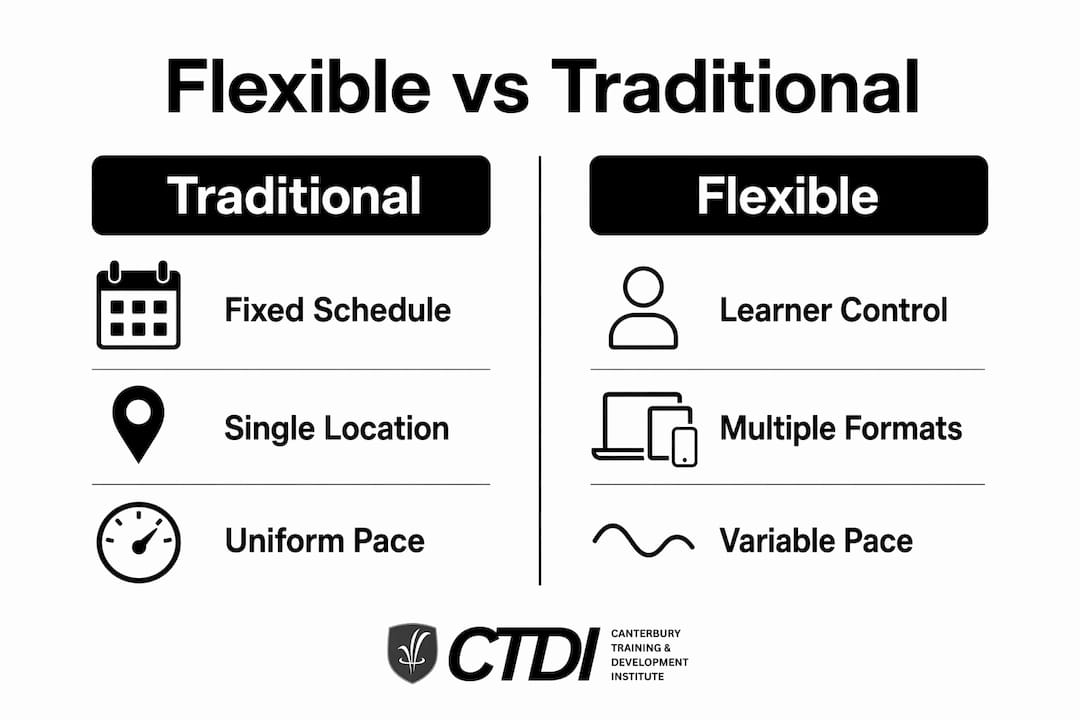
Traditional education fixes three variables: time, place, and pace. You attend class at 9am on Tuesday, sit in a specific room, and move through content at the same speed as everyone else. Flexible learning removes those constraints. You access content when it suits you, from wherever you are, and progress at a rate that matches your schedule and comprehension.
The practical difference shows up immediately for working adults. A nurse finishing a night shift cannot attend a 9am lecture. A parent managing school drop-offs cannot commit to a rigid weekly timetable. Flexible learning solves both problems by offering 24/7 digital access, asynchronous modules, and personalised pathways that fit around real life.
Flexible vs traditional education: a direct comparison
| Feature | Traditional education | Flexible learning |
|---|---|---|
| Schedule | Fixed timetable | Learner-controlled timing |
| Location | Physical campus | Online, blended, or anywhere |
| Pace | Cohort-driven | Self-paced or personalised |
| Delivery mode | In-person lectures | Asynchronous, synchronous, or hybrid |
| Access to materials | During class hours | 24/7 via LMS or digital platforms |
| Learning style support | Limited | Adapted to individual needs |
Blended, hybrid, and HyFlex models all fall under the flexible learning umbrella. Blended learning combines face-to-face sessions with online coursework. Hybrid formats let some students attend in person while others join remotely. HyFlex goes further, giving learners the choice of attending in person, joining live online, or completing work asynchronously. Each model serves a different level of schedule flexibility and personal preference.
What are the benefits of flexible learning for students and professionals?
Flexible study delivers advantages that go well beyond simple convenience. The benefits are structural, affecting how well you learn, how long you stay enrolled, and what skills you build along the way.
Accessibility for adult and non-traditional learners
Flexible learning is critical for adult learners and non-traditional students juggling work and family, enabling them to re-enter education after gaps without losing momentum. This matters because the majority of Australian vocational students are working adults, not school leavers. Removing the requirement to be physically present at a set time removes the single biggest barrier to enrolment.

Skill development beyond the course content
Self-paced and asynchronous formats develop time management, self-discipline, and digital literacy alongside the subject matter itself. These are skills employers actively seek. A student completing an online diploma in digital marketing is not just learning campaign strategy; they are demonstrating the ability to manage their own workload without external supervision.
Reduced stress and lower dropout rates
Personalised pacing reduces stress and dropout rates compared to rigid scheduling. When you are not racing to keep up with a cohort or falling behind because life intervened, you are far more likely to complete what you started. That completion rate matters for your career and for the credibility of your qualification.
Key benefits at a glance:
- Study from any location with an internet connection
- Set your own schedule around work, family, and other commitments
- Revisit recorded lectures and materials as many times as needed
- Develop digital literacy and self-management skills through the process itself
- Access nationally recognised qualifications without relocating or commuting
Pro Tip: Block specific study hours in your calendar each week as if they were work meetings. Flexible learning gives you freedom over when you study, not whether you study. Treating those blocks as non-negotiable is the single most effective habit for completion.
What are the common flexible learning methodologies and technologies?
Flexible learning works through a combination of delivery models and supporting technologies. Understanding the options helps you choose a programme that genuinely fits your life.
Core delivery models
Asynchronous learning means no live sessions. You access pre-recorded lectures, readings, and assessments on your own schedule. This is the most flexible format and suits learners with unpredictable or demanding work hours.
Synchronous online learning involves live video sessions via platforms like Zoom or Microsoft Teams. You attend at a set time but from any location. This format preserves real-time interaction while removing the commute.
Self-paced modules let you move through content at your own speed, completing units when you are ready rather than on a fixed calendar. Many vocational qualifications in Australia use this model. You can read more about how this works in practice in this guide to self-paced learning.
Blended and hybrid formats combine elements of the above. A blended course might include weekly online modules plus one monthly in-person workshop. A hybrid format might let you choose whether to attend a live session in person or online.
Technologies that power flexible learning
| Technology | Function | Learner benefit |
|---|---|---|
| Learning Management System (LMS) | Hosts all course content and assessments | Single access point, available 24/7 |
| Video lectures | Pre-recorded or live-streamed lessons | Rewatch at any time, pause and replay |
| Discussion boards | Asynchronous peer and tutor interaction | Community without fixed meeting times |
| Mobile learning apps | Course access via smartphone or tablet | Study during commutes or breaks |
| Virtual office hours | Scheduled live support from trainers | Real-time help without campus visits |
Active community engagement through discussion boards, virtual office hours, and cohort sessions is critical to success in asynchronous and self-paced learning. The technology enables flexibility, but the community prevents isolation. Programmes that include intentional connection points produce better completion rates and stronger learner satisfaction.
The role of support services in flexible online study is often underestimated. Access to a dedicated student support team, career advisers, and technical help can be the difference between completing a qualification and abandoning it halfway through.
Why is flexible learning important in 2026 and beyond?
The case for flexible education has never been stronger. Three converging forces are making it the default model for serious learners: rapid digital transformation, shifting labour markets, and the growing reality of lifelong learning.
Labour markets in 2026 do not reward static skill sets. Roles in artificial intelligence, digital marketing, and environmental management are evolving faster than traditional three-year degrees can respond. Flexible learning pathways allow workers to upskill in months rather than years, staying relevant without pausing their careers entirely.
UNESCO has made this point at a policy level. Flexible learning pathways prevent dead ends in education and support resilient systems that keep pace with digital transformation and labour market needs. The organisation has embedded flexible learning into its 2030 education policy framework, which signals that this is not a trend. It is a structural shift in how education systems are designed.
"Flexible learning pathways are more relevant for the future of all — they are vital to modern education's resilience and inclusivity, necessary for adapting to rapid digital and labour market shifts." — UNESCO
The inclusivity argument is equally compelling. Flexible formats open education to learners who have historically been excluded: people in regional and remote areas, those with disabilities, carers, and workers in shift-based industries. When geography and timetables stop being barriers, the pool of people who can access quality education expands dramatically.
For professionals specifically, flexible career growth through online learning is no longer a niche option. It is the primary pathway for mid-career upskilling in Australia's fastest-growing sectors.
How do you choose the right flexible learning approach?
Choosing the right programme requires more than picking the most convenient schedule. The quality of the learning experience, the credibility of the qualification, and the level of support available all determine whether you get a genuine return on your time and money.
Follow these steps to evaluate your options effectively:
- Clarify your goal first. Are you seeking a nationally recognised qualification, a specific skill, or a career change? The answer determines whether you need an accredited diploma, a short course, or a micro-credential.
- Assess your schedule honestly. Map out your available hours per week before you enrol. A programme requiring 15 hours per week is not flexible for someone working 50-hour weeks, regardless of how it is marketed.
- Check institutional credibility. In Australia, look for providers registered with the Australian Skills Quality Authority (ASQA). Registration confirms the qualification is nationally recognised and meets quality standards.
- Evaluate the support structure. Ask whether the provider offers dedicated student support, trainer access, and technical help. A well-designed LMS with no human support is not a complete learning environment.
- Compare delivery modes against your learning style. If you need regular interaction to stay motivated, a fully asynchronous programme may not suit you. If your schedule is unpredictable, a synchronous format with fixed live sessions will create friction.
- Review assessment quality. Credible flexible programmes maintain the same academic rigour and qualification value as in-person study. If assessments look superficial, the qualification will reflect that.
Pro Tip: Before enrolling, contact the provider's student support team with a specific question about the course. The speed, clarity, and helpfulness of that response tells you more about the learning experience than any marketing page.
Comparing online versus classroom learning for your specific career goals is a worthwhile exercise before committing to any programme. The right format depends on your industry, your role, and how you learn best.
Key takeaways
Flexible learning succeeds when learners combine genuine schedule freedom with structured habits, credible qualifications, and intentional community engagement.
| Point | Details |
|---|---|
| Flexible learning is a spectrum | It ranges from fully self-paced online study to blended and hybrid formats combining in-person and digital elements. |
| Benefits go beyond convenience | Self-paced study builds time management, digital literacy, and self-discipline alongside subject knowledge. |
| Technology enables, community sustains | LMS platforms and video lectures create access; discussion boards and virtual support keep learners engaged. |
| Credibility requires accreditation | In Australia, choose providers registered with ASQA to confirm your qualification is nationally recognised. |
| Discipline is non-negotiable | Flexible formats require more self-direction than traditional study, not less. Treat study blocks as fixed commitments. |
The uncomfortable truth about flexible learning
I have spent years watching people enrol in flexible programmes with the best intentions and drop out within three months. The reason is almost never the content. It is the assumption that flexibility means easy.
Flexible learning requires more self-direction than traditional study, not less. In a classroom, the timetable enforces your attendance. In a self-paced programme, nothing does. That freedom is genuinely powerful for the right person. For someone who needs external structure to stay on track, it can be a trap.
The other misconception I see constantly is that flexible means lower quality. Faculty at institutions like Northern Virginia Community College (NOVA) are explicit on this point: flexible courses carry the same expectations and assessment rigour as in-person equivalents. The delivery mode changes; the standard does not.
What actually works, in my observation, is treating flexible learning as a professional commitment rather than a personal project. The learners who complete their qualifications are the ones who block study time, engage with discussion boards, attend virtual office hours, and treat their trainer as a resource rather than an obstacle. They use the flexibility to fit study into their life, not to avoid the hard parts of learning.
The best flexible programmes are designed with intentional connection points built in. If a programme you are considering has no community features, no live support, and no structured check-ins, that is a design problem. Lack of intentional design leads to confusion and lower completion rates, not greater accessibility. Ask hard questions before you enrol.
— Sam
Start your flexible learning journey with Edu
Edu, the Canterbury Training and Development Institute (CTDI), offers 100% online, self-paced diplomas and certifications designed for working Australians ready to advance their careers. Courses in AI, digital marketing, and environmental management are built by industry experts and delivered through a structured LMS with dedicated student support at every stage.
Every qualification is designed to meet real industry needs, not just tick academic boxes. If you are ready to study on your terms without sacrificing the credibility of your qualification, explore CTDI's online diplomas and find the programme that fits your career goals. Enrolment is open now.
FAQ
What is the definition of flexible learning?
Flexible learning is an educational approach that gives learners control over the timing, location, pace, and mode of their study. It includes self-paced online courses, blended formats, and hybrid models that combine in-person and digital delivery.
Is flexible learning the same as online learning?
Flexible learning is broader than online learning. Online study is one delivery method within flexible learning, which also includes blended, hybrid, and HyFlex formats that combine digital and in-person elements.
Does flexible learning produce the same quality qualifications?
Yes. Credible flexible programmes maintain the same academic rigour and assessment standards as in-person study. In Australia, qualifications from ASQA-registered providers carry the same national recognition regardless of delivery mode.
Who benefits most from flexible online study?
Working professionals, adult learners, caregivers, and people in regional areas benefit most. Flexible formats remove the barriers of fixed timetables and physical location that prevent these groups from accessing traditional education.
How do I stay motivated in a self-paced programme?
Block fixed study hours each week, engage actively with discussion boards and virtual office hours, and treat your trainer as a regular point of contact. Community engagement is the most reliable predictor of completion in self-paced and asynchronous learning environments.