

TL;DR:
- Lifelong learning involves continuously acquiring knowledge and skills throughout life beyond formal education. It enhances career resilience, cognitive health, and personal fulfillment by fostering curiosity and adaptability. Structured habits, micro-learning, and community engagement support sustained lifelong learning efforts.
Lifelong learning is defined as the continuous, voluntary pursuit of knowledge and skills throughout life, extending well beyond formal education into every stage of adulthood. UNESCO frames it as a fundamental driver of personal growth, social participation, and economic resilience. The concept covers formal study, non-formal workshops, and informal learning through reading, podcasts, and peer conversation. For professionals navigating rapid industry change, lifelong learning is not a luxury. It is the most reliable way to stay relevant, advance your career, and build a life with genuine meaning.
What is lifelong learning and why is it important?
Lifelong learning is the ongoing, self-motivated practice of acquiring new knowledge and skills across your entire life, not just during school or university. The formal term used by educational authorities is "continuous education," though lifelong learning has become the standard phrase in policy, research, and professional development circles. The distinction from formal education is critical: formal education has a defined start and end, while lifelong learning has neither.

The importance of lifelong learning comes down to one reality: the world changes faster than any single qualification can prepare you for. Automation, artificial intelligence, and shifting industry demands mean that skills learned five years ago may already be outdated. Professionals who embrace lifelong learning cultivate curiosity, actively seek feedback, and challenge their own assumptions to stay relevant amid disruption.
Lifelong learning also reshapes your relationship with your career. Rather than treating a degree as a destination, you treat learning as a permanent habit. This mindset shift is what separates professionals who adapt from those who stagnate.
Key characteristics that define lifelong learning include:
- Self-directed: You choose what to learn based on your goals, not a prescribed curriculum.
- Voluntary: It is driven by intrinsic motivation, not external obligation.
- Continuous: It happens throughout life, not in isolated bursts.
- Multi-modal: It spans formal courses, informal reading, mentoring, and experiential practice.
- Goal-oriented: Effective lifelong learners connect learning to specific career or personal outcomes.
The difference between passive information consumption and genuine lifelong learning is intentionality. Scrolling through news is not lifelong learning. Completing a structured course in digital marketing, then applying those skills in your role, is.
What are the key benefits of lifelong learning?
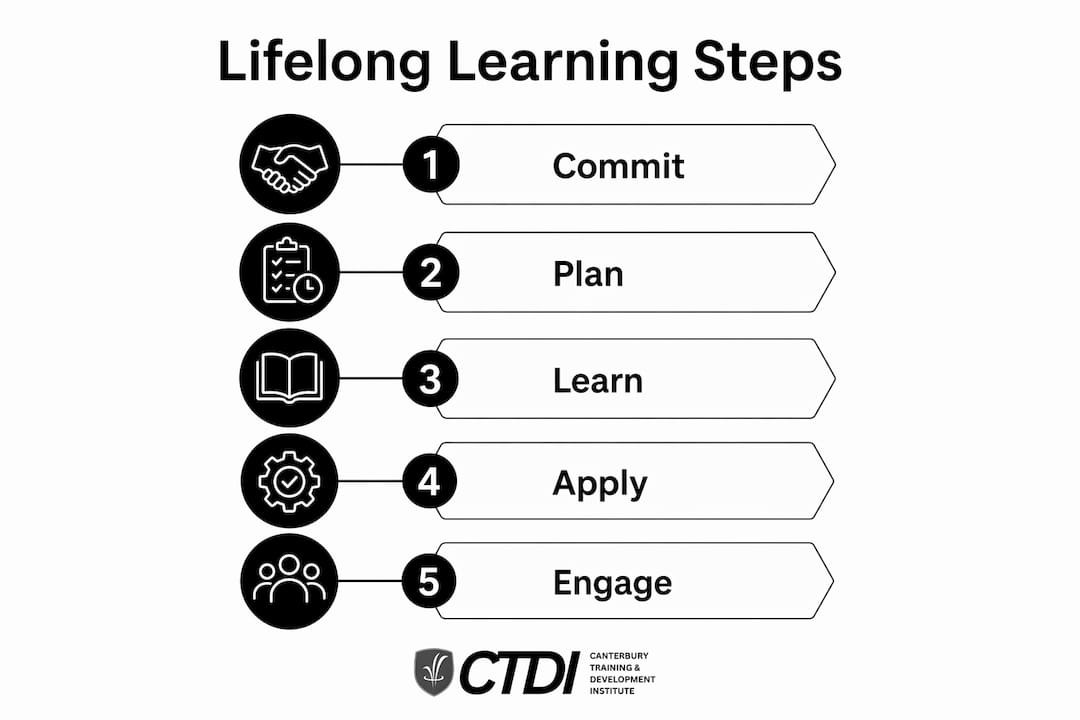
The benefits of lifelong learning reach far beyond a better CV. Research published in the journal Neurology in february 2026 found that high levels of intellectual enrichment reduce Alzheimer's disease risk by 38% and mild cognitive impairment risk by 36%. That is a measurable, biological argument for keeping your mind active throughout life.
Career resilience and adaptability
Lifelong learning is the most direct path to career resilience. Professionals who invest in continuous skill development are better positioned for internal mobility, promotion, and job security when industries shift. IMD research confirms that learning and resilience are directly connected, with ongoing education acting as the connective tissue between long-term professional success and the ability to absorb disruption.
Psychological well-being and meaning
Learning engagement fuels meaning and happiness. Psychological frameworks including Maslow's hierarchy of needs and Self-Determination Theory both identify personal growth and self-actualisation as core drivers of well-being. When you learn something new and apply it, you experience a sense of competence and progress that passive entertainment cannot replicate.
Social and community benefits
"Intergenerational learning promotes social cohesion and community bonding by involving people of different ages in shared learning experiences." — UNESCO Institute for Lifelong Learning
Learning alongside others, whether in a classroom, online cohort, or community group, builds relationships and strengthens communities. Intergenerational learning in particular creates mutual benefit: younger learners gain perspective, while older learners stay cognitively engaged and socially connected.
The full picture of benefits includes:
- Cognitive health: Reduced risk of Alzheimer's disease and cognitive decline through sustained intellectual activity.
- Career advancement: Greater adaptability, stronger skill sets, and improved prospects for promotion or career change.
- Job security: Professionals with current skills are harder to replace during restructures or automation shifts.
- Psychological fulfilment: A consistent sense of progress and purpose that supports mental health.
- Social connection: Shared learning builds networks, friendships, and community bonds across age groups.
The career and cognitive benefits reinforce each other. A sharper mind produces better professional outcomes. Better professional outcomes motivate continued learning. This is why lifelong learning, once established as a habit, tends to compound over time.
How can you effectively engage in lifelong learning?
The most common reason people abandon lifelong learning is not lack of interest. It is lack of structure. Without a deliberate system, learning gets pushed aside by urgent tasks and daily demands.
Schedule learning as a non-negotiable commitment
Effective lifelong learners treat learning time the same way they treat a client meeting: it goes in the calendar and does not move. Scheduling 15–30 minutes daily for focused learning builds a sustainable habit and prevents neglect when other priorities compete for your attention. The specific time matters less than the consistency. Morning works well for many professionals because willpower and focus are highest before the demands of the day accumulate.
Pro Tip: Block your learning time in your calendar as a recurring appointment with a specific topic or course assigned to it. Vague intentions like "learn more about AI this week" rarely survive contact with a busy schedule.
Use micro-learning to target specific skill gaps
Micro-learning and just-in-time skill acquisition allow you to address immediate knowledge gaps without committing to a full degree programme. MIT Sloan Executive Education identifies this approach as one of the most effective ways to make lifelong learning accessible and practical. Instead of enrolling in a broad course on data analytics, you might spend two weeks on a focused module covering the specific tool your team uses this quarter.
Blend formal and informal learning modes
No single learning format suits every goal. A practical approach combines:
- Formal courses and diplomas: Structured programmes that deliver accredited qualifications and systematic skill development.
- Books and long-form reading: Deep knowledge on a subject, consumed at your own pace.
- Podcasts and audio content: Ideal for commuting or exercise, covering industry news and expert interviews.
- Workshops and webinars: Short, focused sessions that deliver practical skills quickly.
- Peer learning and mentoring: Conversations with colleagues, mentors, or learning communities that surface insights no course can teach.
Effective lifelong learners blend all of these modes rather than relying on one. The combination creates depth, breadth, and the social reinforcement that keeps motivation high.
Apply new knowledge immediately
Learning without application is the fastest route to forgetting. The OECD identifies the application gap as a primary cause of skill decay: when learners do not use new knowledge within weeks of acquiring it, retention drops sharply. The fix is simple but requires discipline. After every course module or book chapter, identify one specific way to apply what you learned in your current work or life. Write it down. Do it within the week.
Join a learning community
Accountability accelerates progress. Learning communities, whether formal cohorts in an online course, professional associations, or informal reading groups, provide external motivation and diverse perspectives. Platforms that offer flexible online learning make it easier to find and join communities of learners with shared professional goals.
What are common misconceptions about lifelong learning?
The biggest misconception about lifelong learning is that it requires expensive formal degrees. This belief stops many professionals from starting at all. Lifelong learning is not synonymous with returning to university. It includes free online courses, library resources, YouTube tutorials, industry publications, and peer conversations.
A second misconception is that lifelong learning is only for people early in their careers. Research consistently shows the opposite. Cognitive benefits from intellectual engagement are strongest for adults in their 50s and 60s, precisely because the brain benefits most from stimulation during periods when natural decline might otherwise accelerate.
Common barriers and how to address them:
- Time constraints: Use micro-learning. Fifteen minutes a day adds up to over 90 hours per year.
- Cost: Public adult learning budgets remain below 1% of education spending in many countries, which means individuals must seek affordable alternatives. Free platforms, employer training budgets, and government-subsidised vocational courses are all viable options.
- Motivation: Connect learning to a specific career goal or personal interest. Abstract learning goals fail. Concrete ones stick.
- Access: Online learning removes geographic barriers. A professional in regional Australia can access the same course content as someone in Sydney.
- Imposter syndrome: Many adults feel they are "too old" or "not academic enough" to learn new skills. This belief has no basis in neuroscience. The adult brain retains significant capacity for learning throughout life.
The individual responsibility for lifelong learning has grown precisely because public funding has not kept pace with workforce demands. That is not a reason to disengage. It is a reason to be deliberate about where and how you invest your learning time.
Understanding your own career identity also helps you direct lifelong learning more effectively. When you know what kind of professional you want to become, choosing what to learn next becomes far less overwhelming.
Key takeaways
Lifelong learning is the single most reliable investment a professional can make in their own career resilience, cognitive health, and long-term fulfilment.
| Point | Details |
|---|---|
| Lifelong learning definition | It is the continuous, voluntary pursuit of knowledge and skills across all stages of life. |
| Cognitive health benefit | High intellectual engagement reduces Alzheimer's disease risk by 38%, according to 2026 Neurology research. |
| Daily habit is the foundation | Scheduling 15–30 minutes of learning daily builds a sustainable habit that compounds over time. |
| Application prevents skill decay | Applying new knowledge within weeks of learning it is critical to retaining skills long-term. |
| Formal degrees are not required | Micro-learning, online courses, and peer communities make lifelong learning accessible at any budget. |
Lifelong learning is a mindset, not a milestone
I have spoken with hundreds of professionals over the years who describe a version of the same regret: they stopped learning when they finished their degree and spent the next decade wondering why their career felt stuck. The credential was never the problem. The mindset was.
What I have observed in professionals who genuinely thrive, across industries and career stages, is that they treat curiosity as a professional discipline. They do not wait for their employer to send them to a training day. They carve out time each week, often early in the morning before the inbox takes over, and they learn something specific and applicable. Not because they are anxious about being left behind, but because they find it genuinely satisfying.
The research backs this up. Psychological frameworks like Self-Determination Theory show that learning driven by intrinsic motivation, the kind that comes from genuine curiosity rather than fear, produces deeper engagement and better retention. The professionals I have seen sustain lifelong learning habits are not grinding through content they hate. They have found the intersection of what they are curious about and what their career needs.
My honest advice is this: stop waiting for the perfect course or the right moment. Pick one skill that would make you better at your work right now. Find a structured way to learn it, apply it within a week, and then pick the next one. That cycle, repeated consistently, is what lifelong learning actually looks like in practice. It is less glamorous than the concept sounds, and far more powerful than any single qualification.
The career development strategies that work in 2026 are built on exactly this foundation: deliberate, continuous learning applied directly to real professional challenges.
— Sam
Accredited online courses to put lifelong learning into practice
Knowing the value of lifelong learning is one thing. Having a structured pathway to act on it is another.
Edu, the Canterbury Training and Development Institute, offers nationally recognised online diplomas in areas where career demand is strongest right now: artificial intelligence, digital marketing, and environmental sustainability. Courses are 100% online, self-paced, and designed by industry practitioners, so what you learn maps directly to what employers need. Whether you are looking to enrol in a diploma or explore a specialist qualification like the Advanced Diploma of Digital Marketing or the Certificate IV in Environmental Sustainable Management, Edu provides a flexible, accredited way to turn lifelong learning into a recognised credential.
FAQ
What is the lifelong learning definition?
Lifelong learning is the continuous, voluntary pursuit of knowledge and skills throughout life, covering formal, non-formal, and informal education. UNESCO defines it as extending well beyond compulsory schooling into every stage of adulthood.
Why is lifelong learning essential for career growth?
Lifelong learning keeps your skills current as industries change, improving your adaptability, job security, and prospects for advancement. IMD research identifies it as the connective tissue between professional resilience and long-term career success.
How much time do I need for lifelong learning each day?
Scheduling 15–30 minutes of focused learning daily is sufficient to build a sustainable habit and achieve meaningful skill growth over time. Consistency matters more than the length of each session.
Does lifelong learning require a formal degree?
No. Lifelong learning includes micro-learning, online courses, podcasts, books, workshops, and peer learning, none of which require formal enrolment. Micro-learning and just-in-time skill acquisition are among the most effective and accessible approaches available.
What are practical examples of lifelong learning?
Practical examples include completing an online diploma in digital marketing, listening to an industry podcast during your commute, attending a professional workshop, reading a book on leadership, or joining a peer learning group in your field.