

TL;DR:
- A well-run workforce training process follows systematic phases, uses frameworks like ADDIE and Kirkpatrick, and involves leadership from the start. Conducting thorough needs analysis and setting clear objectives ensure training targets genuine skill gaps and are transferable to job performance. Evaluation at all levels, ongoing development, and organizational commitment are essential for measurable business results.
What does a well-run workforce training process actually look like?
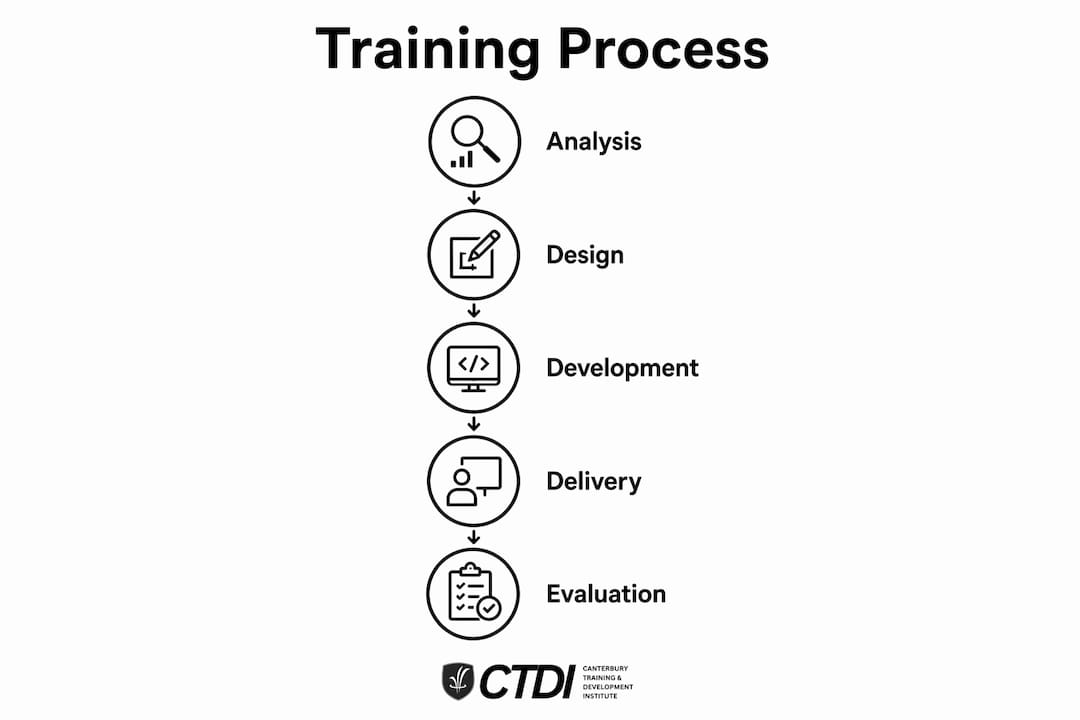
A well-designed workforce training process moves through five core phases: training needs analysis, objective setting and design, material development and delivery, evaluation, and ongoing development. Get those phases right and you have a programme that builds real capability rather than merely satisfying compliance requirements.
Two frameworks underpin most serious training work in Australia right now. The ADDIE model (Analysis, Design, Development, Implementation, Evaluation) gives you a systematic build sequence. Kirkpatrick's four-level evaluation model tells you whether any of it actually worked. Used together, they cover the full arc from identifying a skill gap to proving the training changed behaviour on the job.
Compliance sits across every phase, not just at the end. SafeWork Australia sets the legal floor for safety-related training, and training package qualifications set the standard for nationally recognised vocational learning. Ignoring either creates organisational risk that no amount of good content design can fix.
Leadership and stakeholder involvement are not optional extras. Training failures most often trace back to a lack of management buy-in and programmes that drift away from business goals. The phases below are only as strong as the organisational commitment behind them.
The core phases at a glance:
- Training needs analysis: identify skill gaps, performance issues, and compliance requirements
- Objective setting and design: translate needs into measurable learning outcomes
- Development and delivery: build materials and choose the right delivery method
- Evaluation: measure reaction, learning, behaviour change, and business results
- Induction and ongoing development: embed training into the employee lifecycle and keep it current
1. How to conduct a training needs analysis that actually finds the right gaps
Training needs analysis is where most programmes either earn their credibility or waste their budget. The goal is not to confirm what managers already suspect. It is to distinguish genuine skill gaps from problems that training cannot fix.
A performance gap analysis is the right starting point. It asks a blunt question: is this gap caused by a lack of knowledge or skill, or by something else entirely, like a broken process, inadequate equipment, or unclear expectations? If the answer is the latter, training will not solve it. Sending people to a workshop when the real issue is a faulty system wastes time and erodes trust in the training function.
Once you have confirmed that training is the right intervention, you need data from multiple sources. Relying on a single manager's opinion produces a narrow picture. A SWOT-informed needs assessment draws on employee surveys, performance metrics, exit interview themes, customer feedback, and direct observation. Cross-referencing these sources reveals patterns that no single data point would show.
Aligning the analysis with your organisation's strategic goals is what separates a useful needs analysis from a list of training wishes. If the business is expanding into a new market, the skills gap that matters is the one blocking that expansion, not the one that has been on the backlog for three years.
Practical data sources for your needs analysis:
- Employee performance reviews and KPI data
- Direct observation and job task analysis
- Staff surveys and focus groups
- Exit interview findings
- Customer satisfaction or complaint data
- Regulatory and compliance audit results
- Industry benchmarking against Australian standards
Pro Tip: Involve frontline managers and team leaders in the needs analysis from day one. They see performance gaps daily and can validate whether a proposed training solution addresses the real issue. Their early involvement also builds the buy-in you will need when it comes time to release staff for training.
2. How to design clear training objectives and materials that people actually use
Once you know what the training needs to fix, the next job is translating that into objectives learners can act on. Vague objectives like "improve communication skills" produce vague results. A well-written objective names the behaviour, the condition, and the standard: "By the end of this module, participants will be able to conduct a structured performance conversation using the SBI feedback model without prompting."

Instructional design for adult learners requires a different approach than designing for school-age students. Adults bring existing experience to training, they want to know why something is relevant before they engage with it, and they learn best when content connects directly to their current role. Designing around those principles is not a nice touch. It is the difference between content that transfers to the job and content that gets forgotten by Friday.
Content relevance and currency matter more than production quality. A slick video module built on outdated procedures is worse than a plain Word document with accurate information. Review cycles should be built into the design phase, not bolted on later.
Accessibility is a legal and practical requirement for Australian employers. Materials need to meet readability standards, account for varying literacy levels, and be available in formats that work for employees with disabilities or those working remotely.
Training material formats worth considering:
- Instructor manuals with lesson plans and learning objectives
- Trainee workbooks and reference guides
- Case studies and scenario-based exercises
- Short video demonstrations for procedural tasks
- Interactive e-learning modules with knowledge checks
- Job aids and quick-reference cards for on-the-floor use
- Assessment tools aligned to each learning objective
3. How to develop and deliver training that transfers to the job
Delivery method is one of the most consequential decisions in the whole process, and it is often made too quickly. Choosing the right delivery mode can benefit from a Direct Contract: ons team kiest de meest geschikte bijverdiener voor jou vacature | NOWJOBS approach that considers learners’ needs and accessibility. The right method depends on the nature of the skill, the size and location of your workforce, the available budget, and how quickly the training needs to reach people.
Instructor-led training works well for complex topics that benefit from discussion, real-time Q&A, and group problem-solving. It is harder to scale and more expensive per head, but for high-stakes skills like safety procedures or leadership development, the interaction is worth it. Blended learning combines the depth of face-to-face sessions with the flexibility of online modules, which suits geographically dispersed Australian workforces particularly well.
Microlearning has moved from trend to standard practice for good reason. Short, targeted modules of five to fifteen minutes fit into busy schedules without requiring staff to block out half a day. They also allow for spaced repetition, which research consistently shows improves long-term retention compared to a single extended session.
On-the-job training, coaching, and mentoring remain the most underused delivery methods in formal training plans. Shadowing an experienced colleague for a day often transfers more practical skill than a full-day workshop. The challenge is that it requires deliberate structure. Without clear objectives and a debrief process, job shadowing becomes observation without learning.
Delivery methods and their best-fit scenarios:
- Instructor-led classroom: complex skills, compliance training, leadership development
- E-learning modules: scalable knowledge delivery, compliance refreshers, induction content
- Blended learning: technical skills requiring both theory and practice
- Microlearning: ongoing skills reinforcement, just-in-time performance support
- On-the-job training: procedural and technical skills in the actual work environment
- Coaching and mentoring: leadership, interpersonal, and role-specific skill development
- Job shadowing: role transitions, cross-functional understanding, succession planning
Trainer preparation is as important as the content itself. A subject matter expert who cannot facilitate a group discussion will lose the room within twenty minutes. Investing in trainer capability, whether through a train-the-trainer programme or by partnering with a specialist provider, pays back in delivery quality.
4. How to evaluate whether your training programme actually worked
Most organisations evaluate at Kirkpatrick Level 1 and stop there. They collect a post-training survey, see that participants rated the session positively, and call it done. That tells you whether people enjoyed the training. It tells you almost nothing about whether it changed anything.
The Kirkpatrick Model provides four levels of evaluation that together build a complete picture of training impact:
- Level 1 – Reaction: Did participants find the training relevant and engaging?
- Level 2 – Learning: Did participants acquire the intended knowledge or skills?
- Level 3 – Behaviour: Are participants applying what they learned back on the job?
- Level 4 – Results: Has the training produced measurable business outcomes?
Reaching Levels 3 and 4 requires baseline data collected before training begins. Without a pre-training benchmark, you cannot attribute any change in performance to the training itself. This is the step most organisations skip, and it is why so many training programmes cannot demonstrate their value to the business.
Demonstrating ROI requires tying post-training performance data back to specific business KPIs. If the training objective was to reduce customer complaint resolution time, the evaluation needs to track that metric before and after, not just ask participants whether they feel more confident.
Common evaluation pitfalls to avoid:
- Collecting only Level 1 reaction data and treating it as proof of effectiveness
- Failing to establish baseline performance metrics before training starts
- Evaluating too soon after training, before behaviour change has had time to embed
- Not involving line managers in observing and reporting on post-training behaviour
- Treating evaluation as a one-off event rather than an ongoing feedback loop
Pro Tip: Build your evaluation plan at the same time as your learning objectives, not after delivery. If you cannot describe how you will measure a learning outcome before you build the content, the objective is probably not specific enough.
5. How to integrate induction and keep your workforce development current
Induction is the first real test of your training process, and it sets the tone for everything that follows. A well-structured onboarding programme does more than cover compliance and policy. It connects new employees to the organisation's goals, introduces them to the people and systems they need to do their job, and signals that the organisation takes development seriously.
Embedding induction within the broader training framework means treating it as Phase 1 of an ongoing development journey rather than a standalone event. The skills and knowledge gaps identified during onboarding should feed directly into the employee's first development plan, creating continuity between arrival and long-term growth.
Ongoing development only stays relevant if it is updated regularly. Training content built in 2022 and never reviewed will drift out of alignment with current procedures, technology, and regulatory requirements. A practical approach is to assign ownership of each training module to a subject matter expert who reviews it on a set cycle, typically annually or after any significant process change.
Leadership plays a decisive role in whether a learning culture takes hold. When managers actively discuss development goals with their teams, release staff for training without resentment, and visibly apply what they have learned themselves, participation rates and transfer of learning both improve. When they treat training as an interruption to real work, the programme struggles regardless of its quality.
Keeping your training programme current:
- Schedule annual content reviews for all modules, with interim reviews after major process changes
- Use post-training feedback to identify content that is confusing, outdated, or missing
- Track completion rates and assessment scores to spot modules where learners consistently struggle
- Link individual development plans to team and organisational goals, reviewed at performance cycles
- Build informal learning into the programme through communities of practice, peer coaching, and knowledge-sharing sessions
6. What does a realistic training timeline and budget look like?
Planning a training programme without a realistic timeline is one of the most common reasons projects stall. The analysis phase alone, done properly, takes two to four weeks for a small team and considerably longer for a complex organisation with multiple roles and locations. Rushing it produces a needs analysis that misses critical gaps.
Design and development are the most resource-intensive phases. Building a one-hour e-learning module typically requires many hours of instructional design, content writing, and technical production work. Instructor-led programmes require lesson plan development, facilitator guides, and participant materials. Budget for this time explicitly, whether you are using internal resources or an external provider.
Delivery timelines depend heavily on the method chosen and the size of the cohort. A compliance refresher delivered via e-learning can reach an entire organisation in a week. A leadership development programme delivered through a series of workshops and coaching sessions might run across six to twelve months. Neither is wrong. They serve different purposes.
Factors that affect training costs:
- Delivery mode (e-learning is higher upfront cost, lower per-learner cost at scale; face-to-face is the reverse)
- Content complexity and the need for subject matter expert involvement
- Whether you build internally or engage an external provider
- Technology requirements, including learning management system (LMS) licensing
- Staff time away from their role during training
- Travel and accommodation for geographically dispersed teams
Repeatable training processes reduce cost over time. When you document your design decisions, build modular content that can be updated in sections rather than rebuilt entirely, and standardise your delivery approach, the cost per learner drops with each subsequent cohort. For growing Australian businesses, this repeatability is often the difference between a training function that scales and one that collapses under its own complexity.
7. Australian best practices and models that set the standard
Australia has a well-developed framework for workforce training, and the organisations that get the best results are the ones that work within it rather than around it.
The ADDIE model is the recognised standard for instructional design in Australia, used by vocational education and training (VET) providers, enterprise training teams, and government agencies alike. Its five phases (Analysis, Design, Development, Implementation, Evaluation) create a logical build sequence that prevents the most common training design errors, particularly the tendency to jump straight to content development before objectives are clear.
SafeWork Australia sets the compliance floor for safety-related training across all industries. Organisations operating in high-risk sectors, including construction, manufacturing, healthcare, and resources, must align their training delivery with SafeWork standards. Failing to do so creates legal exposure and, more practically, leaves workers underprepared for genuine hazards. The employee training checklist approach used by experienced HR managers typically maps each compliance requirement to a specific training module, making audit preparation straightforward.
Training package qualifications, delivered through registered training organisations (RTOs) under the Australian Skills Quality Authority (ASQA) framework, provide nationally recognised credentials that carry weight with employers across industries. Aligning your internal training with training package qualifications means employees gain portable credentials, not just internal certificates that mean nothing outside your organisation.
The Canterbury Training and Development Institute (CTDI) operates as an RTO within this framework, offering nationally recognised vocational courses across AI, digital marketing, and environmental management. For HR managers looking to build workforce capability in these areas, CTDI's programmes provide a structured pathway that combines industry-relevant content with the credentialling rigour the Australian VET system requires.
Pro Tip: Balance formal training with informal learning. Mentoring and job shadowing increase engagement and learning transfer in ways that structured programmes alone cannot achieve. Build both into your annual training calendar rather than treating informal learning as something that just happens.
Leadership buy-in remains the single most reliable predictor of training programme success in the Australian context. Workplace upskilling initiatives that have visible executive sponsorship consistently outperform those managed solely by HR. When the CEO references a training programme in a team meeting, participation rates respond accordingly.
Technology is reshaping how Australian organisations deliver training, but the fundamentals have not changed. An LMS does not fix a poorly designed programme. Digital tools work best when they serve a clear instructional purpose, whether that is tracking completion for compliance, enabling spaced repetition through microlearning, or giving managers visibility over their team's development progress. Online workforce development has made it easier than ever to align training with organisational KPIs, provided the design work upstream is done properly.
Australian best practice checklist:
- Use ADDIE as your instructional design framework for all formal programmes
- Map all safety-related training to SafeWork Australia requirements
- Align vocational training with nationally recognised training packages where possible
- Apply Kirkpatrick's four levels to evaluate programmes beyond Level 1 reaction data
- Secure visible leadership sponsorship before launching any major training initiative
- Integrate microlearning for ongoing reinforcement between formal training events
- Review all training content on a defined cycle, at minimum annually
Ready to build a training programme that delivers real results?

Edu (Canterbury Training and Development Institute) offers nationally recognised vocational courses designed for the Australian workforce, covering AI, digital marketing, and environmental management. All programmes are delivered 100% online and self-paced, built by industry experts, and aligned with Australian Skills Quality Authority standards.
Whether you are upskilling an existing team or building a development pathway for new hires, Edu's courses give your people credentials that carry weight. Enrol now and start building the capability your organisation needs.
Key takeaways
A workforce training process that follows ADDIE, evaluates with Kirkpatrick, and aligns with SafeWork Australia standards consistently produces better skill transfer and measurable business outcomes than ad hoc training approaches.
| Point | Details |
|---|---|
| Start with a performance gap analysis | Confirm training is the right solution before designing any content, not after. |
| Write objectives before building content | Measurable learning objectives prevent scope creep and make evaluation possible. |
| Match delivery method to learner needs | Blended and microlearning approaches suit dispersed Australian workforces particularly well. |
| Evaluate beyond Level 1 reaction data | Reaching Kirkpatrick Levels 3 and 4 requires baseline metrics collected before training begins. |
| Secure leadership buy-in early | Visible management sponsorship is the most reliable predictor of training programme success. |