

Start with the job, not the course. Identify the exact role, licence or promotion you're chasing, find the nationally recognised qualification that unlocks it, then confirm on training.gov.au that a registered training organisation is actually authorised to deliver that course code before you pay a cent. Everything else, delivery mode, cost, RPL, is secondary to getting that match right.
Table of Contents
- How do you map your career goal to the right qualification level?
- How do I check a course is nationally recognised?
- Which delivery mode actually suits your life?
- Can prior experience shorten your course?
- What should you compare on cost and duration?
- What's the shortlist checklist and what should you ask providers?
- Where does the evidence for this checklist come from?
- How do accreditation and quality signals go beyond "nationally recognised"?
- Which jobs and industries actually align with common VET courses?
- What does job market demand look like for these skill areas?
- What comes after you finish your VET course?
- How CTDI fits into this picture
- Sources
- FAQ
How do you map your career goal to the right qualification level?
Work backwards from the destination. If a job ad or licensing body specifies "Certificate III in Individual Support" or "Diploma of Building and Construction", that's your target, not a rough category like "healthcare course" or "construction training".
Qualification levels aren't interchangeable badges, they signal different scope of responsibility. A Certificate III generally covers hands-on operational skills. A Certificate IV adds supervisory or specialist technical elements. Diplomas and Advanced Diplomas step into paraprofessional and management territory, often required for team-leader or coordinator roles.
Some pathways run through traineeships or apprenticeships, where you're paid while you train, common in trades, hospitality and community services. Others are stand-alone qualifications you complete before applying for the role.
- Want to move into team leadership in aged care? Look at a Diploma of Community Services, not another Certificate III.
- Aiming for a digital marketing coordinator role? A Certificate IV or Diploma level digital marketing qualification maps more closely than a short course.
- Chasing a licensed trade outcome? Check the specific licensing unit codes your state's regulator requires, not just the qualification title.
How do I check a course is nationally recognised?
Every nationally recognised qualification has a course code, and every RTO has a defined scope of registration listing exactly which codes it's allowed to teach. This is where a lot of learners get caught out. Marketing material can look identical between a nationally recognised course and a non-accredited short course, but the outcomes are entirely different. CTDI's own explainer on national recognition in education and training breaks down that distinction if you want the fuller picture.
The National Training Register (training.gov.au) is the official source of truth. Search the course code, confirm its status reads "current" rather than "superseded", then check the specific provider's scope of registration to see if that code appears against their name. An RTO can be legitimately registered and still not be approved to teach the exact course you want.
Run these checks before enrolling:
- Search the qualification title or code on training.gov.au.
- Confirm the training product status is "current".
- Open the RTO's profile and check the qualification appears on its scope.
- Note the exact course code and cross-check it against what the provider's marketing promises.
- Save a screenshot or PDF of the scope page for your records.
Which delivery mode actually suits your life?
Online, blended and face-to-face courses aren't just about convenience, they change what assessment and support look like. Fully online self-paced study suits people juggling shift work or family commitments, but some units still require a supervised practical assessment or a work placement arranged locally. Blended courses mix online theory with in-person practicals. Face-to-face remains standard for trades and clinical skills where hands-on assessment is unavoidable.
Before enrolling, confirm the provider offers:
- Language, literacy and numeracy (LLN) support if study skills feel rusty.
- Placement assistance, or clear written confirmation you'll need to source your own.
- Access to student support services, academic and wellbeing.
- Basic IT help for accessing learning platforms and submitting assessments.
Pro Tip: Ask providers directly whether assessment is entirely online or requires an in-person or supervised component, this single question stops most enrolment surprises before they happen. ASQA's guidance on choosing a course and provider lists delivery method as one of the core pre-enrolment details every provider must disclose.
Can prior experience shorten your course?
Recognition of prior learning (RPL) lets you demonstrate existing skills and experience against course requirements, potentially reducing both study time and fees. Credit transfer works similarly but applies to units you've already completed at another RTO.
Evidence typically includes work samples, references, position descriptions, licences or previous training records. It's worth requesting an RPL assessment before you enrol, not after, since the outcome affects your total price and timeline.
- Gather payslips, job descriptions and supervisor references early.
- Ask the RTO for its RPL fee and expected turnaround in writing.
- Confirm whether partial RPL still requires you to complete remaining units at a set pace.
CTDI's guide to credit transfer and RPL outlines the paperwork and typical timelines involved, useful reading before you approach any provider.
What should you compare on cost and duration?
Sticker price rarely tells the whole story. Course fees usually list a core tuition amount, but materials, assessment resubmission fees and placement-related costs can sit outside that headline number.
Check for:
- The advertised course fee versus the total cost including materials and reassessment.
- Placement costs, uniforms, police checks, travel, that some providers pass on to students.
- Whether duration is quoted for full-time or part-time study, and how RPL might shorten it.
- Payment plan options and refund terms if your circumstances change mid-course.
Duration figures on provider websites are usually the standard full-time pace, real completion time varies with part-time loads, RPL credit and how much placement scheduling flexibility you have. YourCareer is a useful government-backed starting point for comparing indicative course pricing and duration across providers before you contact anyone directly.
What's the shortlist checklist and what should you ask providers?
Once you've narrowed things to two or three RTOs, run this sequence before signing anything:
- Match the course code to your target job or licence requirement.
- Confirm the exact code sits on the RTO's current scope at training.gov.au.
- Review delivery mode and whether it fits your work and family schedule.
- Ask about RPL and credit transfer options and their cost.
- Get the full fee breakdown in writing, including refund policy.
- Clarify placement arrangements, who organises them and what they cost.
When you call or email a provider, ask directly: "Is this exact course code on your current scope of registration?" "What LLN or academic support is included?" "Who arranges work placement, and what happens if I can't complete it locally?" "What's your refund policy if I withdraw in the first fortnight?"
Pro Tip: A provider that hesitates or can't answer the scope-of-registration question clearly is a red flag worth taking seriously, that information should be instant and confident, not vague. A caveat about needing to arrange your own placement isn't necessarily a dealbreaker, plenty of legitimate RTOs work this way, but it needs to be disclosed upfront, not discovered halfway through the course.
Where does the evidence for this checklist come from?
None of this is guesswork. ASQA's own guidance for students explicitly lists pre-enrolment information, delivery method, student support and payment terms as the factors to assess before committing. The National Training Register is the mechanism ASQA and every RTO rely on for scope verification.
Practical housekeeping matters too:
- Keep your Unique Student Identifier (USI) details on file, you'll need it for every unit of competency.
- Save enrolment agreements and scope screenshots in case of a dispute later.
- Request scope and placement confirmations in writing, not just verbally.
CTDI positions its own online diploma programs around this same verification standard, national recognition, clear scope, and documented student support, rather than asking learners to take marketing claims on faith.
How do accreditation and quality signals go beyond "nationally recognised"?
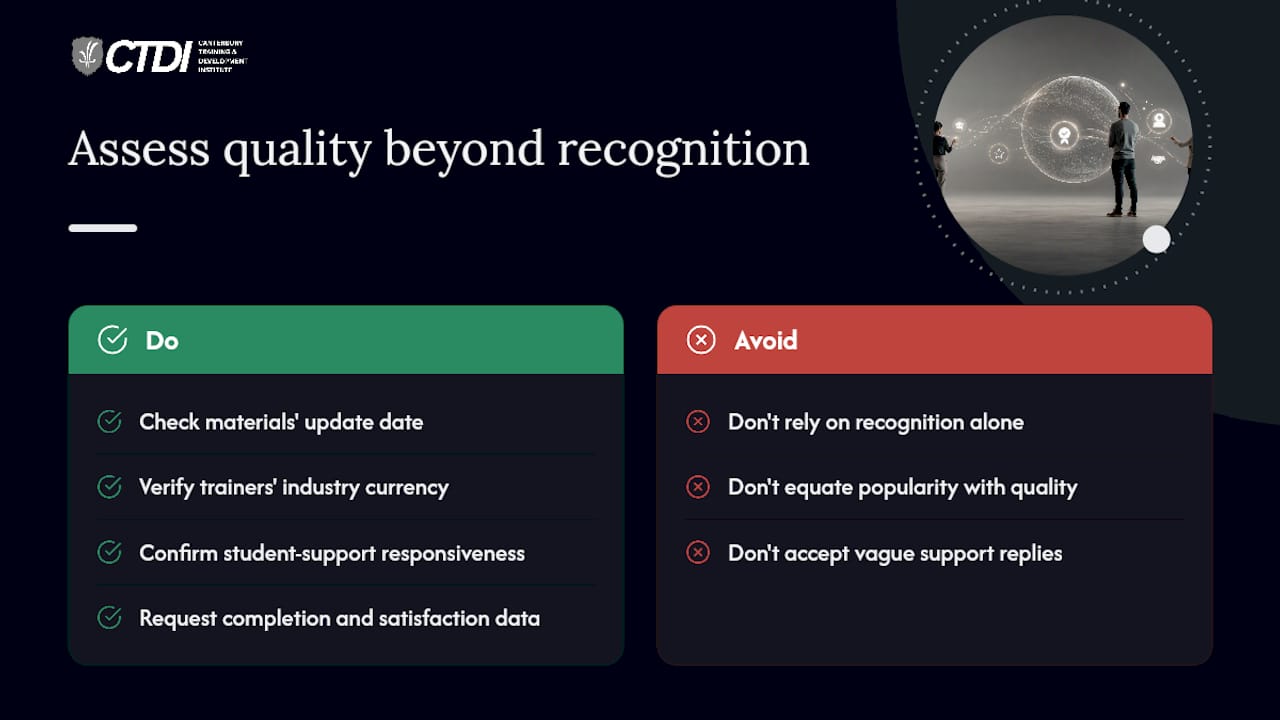
National recognition is the floor, not the ceiling. Two RTOs can both hold a course legitimately on their scope and still differ enormously in trainer experience, industry currency of resources, and how responsive their support team actually is.
Look past the "nationally recognised" badge to genuine quality indicators. Check how recently the provider updated its learning materials, industries move fast, and a digital marketing or AI-related course written three years ago may already be teaching outdated platforms or tools. Ask whether trainers hold current industry experience, not just a training qualification, particularly in fast-moving fields like sustainability reporting or AI-assisted marketing.
Student support responsiveness is another real differentiator. A provider that answers enquiries within a day and gives clear, specific answers about assessment timelines behaves differently to one that stalls or gives generic replies. Completion and satisfaction data, where providers publish it, can also hint at how well a course is actually run day to day, though not every RTO makes this public.
Avoid confusing accreditation with reputation alone. A course can be popular on social media and still be a poor match for your specific licensing or employer requirement. Equally, a smaller or less-marketed RTO can deliver a course that matches your goal precisely, provided its scope, trainers and support stack up under scrutiny. The checklist from earlier sections, scope verification, support confirmation, transparent fees, remains the more reliable filter than course popularity or slick marketing.
Which jobs and industries actually align with common VET courses?
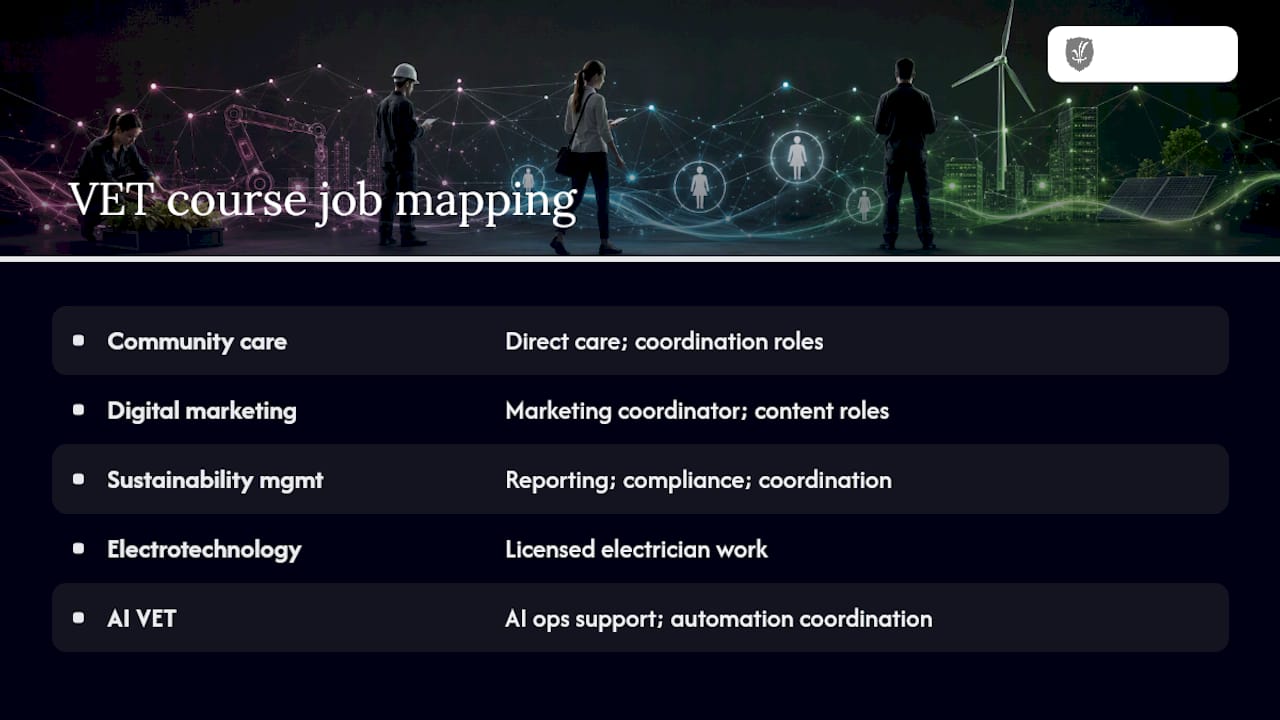
Different qualifications open genuinely different doors, and matching them correctly matters more than picking a trending course title. A Certificate III in Individual Support leads toward direct care roles in aged care or disability support. A Diploma of Community Services tends to align with coordination, case management or team-leader positions in the same broader sector.
In digital and creative fields, a Certificate IV or Diploma in Digital Marketing typically supports roles like marketing coordinator, content specialist or social media manager, positions that increasingly sit inside small businesses and agencies rather than large corporate marketing departments. Courses touching environmentally sustainable management tend to align with roles in sustainability reporting, compliance and environmental coordination, areas where employer demand has grown as businesses respond to reporting obligations.
Trades and technical qualifications map more directly, a Certificate III in Electrotechnology leads toward licensed electrician work, subject to the licensing requirements of your state or territory regulator. AI-related vocational courses are newer territory, and typically support roles like AI operations support, data-informed marketing, or process automation coordination rather than deep technical engineering roles, which usually sit at higher education level.
The point of doing this mapping exercise properly is avoiding a mismatch, enrolling in a qualification because it sounds relevant, only to discover the actual job ads in your target field ask for a different course code or a higher qualification level entirely. Cross-check job listings for your target role before you enrol, not after.
What does job market demand look like for these skill areas?
Demand doesn't move at the same pace across every VET-linked field, and it's worth checking current indicators rather than assuming a qualification's popularity reflects genuine market need. Care and support services have shown sustained demand as Australia's population ages, a trend widely reported across aged care and disability sectors. Digital marketing skills remain sought after as small and medium businesses continue shifting spend toward digital channels rather than traditional advertising.
Sustainability-related roles have grown as more businesses face reporting obligations and client expectations around environmental practices, though the pace of that growth varies by industry and state. AI-adjacent vocational skills are an emerging category, employer demand is real but the job titles and expectations are still settling, which makes it worth checking current job ads rather than relying solely on course marketing to gauge relevance.
Rather than chasing headline growth figures, check job board listings for your target role directly, and look at whether local employers in your industry are advertising for the specific qualification level you're considering. A course that maps well nationally may still have thin local demand, particularly in regional areas, so factor in whether you're prepared to relocate, work remotely or commute for the roles a given qualification typically leads to.
What comes after you finish your VET course?
Completing a VET qualification rarely marks the end of a learning pathway, and it shouldn't be treated that way. Many diplomas and advanced diplomas carry articulation arrangements into related bachelor degrees, meaning some units may count toward university credit, though credit transfer decisions always sit with the receiving institution and are never guaranteed in advance.
Vertical progression within VET itself is common too, a Certificate III graduate often returns later for a Certificate IV or Diploma once they've built workplace experience and want to move into supervisory or specialist roles. This staged approach suits working adults well, since it spreads study cost and time commitment across a longer career trajectory rather than requiring one large upfront investment.
Industry-specific continuing education, short courses, licensing renewals, specialist add-on units, also plays a role in staying current, particularly in fast-moving areas like digital marketing tools or sustainability reporting standards, where a qualification completed a few years ago may need topping up. Some learners use one VET qualification as a stepping stone into a related but higher-scope one, aged care into community services, marketing certificate into a business diploma, rather than jumping straight to a degree.
Whatever pathway you're eyeing next, the same verification habit applies: check the receiving institution's own credit transfer or admission policy directly rather than assuming a marketing claim about "pathway to university" guarantees a specific outcome.
How CTDI fits into this picture
If you've worked through the checklist above, matched your job goal to a qualification level, verified scope, checked RPL options, you're already doing more due diligence than most learners manage. CTDI's own online diplomas in artificial intelligence, digital marketing and environmentally sustainable management are built around that same standard: nationally recognised course codes, clearly stated scope, and support structures designed for working adults studying around a job rather than instead of one.
Courses run fully online and self-paced, with materials designed to reflect current industry practices, which matters given how quickly digital marketing platforms and sustainability reporting standards shift. RPL and credit transfer options are assessed individually, so experienced learners aren't forced through content they've already mastered elsewhere.
Whichever provider you land on, run CTDI through the same scope, support and cost checks you'd apply to any other RTO on your shortlist, that's exactly how this decision should be made. If a course maps to your goal, the next step is straightforward: browse the current diploma offerings and enrol or check the full range of CTDI qualifications to see how they line up against your shortlist.
Sources
FAQ
What career goals should guide a veterinary-adjacent VET course choice?
If you're aiming for animal care work rather than becoming a registered veterinarian (which requires a university degree), VET-level courses in veterinary nursing or animal studies map to roles like veterinary nurse assistant or animal care attendant, check the exact course code against job ads in your area before enrolling.
What are VET courses, in practical terms?
VET stands for Vocational Education and Training, nationally recognised qualifications ranging from Certificate I through to Advanced Diploma level, delivered by registered training organisations and designed to build specific job-ready skills rather than general academic knowledge.
What VET courses are available for a particular city or region?
Course availability varies by provider and delivery mode. Search training.gov.au or YourCareer by course code and location to see which RTOs, including online providers like CTDI, currently have that qualification on scope in your area.
What does "VET" stand for in the education system?
VET stands for Vocational Education and Training, the system of nationally recognised qualifications and training packages that sits alongside, and is distinct from, the university sector in Australia.
How do I know if an online RTO is legitimate before enrolling?
Check the RTO's registration and scope directly on the National Training Register, request written confirmation of the exact course code, and review its pre-enrolment documents against ASQA's guidance for students before paying any fees.
Recommended
- Vocational training in Australia: how to find accredited courses
- Vet student loans eligibility: what Australian students need to check
- Up to 50% Credit: Paperwork Checklist for VET Graduates in Australia
- Career pathways in Australia: your 2026 guide
This article provides general information only. Course requirements, study pathways, credit arrangements and career outcomes may vary. Always confirm current requirements with the relevant education provider or authority.