

TL;DR:
- Effective corporate learning paths are structured sequences designed to develop employee competencies through measurable goals. They must start with clear business outcomes, incorporate practice, and use role-specific personalisation to boost engagement and completion rates. Proper design involves backward planning, milestones, practice opportunities, and ongoing iteration for long-term success.
A corporate learning path is a structured, sequential series of learning activities designed to move an employee from their current skill level to a defined competency. Knowing how to design corporate learning paths is one of the highest-leverage skills an HR professional or training manager can develop. Organisations using well-designed learning paths achieve 68% higher completion rates and 45% faster competency attainment. Those numbers reflect a simple truth: structure beats content volume every time. The industry term for this practice is "instructional pathway design," and it sits at the heart of every effective learning and development strategy.
How to design corporate learning paths: the foundational work
Every effective learning path starts well before a single piece of content is selected. The foundation is a clear link between the learning programme and measurable business outcomes.

Aligning corporate training to business KPIs is the single most important design decision you will make. A learning path built around a vague goal like "improve communication" will drift. One built around a KPI like "reduce customer escalations by 15% in Q3" gives you a clear finish line and a way to measure success. Corporate learning programmes should function as performance drivers, not content libraries.
Once you have your business goal, conduct a skills gap analysis. Pull performance data, run manager interviews, and compare current employee capabilities against the competencies the role demands. This step tells you exactly what the path needs to close.
With the gap identified, write specific, measurable learning objectives. Each objective should describe an observable behaviour: "The learner will be able to write a project brief that meets the internal approval checklist without revision." Vague objectives produce vague content choices.
The final foundational step is learner segmentation. A new graduate and a 10-year veteran in the same role need different paths. Segment by role, experience level, and career line before you build anything.
Key prerequisites at a glance:
- Identify the business KPI the learning path must move
- Conduct a skills gap analysis using performance data and manager input
- Write observable, measurable learning objectives for each competency
- Segment learners by role, experience level, and career stage
- Define what "competent" looks like before selecting any content
Pro Tip: Run a 30-minute interview with two or three high performers in the target role before you write a single objective. They will tell you exactly which skills matter and which training they have ignored for years.
How do you map skills and sequence learning activities?
Skill mapping is the process of identifying every competency a learner needs and arranging those competencies in the order they must be learned. Get this wrong and learners hit content they are not ready for, lose confidence, and drop off.
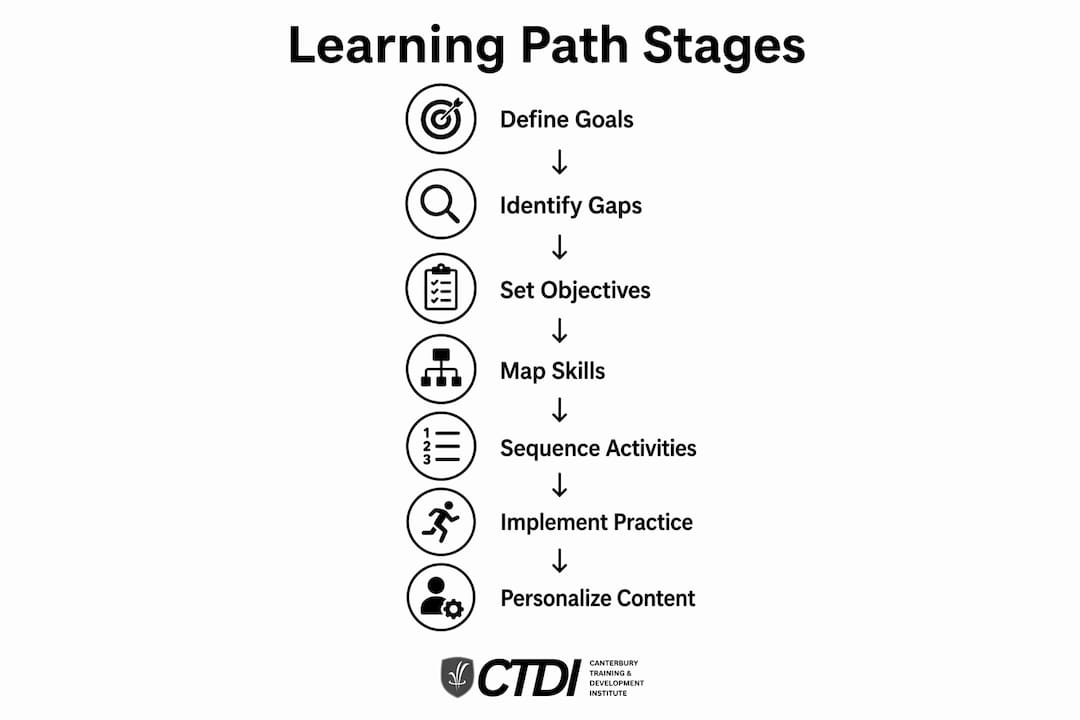
The most reliable approach is backward design. Defining end-state competencies first, then mapping the prerequisite skills needed to reach them, reduces drop-off rates caused by knowledge mismatch. Start with the finish line, then work backwards to the starting blocks.
Once you have your competency map, sequence content using Bloom's Taxonomy as your guide. Move learners from remembering and understanding (knowledge checks, explainer videos) through applying and analysing (case studies, simulations) to evaluating and creating (stretch projects, peer reviews). This progression mirrors how adults actually build skill, not just familiarity.
The tell-show-do-review cycle is a practical sequencing tool that sits inside this framework. Tell the learner what they need to know. Show them a worked example. Have them do it in a low-stakes environment. Then review their output with structured feedback. This cycle can repeat within a single module or across a multi-week path.
Chunk your content into modules of no more than 20–30 minutes each. Longer modules inflate perceived effort and suppress completion. Each chunk should address one competency and end with a clear milestone so learners know they have made progress.
A six to seven phase design framework covers the full build: auditing retention curves, defining outcomes, mapping skills, chunking content, adding milestone assessments, and deploying automated recognition. Use this as your project checklist, not just a conceptual model.
Sequencing a learning path: a practical order
- Define the target competency (backward design starting point)
- List every prerequisite skill needed to reach that competency
- Arrange prerequisites from foundational to advanced
- Assign content formats to each skill level (video, reading, simulation, project)
- Insert a knowledge check or assessment at each module boundary
- Add a milestone credential or badge at each major competency cluster
- Schedule a review point at 30 days post-completion to measure transfer
Comparing content sequencing approaches
| Approach | Best used when | Risk if misapplied |
|---|---|---|
| Bloom's Taxonomy progression | Building new skills from scratch | Skipping lower levels leaves gaps |
| Tell-show-do-review cycle | Procedural or technical skills | Skipping "do" kills transfer |
| Backward design | Competency-based programmes | Starting with content, not outcomes |
| Chunked modular design | Self-paced online delivery | Chunks too long reduce completion |
What role do milestones and practice play in learning path effectiveness?
Formal training transfers to the workplace at less than 20% without practical application opportunities built into the path. That figure should change how you think about content selection. Video and reading alone do not produce skill. Practice does.
Practice-based learning means building on-the-job assignments, simulations, and stretch projects directly into the path. A customer service learning path, for example, should include a live call observation, a role-play simulation scored against a rubric, and a real customer interaction reviewed by a manager. Each of these activities forces the learner to apply knowledge under conditions that resemble actual work.
Visible progress and stackable credentials significantly increase learner engagement and completion. Learners who can see exactly where they are in a path, and who receive a credential when they complete a module cluster, stay motivated through longer programmes. The credential does not need to be formal. A digital badge issued automatically at each milestone is enough to create a sense of forward movement.
Automated issuance of digital credentials at milestones provides timely recognition and gives managers real-time visibility into team progress. This removes the administrative burden from HR while keeping learners and their managers informed.
Building practice and milestones into your path:
- Assign at least one on-the-job task per competency cluster
- Use simulations or role-plays for skills that carry risk if practised live
- Issue a digital badge or credential automatically at each major milestone
- Display a progress bar or completion percentage in the learner's dashboard
- Schedule a manager check-in at the midpoint of any path longer than four weeks
- Include peer review tasks to build both skill and accountability
Pro Tip: Design the on-the-job assignment before you select the content that precedes it. If you cannot describe what the learner will do differently at work after this module, the module probably does not belong in the path.
How do you personalise learning paths using technology?
Personalisation is the difference between a learning path that feels relevant and one that feels like a compliance checkbox. Personalising learning by role, career line, and experience level respects learner time and produces better outcomes than a single path applied to everyone.
The most practical personalisation tool is branching. Build a core path that all learners in a role must complete, then branch into elective modules based on career direction. A marketing coordinator path might branch into a digital analytics track for those moving toward data roles, and a content strategy track for those moving toward editorial roles. Each branch stays relevant to the individual without requiring a separate path to be built from scratch.
Adaptive learning platforms adjust content sequencing based on assessment results and demonstrated competencies. If a learner scores above the threshold on a pre-assessment, the platform skips foundational modules and moves them to applied content. This prevents the frustration experienced learners feel when forced to sit through material they already know. For developing digital skills in particular, this kind of adaptive sequencing can cut path completion time significantly.
Allowing learners to test out of modules is a design decision, not a technology feature. Build it into your path structure regardless of the platform you use. Experienced learners who can demonstrate competency upfront should be able to skip to the assessment and move on.
Personalisation strategies that work in practice:
- Create role-specific branches off a shared core path
- Use pre-assessments to place learners at the right starting point
- Allow test-out options for learners with prior experience or credentials
- Separate mandatory compliance content from optional development modules
- Use learner behaviour data (completion rates, time-on-task) to identify where paths need redesign
- Offer elective modules tied to visible career progression milestones
The balance between mandatory and optional content matters. Paths that are 100% mandatory feel like compliance training. Paths with too many optional modules lose structure. A ratio of roughly 70% core to 30% elective gives learners agency without sacrificing the competency outcomes the organisation needs.
Workplace upskilling examples show that the most effective programmes combine structured paths with visible career outcomes. Learners complete training faster when they can see exactly how a module connects to a promotion, a pay review, or a new project opportunity.
Stretch projects are particularly effective for senior learners. Rather than adding more content, assign a project that requires the learner to apply multiple competencies simultaneously. This mirrors the complexity of real work and produces stronger skill transfer than any single module can achieve. Research on integrating stretch projects into learning programmes confirms that applied tasks close the gap between formal training and on-the-job performance.
Key takeaways
Effective corporate learning paths require backward design, practice-based application, and role-specific personalisation to move employees from current skill levels to defined competencies.
| Point | Details |
|---|---|
| Start with business outcomes | Link every learning path to a measurable KPI before selecting any content. |
| Use backward design | Define the target competency first, then map prerequisite skills in reverse order. |
| Build in practice | Formal training transfers at less than 20% without on-the-job tasks or simulations. |
| Add visible milestones | Digital credentials and progress indicators drive completion and manager visibility. |
| Personalise by role and level | Branching paths and test-out options respect learner time and improve engagement. |
What I have learned from building learning paths that actually stick
The most common mistake I see training managers make is treating a learning path as a content playlist. They gather videos, articles, and courses, arrange them in a logical order, and call it a path. Learners open it, complete the first two modules, and then disappear. The content was fine. The design was the problem.
A learning path is not a library. It is a structured progression with a clear destination, built-in practice, and visible proof of progress. The link between training and business outcomes is not a nice-to-have. It is the reason the path exists. When learners cannot see how a module connects to their actual job or career, they deprioritise it. Every time.
The second mistake is overloading the path before the technology or the culture is ready. I have seen organisations deploy adaptive learning platforms before their managers understood what a learning path was. The technology sat unused because the humans around it had not been brought along. Start with a simple, well-designed path on whatever platform you already have. Prove the model works. Then add complexity.
Manager involvement is the variable most designers underestimate. A learner whose manager references their path in a one-on-one meeting is far more likely to complete it than one whose manager has never seen it. Build manager touchpoints into the path design itself, not as an afterthought.
Start small. Pick one role, one competency gap, and one clear business outcome. Build a tight path of six to eight modules with two or three milestones. Measure completion, measure skill transfer, and measure the business metric. Then iterate. The organisations that build the best learning paths do not design them once. They treat them as living programmes that improve with every cohort.
— Sam
Qualifications that fit inside your corporate learning design
Designing employee learning paths works best when the content itself is credible, current, and built by people who understand the industry.
Edu, the Canterbury Training and Development Institute, offers online diplomas in AI, digital marketing, and environmental management that slot directly into corporate learning path designs. Each course is self-paced, 100% online, and built by industry experts, which means your employees can complete them alongside their work without disruption. For training managers building career-aligned learning programmes, these qualifications provide the formal credential layer that stackable milestone design requires. They are nationally recognised, which adds weight to the competency evidence your organisation collects.
FAQ
What is a corporate learning path?
A corporate learning path is a structured sequence of learning activities designed to move an employee from their current skill level to a defined competency. It differs from a course catalogue because it has a clear destination, a logical sequence, and built-in assessments.
How long should a corporate learning path be?
Path length depends on the complexity of the target competency, but most effective paths run between four and twelve weeks for a single competency cluster. Paths longer than twelve weeks need strong milestone design to prevent drop-off.
What is the biggest mistake in designing employee learning paths?
The most common error is selecting content before defining the target competency. Backward design, starting with the desired outcome and working backwards to prerequisites, produces paths with far lower drop-off rates.
How do you measure the effectiveness of a learning path?
Measure three things: completion rate, skill transfer rate (assessed 30 days post-completion), and movement in the business KPI the path was built to influence. Completion alone does not confirm that learning occurred.
How does personalisation improve learning path outcomes?
Personalising paths by role, experience level, and career direction keeps content relevant and reduces time wasted on material learners already know. Allowing experienced learners to test out of modules and branch into role-specific tracks produces faster competency attainment and higher engagement.