

TL;DR:
- Focusing on high-impact digital skills like AI prompting, data visualization, and cybersecurity accelerates career growth. Developing skills through short daily practice, active recall, and real projects ensures deeper learning and better retention. Structured learning with clear goals and mentorship enhances motivation and helps build credible certifications and portfolios.
Digital skills are defined as the technical competencies that let you use digital tools, platforms, and data to perform work tasks effectively. Knowing how to develop digital skills is no longer optional for career advancement. Sector surveys confirm that AI usage, cloud collaboration, cybersecurity, and data literacy now dominate job requirements across industries. The most effective approach combines focused goal-setting, structured daily practice, and immediate real-world application. Vague ambitions like "learn tech" produce little. Concrete projects and the 80/20 rule produce careers.
Which digital skills deliver the best career leverage today?
The 80/20 rule applied to digital learning means that roughly 20% of skills produce 80% of your career results. Focusing on AI prompting or advanced data visualisation rather than trying to master every software feature prevents overload and accelerates progress. The trick is identifying which 20% matters for your specific industry before you spend a single hour studying.
High-demand skills in 2026 fall into four broad categories. AI usage covers prompt engineering, AI-assisted writing, and workflow automation. Data literacy covers reading dashboards, interpreting analytics reports, and building basic visualisations. Cybersecurity covers password management, phishing recognition, and safe data handling. Cloud collaboration covers tools like Microsoft 365 and Google Workspace.
Role-specific examples make this concrete. A marketing coordinator benefits most from data analytics and AI content tools. A project manager gains the most from cloud collaboration and workflow automation. A small business owner gets the fastest return from cybersecurity basics and digital marketing fundamentals. Matching the skill to the role is more important than chasing the most popular trend.
Skill stacking, which means combining two or more complementary digital skills, significantly improves your job market value. Pairing data analytics with AI prompt engineering, for example, creates a profile that few candidates can match. That combination is increasingly what hiring managers in finance, marketing, and operations are looking for.
| Skill category | Career impact | Complexity for beginners |
|---|---|---|
| AI prompting and automation | Very high | Low to moderate |
| Data analytics and visualisation | Very high | Moderate |
| Cybersecurity fundamentals | High | Low |
| Cloud collaboration tools | High | Low |
| Digital marketing and SEO | High | Moderate |
| Web development basics | Moderate | Moderate to high |
What do you need before starting digital skills training?
The prerequisites for digital skills training are simpler than most people expect. You need a reliable internet connection, a laptop or desktop computer, and access to a browser. Beyond hardware, you need a clear goal and a learning platform that suits your pace and budget.
Free platforms cover a remarkable amount of ground. Microsoft Learn, Google Digital Garage, Coursera, and edX all provide free access to courses and certifications across beginner and advanced levels. Microsoft Learn is particularly strong for cloud and AI fundamentals. Google Digital Garage covers digital marketing and data basics in short, self-paced modules.
Setting goals using the SMART framework (Specific, Measurable, Achievable, Relevant, and Time-bound) separates learners who progress from those who stall. "I want to learn digital marketing" is not a goal. "I will complete Google Digital Garage's Fundamentals of Digital Marketing certification by the end of next month" is a goal. The specificity creates accountability.
- Choose one skill category that aligns with your current or target role
- Identify a free or low-cost platform that offers structured modules in that category
- Set a SMART goal with a clear completion date
- Select a concrete project to build as you learn (a portfolio site, a data dashboard, or a social media campaign)
- Block out a consistent daily time slot, even if it is only 20 minutes
Pro Tip: Replace vague ambitions with project-based goals. Building a real portfolio site or a live data dashboard gives you something tangible to show employers and keeps motivation high when the novelty of learning wears off.
How to develop digital skills step by step
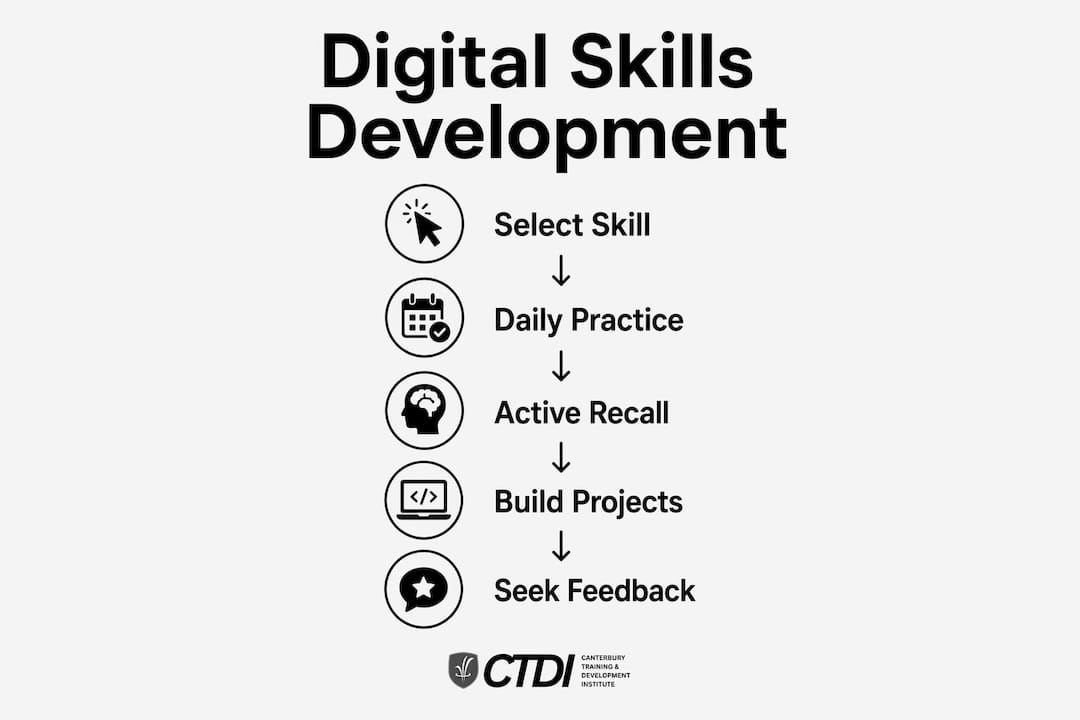
The most reliable method for improving digital skills follows a five-stage cycle. Each stage builds on the last, and skipping any one of them slows your progress considerably.
Stage 1: Select one skill and commit
Pick a single skill from the high-impact category that matches your career goal. Resist the urge to study three things at once. Splitting attention across multiple skills in the early weeks produces shallow knowledge in all of them and mastery in none.
Stage 2: Learn in short daily sessions
Daily 20–30 minute practice sessions beat infrequent long study marathons for retention. Short sessions keep concepts fresh in working memory and reduce the mental fatigue that causes people to quit. Treat your learning slot like a meeting you cannot cancel.
Stage 3: Apply active recall immediately
Passive video watching is the least effective way to retain digital skills. Active recall, which means closing the tutorial and recreating what you just learned from memory, leads to deeper processing and faster mastery. After watching a lesson on Excel pivot tables, close the video and build a pivot table from scratch using your own data.
Stage 4: Build a real project as you go
Volunteering for digital tasks in your current workplace or automating a repetitive workflow you already do is the fastest way to contextualise new knowledge. You do not need a formal degree to apply skills. You need a real problem to solve. If your workplace does not offer opportunities, create a personal project: a blog, a data analysis of public datasets, or a mock marketing campaign.
- Complete a module on your chosen platform
- Close the material and recreate the key concept from memory
- Apply that concept to your personal or workplace project
- Note what broke or confused you
- Return to the material to fill the gap, then repeat
Pro Tip: Structured programmes like online training programmes often include project briefs built into the curriculum. Using a structured brief removes the guesswork about what to build and gives you a benchmark to measure your progress against.
Stage 5: Seek feedback and iterate
Feedback accelerates improvement faster than solo practice alone. Share your project with a peer, a mentor, or an online community. Ask specific questions: "Does this dashboard communicate the trend clearly?" or "Is this email campaign copy persuasive?" Vague feedback requests produce vague answers.
Mentorship provides critical guidance that self-directed learning cannot replicate. A mentor who works in your target field can tell you which skills actually matter in hiring decisions, which tools employers use day-to-day, and where your current work falls short. That kind of alignment saves months of learning the wrong things.
How do you stay motivated through digital learning challenges?
Motivation in digital learning follows a predictable pattern. Early enthusiasm is high, then a plateau hits around weeks three to six, and many learners quit before they reach competence. Knowing this pattern in advance lets you prepare for it rather than interpret it as failure.
The most common reason learners stall is not lack of aptitude. Most fail due to a lack of specific, project-based goals rather than any inability to grasp the material. When the goal is vague, the first difficult concept feels like a dead end. When the goal is a concrete project, the same difficult concept becomes a problem worth solving.
Practical strategies that sustain progress include:
- Limit your scope. Study one skill at a time. Adding a second skill before the first is applied creates confusion, not breadth.
- Track visible progress. Keep a simple log of what you completed each week. Seeing three weeks of entries is more motivating than remembering how far you have come.
- Build accountability. Tell a colleague, friend, or study partner what you are working on and when you plan to finish. External accountability reduces dropout significantly.
- Use mentorship. A mentor aligns your learning choices with realistic career goals and provides perspective when a plateau feels permanent.
- Protect your learning time. Treat your daily 20–30 minute session as non-negotiable. Consistency over weeks produces compound gains that occasional long sessions cannot match.
Balancing learning with work and personal commitments is the practical challenge most guides ignore. The solution is not finding more time. It is reducing the session length until it fits without friction. Ten minutes of active recall every day outperforms a two-hour session once a fortnight.
You can also explore communication training resources that complement digital skill development, particularly if your career involves presenting data or leading digital projects. Clear communication amplifies the value of every technical skill you build.
Key takeaways
Developing digital skills effectively requires focused goals, daily consistent practice, and immediate application through real projects rather than passive study.
| Point | Details |
|---|---|
| Apply the 80/20 rule | Focus on the small set of skills with the highest impact for your specific role. |
| Use active recall | Close tutorials and recreate content from memory to retain skills faster. |
| Build real projects | Replace vague learning goals with concrete projects you can show employers. |
| Practise daily in short sessions | Twenty to thirty minutes each day outperforms long, infrequent study sessions. |
| Stack complementary skills | Combining data analytics with AI prompting creates a standout professional profile. |
Why I think most digital learning advice misses the point
Most guides on ways to enhance digital skills focus on which platforms to use. That is the wrong starting point. Platform choice matters far less than what you do in the first ten minutes after a lesson ends.
The learners I have seen make the fastest progress share one habit: they close the tutorial immediately and try to reproduce what they just learned. No notes open. No video paused. Just them and a blank screen. That discomfort is where real learning happens. Passive watching feels productive but produces little retention. Active struggle produces competence.
The second thing most advice gets wrong is the obsession with breadth. Learners are told to build a "diverse digital skill set" before they have mastered anything. Skill stacking only works when the first skill is genuinely solid. Pairing a shallow understanding of data analytics with a shallow understanding of AI prompting does not create a strong profile. It creates two half-skills. Go deep on one thing first. Then stack.
The third gap is underestimating the role of career-focused digital certification in signalling competence to employers. Self-taught skills are real, but a recognised credential removes doubt at the shortlisting stage. The combination of project-based evidence and formal certification is the most credible package you can present. Neither alone is as strong as both together.
Self-directed learning is powerful, but it works best inside a structure. The learners who struggle most are those who try to build their own curriculum from scratch while also managing full-time work. A structured programme with clear milestones removes that cognitive load and lets you focus entirely on the skill itself.
— Sam
Edu's online programmes for digital skill development
Edu, the Canterbury Training and Development Institute, offers nationally recognised online diplomas in digital marketing and AI for Australians ready to build career-ready skills.
Courses are 100% online and self-paced, designed by industry experts who understand what employers actually require in 2026. Whether you are starting from scratch or adding credentials to existing experience, Edu's Advanced Diploma of Digital Marketing covers AI-powered marketing, data analytics, and campaign strategy in one structured programme. When you are ready to take the next step, enrol online and access flexible, accredited training built around your schedule and career goals.
FAQ
What does "developing digital skills" actually mean?
Developing digital skills means building the technical competencies to use digital tools, data, and platforms effectively in a work context. It includes skills like AI prompting, data analytics, cybersecurity, and cloud collaboration.
How long does it take to learn a new digital skill?
Timeframes vary by skill complexity and daily practice. Structured programmes like short bootcamps typically require 3–4 hours per week over several months to reach a job-ready level.
Do I need a formal qualification to get a digital job?
Formal degrees are not required. Employers respond to demonstrated skills through real projects and recognised certifications. Combining a portfolio of completed work with an accredited credential is the most credible approach.
What is the best way to learn digital skills for beginners?
The best starting point for digital skills for beginners is to choose one high-impact skill, set a SMART goal, and practise daily using a free platform like Google Digital Garage or Microsoft Learn while building a real project alongside the course.
How do I stay consistent with digital skills training?
Consistency comes from short daily sessions rather than long occasional ones. Tracking weekly progress, setting project-based goals, and using a mentor or accountability partner are the most reliable methods for sustaining momentum over months.