
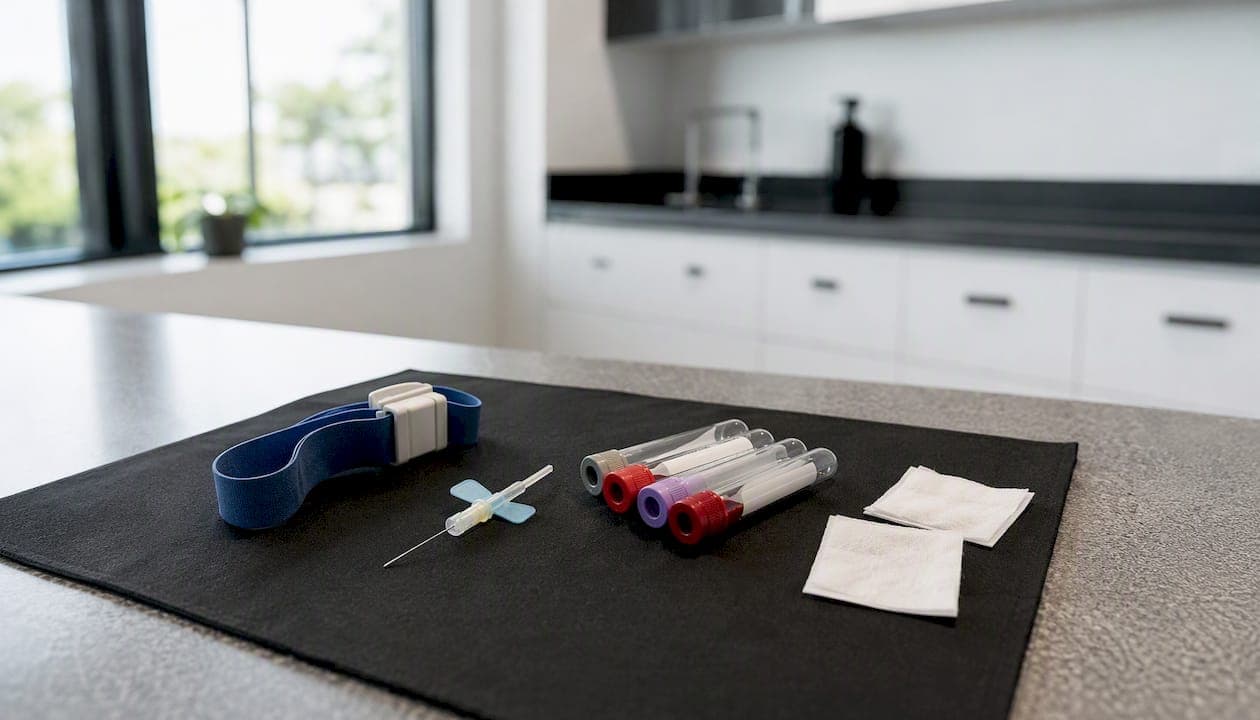
Yes, you can study pathology collection online in Australia — but with one non-negotiable catch. Every accredited provider still requires hands-on workplace placement and supervised practical assessment. No online-only pathway removes that requirement.
The qualification you are looking for is the Certificate III in Pathology Collection. It has been listed under two national codes: HLT37215 (shown as superseded on some provider pages) and the more recently maintained HLT37525. Before you enrol anywhere, check Training to confirm which code is current and that your chosen provider is registered to deliver it.
The main accredited options worth researching first:
- TAFE NSW — blended delivery with structured campus practicals and access to public hospital placement networks
- IHNA Online — private RTO with online theory, scheduled practical sessions, and an online application portal
- TAFE QLD — blended delivery with state fee-assistance schemes for eligible Queensland learners
- APC and AHT Online — private RTOs offering flexible cohort scheduling or self-paced theory, both still requiring supervised placement
The single most important step before comparing fees or enrolment dates: verify the national code and your provider's RTO registration on training.gov.au. A course that cannot demonstrate national recognition will not get you hired.
Table of Contents
- How do the main accredited pathology collection courses compare?
- What skills and units does the Certificate III actually cover?
- How does course delivery, duration, and placement actually work?
- Who should enrol, and what checks do you need to clear first?
- How to choose between online, blended, and on-campus delivery
- What does a pathology collection course cost, and how can you reduce it?
- What jobs and study pathways does the certificate open up?
- How clinical placement works and how to get through it smoothly
- Why course codes matter and how to verify accreditation before you enrol
- What most students get wrong about studying pathology online
- What to do next if you want to enrol in a pathology online course
- Edu offers a different kind of accredited online study
- Sources
How do the main accredited pathology collection courses compare?
The table below covers the key decision criteria across the main providers. Costs vary by state, delivery mode, and subsidy eligibility, so treat fee ranges as a guide and confirm directly with each provider.
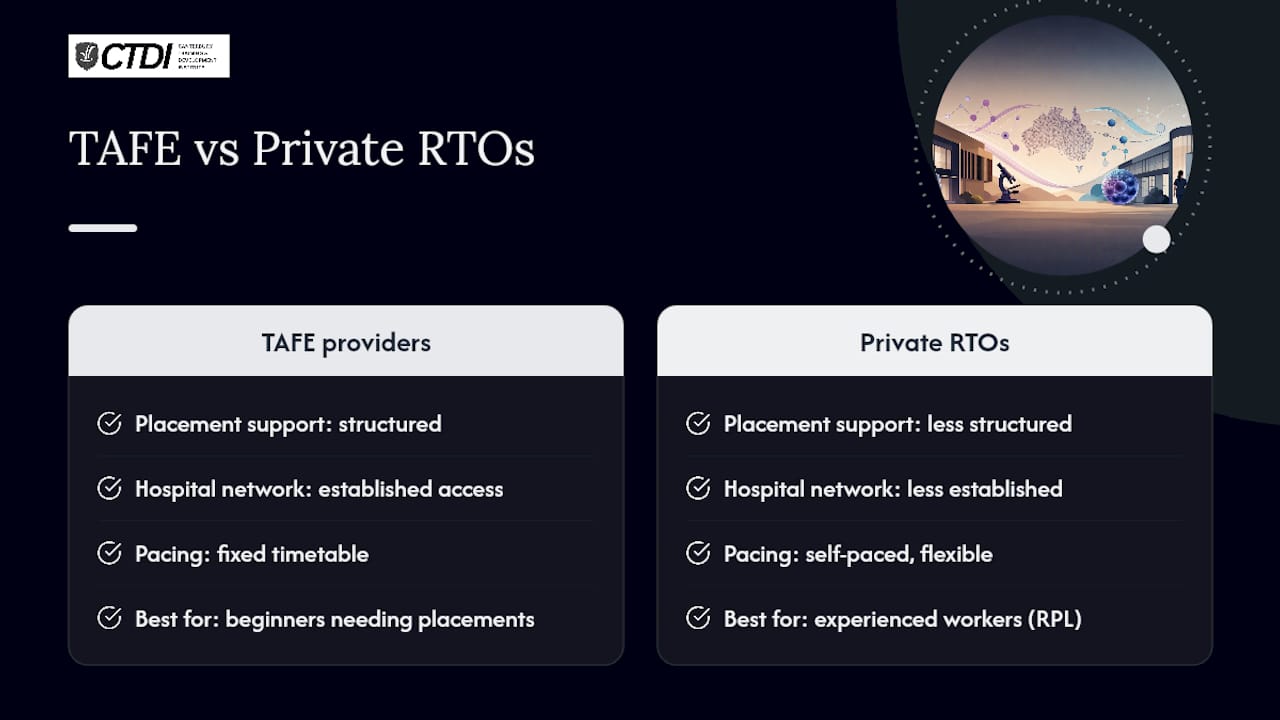
The clearest tradeoff in this market: TAFE providers offer structured placement support and established hospital networks, while private RTOs like AHT Online give you more control over pacing. If you are already working in a clinical setting and want to formalise your skills through recognition of prior learning (RPL), a self-paced private RTO may suit you better. If you are starting from scratch, TAFE's placement relationships are worth the structured timetable.
What skills and units does the Certificate III actually cover?
The Certificate III in Pathology Collection is built around one core clinical skill: collecting blood and other specimens safely, accurately, and with genuine patient care. Around 14 units make up the full qualification, covering both technical competencies and the professional behaviours employers expect from day one.
Core learning outcomes include:
- Venous blood collection (phlebotomy), including difficult draws and paediatric considerations
- Specimen collection other than blood (urine, swabs, capillary samples)
- Infection prevention and control, including standard precautions and PPE use
- Specimen labelling, handling, and chain-of-custody documentation
- Basic patient communication and support, including managing anxious patients
- Medical terminology relevant to pathology and laboratory settings
- Basic ECG recording (included by some providers as an elective unit)
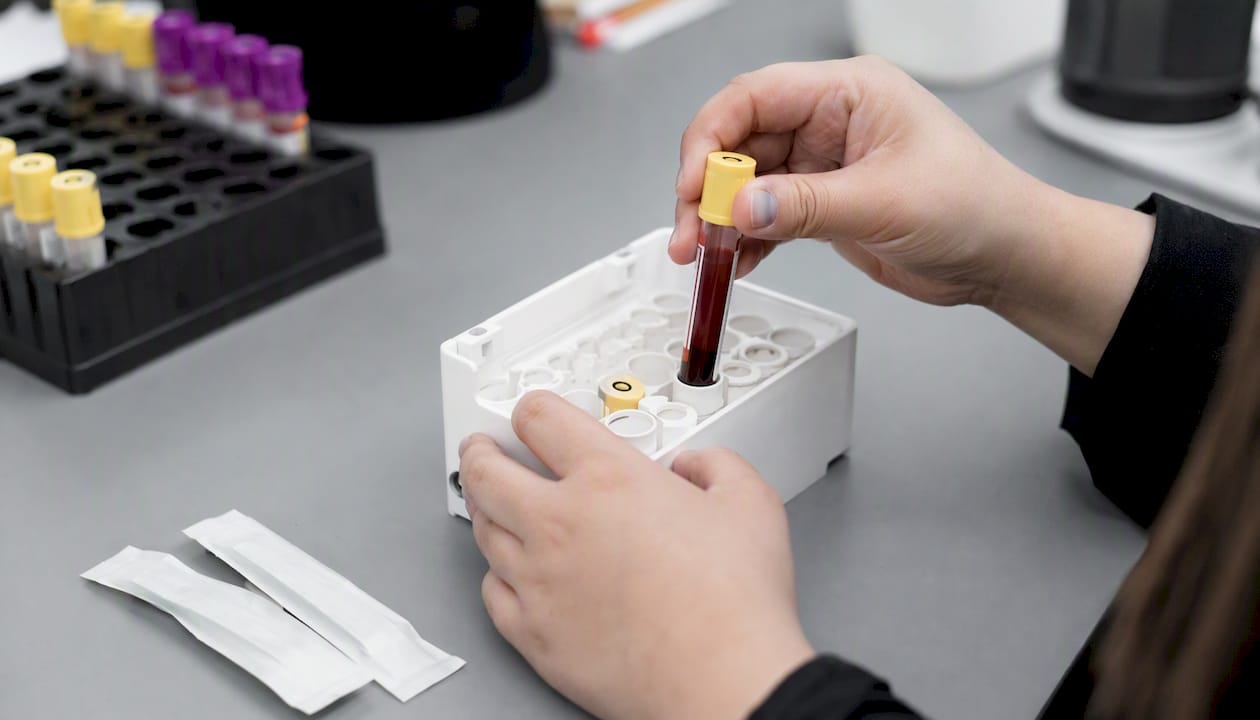
Assessment is typically structured across three layers: online theory quizzes and written tasks, simulated practical demonstrations in a lab or skills lab setting, and workplace sign-offs during placement. You need to pass all three. Passing the theory alone does not complete the qualification.
It is worth distinguishing this certificate from online CPD products. Platforms like Lecturio offer large video libraries and theory tools for pathology learning, and the Digital Pathology Association runs certificate programmes designed to upskill existing practitioners. Those are continuing education tools, not entry-level vocational qualifications. The Certificate III is the nationally recognised credential that gets you hired as a pathology collector.
Pro Tip: Ask your provider for the full unit list before enrolling. A legitimate RTO will share it without hesitation. If a provider is vague about which units are included, that is a red flag worth taking seriously.
How does course delivery, duration, and placement actually work?
The national code question
HLT37215 is the code most providers still display, but it is flagged as superseded on some pages of the national register. The currently maintained code is HLT37525. Both refer to the Certificate III in Pathology Collection, and many providers are in transition between the two. Always confirm the code your provider is delivering against, and cross-check it on training.gov.au before signing any enrolment agreement.
Duration and pacing
Most blended deliveries run approximately six months part-time. Accelerated cohorts exist through some private RTOs and can compress theory into a shorter window, though placement hours remain fixed regardless of how fast you complete the online component. RPL can reduce your study load if you have documented prior experience in a clinical or laboratory setting.
Placement hours and what counts
Placement is commonly around 35 hours of supervised workplace practice, though this varies by provider. The critical requirement is not just the hours: you must achieve sign-off on specific competencies, including supervised venous blood collections. Hours spent observing do not substitute for supervised practice.
What to clarify with any provider:
- Exactly how many placement hours are required
- Whether the provider arranges placement or you source it yourself
- Which competencies must be signed off during placement
- What happens if a placement falls through mid-course
Assessment types
| Assessment type | What it tests | When it happens |
|---|---|---|
| Online theory quizzes | Knowledge of terminology, procedures, infection control | Throughout the course |
| Written assignments | Procedure documentation, case-based reasoning | Mid-course |
| Simulated practical | Venepuncture technique, specimen handling | Before placement |
| Workplace assessment | Real patient collection, competency sign-offs | During placement |
Who should enrol, and what checks do you need to clear first?
The Certificate III suits a wider range of people than most assume. Career changers from retail, hospitality, or administration regularly complete it successfully. Enrolled nurses and support workers use it to add phlebotomy to their existing skill set. Lab assistants without formal qualifications pursue it for professional recognition.
Common entry requirements across providers:
- Minimum age of 18 years
- Basic literacy and numeracy (LLN assessment at enrolment)
- Current immunisation records (hepatitis B is standard; providers may require additional vaccines)
- National police check
- Working with vulnerable people or working with children check, depending on your placement setting (the Victorian working with children check is one example; equivalent checks apply in other states)
- Some providers require a pre-enrolment interview or health declaration
RPL is available through most providers. If you have worked as a phlebotomist overseas, in a clinical support role, or in a laboratory setting, you may be able to have prior learning assessed against the unit requirements. This can shorten your course duration and reduce fees, but you will still need to demonstrate current competency in supervised venepuncture.
Pro Tip: Gather your immunisation records before you contact providers. Tracking down a hepatitis B titre result from years ago takes longer than most people expect, and some providers will not confirm your enrolment until immunisation documentation is complete.
How to choose between online, blended, and on-campus delivery
Not all accredited courses are equal, and the delivery mode is only one variable. Use this checklist when comparing providers.
- Confirm the national code on training.gov.au. Check that the qualification code the provider advertises matches a current, nationally recognised listing. Use the accreditation verification steps as a reference if you are unfamiliar with the process.
- Verify RTO registration. Every provider must be a registered training organisation. You can check RTO registration on training.gov.au directly.
- Ask specifically how placement is arranged. Does the provider have existing relationships with hospitals or clinics? Do they guarantee a placement host, or do you source your own? This single question separates well-resourced providers from those that leave students scrambling.
- Request the full unit list. Compare it against the training.gov.au unit mapping for HLT37525 to confirm nothing is missing.
- Understand the assessment requirements. Confirm that workplace sign-offs are included, not just theory assessments.
- Compare trainer experience. Ask whether trainers hold current industry registration and recent clinical experience.
- Check enrolment timelines and cohort dates. Some providers run rolling enrolments; others have fixed intake dates. Know which applies before you plan around it.
Red flags to watch for:
- Vague or unconfirmed placement arrangements ("you'll sort that out yourself")
- No practical assessment component described
- Provider cannot confirm their RTO number
- Unit list is missing or incomplete on the course page
- Unusually short duration claims that do not account for placement hours
What does a pathology collection course cost, and how can you reduce it?
Fees vary considerably. TAFE providers generally charge lower base fees than private RTOs, and state-based subsidies can reduce costs further for eligible domestic learners. Private RTOs often charge more but may offer greater scheduling flexibility or faster cohort starts.
Funding options worth investigating:
- State fee-assistance schemes: Each state runs its own skills funding programme. Eligibility depends on your residency, prior qualifications, and the specific course. State skills commissions, including the South Australian Skills Commission, publish current eligibility rules and subsidy amounts. Check the equivalent authority in your state.
- Fee-free TAFE: The Australian Government's Fee-Free TAFE initiative has covered some health-related certificates for eligible learners. Availability changes each year and varies by state, so confirm current eligibility directly with your chosen TAFE.
- Employer sponsorship: Some pathology companies and hospital networks sponsor staff through the Certificate III as part of workforce development. If you are already working in a healthcare-adjacent role, ask your employer before paying out of pocket.
- RPL to reduce fees: If you qualify for recognition of prior learning, the units you are assessed out of typically reduce your total fee proportionally.
- Government traineeships: In some states, the Certificate III can be completed as part of a formal traineeship arrangement, which may attract additional government incentives for both you and your employer.
Worth knowing: Fee-free or subsidised places are often limited and fill quickly at the start of each intake period. Contacting providers early in the year typically gives you the best chance of securing a subsidised spot.
What jobs and study pathways does the certificate open up?
The Certificate III in Pathology Collection is a direct entry credential into clinical collection roles. Yourcareer outlines the typical employment outcomes for pathology-collection qualifications, including roles in hospital and community settings.
Typical entry-level roles:
- Pathology collector (phlebotomist) in hospital, clinic, or community collection centre
- Laboratory assistant supporting specimen processing and handling
- Specimen courier or reception staff in pathology services
- Collection centre coordinator with additional experience
Employers generally expect new graduates to build speed and confidence in the first few months on the job. The certificate demonstrates competency; workplace fluency comes with supervised practice after graduation.
Further study options:
- Certificate IV or Diploma-level laboratory technology qualifications
- Continuing professional development in specialised areas such as haematology morphology or digital pathology (note: programmes like the NSH eLearning digital pathology certificate are structured as CPD modules for existing practitioners, not entry-level replacements)
- Allied health pathways including enrolled nursing or medical science degrees for those who want to move into broader clinical or laboratory science roles
Short online courses on platforms like Coursera cover specialist topics such as blood film morphology, but these target learners who already hold a clinical background. They complement the Certificate III; they do not substitute for it.
How clinical placement works and how to get through it smoothly
Placement is where the qualification is actually earned. Online theory prepares you; placement proves you can do it with real patients in a real setting.
Typical placement settings:
- Public hospital collection centres
- Private pathology company collection rooms (Sonic Healthcare, Australian Clinical Labs, and similar networks)
- Community health clinics and GP practices
What you will typically do during placement:
- Perform supervised venous blood collections on real patients
- Handle, label, and process specimens according to chain-of-custody protocols
- Practise infection control procedures in a live clinical environment
- Complete competency sign-off documentation with your workplace assessor
How to prepare and succeed:
- Practise venepuncture technique in every simulated session your provider offers before placement starts
- Arrive with all documentation complete: immunisation records, police check, working with vulnerable people check, and any provider-specific forms
- Keep a daily log of competencies completed and get your assessor to sign off promptly
- Communicate proactively with your workplace assessor if you are struggling with a specific skill
- Maintain professional conduct throughout: punctuality, presentation, and patient communication are assessed informally even when no formal sign-off is happening
Pro Tip: Contact your placement host before your first day and ask what to wear, where to park, and who to report to. It sounds basic, but arriving prepared and on time on day one sets the tone for the entire placement.
Why course codes matter and how to verify accreditation before you enrol
The difference between a provider's course page and the national register entry is not cosmetic. A provider's website is marketing material. The training.gov.au national register is the legal record of what is nationally recognised.
Always check training.gov.au before enrolling. Confirm the qualification code is current, that the unit list matches what the provider advertises, and that the provider's RTO registration is active. A course that cannot be verified on the national register will not be recognised by employers or further study institutions.
Why codes appear as 'superseded':
Qualifications are periodically updated to reflect changes in industry standards or regulatory requirements. When a new version is released, the old code is marked superseded. Providers have a transition period to move to the new code. During that window, both codes may be in circulation. HLT37215 is the older code; HLT37525 is the more recently maintained version. Either may be valid depending on when your provider last updated their registration, but you need to confirm this rather than assume.
Verification checklist:
- Search the qualification code on training.gov.au and confirm it is not expired
- Check that your chosen provider appears as a registered RTO for that specific qualification
- Compare the unit list on the provider's course page against the national register entry
- Ask the provider for their RTO number and verify it independently on training.gov.au
What most students get wrong about studying pathology online
The appeal of online delivery is real. Flexible theory, no commuting for lectures, and the ability to study around work or family commitments make blended pathology collection courses genuinely accessible. But the students who struggle most are the ones who treat the online component as the whole course.
Placement is not an afterthought you organise in the final week. Providers who leave placement arrangement entirely to students create a genuine risk: if you cannot secure a host, you cannot complete the qualification. Ask about placement support at the very first conversation with any provider, not after you have paid your deposit.
The immunisation requirement catches people off guard more than any other entry condition. Hepatitis B vaccination with a documented titre result is standard, and some placement settings require additional vaccines. Tracking down old records or completing a vaccination course takes weeks. Start this process the moment you decide to enrol.
Finally, the national code question is not bureaucratic pedantry. Employers and further study institutions check whether your qualification is nationally recognised. A certificate from an unregistered provider, or one delivered against an expired code without proper transition documentation, may not be accepted. Thirty minutes on training.gov.au before you enrol is the cheapest insurance you can buy.
What to do next if you want to enrol in a pathology online course
The Certificate III in Pathology Collection is available through accredited blended delivery in Australia, but placement is mandatory and the national code needs verification before you commit to any provider.
| Point | Details |
|---|---|
| Verify the national code | Check training.gov.au for the current code (HLT37525) and confirm your provider is registered to deliver it. |
| Confirm placement support | Ask every provider how placements are arranged and whether they guarantee a host before you pay. |
| Gather documents early | Immunisation records, police check, and working with vulnerable people check can take weeks to obtain. |
| Compare costs and subsidies | State fee-assistance schemes vary; check your state skills commission and TAFE pages for current eligibility. |
| Edu as an alternative pathway | Edu (CTDI) offers nationally accredited online vocational courses for career changers seeking flexible, accredited study in Australia. |
Edu offers a different kind of accredited online study
TAFE NSW, IHNA Online, TAFE QLD, and the private RTOs covered above are the right places to go for the Certificate III in Pathology Collection. That is a hands-on vocational qualification that requires supervised clinical placement, and those providers are built for it.
Edu (CTDI) is a different route for a different goal. Courses are designed by industry experts, recognised under the Australian Qualifications Framework, and open to both domestic and international learners. It is the practical choice for people who need flexibility without sacrificing accreditation.
Ready to explore accredited online study that fits around your life? Enrol now at CTDI and find the qualification that matches where you want to go.
Sources
These are the primary authorities to consult when verifying accreditation, placement requirements, and career outcomes.
- Training
- Digital Pathology Association — digital pathology certificate program
- Victoria government — working with children check
- Yourcareer
- Application