

Industry experts make nationally accredited online VET courses genuinely employable by shaping what you learn, how you're assessed, and which workplace tools you practise with. Before you enrol anywhere, check two things: whether named practitioners authored or reviewed the course units, and whether the provider lists employer or advisory board partnerships. Those two signals separate courses built for the job market from courses built to fill a catalogue.
The CDIO Initiative has documented for years that involving industry practitioners in curriculum design narrows the gap between what graduates know and what employers actually need. Research into practitioner knowledge reinforces this: organisations with deep sector knowledge consistently outperform those without it, and that advantage starts with how people are trained.
Table of Contents
- What does 'industry expert' actually mean in Australian VET?
- How do industry experts shape what you actually learn?
- What do you actually gain when a course uses industry experts?
- What evidence should a credible course publish?
- How to verify a course genuinely uses industry experts
- Why industry expertise matters even more in online, self-paced courses
- How Edu embeds industry experts in its accredited online courses
- Key takeaways
- Why practitioner-led design is the standard worth holding providers to
- Edu's nationally accredited courses, built by practitioners
- Useful sources and further reading
What does 'industry expert' actually mean in Australian VET?
In the context of nationally accredited vocational education, an industry expert is a practitioner with recent, demonstrable experience in the specific occupation or sector a unit targets. That means someone currently working, or recently working, in an operational, technical, managerial, or regulatory role, not a retired professional with decade-old knowledge and not a pure academic.
GrowthSpace research frames genuine expertise as comprehensive strategic knowledge across a sector, not just familiarity with its vocabulary. For VET purposes, the credibility signals to look for are:
- Named practitioner authors credited on unit documentation
- Trainer CVs showing a current or recent industry role
- Advisory board membership with named employers or industry bodies
- Employer partnership letters or formal endorsements
The distinction between a practitioner and a pure academic matters because experiential know-how covers edge cases, integration constraints, and workflow realities that textbooks rarely capture. A digital marketing lecturer who has never managed a paid search budget above $500 cannot design an assessment that reflects what a real campaign manager faces on a Monday morning.
How do industry experts shape what you actually learn?
Experts influence three concrete levers in course design: learning outcomes, assessment tasks, and learning resources.
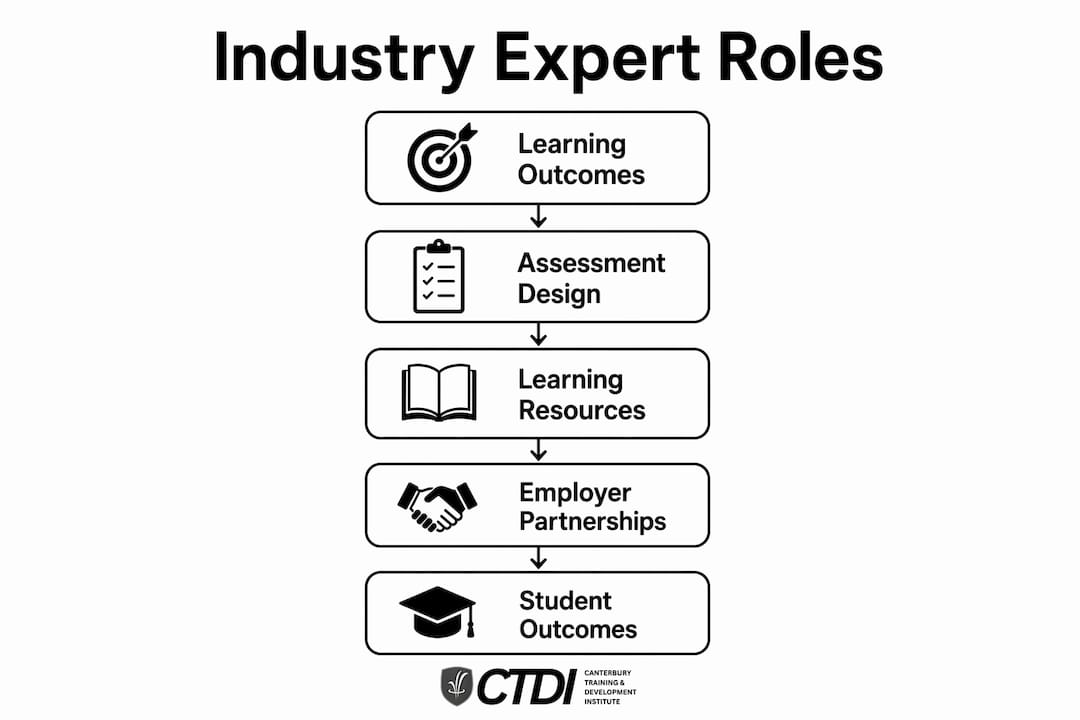
Learning outcomes written by practitioners reflect current workplace performance standards drawn from training packages, not idealised academic benchmarks. When an AI specialist co-designs a unit, the outcomes describe tasks that appear in real job descriptions, not tasks that appeared in job descriptions five years ago.
Assessment tasks are where practitioner involvement is most visible. Experts co-design or review assessments so they require workplace-relevant evidence: project briefs modelled on real client scenarios, tools and templates actually used in the field, and simulations that mirror on-the-job constraints. Silverlight Research notes that expert input validates assumptions and surfaces real-world constraints that theoretical design misses entirely.
Pro Tip: Ask to see a sample assessment task before you enrol. If it reads like a textbook exercise with no workplace context, the course likely had minimal practitioner input.
Learning resources selected by practitioners include industry tools, proprietary software, and real job artefacts. Experts also design work-integrated learning activities or simulated workplace tasks that give you practice evidence you can show an employer.

What do you actually gain when a course uses industry experts?
The benefits split clearly between students and employers, and both sides matter when you're choosing a course.
For students:
- Stronger assessment evidence for job applications, because your portfolio reflects real workplace tasks
- Clearer pathways to Recognition of Prior Learning (RPL), since unit outcomes map to actual job roles
- Faster on-the-job readiness, because industry knowledge enables better client communication, outcome prediction, and more efficient task performance from day one
For employers:
- Graduates who need less entry-level upskilling because they've already practised on the tools and workflows the role uses
- Easier recruitment screening, since assessment evidence maps directly to role tasks
- Better cultural fit, because students have been exposed to real industry expectations throughout their studies
The skills gap between academic curricula and employer needs is well documented in Australia. Expert-led course design is the most direct mechanism for closing it.
What evidence should a credible course publish?
A provider serious about industry involvement publishes specific, verifiable evidence, not vague claims. Here's what to look for and how to read it:
| Evidence type | What to look for | Red flag |
|---|---|---|
| ASQA alignment | Unit codes matching current training packages | No unit codes listed |
| Practitioner authorship | Named authors with current industry roles | "Developed by our team" with no names |
| Trainer CVs | Specific roles, employers, and years of experience | Generic "industry experience" with no detail |
| Advisory board | Named employers or industry bodies | No board listed or board not updated |
| Graduate outcomes | Employment rates, placement numbers, employer feedback | No outcomes data published |
| Assessment samples | Workplace-relevant briefs and rubrics | Multiple-choice only, no workplace artefacts |
Expert input alone is not statistically representative of an entire industry. The strongest courses combine practitioner authorship with published outcome metrics and employer case studies that show before-and-after results.
How to verify a course genuinely uses industry experts
Use this checklist before you contact any provider:
- Search the course page for named practitioner authors on individual units.
- Request trainer CVs and check for specific employer names and recent roles.
- Ask which employers accept or recognise the assessments from this course.
- Confirm whether work-integrated learning (WIL) or simulated workplace activities are included.
- Look for published graduate employment or placement rates.
- Request a sample assessment task and check it for workplace-relevant context.
- Ask whether an advisory board exists and when it last met.
Questions worth asking admissions directly: "Who reviewed these units and what is their current role?", "Can you share trainer CVs?", and "Which employers have hired your graduates?"
Red flags to watch for: vague references to "industry input" with no named practitioners, assessments that are purely multiple-choice, no published outcomes data, and trainer profiles that list only academic credentials.
Pro Tip: If a provider cannot answer the trainer CV question within 24 hours, that tells you something about how central industry expertise actually is to their operation.
Why industry expertise matters even more in online, self-paced courses
Online delivery removes the incidental learning that happens in a physical workplace, so expert design has to work harder. The CDIO Initiative's curriculum-design framework specifically recommends embedding industry involvement to compensate for this gap.
Practically, experts enable online courses to include recorded masterclasses, annotated work samples, authentic assessment briefs, and virtual simulations of on-the-job tasks. Feedback mechanisms in quality online courses include rubric-based assessment, recorded screen reviews, and employer-review panels for capstone tasks.
This is especially relevant for technology subjects. Bosch's expert perspective illustrates how practitioners bridge rapidly evolving technologies and real-world applications, keeping learners practising on workflows that are actually current. For an AI or digital marketing course, that currency is not a nice extra — it's the whole point.
How Edu embeds industry experts in its accredited online courses
Canterbury Training & Development Institute (CTDI) builds practitioner involvement into its AI, digital marketing, and sustainable management courses at the unit level, not as a marketing afterthought.
Course units are authored and reviewed by practitioners with current roles in their respective fields. Trainer profiles document specific employer experience and industry roles, not just qualifications. For technology-focused units, this matters because expert practitioners keep curriculum aligned with the tools and workflows that employers are actually using right now.
Employer partnerships and advisory input inform how assessments are structured, so the evidence students produce maps directly to what hiring managers look for. Graduate outcome data is published to give prospective students a concrete basis for comparison.
Pro Tip: Before enrolling with Edu, visit the course page for your chosen qualification, check the unit authorship credits, and request a trainer CV. The industry-relevant training guide on the Edu site explains exactly how practitioner input is embedded in each program.
Key takeaways
Nationally accredited online VET courses with genuine industry expert involvement produce graduates who are more employable, better prepared for workplace tasks, and easier for employers to onboard.
| Point | Details |
|---|---|
| Named practitioner authorship | Look for credited authors with current industry roles on individual unit pages, not just a generic "industry-designed" claim. |
| Trainer CVs with real roles | Request CVs listing specific employers and recent experience — generic academic credentials alone are not sufficient. |
| Published graduate outcomes | Employment rates, placement numbers, and employer case studies give you evidence that expert input translated into real results. |
| Verification before enrolment | Use the seven-point checklist above and ask admissions directly about advisory boards and employer acceptance of assessments. |
| Edu's approach | Edu documents practitioner authorship, trainer experience, and employer partnerships across its AI, digital marketing, and sustainability courses. |
Why practitioner-led design is the standard worth holding providers to
The conventional wisdom is that accreditation alone is enough — that an ASQA-aligned qualification signals quality. It doesn't, not on its own. Accreditation confirms that a course meets minimum regulatory standards. It says nothing about whether the assessments reflect what employers actually need in 2026, whether the trainer has set foot in a real workplace in the last decade, or whether the tools you practise with are the ones hiring managers expect you to know.
The providers worth your time and money are the ones who can answer specific questions about practitioner involvement without hesitation. Vague answers to direct questions about trainer CVs or unit authorship are the clearest signal that "industry-designed" is a marketing phrase, not a structural commitment.
Edu's nationally accredited courses, built by practitioners
Edu's online vocational courses in AI, digital marketing, and environmental sustainability are designed by practitioners for the roles those qualifications lead to. Every unit reflects current workplace standards, every trainer brings real industry experience, and every assessment produces evidence you can put in front of an employer.
The Advanced Diploma of Digital Marketing is a strong starting point if you want to see exactly what practitioner-authored curriculum looks like in practice: check the unit authorship, review the assessment structure, and compare it against the checklist in this article. When you're ready, enrol directly online or contact Edu's admissions team to request trainer CVs and a sample assessment task before you commit.
Useful sources and further reading
- ASQA — Australian Skills Quality Authority: the national regulator for VET; use it to verify that any course you're considering is registered and ASQA-compliant.
- CDIO Initiative: documents how industry involvement in curriculum design improves graduate work-readiness.
- GrowthSpace: deep industry expertise: explains how organisations distinguish genuine practitioner expertise from surface-level familiarity.
- Nexus Expert Research: makes the case for industry expertise as a driver of competitive advantage and better outcomes.
- Silverlight Research: how organisations use industry experts: practical overview of how expert input is integrated into research and design processes.
- Bosch expert perspective: illustrates how practitioners bridge emerging technologies and real-world application, relevant for AI and tech-focused VET units.
- Edu: industry relevance in education: explains how industry-designed programs increase career readiness and employability for Australian VET students.
- Edu: upskilling tips for professionals: practical guidance for choosing courses with strong evidence of outcomes.
Recommended
- Career pathways in Australia: your 2026 guide
- How expert trainers shape your success in online education — Canterbury Training and Development Institute
- Career growth through online learning in Australia — Canterbury Training and Development Institute
- Explain nationally recognised courses: your career guide