

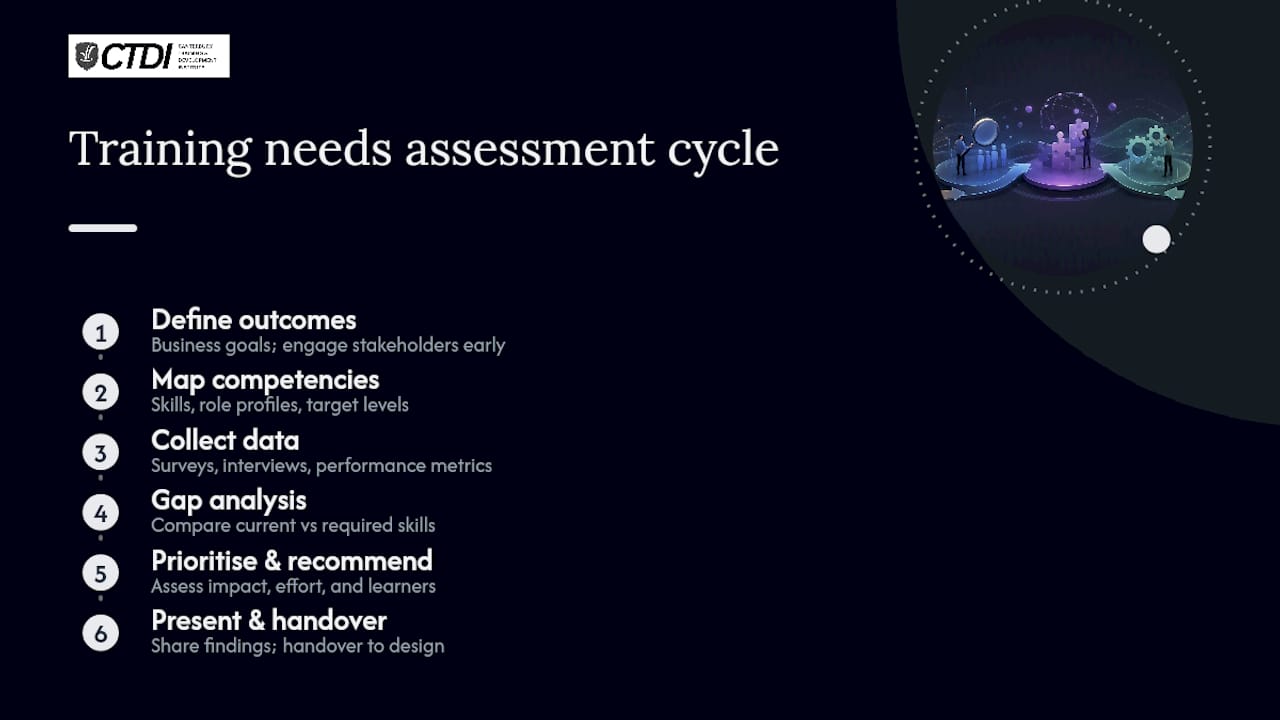
A repeatable training needs assessment workflow runs like this: set business outcomes → map required competencies → collect and triangulate data → analyse gaps → prioritise by impact and feasibility → recommend solutions → present findings and secure buy-in → hand over to design. The end product is a prioritised, measurable learning plan your designers can act on without re-running the analysis.
The CDC frames needs assessment as the first quality training standard before any training is designed or delivered; this means skipping it is not a time-saver, but a budget risk. Run the process right and you get a defensible, stakeholder-approved brief. Run it poorly and you get a course nobody needed.
At a glance: who owns what
- Define business outcomes — HR/L&D lead; output: signed scope document
- Map competencies — L&D lead + subject matter experts (SMEs); output: competency framework draft
- Collect data — L&D analyst + line managers; output: raw data set (surveys, interviews, metrics)
- Analyse gaps — L&D analyst; output: gap log with current vs desired state
- Prioritise — L&D lead + HR business partner; output: scored prioritisation matrix
- Recommend solutions — L&D lead; output: recommendations report (training and non-training)
- Present and secure buy-in — L&D lead + sponsor; output: approved business case
- Hand over to design — L&D lead → learning designer; output: design brief and learner personas
Minimum artefacts to produce:
- Gap log (competency, current state, desired state, evidence source)
- Prioritisation matrix (impact score, feasibility score, decision)
- Recommendations report (training and non-training interventions)
- Design brief (approved, signed off by sponsor)
Key takeaways
A well-run training needs assessment workflow produces a prioritised, measurable learning plan that designers can act on without re-running the analysis, and it explicitly rules out non-training solutions before any budget is committed.
| Point | Details |
|---|---|
| Start with a business outcome | Anchor every assessment to a measurable performance problem, not a training request, before collecting any data. |
| Triangulate your evidence | Use at least two independent data sources per gap; broad surveys surface candidates, observation and testing confirm them. |
| Prioritise with a scoring rule | Rate each gap on impact and feasibility (1–5 each), multiply to rank, and document the rationale for governance approval. |
| Rule out non-training causes first | Ask whether the gap is caused by unclear expectations, tooling, or process before recommending a course. |
| CTDI for formal L&D capability | CTDI's accredited online courses in AI and Digital Marketing build the assessment design and analytics skills that make TNA recommendations defensible. |
Table of Contents
- What is a training needs assessment, and how does it differ from related terms?
- How does the training needs assessment workflow run step by step?
- What data collection methods work best for a training needs assessment?
- How do you turn raw data into a prioritised list of training needs?
- When is training not the right solution?
- What templates and worked examples can you use right now?
- How long does a training needs assessment take, and what does it cost?
- How do you design assessment instruments that are valid and defensible?
- What does a complete handover to learning designers look like?
- CTDI accredited courses for L&D professionals who want to go deeper
- Sources
What is a training needs assessment, and how does it differ from related terms?
A training needs assessment (TNA) is a structured process for determining whether a performance gap exists, what is causing it, and whether training is the right fix. The OPM framework describes it as a process that distinguishes organisational, occupational/role, and individual assessment levels, and emphasises planning, stakeholder engagement, and building a business case before any learning solution is commissioned.
TNA vs training needs analysis vs skills gap analysis
These three terms are often used interchangeably, which creates confusion about scope. The clearest way to separate them:
A training needs assessment is the broader decision process. It asks: is there a gap, what is causing it, and is training the right response? A training needs analysis sits inside the assessment; it assumes training is appropriate and focuses on what specifically needs to be learned. A skills gap analysis is narrower still: it maps current competency levels against a defined standard, usually for a specific role or team, without necessarily recommending a solution.
In practice, many organisations use "TNA" to mean all three. The distinction matters most when you are scoping the work: if you have not yet confirmed that training is the right fix, you are doing an assessment, not an analysis.
The three assessment levels
Organisational level asks whether the gap is connected to a strategic priority, a regulatory requirement, or a business performance problem. Example: a logistics company's on-time delivery rate has dropped and the suspected cause is inconsistent route-planning decisions by team leaders.
Task or role level (sometimes called operational level) examines the specific competencies, knowledge, and behaviours required for a role or process. Example: mapping the exact decision-making steps a team leader should follow when re-routing a delivery.
Individual level compares each person's current capability against the role standard. Example: assessing which team leaders can already apply the correct re-routing logic and which cannot.
Regulatory or compliance-driven assessments typically sit across all three levels. A new workplace health and safety regulation, for instance, creates an organisational obligation, defines role-specific requirements, and generates individual compliance records. Treat these as a fourth trigger that can initiate a TNA at any level.
How does the training needs assessment workflow run step by step?
A robust needs assessment workflow follows a 5–8 step cycle, and early stakeholder engagement materially increases the chance of success. The expanded version below gives you inputs, outputs, owners, and minimum acceptance criteria for each step.
Step 1: Define business outcomes
Inputs: strategic plan, performance data, sponsor brief Outputs: signed scope document, success metrics Owner: L&D lead, HR business partner, executive sponsor Typical duration: 2–3 days
Start by anchoring the assessment to a measurable business outcome, not a training request. "We need a leadership course" is not a business outcome. The scope document should name the business problem, the population affected, the success metric, and the assessment boundaries (which roles, which sites, which time period).
Minimum acceptance criteria to move forward: sponsor has signed the scope; success metric is agreed and measurable.
Step 2: Map required competencies
Inputs: job descriptions, role standards, regulatory requirements, SME input Outputs: competency framework draft, behaviour indicators Owner: L&D lead + SMEs Typical duration: 3–5 days
Work with SMEs to define what "good" looks like for the roles in scope. Each competency needs at least one observable behaviour and one objective metric (a KPI, quality checklist item, or time-to-competence measure) so that every recommended training solution has a measurable success criterion. Without this, your gap analysis has no baseline to measure against.
Minimum acceptance criteria: each competency has at least one behaviour indicator and one measurable metric; SMEs have reviewed and agreed the framework.
Step 3: Collect data
Inputs: competency framework, employee list, existing performance data Outputs: raw data set (survey responses, interview notes, observation records, LMS/KPI extracts) Owner: L&D analyst + line managers Typical duration: 5–10 days

Use a triangulated approach: at least two independent data sources per gap candidate. Surveys cover breadth quickly; interviews and observation add depth and context. LMS completion data and KPI extracts give you objective evidence that self-report alone cannot provide.
Pro Tip: Do not try to collect everything at once. Run a broad, inexpensive sweep first (a short survey plus a KPI review) to surface candidate gaps, then validate the top three to five with higher-accuracy methods like observation or a short knowledge test. This staged approach, recommended by Coggno's TNA guide, saves significant time and budget.
Step 4: Analyse gaps
Inputs: raw data set, competency framework Outputs: gap log (competency, current state, desired state, evidence source, gap size) Owner: L&D analyst Typical duration: 3–5 days
Write each gap as a tight gap statement: current state → desired state → measurable difference.
Run a root-cause check on each candidate gap before moving to prioritisation (see Section 5 for the full framework). A gap that looks like a skill deficit may actually be caused by unclear expectations, a broken process, or the wrong tool.
Minimum acceptance criteria: every gap in the log has a gap statement, at least two evidence sources, and a preliminary root-cause note.
Step 5: Prioritise
Inputs: gap log, business outcomes, budget constraints Outputs: scored prioritisation matrix Owner: L&D lead + HR business partner Typical duration: 1–2 days
Score each gap on impact (1–5: how directly does closing this gap affect the business outcome?) and feasibility (1–5: how achievable is a solution given time, cost, and organisational readiness?). Multiply the scores to get a priority rank. Capture the rationale for each score; this short audit trail makes governance approval and budget negotiation considerably easier.
Minimum acceptance criteria: all gaps are scored; top-priority gaps have a rationale note; sponsor has reviewed the matrix.
Step 6: Recommend solutions
Inputs: prioritised gap log, root-cause notes, budget parameters Outputs: recommendations report (training and non-training interventions) Owner: L&D lead Typical duration: 2–3 days
For each priority gap, recommend the most appropriate intervention. Training is not always the answer (see Section 6). Where training is appropriate, specify the modality (e-learning, workshop, on-the-job coaching, blended), the target population, and the expected outcome metric.
Pro Tip: Frame each recommendation in terms of cost avoidance, not just learning outcomes. Showing a sponsor that addressing a compliance gap now costs less than a regulatory fine later is a far more persuasive argument than citing a learner satisfaction score.
Minimum acceptance criteria: every recommendation maps to a gap, a root cause, and a measurable outcome; non-training alternatives are explicitly considered.
Step 7: Present findings and secure buy-in
Inputs: recommendations report, prioritisation matrix, business case Outputs: approved business case, signed-off priority list Owner: L&D lead + executive sponsor Typical duration: 3–5 days (including revision cycles)
Prosci's needs assessment guidance notes that many practitioners treat data collection as the hardest part, but the real leverage comes from analysis and presentation. A well-structured findings presentation connects each gap to the business outcome named in Step 1, shows the cost of inaction, and gives stakeholders a clear decision to make: approve the priority list and budget, or redirect resources.
Minimum acceptance criteria: sponsor has signed off the priority list and budget allocation.
Step 8: Hand over to design
Inputs: approved business case, gap log, learner personas, assessment rubrics Outputs: design brief, modality decisions, acceptance criteria for each solution Owner: L&D lead → learning designer Typical duration: 1–2 days
The handover brief should give designers everything they need to start without re-running the analysis. Include the gap statement, the target population, the chosen modality, the success metric, and any constraints (budget, timeline, technology platform). See Section 10 for the full handover checklist.
Minimum acceptance criteria: designer confirms the brief is sufficient to begin; sponsor has signed the brief.
What data collection methods work best for a training needs assessment?
The right method depends on what you need to know and how much time you have. Surveys cover a large population quickly but rely on self-report, which tends to overstate capability. Observation and testing are more accurate but take longer and cost more. The practical answer is to use both: broad methods to find candidate gaps, precise methods to confirm them.
Method comparison
| Method | Speed | Cost | Accuracy | Best use case |
|---|---|---|---|---|
| Online survey | Fast (days) | Low | Moderate | Broad population scan, perception data |
| Manager interview | Moderate (1–2 weeks) | Low–medium | High | Role-level context, performance patterns |
| Focus group | Moderate | Low–medium | Moderate | Team-level themes, cultural factors |
| Direct observation | Slow (weeks) | High | High | Task-level accuracy, process compliance |
| LMS/KPI data review | Fast (days) | Low | High | Objective performance evidence |
| Knowledge/skills test | Moderate | Medium | High | Individual-level gap confirmation |
SHRM's TNA guidance recommends combining survey templates with manager interview approaches to get both breadth and depth in data collection.
Practical tools
For surveys: Google Forms, Microsoft Forms, and SurveyMonkey all handle basic needs assessment surveys. For engagement and quick pulse checks during workshops, Mentimeter lets you run live polls and word clouds that surface themes in real time. For assessment builders and competency mapping, iSpring Suite includes quiz and assessment tools that integrate with most LMS platforms. For structured learning data, your existing LMS (whether Moodle, Canvas, or a corporate platform) can usually export completion rates, assessment scores, and time-on-task data that serve as objective gap evidence. AIHR's HR analytics resources provide frameworks for connecting LMS data to business KPIs.
Sample survey and observation questions
These eight questions can be adapted for most departmental TNAs:
- "How confident are you in performing [specific task] without assistance?" (1–5 scale)
- "How often do you encounter a situation where you are unsure of the correct procedure for [task]?" (frequency scale)
- "What is the single biggest barrier to performing [task] at the required standard?"
- "If you needed to improve your performance on [task], what would help most?" (open text)
- "Does your team have clear, documented procedures for [task]?" (yes/no + comment)
- "In the past three months, have you received feedback on your performance of [task]?" (yes/no)
- (Observation) "Does the employee follow the documented procedure for [task] without prompting?"
- (Manager interview) "Which members of your team consistently meet the standard for [task], and what do they do differently from those who do not?"
How do you turn raw data into a prioritised list of training needs?
The gap log is your working document. Every row is a candidate need; every column is a piece of evidence. The goal of analysis is to convert that raw log into a short, ranked list of needs that are worth spending budget on.
Writing a tight gap statement
A gap statement has three parts: current state, desired state, and the measurable difference between them. Vague gap statements ("employees lack communication skills") cannot be prioritised, budgeted, or measured after training.
Root-cause check
Before you recommend training for any gap, run through these questions:
- Does the employee know what is expected? (Unclear expectations = process or communication fix, not training)
- Does the employee have the tools, access, or authority to perform the task? (Tooling or systems fix)
- Has the employee ever performed the task correctly? (If yes, the gap may be motivational or environmental, not a skill deficit)
- Is the gap consistent across the team, or isolated to a few individuals? (Isolated gaps may indicate hiring or fit issues)
As Watkins (2011) frames it, a needs assessment is fundamentally a decision tool: it defines gaps between current and desired results and helps prioritise needs by comparing costs and benefits. If the root cause is not a skill or knowledge deficit, training will not close the gap regardless of how well it is designed.
Impact × feasibility matrix
Rate each confirmed gap on two axes:
| Gap | Impact (1–5) | Feasibility (1–5) | Priority score | Decision |
|---|---|---|---|---|
| First-contact resolution rate | 5 | 4 | 20 | Train (high priority) |
| Advanced Excel reporting | 3 | 5 | 15 | Train (medium priority) |
| Leadership communication | 4 | 2 | 8 | Defer or phase |
| New CRM navigation | 2 | 5 | 10 | Job aid or micro-learning |
Score impact by asking: how directly does closing this gap affect the business outcome named in Step 1? Score feasibility by asking: given current budget, timeline, and organisational readiness, how achievable is a solution? Multiply to rank. Gaps scoring above 15 typically warrant a full training solution; gaps below 10 often suit a job aid, process change, or a brief coaching conversation.
Decision-rule checklist: when to recommend training
- Root cause is confirmed as a skill or knowledge deficit
- The gap is measurable and linked to a business outcome
- The affected population is large enough to justify design cost
- The skill is not easily addressed by a job aid, checklist, or process change
- The gap will recur (not a one-time event that a memo would fix)
When is training not the right solution?
Training is the right answer less often than most training requests suggest. A 2026 survey of L&D professionals consistently finds that a significant proportion of training requests, when properly diagnosed, turn out to be process, tooling, or management problems in disguise. The diagnostic questions below help you rule out training before committing budget.
Common non-training causes
- Unclear expectations: employees do not know what the standard is or how their performance is being measured
- Broken or missing processes: the correct procedure does not exist, is not documented, or is not enforced
- Tooling or systems gaps: employees lack the software, equipment, or access needed to perform the task
- Hiring or fit issues: the role requires capabilities the employee was never selected for
- Motivation or engagement: the employee knows how to perform but chooses not to, often due to incentive misalignment or management issues
Diagnostic questions
Ask these before recommending any training solution:
- "Could this employee perform the task correctly if their life depended on it?" (If yes, the gap is not a training problem.)
- "Has the expected standard been communicated clearly and recently?" (If no, start with a communication or process fix.)
- "Is the gap consistent across the whole team, or concentrated in a few individuals?" (Widespread gaps suggest systemic causes; isolated gaps suggest individual factors.)
- "What happened the last time an employee tried to perform this task correctly and failed?" (The answer often reveals a systems or process barrier.)
- "Would a job aid, checklist, or updated procedure close the gap without a course?" (If yes, build the job aid.)
Alternative interventions and ownership
| Root cause | Intervention | Owner |
|---|---|---|
| Unclear expectations | Role clarity conversation, updated KPIs | Line manager + HR |
| Missing process | Procedure documentation, SOP update | Operations + L&D |
| Tooling gap | System upgrade, access provisioning | IT + operations |
| Hiring/fit issue | Role redesign or recruitment | HR |
| Motivation/engagement | Coaching, performance management | Line manager + HR |
The minimum evidence needed to rule out training: at least one data source confirming the employee has previously performed the task correctly, or confirming that the barrier is environmental rather than skill-based. A single manager interview plus a KPI review is usually sufficient for this determination.
What templates and worked examples can you use right now?
The artefacts below are designed to be copied directly into a spreadsheet or document and adapted for your context. They cover a single-department assessment; scaling notes follow each one.
Core templates
- Gap log: columns for competency name, current state (evidence + metric), desired state (standard + metric), gap size, evidence sources (minimum two), root-cause note, and priority score
- Prioritisation matrix: columns for gap name, impact score (1–5), feasibility score (1–5), priority score (impact × feasibility), recommended intervention, and rationale note
- Recommendations report slide: one slide per priority gap, structured as: gap statement → root cause → recommended intervention → target population → success metric → estimated cost and timeline
- Design brief template: gap statement, learner persona, chosen modality, success metric, constraints (budget, timeline, platform), acceptance criteria, sponsor sign-off field
For a practical employee training checklist that complements these templates, CTDI's HR manager guide covers the operational steps from enrolment to completion tracking.
Worked example: customer service first-contact resolution
Root-cause check: Employees had received initial training but the resolution checklist had been updated six months ago without a refresher. The gap is a knowledge currency issue, not a hiring or motivation problem.
Priority score: Impact 5 (directly tied to customer satisfaction KPI) × Feasibility 4 (existing module can be updated) = 20. High priority.
Recommendation: Update the complaints-handling e-learning module to reflect the current checklist; add a 15-minute practice scenario; require completion within 30 days.
One-page checklist for your first TNA run
- Scope document signed by sponsor
- Competency framework reviewed by at least two SMEs
- At least two data sources per priority gap
- Gap log completed with gap statements (current → desired → metric)
- Root-cause check completed for every gap
- Prioritisation matrix scored and rationale documented
- Recommendations report reviewed by HR business partner
- Design brief signed off by sponsor
Scaling note: For an organisation-wide assessment, replicate the gap log and prioritisation matrix by business unit, then run a second-pass consolidation to identify cross-cutting gaps that warrant enterprise-level solutions. The worked example above scales directly; the only change is adding a "business unit" column to the gap log.
For AI skills-based TNA examples and competency mapping in digital roles, CTDI's AI skills training workflow guide provides a practical parallel.
How long does a training needs assessment take, and what does it cost?
Timeline and cost vary primarily by scope: how many roles, how many sites, and which data collection methods you choose. Coggno's TNA guide puts focused department assessments at 2–3 weeks and organisation-wide assessments at 6–10 weeks, which aligns with practitioner experience across most industries.
Duration and staffing by scope
| Scope | Typical duration | Core team | Primary cost drivers |
|---|---|---|---|
| Single team (10–20 people) | 1–2 weeks | 1 L&D analyst, 1 HR BP | Survey design, 2–3 manager interviews |
| Single department | 2–3 weeks | 1–2 L&D analysts, 1 HR BP | Survey + focus groups + KPI data pull |
| Multi-department | 4–6 weeks | 2–3 L&D analysts, HR BP, SMEs | Observation, testing, stakeholder workshops |
| Organisation-wide | 6–10 weeks | L&D team + external consultant | Full data collection suite, validation, reporting |
Primary cost drivers
The biggest cost variable is not the number of employees surveyed; it is the data collection method. Observation and skills testing are accurate but labour-intensive. Surveys and KPI reviews are cheap but require validation. External consultants add cost but bring independence and specialist methodology, which can be worth it for politically sensitive assessments or when internal capacity is limited.
Quick wins to reduce cost without sacrificing rigour:
- Use existing LMS and HR system data before commissioning new surveys
- Sample rather than census for large populations (a representative sample of 30–40 people per role group is usually sufficient)
- Reuse validated survey instruments rather than building from scratch each time
Pro Tip: Budget for a validation round. Many teams skip it to save time, then find their top-priority gap collapses under scrutiny because it was based on a single data source. One round of targeted observation or a short knowledge test on your top three gaps costs a fraction of designing a course that turns out to be unnecessary.
For guidance on aligning your assessment instruments with Australian training package requirements, CTDI's qualifications guide covers the accreditation and evidence standards that apply to nationally recognised training.
How do you design assessment instruments that are valid and defensible?
The quality of your recommendations is only as good as the quality of your evidence. ASQA's Guide to Assessment Tools sets out the core requirements: fairness, validity, reliability, and flexibility, with clear evidence criteria, administration rules, and instructions for assessors so that competency decisions are defensible and repeatable.
Assessment design checklist
- Validity: does the assessment actually measure the competency it claims to measure? A knowledge quiz does not validate a practical skill.
- Reliability: would two different assessors reach the same conclusion using the same instrument? Test this by having two people independently score the same response.
- Fairness: does the assessment give all participants a reasonable opportunity to demonstrate their capability, regardless of language background, disability, or prior learning pathway?
- Flexibility: can the assessment be administered in multiple formats (written, verbal, observed) without changing what is being measured?
Quality-control steps
| QC step | What it involves | Who does it |
|---|---|---|
| Piloting | Run the instrument with 3–5 people before full deployment; check for ambiguous questions and timing | L&D analyst |
| Moderation | Have a second assessor review a sample of completed assessments against the same rubric | L&D lead or SME |
| Data retention | Store completed assessments and evidence according to your organisation's retention policy (or regulator's requirement, whichever is longer) | HR/L&D records manager |
| Recordkeeping | Document assessment conditions, date, assessor name, and outcome for every participant | L&D analyst |
Accessibility and inclusion
Reasonable adjustments do not change what is being assessed; they change how. A participant with a reading difficulty might complete an oral assessment instead of a written one. A participant in a remote location might complete an observed task via video. Document every adjustment and the rationale for it so the decision is auditable.
Making results audit-ready
Map each competency to at least one objective metric before you begin data collection. When the assessment is complete, your evidence package should include: the assessment instrument, the marking guide or rubric, completed participant responses, moderation records, and a summary of findings with gap statements. This package supports both internal governance and external audit or accreditation review. For competency-based assessment in vocational training contexts, CTDI's vocational training guide explains how these standards apply in accredited delivery.
What does a complete handover to learning designers look like?
A handover that forces designers to re-run analysis is a handover that failed. The brief should be complete enough that a designer who was not involved in the assessment can start work on day one.
Required deliverables
- Prioritised gap log: final version, sponsor-approved, with gap statements and root-cause notes
- Learner personas: one per distinct audience group, covering role, experience level, technology access, preferred learning context, and any accessibility considerations
- Assessment rubrics: the marking guides and evidence criteria developed during the assessment phase, ready to be adapted into post-training evaluation instruments
- Chosen modalities: for each priority gap, the recommended delivery format (e-learning, workshop, coaching, blended) with a brief rationale
- Success metrics: the post-training KPI, error-rate reduction target, or time-to-competence measure for each solution
- Constraints: budget ceiling, timeline, technology platform, and any mandatory compliance requirements
Handover checklist and sign-off
- Gap log reviewed and approved by sponsor
- Learner personas validated by at least one line manager per audience group
- Assessment rubrics reviewed by an SME
- Modality decisions documented with rationale
- Success metrics agreed with the business owner
- Design brief signed by L&D lead and sponsor
- Designer confirms brief is sufficient to begin (written confirmation)
Sprint or pilot approach
For priority gaps, a sprint approach works well: the designer produces a minimum viable version of the solution (a single module, a one-hour workshop, or a job aid) within two to three weeks, tests it with a small cohort of five to ten learners, and iterates before full rollout. This limits the cost of getting the design wrong and generates early performance data against the success metric.
Acceptance criteria for a complete handover
The handover is complete when: the designer has confirmed the brief in writing; the sponsor has signed the design brief; and the first sprint or pilot has a scheduled start date. Any brief that leaves the designer with unanswered questions about the target population, the success metric, or the platform constraints is not complete.
For a practical guide to the workforce training process from assessment through to delivery, CTDI's operational guide covers the end-to-end project management steps.
What experienced L&D practitioners know that most guides leave out
That is the wrong ratio. Data collection is the part that feels productive: you are sending surveys, booking interviews, pulling reports. Analysis is the part that actually earns your seat at the table, because it is where you convert a pile of responses into a recommendation a CFO will approve.
The single most common failure mode in a TNA is not bad data; it is good data that never gets turned into a clear decision. You end up with a 40-page report that lists every gap anyone mentioned, ranked by nothing, with no explicit recommendation about what to do first. Stakeholders nod, file it, and commission the same course they were going to commission anyway.
The fix is to commit to a prioritisation rule before you start analysis, not after. Decide upfront: we will recommend solutions only for gaps that score above a threshold on the impact × feasibility matrix, and we will explicitly state what we are NOT recommending and why. That second part is what separates a TNA from a wish list.
A few phrases that consistently work in stakeholder conversations:
"We found 14 gaps. We are recommending action on four. Here is why the other ten are either not training problems or not worth the cost right now."
"If we address these two gaps, the model suggests we recover approximately [X] in error-related costs within 12 months. If we do not, the cost of inaction is [Y]."
On time-saving: sample aggressively.
Where to invest your effort: analysis, not data collection. Spend the extra day on your gap statements and root-cause checks. A tight gap statement with a clear metric is worth more than three additional survey responses.
CTDI accredited courses for L&D professionals who want to go deeper
Running a rigorous TNA requires more than a good template. It requires capability in assessment design, data analysis, and instructional handoff, and those skills are worth formalising.

CTDI offers nationally accredited online courses in AI, Digital Marketing, and Environmentally Sustainable Management, all delivered self-paced so working L&D professionals can study around project commitments. The AI and Digital Marketing programmes directly build the analytics and data literacy skills that underpin strong gap analysis and evidence-based recommendations, including the kind of audit-ready documentation that regulators and accreditation bodies expect. Completing an accredited qualification also gives you a formal credential to attach to your TNA methodology, which strengthens your position when presenting findings to senior stakeholders who want to know the process was rigorous.
Enrol in a CTDI accredited course and build the formal capability to run assessments that hold up to scrutiny.
Sources
These sources substantiate the frameworks and workflow steps covered in this guide:
- needs-assessment
- Assess Training Needs: Conducting needs analysis | CDC
- Training Needs Assessment | OPM
- A guide to assessing needs - Watkins (2011)