

TL;DR:
- Competency-based learning measures student progress through mastery of skills, not time or grades. It allows personalized pacing, authentic assessments, and continuous retakes until competency is achieved. This model offers a fairer, more transparent approach that emphasizes real-world ability over traditional qualifications.
Competency-based learning is an instructional method that measures a student's progress by proven mastery of skills and knowledge rather than time spent in class or traditional grades. Known formally as competency-based education and training (CBET), this model has reshaped how vocational and professional programmes are designed across Australia and globally. Instead of moving every learner through content at the same pace, it lets each person advance only when they can demonstrate real capability. The result is a system built around what you can actually do, not how long you sat in a room doing it.
What is competency based learning and how does it work?
Competency-based learning measures progression by mastery demonstration rather than time or traditional grades. Mastery means applying knowledge, skills, and behaviours to real-world tasks consistently and reliably. A learner who can already perform a task moves forward immediately. A learner who cannot stays with the material until they can.

This model rests on three core ideas. First, every learner has a defined set of competencies to achieve. Second, the pace of learning is personalised to the individual. Third, progression is only granted when evidence of mastery is confirmed, not assumed. These ideas sit at the heart of competency-based education and training frameworks used by registered training organisations across Australia, including those operating under the Australian Skills Quality Authority (ASQA) standards.
The contrast with traditional education is stark. In a conventional classroom, a student who scores 55% on an exam passes and moves on, even though they have not mastered 45% of the content. In a competency-based model, that gap must be closed before progression. This is not a punitive approach. It is a quality guarantee.
Pro Tip: If you are evaluating a training programme, ask whether assessment is criterion-referenced or norm-referenced. Criterion-referenced assessment judges you against a fixed standard of competence. Norm-referenced assessment judges you against other learners. Only the first one tells you whether you are actually job-ready.
How does competency based learning differ from traditional education?
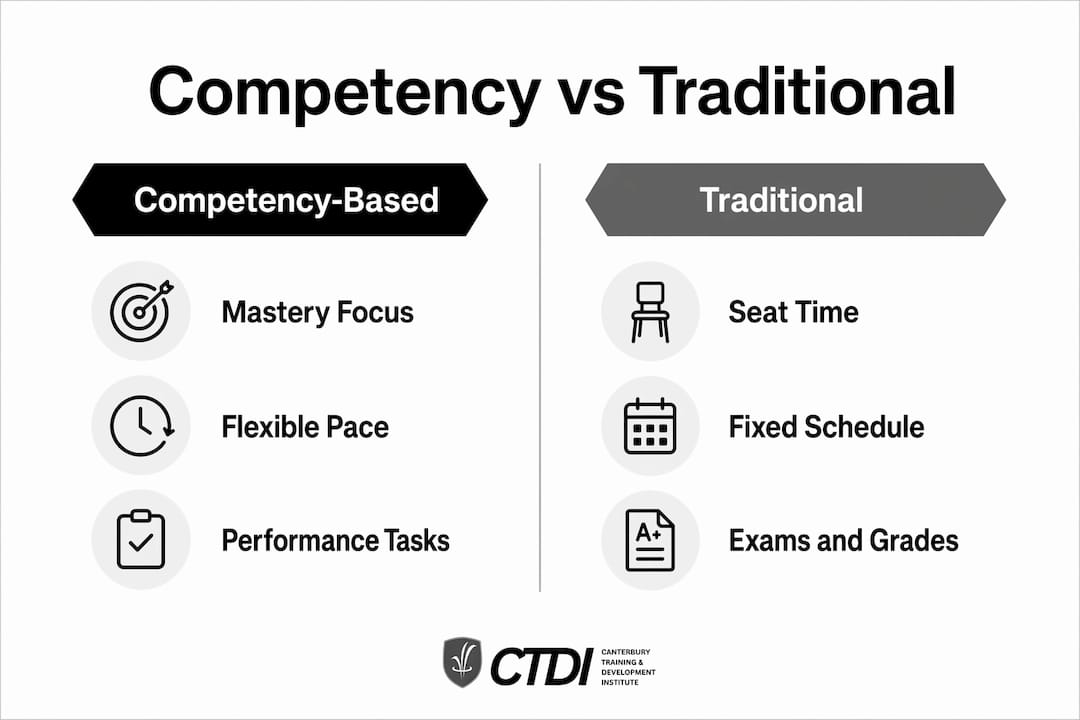
Traditional education is built on seat time. A semester lasts 13 weeks, and everyone finishes together regardless of individual mastery. Competency-based training measures success by the ability to demonstrate role-specific skills rather than course completion timeframes. That single shift changes everything downstream, from how assessments are designed to how educators spend their time.
Assessment approaches
Traditional models rely heavily on norm-referenced assessment. Your grade reflects how you performed relative to your peers. Competency-based assessment is criterion-referenced. Your result reflects whether you met a defined standard, full stop. A learner either demonstrates competence or they do not. There is no bell curve, and there is no partial credit for partial capability.
Pacing and learning pathways
In a time-based model, the curriculum moves at the institution's pace. In a competency-based model, the curriculum moves at the learner's pace. A professional with prior experience in digital marketing, for example, may demonstrate competency in foundational units quickly and spend more time on advanced analytics. A career changer may need more time on the basics. Both learners get what they actually need. Self-paced learning is a natural fit for this model because it removes the artificial constraint of a fixed timetable.
Assessment types
Competency-based programmes use performance-based tasks: projects, simulations, workplace observations, and portfolio submissions. These replace or supplement traditional written exams. The goal is to assess what a learner can do in a realistic context, not just what they can recall under pressure.
| Feature | Traditional education | Competency-based education |
|---|---|---|
| Progression trigger | Time or grades | Demonstrated mastery |
| Assessment type | Norm-referenced exams | Criterion-referenced performance tasks |
| Pacing | Fixed by institution | Personalised to learner |
| Focus | Content coverage | Skill application |
| Outcome | Grade or pass/fail | Verified competency |
What are the main components of competency-based education and training?
Competency-based education and training is built from several interlocking components. Each one is necessary. Remove any one of them and the model loses its integrity.
Defined competencies. Every programme begins with a clear list of competencies the learner must achieve. A competency is not a vague learning objective. It is a specific, observable combination of knowledge, skills, and behaviours required to perform a task to an industry standard. In Australian vocational education, these are codified in training packages developed by industry bodies and endorsed by the Australian Industry and Skills Committee (AISC).
Transparent frameworks and rubrics. Competency frameworks must be clearly defined and contextualised by role level for assessments to be effective and unambiguous. A framework without a rubric is just a list of words. A rubric translates each competency into observable, measurable behaviours so that both the learner and the assessor know exactly what "competent" looks like. This transparency is what makes the model fair.
Personalised learning pathways. No two learners arrive with the same background. Competency-based education accounts for this by allowing learners to enter at the appropriate level, skip content they have already mastered through recognition of prior learning (RPL), and focus their effort where genuine gaps exist. Competency-based training respects prior experience, focusing training where skill gaps exist and avoiding repetition of known content.
Iterative assessment and mastery verification. Assessment is not a single event. It is a cycle. Learners attempt a task, receive feedback, address gaps, and attempt again. This cycle continues until mastery is confirmed. The following elements make this cycle work:
- Clear behavioural indicators for each competency unit
- Structured feedback that identifies specific gaps rather than general weaknesses
- Multiple assessment methods to capture different dimensions of competence
- Opportunities to resubmit or reattempt tasks without penalty
- Assessor judgement grounded in observable evidence, not impressions
Support mechanisms. Learner agency is central to competency-based education, but agency without support leads to disengagement. Effective programmes build in regular check-ins, milestone reviews, and access to expert trainers who act as coaches rather than lecturers. The role of trainers in this model is fundamentally different from a traditional classroom teacher.
How is competency-based assessment conducted?
Competency-based assessment involves ongoing evaluation cycles until mastery is confirmed, with the goal of 100% proficiency among learners. This is the defining feature that separates it from a single high-stakes exam. Assessment is treated as a process, not a moment.
Effective competency-based assessment follows a structured sequence:
- Define the evidence required. Before assessment begins, the assessor and learner agree on what evidence will demonstrate competency. This might be a completed project, a recorded simulation, a workplace observation, or a portfolio of work samples.
- Collect evidence through authentic tasks. The learner completes real or realistic tasks that mirror actual job requirements. Simulations, case studies, and supervised workplace activities are all valid methods.
- Apply behavioural indicators. Assessment focuses on measurable behavioural indicators such as specific leadership actions or technical procedures, breaking down complex skills into observable components.
- Make a judgement and provide feedback. The assessor determines whether the evidence meets the standard. If it does not, specific, targeted feedback is provided so the learner knows exactly what to address.
- Allow iteration. The learner addresses the gaps and submits again. Assessment retakes are normal and part of the mastery process. Learner agency is critical but requires clear expectations and support.
- Confirm and record competency. Once the standard is met, competency is formally recorded. This record becomes part of the learner's credential and, in Australian vocational education, feeds into their nationally recognised qualification.
Multiple perspectives strengthen the assessment process. Self-assessment builds metacognitive awareness. Peer assessment introduces collaborative evaluation skills. Expert assessor judgement provides the authoritative standard. Together, these perspectives create a richer picture of actual capability than any single exam can provide.
Pro Tip: When designing or selecting a competency-based programme, check whether the assessment tasks are drawn from real workplace scenarios. Generic tasks that could apply to any industry are a warning sign. Strong programmes use tasks that reflect the actual conditions and complexity of the target role.
What are the challenges in implementing competency-based learning?
Competency-based learning is not a plug-and-play replacement for traditional education. It requires deliberate design, cultural change, and sustained support. The challenges are real, and ignoring them is how programmes fail.
Mindset shift. Competency-based education requires a psychological mindset shift from timed progress to mastery focus for both educators and learners. Educators trained in traditional models often default to covering content rather than developing competence. Learners accustomed to grades can struggle with a system that says "not yet competent" instead of "65%". Both groups need time and support to adjust.
Upfront design investment. Competency frameworks, rubrics, and assessment tasks must be built before the programme launches. This is time-intensive work. Designing transparent, rigorous rubrics is a critical but demanding process. Organisations that underinvest in this phase produce frameworks that are vague, inconsistent, or disconnected from real job requirements.
Educator role transition. Educators' roles transition to facilitators and coaches who create authentic, evidence-based assessments rather than delivering traditional content. This is a significant professional shift. Not every educator makes it comfortably without targeted professional development and institutional support.
Best practices for successful implementation include:
- Map competencies to specific, observable job tasks before writing any learning content
- Build structured milestones and iteration checkpoints into the programme design. Effective programmes include structured learning milestones to prevent learners from stalling
- Provide assessors with calibration training so judgements are consistent across the cohort
- Communicate the rationale for the model clearly to learners at the start, including how retakes work and what support is available
- Review and update competency frameworks regularly to keep pace with industry change. Frameworks require contextual adaptation for different role levels, as competencies manifest with varying complexity and responsibility
Workplace upskilling programmes that adopt these practices consistently produce stronger skill transfer outcomes than those that treat competency-based learning as a rebranding exercise.
Key takeaways
Competency-based learning works because it ties every assessment, every learning pathway, and every progression decision to demonstrated mastery of real, job-relevant skills.
| Point | Details |
|---|---|
| Mastery over time | Learners progress only when they demonstrate competence, not when a fixed period ends. |
| Criterion-referenced assessment | Judgements are made against a defined standard, not relative to other learners. |
| Personalised pathways | Prior experience is recognised and learning focuses on genuine skill gaps. |
| Iterative assessment cycles | Retakes and resubmissions are built into the model, not exceptions to it. |
| Educator as facilitator | Trainers coach and assess rather than deliver content, requiring a deliberate role shift. |
Why I think competency-based learning is the most honest model we have
I have spent years watching learners graduate from time-based programmes with credentials that do not reflect what they can actually do. A certificate earned by sitting through 12 weeks of lectures tells you very little about job readiness. A credential earned by demonstrating mastery of specific, industry-defined competencies tells you a great deal.
The equity argument for competency-based education is the one that convinces me most. Competency-based education is fundamentally an equity-oriented approach that ensures all learners can reach high standards with tailored pacing and opportunities. A learner who needs more time to master a skill gets more time. A learner who already has the skill moves on. Neither is penalised for the pace at which they learn. That is a fairer system than one that rewards speed and penalises depth.
The transparency of the model also matters more than people realise. When a learner knows exactly what "competent" looks like before they start, they can direct their own effort. When feedback tells them specifically what they did not demonstrate rather than just assigning a number, they know what to fix. This is not just good pedagogy. It is respectful of the learner's time and intelligence.
The challenge I see most often is institutions adopting the language of competency-based learning without adopting the substance. They call something a competency framework but produce a list of vague capabilities with no rubrics and no authentic assessment tasks. The model only works when the design is rigorous. Shortcuts produce the same outcome as the traditional model: learners who look qualified on paper but are not ready for the job.
The future of competency-based learning in Australia sits at the intersection of industry-relevant training and lifelong career development. As industries change faster than fixed curricula can keep up, the ability to map, assess, and verify specific skills becomes more valuable, not less.
— Sam
Competency-based programmes at Edu
Edu, the Canterbury Training and Development Institute, offers nationally recognised online diplomas and certificates built on competency-based principles. Every programme is designed by industry experts and assessed against real-world performance standards, not arbitrary exam scores.

Learners benefit from flexible, self-paced study with personalised trainer support throughout. Whether you are pursuing an Advanced Diploma of Digital Marketing or a Certificate IV in Environmental Sustainable Management, your progression is tied to what you can demonstrate, not how long you have been enrolled. Enrol now and start a qualification that reflects genuine capability.
FAQ
What is competency based learning in simple terms?
Competency-based learning is a training approach where you progress by proving you can perform specific skills to a defined standard, rather than by completing a set number of hours or achieving a percentage grade.
How does competency-based assessment differ from a traditional exam?
Competency-based assessment uses real-world tasks, projects, and observations to judge whether you meet a fixed performance standard. Traditional exams measure recall under time pressure and rank you against other learners rather than against a defined competency.
Can I use prior experience to skip units in a competency-based programme?
Yes. Most competency-based programmes in Australia offer recognition of prior learning (RPL), which allows you to demonstrate existing competence and receive credit without repeating content you already know.
Is competency-based education used in Australian vocational training?
Competency-based education and training is the foundation of Australia's vocational education and training (VET) sector. All qualifications delivered under the Australian Qualifications Framework (AQF) by registered training organisations are built on nationally endorsed competency standards.
What happens if I do not demonstrate competency the first time?
You receive specific feedback identifying the gaps and are given the opportunity to address them and resubmit. Retakes are a normal part of the competency-based model, not a failure. The goal is confirmed mastery, and the process supports you until you get there.