

TL;DR:
- Most adults change careers at age 39 to pursue work aligned with their values and well-being. Unhealthy environments and work-life imbalance drive transitions more than salary concerns, leading to increased happiness and better mental health. Uncertainty and social pressure are the main barriers, but experimentation and targeted upskilling can facilitate successful, financially rewarding shifts at any age.
A career change is a deliberate shift from one field or role to another, made to improve satisfaction, alignment, and long-term well-being. 78% of working adults will make at least one significant career change during their lives, with the average age of transition sitting at 39. That figure alone dismantles the myth that career change is a young person's game. The reasons people pursue a career change go well beyond pay. Most are driven by a need to align their work with who they have become, not just who they were when they first entered the workforce. 80% of career changers report increased happiness after switching. That outcome is worth understanding.
Why pursue a career change? The real motivations behind the shift
The most common reasons for career change have little to do with salary. Leading motivations include unhealthy work environments (43%), poor work-life balance (41%), and misalignment with personal values (40%). Pay concerns rank considerably lower, at just 30%. This tells you something important: most people are not leaving for more money. They are leaving because the environment, the culture, or the meaning of the work no longer fits.
Career dissatisfaction carries a real cost. Career dissatisfaction harms life satisfaction for 73% of changers and mental health for 91%, contributing to burnout, anxiety, and depression. Those numbers are not abstract. They describe people who wake up dreading work, who feel disconnected from their purpose, and who carry that weight into every other part of their lives.
The motivations for career transition often cluster into three categories:
- Values misalignment: The job no longer reflects what you believe in or care about. A person who values environmental impact working in fossil fuels, for example, will feel that friction daily.
- Well-being and culture: Toxic workplaces and relentless hours erode health over time. When the environment itself is the problem, no promotion fixes it.
- Growth ceiling: Some roles simply run out of room. When learning stops and challenge disappears, disengagement follows quickly.
Understanding which category applies to you is the first step toward a purposeful transition. Knowing your reason sharpens every decision that follows.
What challenges and barriers do people face when changing careers?
The biggest barrier to career change is not money. 49% of people cite uncertainty about what to do next as their primary obstacle. Only 12% name financial constraints as the top barrier. That gap matters. It means most people are not stuck because they cannot afford to change. They are stuck because they do not know where to go.

This uncertainty often feeds a paralysis loop. Without a clear destination, people delay action. Delay breeds guilt. Guilt reinforces the belief that they should already know the answer. The cycle continues until something external forces the issue, a redundancy, a health scare, or a conversation that finally names the problem.
The sunk cost fallacy compounds the challenge. After ten years in a field, leaving can feel like abandoning an investment. But the time already spent is gone regardless of what you do next. The only question worth asking is whether the next ten years should look the same as the last ten.
Common barriers worth naming:
- Fear of starting over: The discomfort of being a beginner again after years of expertise.
- Social pressure: Family and peers who equate stability with staying put.
- Skill doubt: Underestimating how much of what you already know transfers to a new field.
- Financial anxiety: Concern about income during the transition period, even when the long-term outlook is positive.
Pro Tip: Before assuming your skills do not transfer, write down every task you perform in a typical week. Most people discover that communication, problem solving, project management, and leadership appear on that list regardless of their industry. Those are exactly the skills new employers value.
Social support matters more than most people expect. Going through a career transition without a community of people who understand the process increases the risk of abandoning the goal when it gets hard. Structured support, whether through a course, a professional network, or a peer group, significantly improves outcomes.
How does the career change process typically unfold?
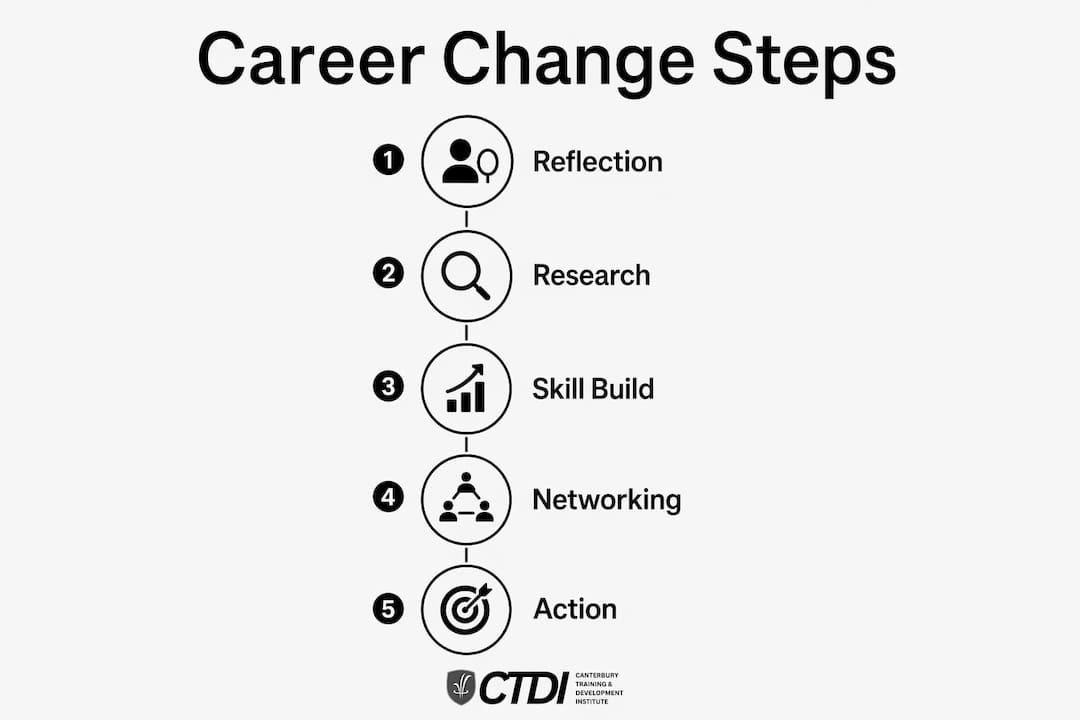
Career change is rarely a single decision followed by a clean exit. Successful transitions often involve a phase of experimentation such as freelancing, volunteering, or taking on adjacent projects before fully committing. This phase is not indecision. It is evidence gathering. You are testing whether the new direction actually fits before you bet everything on it.
A typical transition moves through recognisable phases:
- Recognition: You name the dissatisfaction clearly. This is often the hardest step because it requires honesty about a situation you may have been tolerating for years.
- Exploration: You research options, speak to people in target fields, and identify what genuinely interests you. This phase should be wide before it narrows.
- Experimentation: You test the new direction through low-risk activities. A freelance project, a short course, or a volunteer role gives you real data that no amount of research can replace.
- Preparation: You build the skills, credentials, and network needed for the target role. This is where formal study, upskilling, and career-focused courses become genuinely useful.
- Transition: You make the move, whether through a direct application, a part-time bridge role, or a phased exit from your current position.
Pro Tip: Setting a concrete deadline of 90 days to six months for your next career milestone significantly increases the likelihood of making real progress. Without a deadline, exploration becomes a permanent state. Write the date down and treat it like a professional commitment.
Treating career change as a formal goal with milestones converts an abstract desire into a series of concrete actions. The people who succeed are not necessarily the most talented or the most connected. They are the ones who planned deliberately and acted consistently.
What are the typical financial outcomes of a career change?
The financial picture of career change is more positive than most people expect. 77% of career changers earn the same or more within two years of switching. The short-term dip, typically lasting 3–6 months, is real but temporary for most people.
Mid-career changers aged 45–54 see an average wage increase of 7.4% after transitioning. That figure reflects the value of accumulated experience. Employers in new fields often pay a premium for people who bring maturity, transferable skills, and a track record of delivery.
| Financial stage | What typically happens |
|---|---|
| Months 1–3 post-change | Possible salary dip during job search or entry-level positioning |
| Months 3–6 | Income stabilises as skills and experience are recognised |
| Year 1–2 | 77% earn the same or more than their previous role |
| Ages 45–54 | Average wage increase of 7.4% compared to pre-change salary |
Financial risks are often overstated. Many career changers manage the transition by using phased entry strategies: staying in their current role while building skills part-time, taking on freelance work in the new field, or moving into a bridge role that sits between the two industries. These approaches reduce income disruption without requiring a leap into the unknown.
The key insight is that targeting roles that value experience rather than entry-level positions changes the financial equation entirely. A former teacher moving into corporate training, or a nurse moving into health policy, brings expertise that commands appropriate compensation from day one.
How can you find clarity about your next career path?
Clarity rarely arrives before action. Most people wait for certainty before they move, but certainty comes from doing, not from thinking. Experimentation allows you to gather evidence cheaply and validate or reject options before fully committing. A single freelance project or a short course in a new area tells you more about fit than months of research.
Durable skills like communication, problem solving, and leadership appear in 7 of the top 10 most valued skills across industries. Mid-career workers hold a genuine advantage here. Years of professional experience clarify your values, sharpen your strengths, and give you a track record that younger candidates simply cannot match.
Practical strategies for building clarity:
- Talk to people already doing the work: Informational interviews with people in your target field give you ground-level insight that job descriptions never capture.
- Take a short course in the new area: Even a certificate-level qualification in digital marketing, sustainability, or AI signals commitment and builds foundational knowledge. Exploring online learning options makes this accessible without disrupting your current income.
- Join a community of career changers: Structured support and community reduce the social stigma around switching and connect you with people who understand the process from the inside.
- Treat uncertainty as information: If you try something and it does not feel right, that is a useful result. You have narrowed the field.
Pro Tip: Avoid relying solely on friends and family for career advice. They care about you, but they are often risk-averse on your behalf. Seek guidance from people who have made similar transitions or from professionals who understand the current job market.
Lifelong learning is the most reliable tool for keeping options open. Upskilling strategies for professionals show that targeted study in a new field builds both competence and confidence, two things that make the next step feel far less daunting.
Key takeaways
Pursuing a career change is a well-supported, evidence-based decision that most working adults make at least once, with the majority reporting better pay, greater happiness, and improved well-being within two years.
| Point | Details |
|---|---|
| Change is common and positive | 78% of adults change careers at least once, and 80% report higher happiness after switching. |
| Well-being drives most transitions | Unhealthy environments and values misalignment outrank pay as the top reasons for leaving. |
| Clarity is the main barrier | 49% of people cite uncertainty about next steps as their biggest obstacle, not finances. |
| Experimentation reduces risk | Testing a new field through freelancing or short courses builds evidence before full commitment. |
| Financial outcomes are strong | 77% of career changers earn the same or more within two years of making the switch. |
The uncomfortable truth about career change
Career change is treated as a crisis in most conversations I have observed. People speak about it in hushed tones, as if admitting dissatisfaction is a failure. That framing is wrong, and it costs people years.
What I have seen consistently is that the people who wait for the "right moment" or the "perfect plan" are the ones who wait longest. The people who move are the ones who accept that discomfort is part of the process, not a sign that they are making a mistake. The transition is supposed to feel uncertain. That is not a warning. It is just what change feels like.
The other misconception I want to name directly: career change is not a young person's privilege. Mid-career workers have clarified values, transferable skills, and professional credibility that genuinely accelerate transitions. The idea that it is too late at 40 or 50 is not supported by evidence. The data says the opposite.
What I would encourage anyone contemplating a transition to do is treat it like a project, not a prayer. Set a deadline. Run an experiment. Talk to someone who has done it. The career you want is not waiting for you to feel ready. It is waiting for you to start.
— Sam
Courses that support your next career move
Knowing you want to change is one thing. Building the skills to make it happen is another. Edu, through the Canterbury Training and Development Institute, offers nationally recognised, 100% online vocational courses designed for working adults who are ready to move.

Whether you are drawn to digital marketing, artificial intelligence, or environmental sustainability, Edu's programmes are built around practical, industry-relevant skills. Courses are self-paced, which means you can study while you are still employed and transition with confidence rather than urgency. The Advanced Diploma of Digital Marketing and the Certificate IV in Environmental Sustainable Management are two strong starting points for career changers entering high-growth fields. When you are ready to take the next step, enrol with Edu and build the foundation your new career needs.
FAQ
Why do most people pursue a career change?
The leading motivations for career transition are unhealthy work environments (43%), poor work-life balance (41%), and values misalignment (40%), not pay. Most people change careers to improve their well-being and find work that fits who they have become.
Is a career change worth it financially?
77% of career changers earn the same or more within two years of switching, and mid-career changers aged 45–54 see an average wage increase of 7.4%. A short-term income dip of 3–6 months is common but temporary for most people.
What is the biggest barrier to changing careers?
Uncertainty about what to do next is the primary obstacle for 49% of people considering a career change. Financial constraints rank much lower, cited by only 12% as their top barrier.
How do I switch careers without starting from scratch?
Transferable durable skills like communication, problem solving, and leadership appear in 7 of the top 10 most valued skills across industries. Targeting roles that value your existing experience, and supplementing with a short course in the new field, significantly reduces the need to start over.
At what age do most people change careers?
The average age of a career changer is 39, which means mid-career transitions are the norm, not the exception. Adults in their 40s and 50s regularly make successful switches, often with better financial outcomes than younger changers.