

Australian employers now prioritise a specific cluster of skills: performance marketing and attribution, SEO and answer engine optimisation, GA4 analytics, marketing automation, AI literacy and the commercial judgement to tie all of it to business outcomes. Data confidence and comfort with AI tools are no longer optional extras. The single most useful thing you can do this week is pick one of these areas and build a small, measurable project that proves you can do the work, not just describe it.
Table of Contents
- What digital marketing skills do employers look for right now?
- Performance marketing and attribution: what to know and how to show it
- SEO and answer engine optimisation: modern expectations
- Analytics, GA4 and data skills employers expect
- Marketing automation, CRM and lifecycle marketing
- AI literacy: using AI responsibly to increase productivity
- Meta skills: commercial thinking, communication and project-running
- How to demonstrate skills: portfolio, CV bullets and interview evidence
- Practical pathways to build these skills
- Your 30 to 90 day action plan
- Social media marketing and community management
- Email marketing and list management
- Understanding customer journey and buyer personas
- Basic graphic design and video editing skills
- Knowledge of current digital marketing trends and tools
- Sources
What digital marketing skills do employers look for right now?
Employers hiring in 2026 are less interested in a long list of tools you have touched and more interested in evidence you can drive a result. Hiring managers consistently ask for applied fluency over certificates alone: custom analytics reports, campaigns you have actually run, and the ability to explain why something moved.
Here is the shortlist worth prioritising, roughly in order of how often it shows up in job ads and interviews:
- Performance marketing and attribution — running and optimising paid campaigns with a clear read on return.
- SEO and AEO — getting found in traditional search and in AI-generated answers.
- GA4 and analytics fluency — building reports that explain, not just display, data.
- Marketing automation and CRM — turning leads into customers through structured workflows.
- AI literacy — using generative tools productively while catching their mistakes.
- Content strategy — planning content that supports a business goal, not just a content calendar.
- Commercial thinking — connecting marketing activity to revenue, cost or retention.
- Communication and project delivery — briefing, reporting and reflecting on your own work.
For junior hires, the top three to nail first are analytics, one paid channel done well, and demonstrated AI literacy. Employers judge all of these on evidence: a dashboard, a campaign write-up, a before-and-after example, not a badge on a CV.
Performance marketing and attribution: what to know and how to show it
Performance marketing means running paid campaigns (Google Ads, Meta, sometimes programmatic) and being judged on numbers: return on ad spend (ROAS), customer acquisition cost (CAC), and click-through rate (CTR). Attribution is the discipline of working out which touchpoint actually drove the conversion, and employers expect candidates to think in terms of return, not just clicks.
You do not need a huge budget to prove this skill. Build evidence with:
- A small, self-funded campaign (even $50–100) with a documented result.
- An A/B test write-up showing what you changed and what happened.
- A short attribution note explaining which channel or touchpoint likely drove a conversion, and why.
Pro Tip: Screenshot the raw campaign dashboard alongside your written analysis. Employers trust a number they can see over a number you claim.
SEO and answer engine optimisation: modern expectations
SEO in 2026 is no longer just keywords and backlinks. Employers increasingly expect candidates to understand answer engine optimisation (AEO): how content gets surfaced and cited inside AI-generated answers, not just traditional search results. This sits alongside the SEO/AEO shift that recruiters report as a growing hiring priority.
Junior roles usually test for intent-driven content writing and basic technical fixes (meta tags, site speed issues, internal linking). Specialist roles go deeper into structured data, crawl budgets and content architecture. To show this skill:
- Write a content brief that maps a topic to search intent and structure.
- Document a ranking or traffic change you influenced, even on a personal or volunteer site.
- List one or two technical SEO fixes you diagnosed and resolved.
Analytics, GA4 and data skills employers expect
Analytics fluency is now a baseline expectation, not a specialist add-on. Employers want people who can build a custom report in Google Analytics 4, troubleshoot broken tracking, and explain what a number actually means for the business, a point recruitment research keeps flagging as a key differentiator.
Roughly 75% of Australian marketers now use AI tools weekly, but only around 29% have had any formal training on how to use them properly. That gap applies to analytics too: plenty of marketers can open GA4, far fewer can build a report that answers a real business question.
Practical ways to show this:
- Build a one-page analysis explaining why a funnel step (checkout, sign-up, enquiry) improved or dropped.
- Include a dashboard screenshot alongside plain-English commentary, not just charts.
- Practise basic attribution modelling in a spreadsheet before you touch a paid platform.
Marketing automation, CRM and lifecycle marketing
Automation skills matter because they turn one-off campaigns into repeatable systems. Employers want people who understand workflow design, audience segmentation, lead scoring and how these connect to a CRM, whether that is a simple pipeline tool or an enterprise platform.
The tools themselves matter less than what you build with them:
- Map a simple customer journey from first contact to purchase, with an automated email or trigger at each stage.
- Show a segmentation logic (e.g. by engagement level or purchase history) and what each segment received.
- Document one automation end-to-end: the trigger, the workflow, and the measurable outcome (open rate, conversion, retention).
A documented lifecycle project, even a small one built in a free CRM trial, does more for a job application than listing "CRM experience" on a CV.
AI literacy: using AI responsibly to increase productivity
Marketing leaders allocated roughly 15.3% of marketing budgets to AI initiatives in 2026, and that spending is pulling AI fluency into almost every marketing job description. Employers do not mean "has used ChatGPT". They mean you can brief a tool properly, evaluate what it hands back, and catch a hallucination or a biased assumption before it goes live.
Show this with:
- A before-and-after example: your prompt, the raw AI output, and your edited final version.
- A short note on what you checked or corrected (facts, tone, accuracy) and why.
- One example where you decided NOT to use an AI draft, and what that judgement call was based on.
Pro Tip: Keep your prompt history for one real project. Being able to walk an interviewer through your reasoning, not just the polished output, is what separates AI literacy from AI dependence.
Employers are explicit that judgement is the differentiator, not the tool itself. Use AI to speed up drafts and research, but the evidence to bring to an interview is your evaluation process, not the AI's output.

Meta skills: commercial thinking, communication and project-running
Technical skills get you shortlisted. Commercial thinking and communication are usually what decide the hire. IAB Australia's review of the talent pipeline found employers increasingly prioritise AI fluency paired with strategic and commercial capability, not technical skill in isolation.
Commercial reasoning, in hiring terms, means you can answer "so what?" Interviewers often test this with a scenario: "traffic is up 20% but sales are flat, what do you check first?" There is no single right answer, but there is a wrong one, which is talking about vanity metrics.
Build and evidence this through:
- A simple project-running checklist: brief, timeline, tracking method, final report, and a short post-mortem on what you would change.
- A one-paragraph case study format: situation, what you did, what changed, what you learned.
- Practice explaining a marketing metric to someone outside marketing, in plain language, in under a minute.
How to demonstrate skills: portfolio, CV bullets and interview evidence
Certificates tell an employer you sat through content. Projects tell them you can do the work. Structure every portfolio piece the same way: context, action, outcome, with a number wherever honestly possible.
- Pick a context. A real business, a volunteer group, a personal project, or a simulated brief from a course.
- Document the action. What you actually did: the campaign, the content brief, the automation, the analysis.
- State the outcome with a metric. Traffic change, engagement rate, cost per lead, conversion lift, whatever is real and checkable.
- Turn it into a CV bullet. "Built and ran a $100 Meta campaign, reduced cost per click by X%, documented in a case study."
- Keep three project templates on hand, each completable in two to eight weeks: a small paid campaign, a documented automation workflow, and a content/SEO project with before-and-after data.
Pro Tip: List certificates separately from projects on your CV. A recruiter should be able to tell within ten seconds which line proves you can do the job and which line shows you studied it. Research into Australia's digital skills gap found that job ads and training packages often describe digital skills vaguely, listing tools rather than proficiency levels, which is exactly why a clear, evidence-based portfolio stands out. For a longer walkthrough on presenting applied experience for entry-level roles, see this guide to launching a digital marketing career. If you are actively job hunting, it is also worth reading how to document your AI use credibly on a resume, since more recruiters now ask about it directly.
Practical pathways to build these skills
Not every skill needs the same route. Short courses and micro-credentials are fast ways to get exposure to a tool or concept, usually in days to a few weeks, but they carry less weight with employers on their own. A nationally recognised VET diploma takes longer, typically months rather than weeks, but it signals structured, assessed depth across a discipline rather than a single tool.
- Short courses / micro-credentials: fast, useful for filling a specific gap (e.g. a GA4 refresher), but limited as standalone proof of capability.
- Accredited VET diplomas: slower but carry stronger employer recognition because they are nationally recognised qualifications, not certificates of completion.
- Workplace or self-directed projects: the fastest way to generate real evidence, and best run alongside formal study rather than instead of it.
A practical sequence is to study a structured pathway (like CTDI's advanced diploma in digital marketing, delivered flexibly online) while building one or two live projects from the templates above in parallel. Studying without applying the skills, or freelancing without any structured grounding, both leave gaps. Combining self-paced study with a documented project is what turns coursework into interview-ready evidence. For a sense of how a VET pathway maps to marketing roles, this overview of digital marketing career pathways is worth a look.
Your 30 to 90 day action plan
Pick one specialisation (paid, SEO, analytics or automation) and one portfolio project to match it. Set a measurable goal, a traffic lift, a lower cost per click, a working dashboard, rather than a vague "learn more" intention. Build the evidence first; let certificates support it, not replace it.
Social media marketing and community management
Social media work has split into two distinct skill sets, and employers expect you to know which one you are applying for. Paid social sits inside performance marketing, covered earlier. Organic social and community management is a different discipline: content pacing, tone, response time, and the judgement to know when a comment thread needs a human reply versus a template.
Community management specifically tests your ability to protect a brand's reputation in real time. That means knowing when to escalate a complaint, when to let a positive thread run, and how to keep a consistent voice across a platform with its own norms, whether that is LinkedIn, Instagram or TikTok. Employers look for candidates who understand platform-specific behaviour rather than posting the same content everywhere.
To build evidence here, run a small content calendar for a real or simulated brand across four to six weeks and track engagement rate, follower growth, and response time to comments or messages. Document one moment where you had to make a judgement call, a mildly negative comment, a customer question, a trending moment, and explain what you did and why. That single documented decision often tells an employer more than a month of posting metrics, because it shows judgement under a live, slightly messy situation rather than a controlled campaign.
Community management increasingly overlaps with customer service, so if you have handled customer complaints or enquiries in any past role, that experience is directly transferable and worth naming explicitly rather than leaving buried under a generic job title.
Email marketing and list management
Email remains one of the highest-return channels in digital marketing, and employers still test for it because so few candidates can demonstrate it properly. The core skills are list segmentation, deliverability basics (why emails land in spam), subject line testing, and sequencing, meaning the order and timing of emails in a nurture flow.
List management is the less glamorous half and the part employers care about most. A poorly maintained list, full of bounced addresses, unengaged subscribers and no segmentation, drags down deliverability for every email sent afterward. Understanding sender reputation, unsubscribe hygiene, and basic compliance with Australia's Spam Act requirements shows a level of maturity that separates a candidate who has "used Mailchimp" from one who understands why list health matters commercially.
Build a demonstrable project by creating a simple three-email welcome sequence for a fictional or real small business, then documenting the logic: what triggers each email, what it is testing (a subject line, a send time, a call to action), and what a "good" open or click rate would look like for that type of email. If you can run it as a live test, even on a small list, note the actual open and click rates and what you would adjust next.
This pairs naturally with automation skills covered earlier, since most email sequences today run through the same platforms used for lifecycle marketing.
Understanding customer journey and buyer personas
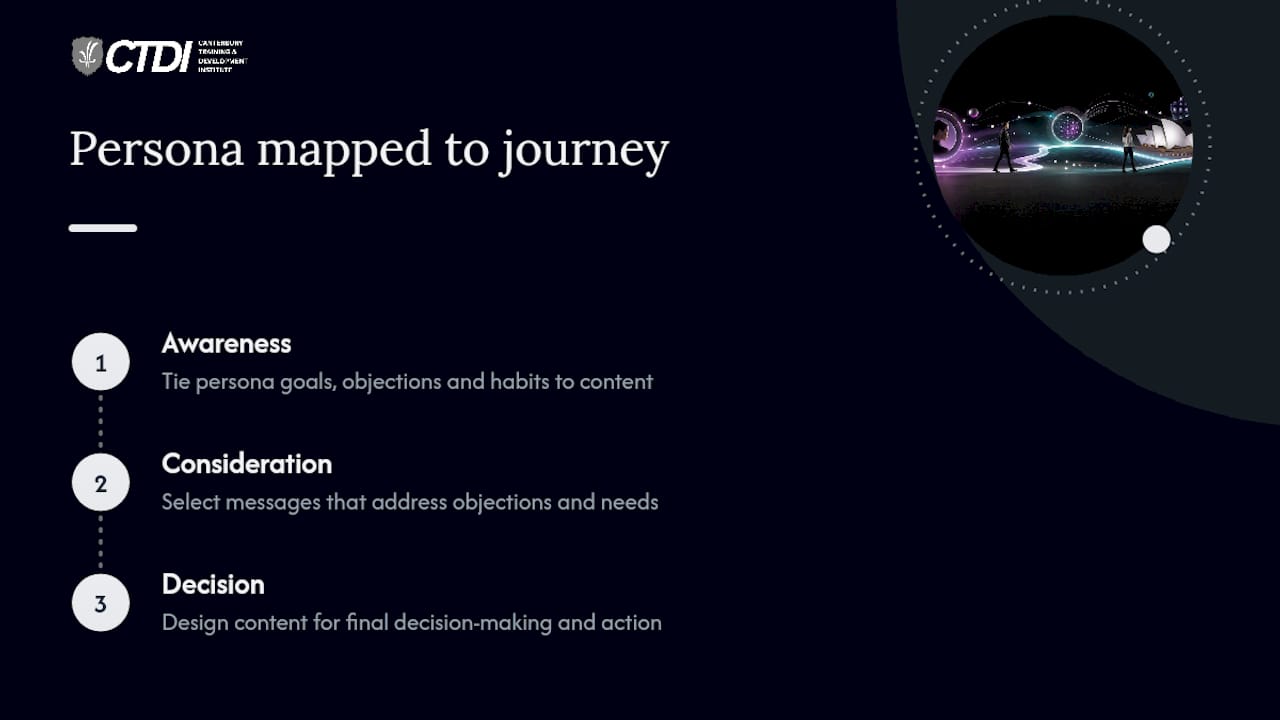
Every channel skill above sits inside a bigger question employers care about: do you understand who you are marketing to and where they are in their decision? A buyer persona is a structured summary of a target customer, their goals, objections and habits, built from research rather than guesswork. The customer journey maps the stages that persona moves through, from first awareness to purchase and beyond.
Employers test this less through direct questions and more through how you talk about your other project work. If you can explain why you chose a particular channel, message or timing based on where a customer sits in their journey, that reasoning carries weight in an interview. If your answer to "why this campaign?" is simply "it seemed like a good idea," that is a gap worth closing.
A useful exercise is to build one basic buyer persona from real or observed behaviour (not invented demographics) and map it against a three-stage journey: awareness, consideration, decision. Note what content or message fits each stage and why. This single document can support almost every other project in your portfolio, from the SEO content brief to the email sequence to the paid campaign, because it shows you are designing for a real person's decision-making, not just filling a content calendar.
Basic graphic design and video editing skills
You do not need to become a designer or video editor to be hireable in digital marketing, but basic fluency in both is now expected, particularly for social media, email and paid creative roles. Employers are not asking for advanced motion graphics. They are asking whether you can put together a clean, on-brand static image or a simple short-form video without waiting on a design team for every asset.
Tools like Canva have made basic graphic design accessible without formal training, and short-form video editing apps built into platforms like CapCut or native Instagram and TikTok tools cover most day-to-day needs. What employers actually check for is consistency (using brand colours and fonts correctly), legibility (text that is readable on a small screen) and an understanding of platform specifications, because a video cropped wrong for Instagram Stories looks amateurish regardless of the content.
Build evidence by creating a small set of matching assets, three social posts and one 15 to 30 second video, for the same fictional or real campaign, keeping them visually consistent. Note in your portfolio which platform each was built for and why the format differs. This is a low-effort, high-signal project because so few entry-level applicants bother to show it, despite how often the skill comes up in day-to-day marketing work.
Knowledge of current digital marketing trends and tools
Employers do not expect you to have mastered every platform, but they do expect you to be actively aware of where the industry is moving, particularly the shift toward AI-assisted workflows and answer engine visibility. Staying current is less about memorising tool names and more about understanding why a shift is happening and what it changes for a marketer's day-to-day work.
The IAB Australia review of the industry found that entry-level pathways are narrowing while AI reshapes daily marketing work, which means candidates who can speak knowledgeably about current shifts, rather than outdated tactics, stand out in interviews. A practical way to build this awareness is to follow two or three credible industry sources regularly (an industry body, a search engine's own documentation, a reputable marketing publication) rather than skimming social media takes.
In interviews, this knowledge shows up as specificity: being able to name a recent platform change and explain what it means for a campaign, rather than offering a vague comment about "the industry moving fast." That specificity, more than any list of tools on a CV, is what tells an employer you are paying attention to the field you want to work in. For a broader view of how these skills fit together across a career, this step by step digital marketing guide is a useful reference point, and CTDI's own work on AI skills for marketers covers the automation side of this shift in more depth.
If you want a structured way to build several of these skills at once rather than piecing them together from scattered short courses, CTDI's Advanced Diploma of Digital Marketing is designed around practical, industry-aligned projects delivered flexibly online, so you can study around existing work commitments. It is a nationally recognised VET qualification, not a certificate of completion, which matters if you are weighing depth of study against a quick course. You can view course details and enrol online when you are ready to commit to a structured pathway.
Sources
- What Digital Marketing Skills Are Australian Employers Actually Hiring for in 2026?
- Gartner 2026 CMO spend survey
- Developing appropriate workforce skills for Australia’s emerging digital economy: working paper
- IAB Australia: digital advertising talent pipeline under pressure
This article provides general information only. Course requirements, study pathways, credit arrangements and career outcomes may vary. Always confirm current requirements with the relevant education provider or authority.