

Yes, you can get into digital marketing without a degree. The fastest route is proof, not more study: a live project, one paid campaign you can show results from, and a handful of sharp written case studies. Most junior and mid roles now screen for demonstrable skill over qualifications. Give yourself six to nine months and a modest budget of roughly $300 to $800, and you have a realistic shot at your first role. A degree still helps for graduate schemes and some government positions, but for the bulk of digital marketing jobs, no degree is required if your portfolio does the talking.
Table of Contents
- How to start digital marketing without a degree in 6 to 9 months
- What skills do employers actually look for?
- How do you build a portfolio without any work experience?
- Should you pay for courses or learn digital marketing for free?
- Which tools should you learn first?
- How do you apply and interview without a degree?
- How do nationally recognised VET diplomas fit into this pathway?
- How do you network in digital marketing without a formal education background?
- What trips up newcomers, and how do you get past it?
- Where to check qualifications and learning resources
- Sources
How to start digital marketing without a degree in 6 to 9 months
Getting hired without a degree comes down to sequencing. Do the steps out of order and you end up with certificates but no proof; do them in order and you build a case for yourself month by month.
- Month 1: Pick one specialisation (SEO, paid media, content, or email/CRM), complete one foundation certificate, and set up Google Analytics 4 (GA4) plus a basic portfolio URL. Trying to learn everything at once is the most common reason people stall here.
- Months 1 to 3: Run small experiments on your own site or a client project. Launch something real, a Substack newsletter, a niche blog, or a small Shopify store, and finish your core certifications alongside it.
- Months 3 to 5: Spend a moderate amount on a genuine paid campaign, capture the data properly, and write it up as a full case study. This single step is often what separates an applicant who gets interviews from one who doesn't, since running your own paid campaign is the most credible signal you can offer a hiring manager when you have no agency history.
- Months 5 to 7: Publish three to five long-form teardowns or campaign breakdowns, line up two or three references from collaborators or clients, and polish your portfolio site until it reads like a body of work rather than a scrapbook.
- Months 7 to 9: Apply to a short, focused list of roles and tailor each application with the one case study that most closely matches the job description.
Pro Tip: Don't apply broadly in month two. A sequenced 6 to 9 month plan that ends with a paid campaign and public writing consistently outperforms early, scattergun applications, because hiring managers can see the proof before they meet you.
What skills do employers actually look for?
Job ads list dozens of "desirable" skills, but hiring managers are really checking for three things and a handful of supporting ones.
- Analytics fluency, specifically GA4, since almost every marketing role now touches reporting.
- One paid channel practised properly, whether that's Google Ads or Meta Ads, rather than a shallow overview of both.
- Strong marketing writing, the kind that turns a landing page or ad into a measurable result, not just clean prose.
- SEO basics, enough to brief content and diagnose obvious technical issues.
- Spreadsheet fluency in Excel or Google Sheets for reporting and budget tracking.
- Light HTML familiarity and awareness of marketing automation tools.
Australian employers consistently prioritise analytics, one paid channel, and writing ability above broader qualifications when hiring juniors. The trick is packaging each skill as an artefact: a screenshot of a GA4 funnel report, a campaign dashboard with real metrics, or two landing-page copy examples with before-and-after conversion data. A skill nobody can see on your CV is a skill you don't have as far as a recruiter is concerned.
How do you build a portfolio without any work experience?
You manufacture experience deliberately, rather than waiting for someone to hand it to you. Three artefacts do most of the work: a live URL you built and maintain, a paid campaign with documented results, and three to five written teardowns or long-form posts that show how you think.
Structure each case study the same way: goal, approach, data, learnings, and next steps. Keep it to one page. The best format includes a headline metric up top, the objective and channels used, a short description of your experiment structure, a screenshot or two as visual evidence, and three clear bullet-point learnings underneath.
- Publish teardowns on LinkedIn or Medium rather than keeping them private; visibility is part of the proof.
- Document every campaign as you run it, not weeks later from memory.
- Ask for one honest reference from anyone you collaborated with, even informally.
On unpaid work: genuine volunteering for a not-for-profit is fine and often useful for a first case study. Unpaid "internships" doing commercial marketing work for a for-profit business are a different matter and can breach Australian workplace laws around minimum entitlements. If in doubt, treat any ongoing commercial work as something that should be paid.
Pro Tip: Certificates prove you sat through content. A published body of work proves you can think, which is the harder thing for employers to verify any other way.
Should you pay for courses or learn digital marketing for free?
Most of the foundational learning is free or close to it, so spend your money on the things that actually generate proof, not on more certificates.
- Google Digital Marketing & E-commerce Certificate (via Coursera): broad, practical, and widely recognised as a credible starting point.
- Google Skillshop: free, official training for Google Ads and Analytics, directly relevant to interview questions.
- Meta Blueprint: free training for Meta's advertising platforms, useful if paid social is your specialisation.
- HubSpot Academy fundamentals: free certifications covering inbound marketing, content, and email.
Where the money actually goes is ad spend, domain and hosting, and occasional premium tool trials. Combining free learning with modest out-of-pocket spend of roughly $300 to $800 total, covering things like ad tests and hosting, is often enough to land a junior role. A nationally recognised VET diploma becomes strategically useful later, when you want formal recognition for career advancement or a role that specifically screens for accredited qualifications rather than portfolio work.
Which tools should you learn first?
You don't need to master a dozen platforms. Employers care about a short, practical list, and about whether you can actually use them, not just recognise the logos.
- GA4 for analytics; non-negotiable for almost every role.
- An email or CRM platform, either HubSpot or Mailchimp, to show you understand nurture sequences.
- Google Sheets or Excel for reporting and budget tracking.
- Google Ads, strongly preferred even outside paid media roles.
- Canva, useful for quick creative work and social assets.
A concise, non-negotiable tool set covering GA4, an email/CRM platform, and spreadsheets, with Google Ads and Canva as strong extras, matches what most junior job ads actually test for. Starter tasks worth doing this week: build a GA4 funnel report on your own site, run a $50 Google Ads test campaign, and set up a simple three-email drip sequence. Bring screenshots of all three to interviews rather than describing them from memory.
How do you apply and interview without a degree?
Structure your CV so the portfolio does the heavy lifting. Lead with your live project link and one measurable outcome (a conversion rate, a cost-per-click improvement, an open rate), and keep education brief and honest further down the page. Hiding it or leaving it vague reads as evasive, not strategic.
In interviews, frame your background as a stack rather than an apology: prior experience, whatever it was, followed by deliberate and recent learning, followed by demonstrable outcomes you can point to. That sequence tells a hiring manager you're capable of self-directed growth, which is exactly what the role demands anyway.
- Ask collaborators or freelance clients for a short written reference, even a two-line LinkedIn recommendation.
- Avoid unpaid "internships" with for-profit companies; treat genuine commercial work as something you're paid for.
- Never claim credentials you don't hold. It's checkable, and it undoes every ounce of trust your portfolio built.
Pro Tip: When a job ad lists "degree preferred," read it as a soft filter, not a wall. Candidates who wait to apply until they have a live URL and one paid campaign get interviewed far more often than those who apply before they have anything to show.
How do nationally recognised VET diplomas fit into this pathway?
Short courses, certificates, and nationally recognised VET qualifications signal different things to employers, and it's worth being precise about the difference. A certificate of completion tells an employer you finished a module. A nationally recognised qualification listed on training.gov.au tells them you met a defined, government-regulated standard.
The 11422NAT Diploma of Digital Marketing covers planning, implementing, and evaluating omnichannel campaigns, including working with AI and automation tools. The 11266NAT Advanced Diploma of Digital Marketing goes further, into SEO, SEM, social media, ecommerce, and automation, aimed at specialist or manager-level roles.
A portfolio proves you can do the work today. A nationally recognised diploma proves you've met a formal, industry-benchmarked standard, which matters for career progression, some employer applicant tracking filters, and any role that specifically requires accredited training.
- Both diplomas are offered as flexible, self-paced online programs designed by industry practitioners.
- Student support is available throughout the course.
- The diploma pathway complements, rather than replaces, the portfolio-building work covered above.
If you want a recognised qualification to sit alongside your case studies, that's a reasonable next step once your portfolio is underway, not a substitute for it.
How do you network in digital marketing without a formal education background?
Nobody in digital marketing checks credentials before they'll answer a question in a Slack group. That informality is your opening.
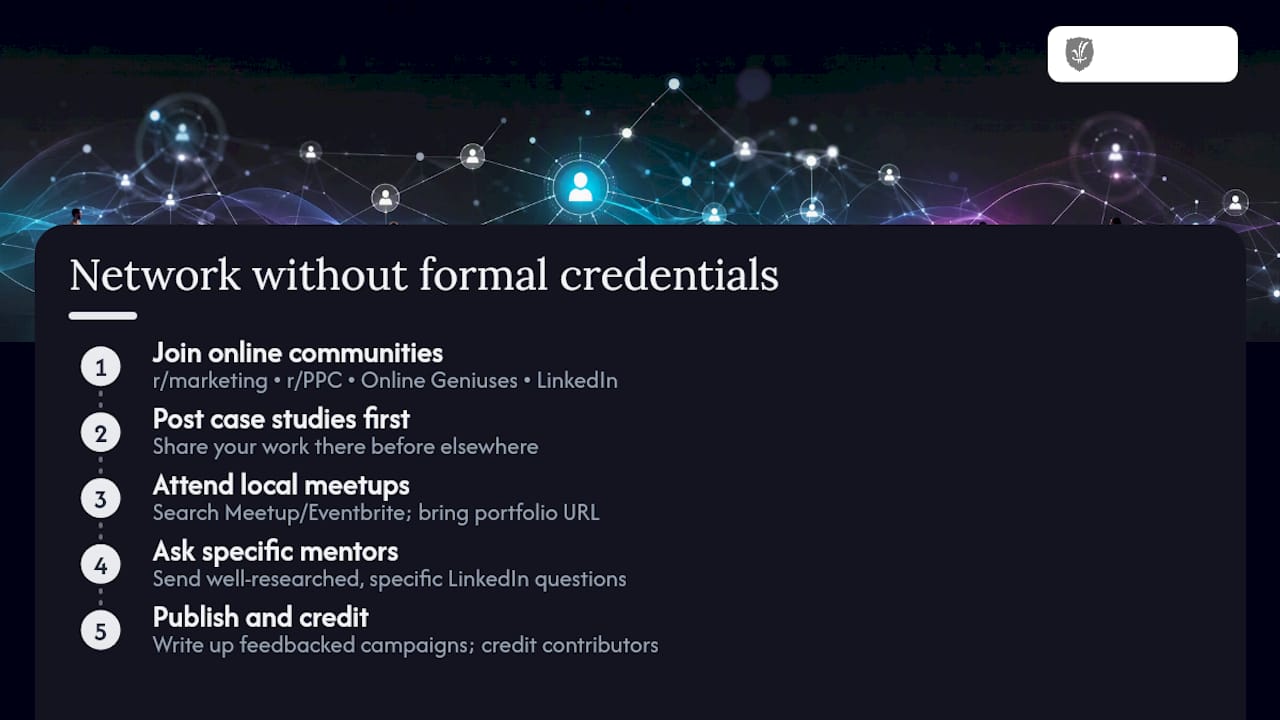
Start with free online communities: r/marketing and r/PPC on Reddit, the Online Geniuses Slack, and LinkedIn groups tied to your specialisation. Post your case studies there before you post them anywhere else. People in these spaces will critique your GA4 setup or your ad copy for free, and that feedback is often sharper than anything a paid course will give you.
Local meetups matter more than they get credit for. Search Meetup.com and Eventbrite for digital marketing or growth marketing events in your city; even a handful of attendees at a small event can turn into a reference or a lead on an unlisted role. Bring a business card or a phone ready to share your portfolio URL, not a printed CV.
Mentorship rarely arrives through a formal program. It usually starts with a specific, well-researched question sent to someone whose work you've studied, on LinkedIn or via a community. Vague requests like "can you mentor me" get ignored. A question like "I ran this GA4 funnel and got X result, what would you check next" gets answered, because it shows you've already done the work.
Treat every interaction as a chance to publish. If someone gives you good feedback on a campaign, credit them when you write it up. That habit builds a reputation faster than any certificate.
What trips up newcomers, and how do you get past it?
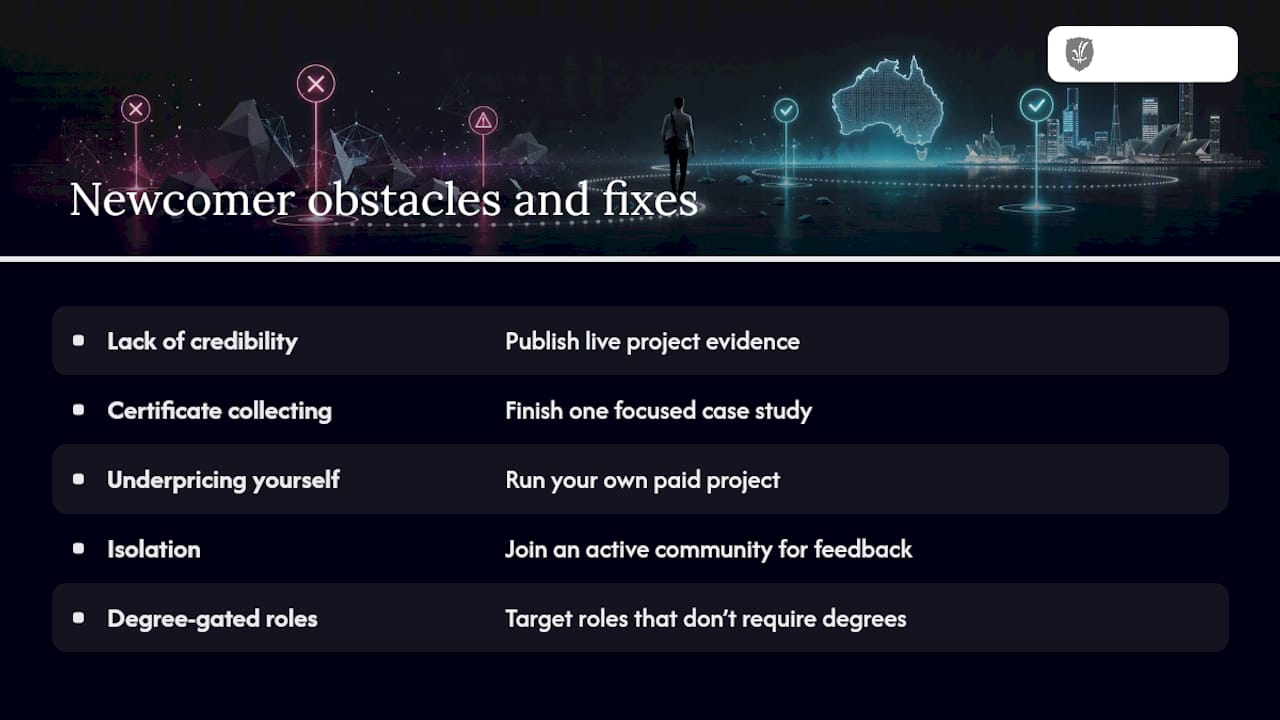
The first challenge is credibility without a track record. Recruiters filter on experience, and "no degree, no experience" reads as a double gap on paper. The fix is the sequencing covered earlier: build the live project and paid campaign before you start applying, so the gap on your CV is filled with proof instead of an explanation.
The second is decision paralysis from too many free courses. Google, Meta, HubSpot, and a dozen other platforms all offer training, and it's tempting to collect certificates instead of building anything. Pick one specialisation in month one and resist the urge to add a second until you have a case study to show for the first.
The third is underpricing yourself, particularly for freelance digital marketing work early on. Newcomers often take unpaid or severely underpaid "trial" projects to build a portfolio, which both undervalues the work and sets a bad precedent with that client. A better approach is running your own project at your own cost rather than working for free for someone else.
The fourth is isolation. Learning alone, with no feedback loop, means mistakes compound instead of getting corrected. Joining even one active community, as covered above, solves most of this within weeks rather than months.
Finally, some roles, particularly graduate programs at large agencies and certain government or regulatory positions, still list a degree as required or strongly preferred. These specific channels remain an exception to the general pattern, so it's worth knowing which doors are genuinely harder to open without formal study and focusing your energy on the ones that aren't.
If you decide a formal qualification is the right next move, whether for career progression or to meet a specific employer requirement, CTDI's Advanced Diploma of Digital Marketing is delivered flexibly online with industry-aligned content and student support built in. You can review course details and enrol directly if it fits where you're heading.
Where to check qualifications and learning resources
Verify any nationally recognised course directly on training.gov.au, searching for 11422NAT or 11266NAT to confirm current accreditation. For the step-by-step approach covered above, CTDI's career growth guide and practical step guide offer further detail on building toward a first role.
Sources
Recommended
- Launch and grow your digital marketing career in Australia
- Step-by-step digital marketing guide for career growth
- Mastering the digital marketing learning process: career growth
This article provides general information only. Course requirements, study pathways, credit arrangements and career outcomes may vary. Always confirm current requirements with the relevant education provider or authority.