

TL;DR:
- Creating an online course involves validating demand before building, designing curriculum backward from desired outcomes.
- Choosing an all-in-one platform like Kajabi or Ruzuku streamlines hosting, payments, and marketing to reduce technical issues.
Starting an online course means creating a focused learning experience that delivers a clear, measurable transformation for your students. Course creation, the industry term for this process, covers everything from topic selection and curriculum design to platform choice and marketing. Tools like Kajabi, Ruzuku, and Articulate 360 each play a distinct role in that process. Whether you want to teach digital marketing, sustainability, or AI skills, the steps are the same: validate first, build second, and sell with intention.
How to start an online course: choosing the right topic
The most common mistake new course creators make is building before validating. Kajabi advises choosing topics that sit at the intersection of your expertise and what your audience actively wants to learn. That means avoiding trend-chasing and instead framing your course around a specific outcome your students will achieve.
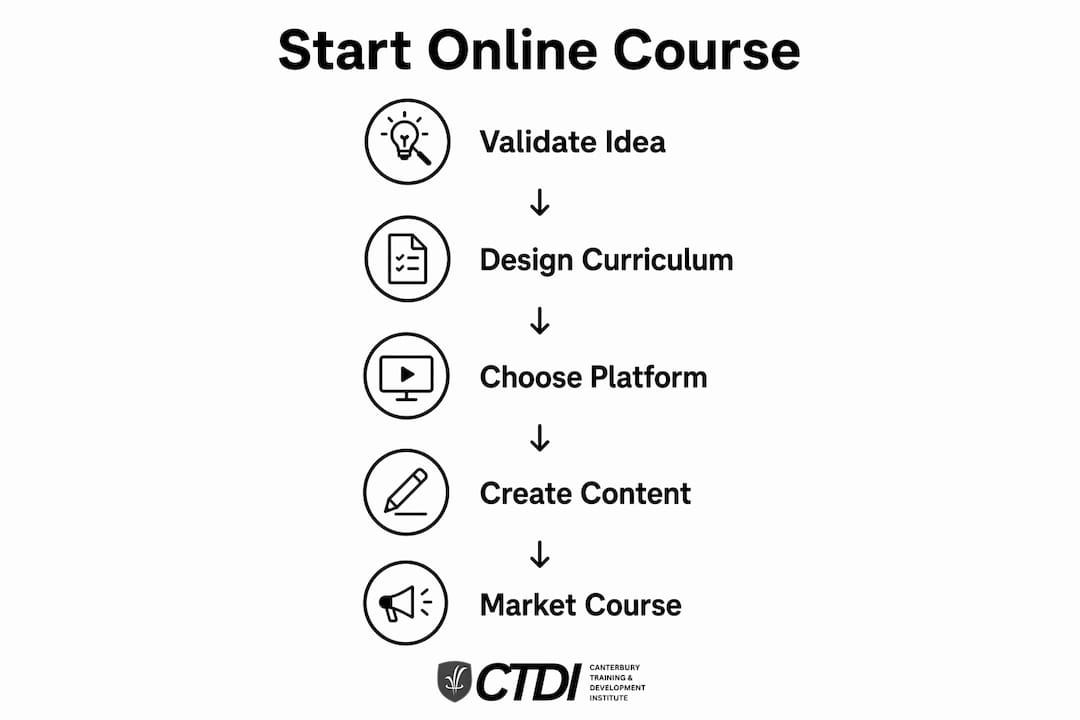
A strong course topic answers one question clearly: "What will my student be able to do after this?" That framing shapes everything from your curriculum to your marketing copy. Vague topics like "Introduction to Marketing" underperform compared to outcome-driven titles like "How to Run Your First Google Ads Campaign in 30 Days."
Before you record a single video, validate demand by surveying your audience, posting questions in relevant communities, or running a presale. Ruzuku recommends selling 5–10 presale spots at a discounted price to your most trusted audience members. That benchmark tells you whether your message resonates and whether people will actually pay.
- Identify 3–5 specific problems your audience faces regularly
- Frame each as a course outcome, not a subject area
- Post the outcome statement in a community or to your email list and measure response
- Run a presale page before building any content
- Use presale sign-ups to confirm both interest and price tolerance
Pro Tip: Your presale page is as much a test of your positioning as it is of your topic. If people do not buy, the problem is usually the message, not the idea. Rewrite the outcome statement before abandoning the topic entirely.
What are best practices for designing an online course curriculum?
Curriculum design starts at the end, not the beginning. Kajabi's 8-step process recommends working backward from the final outcome to build modules that each represent a milestone on the path to that result. Each lesson should accomplish exactly one specific goal. When a lesson tries to cover three ideas, learners retain none of them well.
The ADDIE model, widely used in instructional design, gives course creators a repeatable framework. D2L explains that ADDIE stands for Analysis, Design, Development, Implementation, and Evaluation. Each phase builds on the last, and skipping any one of them is where scope creep begins.
- Analysis. Define who your learner is, what they already know, and what gap your course fills.
- Design. Map out learning objectives for each module. Write these before creating any content.
- Development. Build lessons, activities, and assessments that serve each objective directly.
- Implementation. Deliver the course to your first cohort and monitor where learners drop off or struggle.
- Evaluation. Gather feedback, review completion rates, and revise content that is not working.
Defining learning objectives and success metrics at the design stage prevents scope creep and keeps content development aligned with what learners actually need. Articulate also stresses that courses must align with audience needs and include accessibility considerations from the start, not as an afterthought. Captions, readable fonts, and logical navigation are not optional extras. They determine whether your course works for all learners, including those with disabilities or those learning in a second language.
For Australian course creators building self-paced content, a practical guide to breaking down course modules can help you map milestones to flexible enrolment timelines.

Pro Tip: Write your module outcomes before you write a single lesson script. If you cannot state what a learner will do differently after a module, the module is not ready to build.
Which platform should you use to host your online course?
Platform choice shapes the entire student experience. Kajabi recommends choosing an all-in-one platform that handles hosting, payments, and content delivery in one place. Stitching together separate tools for video hosting, payment processing, and email marketing creates technical friction and increases the chance of something breaking during a launch.
Self-paced course enrolment models vary by platform. Some platforms open enrolment continuously, while others map access to academic terms or cohort start dates. The University of Northern Iowa's online education programme uses term mapping for self-paced courses to set consistent learner expectations around access and certification. If your course includes a certificate or formal reporting, defining how enrolment dates correspond to access periods matters from day one.
| Platform | Hosting | Payments | Analytics | Community |
|---|---|---|---|---|
| Kajabi | Yes | Yes | Advanced | Yes |
| Ruzuku | Yes | Yes | Basic | Yes |
| Articulate 360 | No (SCORM export) | No | Via LMS | No |
| Teachable | Yes | Yes | Intermediate | Limited |
| Thinkific | Yes | Yes | Intermediate | Yes |
Kajabi suits creators who want marketing automation built in alongside course delivery. Ruzuku suits smaller creators who want a clean, simple experience without the complexity. Articulate 360 is the right choice when you are building corporate training content that needs to plug into a Learning Management System like Moodle or Canvas. Teachable and Thinkific sit in the middle ground, offering solid delivery without Kajabi's full marketing suite.
For creators focused on making courses accessible to diverse learners, platform support features like discussion boards, direct messaging, and progress nudges matter as much as the video player.
How do you create content and market your online course?
Content quality does not require a studio. Kajabi's guide recommends mixing formats: talking-head videos, screen recordings, downloadable PDFs, and audio lessons. That variety keeps learners engaged across different learning styles and makes your course feel complete rather than thin. A good USB microphone and a quiet room with natural light will outperform expensive camera gear recorded in a noisy space every time.
- Record in short segments of 5–10 minutes per lesson to reduce editing time and maintain attention
- Use screen recordings for software tutorials and talking-head video for concept explanations
- Include a downloadable summary or worksheet for each module to reinforce learning
- Add captions to every video, both for accessibility and for learners watching without sound
- Test your audio before recording a full lesson; poor sound quality is the fastest way to lose a learner's trust
Marketing starts before the course is finished. Kajabi's 2026 selling guide recommends launching with email sequences and social posts that focus on the transformation your course delivers, not the features it contains. "Six modules of video content" is a feature. "You will be able to write and schedule a month of social media content in one afternoon" is a transformation. Sell the second one.
Your existing audience is your fastest path to early sales. Email your list, post in communities where you are already known, and ask past clients or students if the topic solves a problem they have. Honest, specific communication about outcomes converts better than polished sales copy every time.
Pro Tip: Build an evergreen email sequence of 5–7 emails that runs automatically after someone signs up to your list. That sequence does your selling while you focus on improving the course itself.
For a detailed look at structuring your online learning workflow from content creation through to student completion, Edu's 2026 guide covers the full process in practical steps.
Key takeaways
Starting an online course requires validating demand before building, designing curriculum backward from the outcome, choosing a platform that handles hosting and payments together, and marketing the transformation rather than the content.
| Point | Details |
|---|---|
| Validate before building | Sell 5–10 presale spots to confirm demand and price tolerance before recording any content. |
| Design from the outcome backward | Map each module to a milestone that moves learners toward the final result. |
| Use the ADDIE model | Follow Analysis, Design, Development, Implementation, and Evaluation to prevent scope creep. |
| Choose an all-in-one platform | Platforms like Kajabi combine hosting, payments, and analytics to reduce technical complexity. |
| Sell the transformation | Marketing copy focused on learner outcomes converts better than feature lists. |
What I have learned from watching course creators succeed and fail
The pattern I see most often is this: a creator spends three months building a beautiful course, launches it to silence, and concludes the topic was wrong. Almost always, the topic was fine. The validation step was skipped.
Preselling is not just a revenue tactic. It forces you to write your sales page before you build your curriculum. That sequence is actually the right order. Your sales page tells you what your audience believes the course will do for them. Your curriculum then delivers exactly that. When you build first and sell second, you are guessing at both.
Platform selection is where I see the second most wasted time. Creators spend weeks comparing features on platforms they will never use at full capacity. For a first course, the right platform is the one you will actually launch on. Ruzuku is genuinely good enough to validate and sell a first course. Kajabi makes sense once you have proven the course works and want to scale marketing. Articulate 360 belongs in a corporate training context, not a solo creator's first launch.
The marketing mindset shift is the hardest one. Selling a course feels uncomfortable to most educators because they were trained to teach, not to sell. Reframe it: you are not selling content, you are offering a result. When you believe in the result your course delivers, communicating it clearly is not selling. It is just being honest about what you have built.
One last thing. Student engagement after enrolment is where most courses quietly fail. Completion rates for online courses are notoriously low across the industry. Build in check-ins, short wins in the first module, and a community space where learners can ask questions. The learners who finish are the ones who leave reviews, refer friends, and buy your next course.
— Sam
Edu's online diplomas for aspiring course creators
Canterbury Training and Development Institute, known as Edu, offers nationally recognised online diplomas in AI, digital marketing, and environmental management. These programmes are designed by industry experts and delivered entirely online in a self-paced format, which means you study around your existing commitments.
If you are building your own course business, studying a discipline like digital marketing or AI through Edu gives you both the credential and the practical knowledge to teach it credibly. Edu's student support services and expert trainers are available throughout your studies. Check out Edu's online diploma programmes to find the right qualification for your goals in 2026.
FAQ
How long does it take to create an online course?
A focused first course with 4–6 modules typically takes 6–12 weeks to build from validation to launch. The timeline shortens significantly when you presell before recording.
What is the best platform for starting an online course?
Kajabi suits creators who want hosting, payments, and marketing in one place. Ruzuku is a simpler, lower-cost option for a first launch.
Do I need to validate my course idea before building it?
Yes. Kajabi and Ruzuku both recommend validating demand through presales or surveys before recording any content. Validation prevents wasted effort and tests your pricing at the same time.
What does the ADDIE model mean for online course design?
ADDIE stands for Analysis, Design, Development, Implementation, and Evaluation. D2L describes it as a systematic instructional design framework that aligns course content with learning objectives and reduces scope creep.
How do I market an online course with no existing audience?
Start by posting in communities where your target learners already gather, then build an email list with a free resource related to your course topic. Kajabi recommends leading all marketing with the transformation your course delivers, not the number of lessons or hours of video.