

Yes, you can study online while working full time, but only if you drop the idea of a full-time study load on top of a full-time job. Pick a part-time pace of roughly 10 to 20 hours a week, lock in asynchronous courses over live-session ones, and treat your study blocks as fixed appointments nobody can move. That single shift in expectations is what separates working students who finish from those who quit in week six.
Table of Contents
- Five quick actions you can implement this week
- What realistic study load looks like for working professionals
- Time-management tactics that actually work for busy professionals
- Integrating study with your job: negotiate flexibility and use work as learning material
- Avoiding burnout: rules, red flags and when to back off
- Study workflow and tools that save time
- A realistic weekly sample schedule for a 38–40 hour worker
- Why flexible online VET study can be a practical choice
- Sources
Five quick actions you can implement this week
You don't need a perfect system to start. You need five decisions made correctly, right now.
- Block sacred study hours in your calendar and label them like client meetings, not "personal time" that gets bumped the moment something urgent lands.
- Choose fully asynchronous modules where possible, and if a course requires live tutorials or exams, find out the exact dates before you enrol, not after.
- Use commute time and lunch breaks for micro-learning, then pair that with two proper three-hour deep-work sessions each week for the tasks that need real focus.
- Talk to your manager early, and frame the request around minimal disruption rather than asking for a favour.
- Schedule recovery time, including one full day off study every week and short breaks inside longer sessions.
Pro Tip: Put your study blocks in your work calendar as "busy", not as a personal appointment. Colleagues respect a blocked slot far more than they respect a vague excuse.
None of this is glamorous. It's just the scaffolding that stops week three from collapsing into week thirteen of falling behind.
What realistic study load looks like for working professionals
Australian universities generally treat full-time study as equivalent to about 40 hours of work per week, with part-time study sitting around 10 to 20 hours, depending on the subjects involved. Add a full-time job to a full-time study load and you're looking at an unsustainable number of total hours per week. That's not sustainable for more than a term, if that.
Most courses express workload in credit points, and providers usually publish an expected hours-per-credit-point figure you can use to estimate your real weekly commitment before you enrol. A subject rated at 10 to 12 hours a week part-time is a very different proposition to one demanding 20.
The decision rule is simple: match the study load to your predictable free time, not your ideal week.
- Shift workers should count actual rostered gaps, not theoretical evenings.
- Parents with young kids often do better stacking study into weekend mornings than trying to find weeknight energy.
- Long commuters can bank real hours in transit, provided the course allows offline access.
If none of those windows add up to 10 hours reliably, a short course or micro-credential is a more honest starting point than a full qualification.
Time-management tactics that actually work for busy professionals
Time blocking beats to-do lists for study, because a to-do list has no boundaries and a calendar block does. Here's how to set it up properly:
- Create recurring calendar blocks for each study session and name them with the subject or module code, not just "study", so they carry the same weight as any other named meeting.
- Run Pomodoro-style sprints inside those blocks, working in 25 to 50 minute stretches with short breaks, especially for reading-heavy or writing-heavy tasks that drain focus fast.
- Batch admin tasks together, checking discussion boards, downloading readings and replying to tutors in one sitting rather than scattering them across the week.
- Stack study onto an existing habit, such as reviewing flashcards straight after your morning coffee, so it rides on a routine you already have.
- Set your own internal deadlines three to five days ahead of the real ones, so a bad week doesn't tip you into a missed submission.
Pro Tip: Personal deadlines only work if you write them somewhere you'll actually see them. A note in an app you never open is not a deadline, it's a wish.
Integrating study with your job: negotiate flexibility and use work as learning material
Most managers respond better to a specific, low-cost request than a vague one. Try something like: "I'm doing a part-time online qualification. It won't affect my output, but could we agree on [one early finish a week / a fixed remote day / a shift swap] to protect study time?" That framing matters, because Randstad's research shows work-life balance sits high on many employees' priority lists, and employers increasingly expect these conversations.
- Propose small, specific adjustments rather than open-ended flexibility.
- Check your course's assessment rules before using real workplace projects as assignment material, and confirm confidentiality boundaries with your employer first.
- If your study is directly relevant to your role, ask whether formal study leave or partial sponsorship is on the table. Some employers fund training as part of broader corporate upskilling arrangements.
Avoiding burnout: rules, red flags and when to back off
Persistent exhaustion, dropping quality in both work and study, and skipping sleep to catch up are the clearest signs the pace has tipped from demanding into unsustainable. Healthdirect recommends seeking support early and building recovery into your routine rather than waiting until you're depleted.
- Protect sleep first. Everything else is easier to manage when you're not exhausted.
- Take one full day off study every week, no exceptions.
- Build short breaks into longer study sessions rather than pushing through fatigue.
- Use your provider's student support services and your workplace's employee assistance program if things start slipping.
If two or more warning signs persist for a fortnight, that's your cue to drop a subject, extend your timeline, or pause for a term.
Study workflow and tools that save time
The right tools remove friction rather than adding another thing to manage. Look for a calendar app with recurring blocks, a task manager that handles deadlines, a Pomodoro timer, and an offline reader or downloadable lecture format for commute study.
- Confirm whether a course is genuinely asynchronous or has hidden synchronous requirements, like mandatory live tutorials, before you commit.
- Run a short weekly planning session, ideally 30 to 45 minutes, to set the week's priorities.
- Do quick micro-reviews of new material within a day or two of first seeing it, so nothing goes stale before it's needed.
- Keep a simple archive of notes and feedback so you're not hunting through old emails before an assignment is due.
- Download recorded lectures where the platform allows it, so a bad train connection doesn't cost you a study session.
A realistic weekly sample schedule for a 38–40 hour worker
A workable week for a full-time employee doing part-time study often looks like this:
- Weekday evening deep-work block, three hours, once or twice a week, for assignments and harder concepts.
- Weekend morning deep-work block, three hours, for the bulk of reading and revision.
- Commute micro-sessions, 15 to 30 minutes each way, for lecture recordings or flashcards.
- Lunch break micro-reviews, 20 minutes, for consolidating what you covered that morning.
- Weekly planning session, 30 to 45 minutes, usually Sunday evening, to set the coming week's priorities.
That totals roughly 10 to 14 hours in a normal week. In an unusually heavy work week, drop straight to the two deep-work blocks and the planning session, and let the micro-sessions go. Shift workers and long commuters should rebuild this around their actual rostered gaps rather than forcing evenings that don't exist.
Why flexible online VET study can be a practical choice
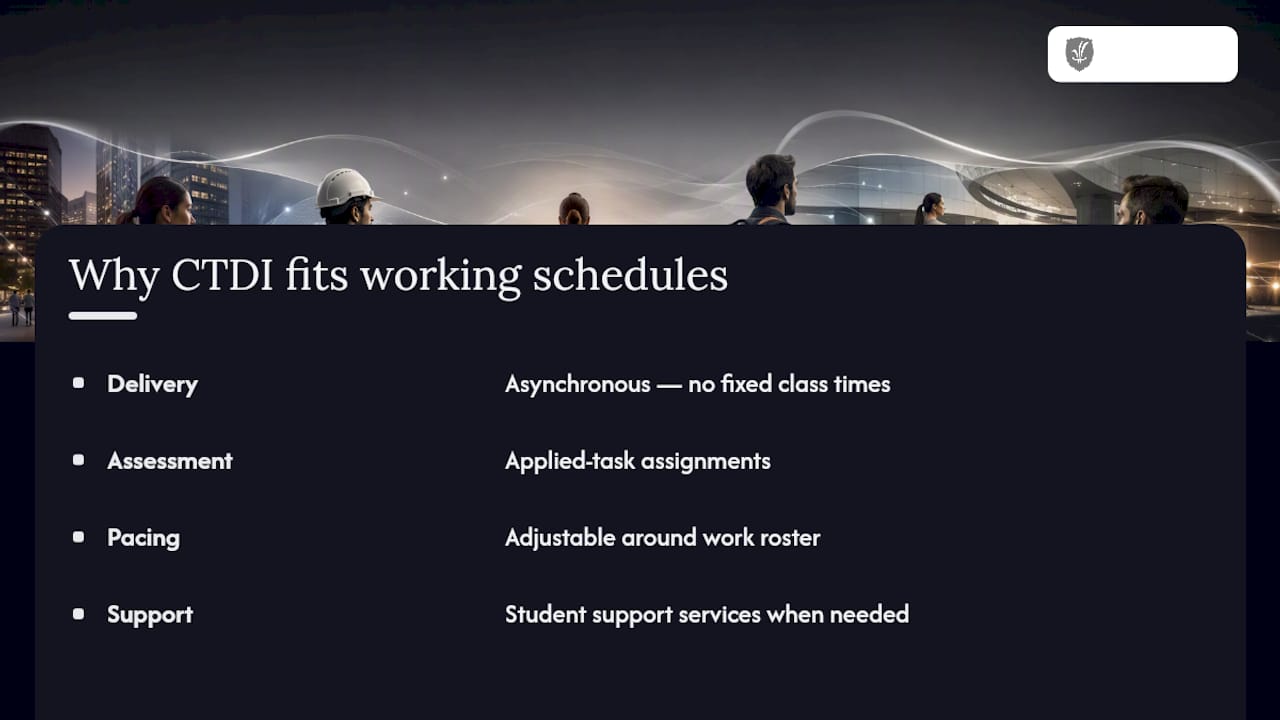
Nationally recognised vocational courses are built around assignments and self-paced modules rather than fixed lecture times, which suits the schedule most working professionals actually have. CanterburyTDI designs its online diplomas in areas like artificial intelligence, digital marketing and environmentally sustainable management around this reality: asynchronous delivery, assessment based on applied tasks, and pacing you can adjust around a demanding job.
That structure maps directly onto the problems this guide covers. Asynchronous delivery removes the clash between rostered shifts and mandatory class times. Assignment-based assessment lets you apply study directly to real work tasks, where your course rules permit it. Student support services give you somewhere to go when a module gets harder than expected, rather than muscling through alone.
If you're weighing up whether a structured qualification fits your working week, CTDI's guide to studying while working full time without burning out walks through scheduling in more detail, and the online learning workflow guide offers templates for organising tasks week to week. When you're ready to look at courses, you can explore CTDI's online diplomas in AI, digital marketing and sustainability.
Sources
For study-load benchmarks and course recognition, check MySkills and StudyAssist, both government-run portals for Australian students. UNSW's guidance on balancing work and study and Victoria University's advice on studying while working full time both offer practical, institution-backed detail on managing the two at once.
- Balancing part-time or full-time study with full-time work – Insight
- Work-life balance - strategies and where to get help | healthdirect
Recommended
- Study while working full time without burning out
- Why choose online learning? Unlock career flexibility
- Your online learning workflow: a 2026 guide
- Why online learning matters for flexible career growth
This article provides general information only. Course requirements, study pathways, credit arrangements and career outcomes may vary. Always confirm current requirements with the relevant education provider or authority.