

Yes, you can study while working full time. It takes systems, not willpower. Start conservatively at 8 to 12 hours a week, scaling toward the 10–15 hours most working students can sustain, and build the habit around three fixed, protected slots rather than hoping motivation shows up.
This week, do three things. Run a 60 minute time audit of a typical Sunday to Saturday. Book three study appointments straight into your calendar as if they were meetings you can't cancel. Set a hard sleep stop time and stick to it, because tired study is mostly wasted study. Use retrieval practice (quizzing yourself instead of rereading notes) in short bursts. CTDI designs its diplomas for exactly this kind of learner: self paced, 100% online, and built around real jobs rather than campus timetables.
- Time audit: track one full week honestly, including scrolling and admin
- Calendar lock: three sessions, same days, same times, every week
- Sleep boundary: pick a stop time and defend it like a deadline
- One technique: swap rereading for retrieval practice this week
Key Takeaways
Studying while working full time succeeds when protected time blocks, spaced retrieval practice, and honest weekly hour targets replace reliance on willpower alone.
| Point | Details |
|---|---|
| Audit before you schedule | Track one full week honestly to find your real available hours before committing to a target. |
| Start conservative, scale up | Begin at 8 to 12 hours a week and grow toward the 10–15 hour range most working students sustain. |
| Use retrieval, not rereading | Quiz yourself with flashcards or spaced repetition apps instead of passively rereading notes. |
| Protect sleep and one full day off | Sleep consolidates memory, and a weekly break prevents burnout by week six. |
| Choose a format built for work | CTDI's 100% online, self paced diplomas remove fixed timetable clashes for working learners. |
Table of Contents
- How do you plan a study schedule around full time work?
- What study techniques work best in short time windows?
- How do you negotiate study time with your employer?
- How do you set up a study space that actually works?
- Why does protecting sleep matter more than squeezing in extra hours?
- Which study format actually fits a full time job?
- How CTDI's flexible online diplomas fit around a full time job
- What does a 30 day plan to get started look like?
- How do you prioritise work tasks against study deadlines?
- Who should be in your support network while you study?
- Which productivity tools actually help a busy schedule?
- How do you set goals that keep you motivated for months?
- Sources
How do you plan a study schedule around full time work?
The biggest mistake working students make is guessing at their available hours instead of measuring them. A proper time audit fixes that in under an hour.
- Write down every fixed commitment for one week: work hours, commute, sleep, meals, family and household tasks.
- Add up what's left. Most people are shocked to find only 10 to 15 genuinely free hours a week, not the 25 they imagined.
- Subtract a buffer for fatigue and unplanned events, then commit to a conservative number, not the maximum possible.
- Convert that number into three or four fixed appointments, ideally at the same time each day so the routine becomes automatic.
- Book one backup slot each week for when work runs late or life intervenes.
A realistic template: Tuesday and Thursday evenings, 7pm to 8:30pm, for new content; Saturday morning, 9am to 11am, for review and practice questions; Sunday evening, 30 minutes, for planning the week ahead. That's roughly 4.5 hours locked in, with room to grow.
Pro Tip: Treat study appointments the same way you'd treat a client meeting. If you wouldn't casually cancel on a client, don't casually cancel on your own study block.
What study techniques work best in short time windows?
Rereading notes feels productive but teaches you almost nothing. Spaced retrieval, testing yourself on material at increasing intervals, builds far stronger long term retention than passive review, and it fits neatly into the fragmented pockets of time a working schedule actually offers.
The trick is matching the task to your energy, not just your available minutes. New, difficult material needs your sharpest hours, usually early morning or the first slot after a proper break. Review and repetition can happen when you're tired, on a train, or half watching the kettle boil.
Practical micro sessions that work inside a 10 to 30 minute window:
- Flashcards or a spaced repetition app during a commute or lunch break
- A 15 minute practice quiz on yesterday's material before bed
- Listening to a recorded lecture or audio summary while walking or driving
- Five minutes of "brain dump" writing everything you remember from a topic, then checking gaps
Using commute and lunch time for light review turns dead time into genuine progress, and it's one of the most consistently recommended tactics in practical guides for working students.
How do you negotiate study time with your employer?
Most workplaces have a professional development or study assistance policy that never gets used because nobody asks. Check your employee handbook or HR portal before assuming there's nothing on offer.
Frame the conversation around what your employer gains, not just what you need. Negotiating flexibility works best when study is positioned as professional development that sharpens skills relevant to your role, not a personal project competing with your job.
Options worth raising:
- Flexible start or finish times on exam days
- A compressed four day week during intensive study periods
- One paid or unpaid study day per assessment cycle
- Formal exam leave, if your enterprise agreement includes it
A simple script: "I'm completing a diploma that will strengthen my skills in [area]. Could we look at flexible hours around assessment weeks, similar to what's offered for other professional development?" Then plan annual leave around major deadlines and public holidays well ahead of time.
Pro Tip: Ask HR for the policy document, not just a verbal yes. Verbal flexibility disappears the moment your manager changes; written policy doesn't.
How do you set up a study space that actually works?
Friction kills consistency faster than lack of time does. If setting up to study takes fifteen minutes of hunting for chargers and clearing the table, you'll skip sessions.

Keep one spot, even a corner of a bedroom, dedicated to study with everything ready to go: laptop charged, notes accessible, water bottle filled. A phone left in another room, or a site blocker like Freedom or Cold Turkey running during study blocks, removes the temptation to "just check one thing."
Build a short ritual that tells your brain it's time to switch modes: a two minute walk, a snack, five minutes with your eyes closed, then a quick glance at your plan for the session. This transition ritual matters more than people expect, because jumping straight from a work mindset into study mode without a buffer usually means the first ten minutes are wasted anyway.
- Keep study gear in one fixed spot, always ready
- Block distracting apps and sites during sessions
- Use a two to five minute ritual to switch mental gears
- Tell housemates or family your study times so interruptions drop
Why does protecting sleep matter more than squeezing in extra hours?
Sacrificing sleep to study feels efficient and almost never is. Sleep is when memory consolidation happens, and adults generally need 7 to 9 hours for the brain to properly file away what it learned that day. Push past midnight cramming and you're often studying material you'll barely retain.
Build in one full day off each week with zero study obligations. It's not laziness, it's what stops steady progress turning into burnout by week six.
Small habits protect energy without eating into your schedule: a 20 minute walk, regular meals instead of skipped ones, and short breaks every 45 to 60 minutes during longer sessions.
Watch for warning signs that your load is too heavy: persistent exhaustion, falling grades despite effort, or dreading every session. If two or more show up together, it's time to drop a unit, request an extension, or slow your enrolment pace rather than pushing through.
Which study format actually fits a full time job?
Not all course structures are built the same, and the wrong one will fight your schedule every step of the way. Distance and block model programs are specifically designed to reduce clashes with full time work, unlike traditional timetabled courses that assume daytime availability.
- Part-time enrolment spreads the workload thin over more time, which suits people who need lower weekly hours but can commit for longer.
- Asynchronous online study lets you complete material whenever suits, ideal for shift workers or unpredictable hours.
- Block models, where you study one subject intensively before moving to the next, work well if your job has predictable quiet periods.
Before enrolling anywhere, ask providers directly: is attendance compulsory, or can I complete work asynchronously? When are assessments due, and are extensions realistic? What student support exists if I fall behind? Can recognition of prior learning (RPL) or credit transfer cut down my required units?
How CTDI's flexible online diplomas fit around a full time job
CTDI builds its diplomas in Artificial Intelligence, Digital Marketing, and Environmentally Sustainable Management around exactly the constraints this article has covered. Courses run 100% online and self paced, so there's no fixed lecture time competing with your job, and flexible online learning genuinely does unlock career growth for people who can't attend campus.
- Nationally recognised qualifications designed with industry input, not generic content
- Student support available when assessments and work deadlines collide
- Flexible unit pacing that maps to the checklist above: ask about RPL, assessment timing, and support before you enrol
If you're weighing formats, understanding what student support actually covers is worth doing before you commit to any provider.
What does a 30 day plan to get started look like?
Momentum beats perfection. A month is long enough to build a habit and short enough to stay motivated.
- Week 1: Run your time audit, book three fixed study slots, and have the professional development conversation with your manager.
- Week 2: Set up a spaced repetition tool or flashcard system, start applying retrieval practice, and lock in a consistent sleep stop time.
- Week 3: Test one longer weekend deep work block of two to three hours, and use a half day of leave if a deadline is tightening.
- Week 4: Review what actually happened against your plan, then adjust your weekly hours or enrolment pace before month two begins.
Pro Tip: Don't judge week one by how much you learned. Judge it by whether you showed up to all three sessions. Content mastery follows consistency, not the other way around.
How do you prioritise work tasks against study deadlines?
Work will always feel urgent. Study deadlines feel distant right up until they aren't. The fix is separating urgency from importance instead of letting your inbox decide your priorities for you.
Start each week by listing every work deliverable and every study task with a due date, then sort by which has the harder, more immovable deadline. A performance review next month can often shift a week; an assessment submission usually can't. When both compete for the same evening, the one with less flexibility wins the slot, and you renegotiate the other.
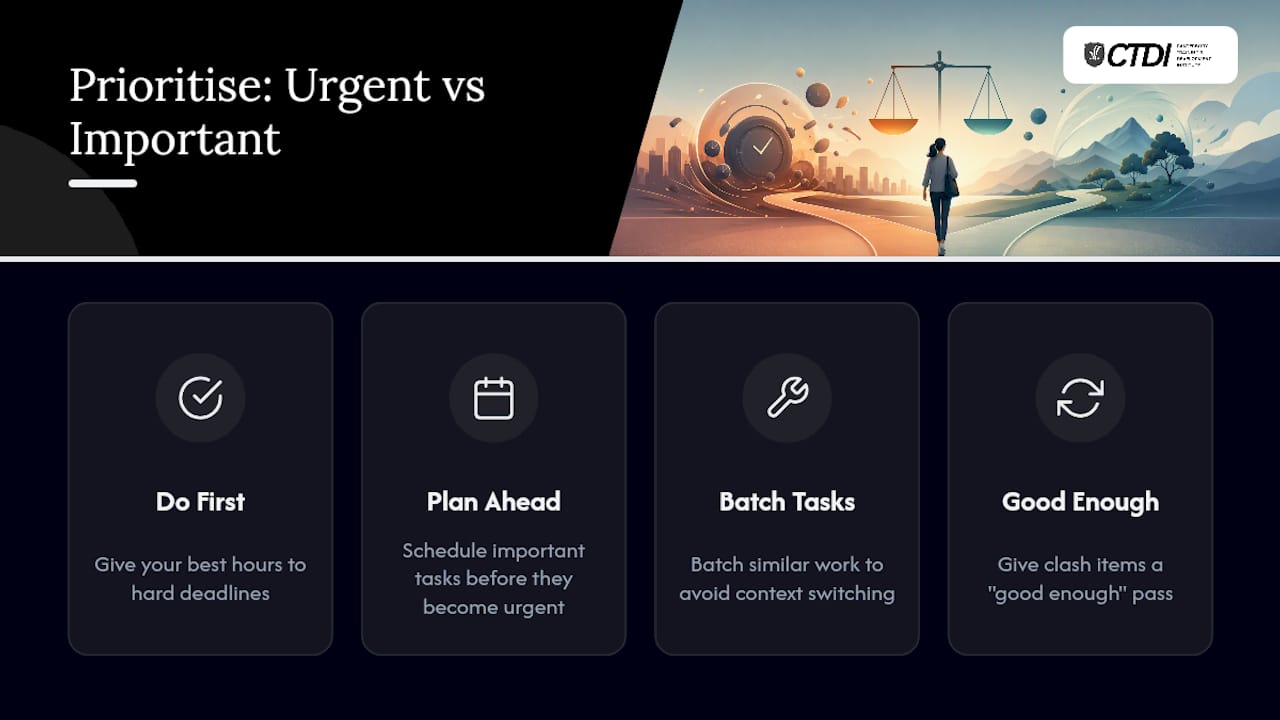
The Eisenhower approach, sorting tasks into urgent/important quadrants, works well here. A study task that's important but not urgent yet (like starting an assignment three weeks out) is exactly the kind of thing that gets pushed indefinitely unless you schedule it deliberately, before it becomes urgent and stressful.
Batch similar work tasks together rather than context switching between emails, meetings and study all day. Constant switching between a work problem and a study concept costs you far more time in mental reset than either task alone. If your job allows it, protect one or two hours a week where you do only focused work, so the rest of your evening is genuinely free for study rather than half occupied by lingering work thoughts.
When a genuine clash arrives, a major project deadline landing the same week as an assignment, decide in advance which one gets your best hours and which gets a "good enough" pass.
Who should be in your support network while you study?
Studying while working full time is much harder to sustain alone. The people around you either protect your study time or unknowingly chip away at it, and it's worth being deliberate about which.
Tell your household your fixed study times, not as an announcement but as a request: fewer interruptions during those windows, help with a chore you'd normally do, or simply quiet in the house. Family members who know the schedule are far less likely to accidentally sabotage it.
Friends matter too, particularly the ones who'll understand why you're saying no to a weeknight dinner. You don't need everyone to understand your choice, just the handful of people whose plans regularly clash with your study slots.
Study groups, even informal ones, add accountability that solo study lacks. A weekly 20 minute video call with two or three classmates to compare progress and swap questions catches gaps you wouldn't notice studying alone, and it's harder to skip a session when someone's expecting you. If your course doesn't organise one, ask your student support contact whether other working students would be open to forming one, or start a small group chat yourself.

Don't overlook workplace allies either. A manager or colleague who knows your study load is more likely to flag flexibility when a project deadline moves, simply because they remember you mentioned an exam that week.
Which productivity tools actually help a busy schedule?
Most productivity apps are built for people with spare time to organise, not people trying to claw hours out of a full week. The right tools for a working student do one job well and get out of the way.
A calendar app you already use, Google Calendar or Outlook, is more reliable than a dedicated study planner you'll forget to open. Block study sessions directly into it, colour coded, so a glance at your day shows work, study and rest without extra effort.
Spaced repetition apps like Anki turn scattered five minute pockets into genuine review sessions, since the software decides what to test you on based on what you're about to forget. Task managers like Todoist or a simple physical list work best when kept to one list, not scattered across three apps you half check.
Site blockers matter more than people expect. If checking one notification turns into twenty minutes lost, a blocker running during study blocks removes the decision entirely rather than relying on discipline you won't have at 9pm on a Tuesday.
Keep the toolkit small. Three or four apps used consistently beat ten apps downloaded once and abandoned. If a tool needs more than a five minute setup before each use, it's adding friction, not removing it.
How do you set goals that keep you motivated for months?
A diploma that takes a year feels abstract in week two and exhausting by week twenty unless you break it into pieces you can actually feel progress on.
Set a long-term goal first: the qualification itself, and what it changes for you professionally. Write it down somewhere you'll see it, not just in your head, because vague intentions fade the first time work gets stressful.
Then build short-term goals underneath it: finish this module by Friday, complete three practice quizzes this week, submit a draft before Sunday. Short-term goals give you a win roughly every week, which matters far more for motivation than a distant qualification date does.
Track progress somewhere visible, a simple spreadsheet or a checklist pinned near your desk. Ticking something off, even something small, creates the kind of momentum that makes the next session easier to start.
Revisit your goals every two to four weeks and adjust them honestly. If you're consistently missing targets, the goal was probably unrealistic, not you. Scaling back a target is a course correction, not a failure, and it keeps you moving instead of quitting altogether.
A candid note on pacing
Some months you'll hit every session. Others, work will eat your study time and progress will stall, and that's normal, not failure. Try the 30 day plan above, then adjust it honestly rather than abandoning it. CTDI's flexible online formats exist precisely because real schedules aren't tidy.
How to explore CTDI courses that fit a full time job
CTDI is built for people studying around a full time job, not around a lecture timetable. Every diploma runs 100% online and self paced, so there's no fixed class time competing with your shifts, deadlines or commute.

The diplomas in Artificial Intelligence, Digital Marketing, and Environmentally Sustainable Management are designed with industry input, which means the content maps to real job tasks rather than abstract theory you'll never use. Flexible assessment timing and student support give you room to move deadlines when a work crunch hits, instead of forcing a choice between your job and your grade. If a format that respects your actual schedule sounds like the missing piece, you can enrol now and start building your study plan around a course that was never designed to fight it.