

Self-awareness training is the deliberate practice of noticing your own thoughts, feelings, and behaviour patterns, plus how they land on other people, so you can respond with more choice and less autopilot. It changes how you handle feedback, conflict, and pressure because you catch the reaction before it runs you.
There are three realistic ways in: self-practice (journalling plus short mindfulness sessions), a short online course with structured lessons, or a coach or facilitated workshop for real-time feedback. You don't need to pick a lane today; you just need to start.
- Right now: spend 10 minutes journalling on "What did I feel today, and where did I feel it in my body?" then do a 2-minute mindful check-in before you close your laptop. Expect a small but noticeable shift by the end of the week: you'll catch a reaction a beat earlier than usual.
Key Takeaways
Self awareness training works because it pairs daily low-effort practices, journalling and short mindfulness sessions, with periodic external feedback, and sustained repetition over weeks turns noticing into genuine behaviour change.
| Point | Details |
|---|---|
| Start small today | Ten minutes of journalling plus a 2-minute mindful check-in builds the habit before you add anything else. |
| Internal and external both matter | Journalling and mindfulness build internal awareness; feedback and 360 input close the external gap. |
| Use structured models | The Johari Window and self-awareness wheel turn vague self-reflection into a specific exercise with a clear output. |
| Expect weeks, not days | Real behaviour change typically shows up over an 8 to 12 week foundational programme, not overnight. |
| Match format to your goal | Choose self-practice, a short course, or a coach based on your goal, time, and how you actually learn best. |
| Sustain it through habit-pairing | Attach practices to an existing daily routine so they survive busy weeks and stressful periods. |
Ready to build these skills inside a structured, accredited pathway rather than piecing it together alone? CTDI's Advanced Diploma of Digital Marketing folds self-awareness and emotional intelligence into real career-facing coursework, delivered self-paced with genuine trainer support. If you're ready to commit to a structured pathway now, you can enrol with CTDI today.
Where to read more on self-awareness and mindfulness
- NHS mindfulness overview: beginner-friendly explanation of present-moment attention.
- Mayo Clinic mindfulness exercises: practical, evidence-backed starting exercises.
- MBSR curriculum guide: for readers wanting a structured, multi-week programme.
- Black Dog Institute on mindfulness and meditation: deeper reading on the psychology behind the practice.
- Healthdirect mindfulness guide: practical tips for handling difficult emotions during practice.
- Alison's free self-awareness course: a low-commitment introduction covering common frameworks.
- BSBWRK311 unit details: for readers wanting a nationally recognised, structured skills unit.
Table of Contents
- What is self-awareness? Internal vs external explained
- Why self awareness training pays off at work and in life
- What models like the Johari Window actually teach you
- Practical activities to build self-awareness starting today
- Which tests and tools actually measure progress?
- How to structure a training programme that actually works
- An 8-week self-awareness plan you can start this week
- Where to find quality courses, worksheets and further training
- How to pick the right training for your specific goals
- Why self-awareness training stalls (and how to fix it)
- Making self-awareness stick after the training ends
- Frequently asked questions
- Sources
What is self-awareness? Internal vs external explained
Self-awareness training splits into two distinct skills, and most people are lopsided in one direction without realising it.
Internal self-awareness is your read on your own thoughts, feelings, values, and bodily signals. It's the tightness in your chest before a hard conversation, or noticing you've gone quiet in a meeting because you're annoyed, not because you have nothing to say.
External self-awareness is knowing how others actually experience you. It's the gap between "I thought I came across as calm" and a colleague later admitting you seemed tense all through the meeting.
- Someone with strong internal awareness but weak external awareness might know exactly why they're frustrated but have no idea their tone shuts down conversations.
- Someone with the reverse might read a room well but struggle to name what they're actually feeling in the moment.
Both feed into what emotional intelligence frameworks describe as self-management: you can't regulate a reaction you haven't noticed, and you can't repair an impression you don't know you've made.
Why self awareness training pays off at work and in life
The payoff is specific, not vague self-improvement fluff.
- Better decisions. You separate "I'm annoyed" from "this is a bad idea," so choices don't get hijacked by mood.
- Improved relationships. You catch defensive reactions to feedback before they come out as a sharp reply.
- Less reactivity. A tense meeting stops triggering the same old spiral, because you notice the trigger earlier each time.
- Leadership gains. People trust leaders who can say "I got that wrong" without spiralling into shame or excuse-making.
- Faster learning. You extract the lesson from a mistake instead of just feeling bad about it.
None of this happens in a weekend. Structured programmes note that lasting behavioural change needs sustained practice, and most people notice real shifts over weeks to months, not days. Training compounds. A skill you practise for ten minutes daily in week one is a different skill by week eight.
What models like the Johari Window actually teach you
Three frameworks turn up again and again in self awareness training, and each does a different job.
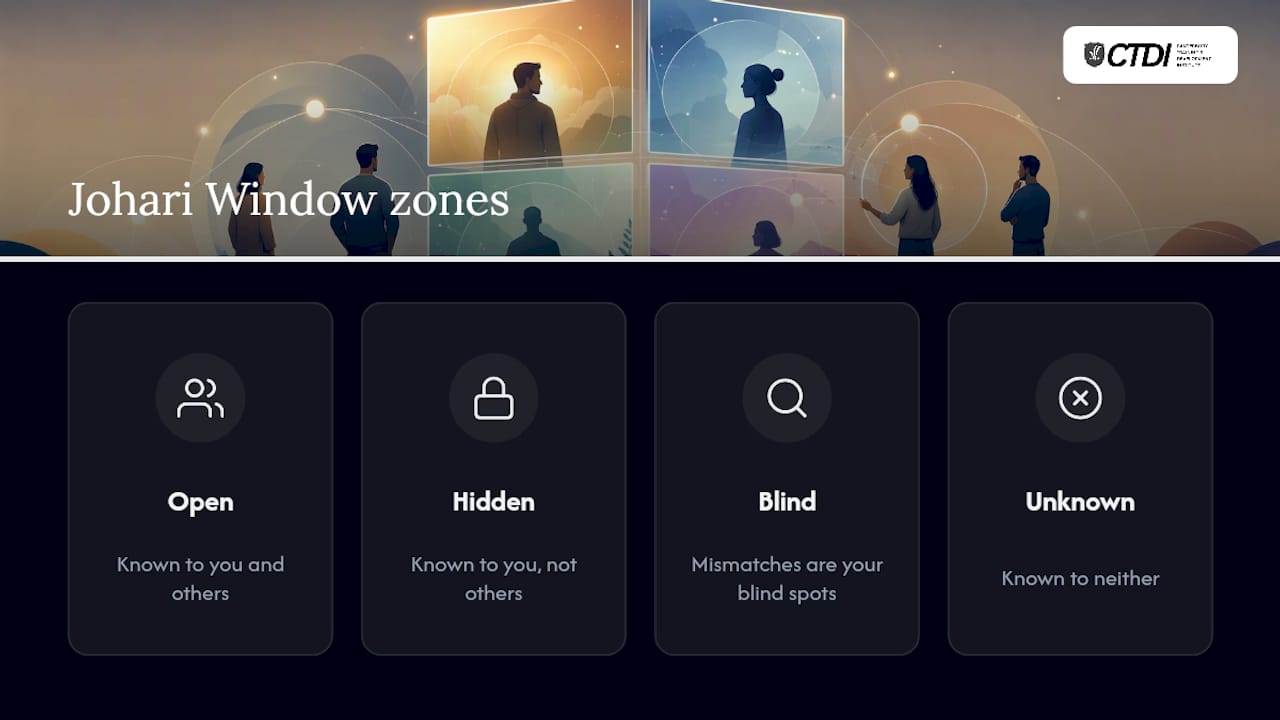
The Johari Window maps what's known and unknown about you across four zones: open (known to you and others), hidden (known to you, not others), blind (known to others, not you), and unknown (known to neither). The quick exercise: ask two people who know you well to describe you in a few words, then compare it against your own list. The mismatches are your blind spots.
The self-awareness wheel (sometimes called the wheel of life or wheel of emotions) works differently. You map segments like emotions, values, physical sensations, and behaviours, then rate where you're strong or shaky right now. Free introductory courses often build entire modules around this tool because it gives a visual snapshot rather than a single score.
Emotional intelligence basics come down to three steps: notice the emotion, name it accurately, then choose a response instead of reacting. "I'm frustrated" is more useful than "I'm fine" said through gritted teeth, because naming it correctly gives you options.
Pro Tip: Run the Johari Window exercise with people from different parts of your life, a colleague and a close friend, since they'll often reveal different blind spots.
Practical activities to build self-awareness starting today
This is the hands-on core. Pick two or three activities below rather than trying all of them at once. Depth beats breadth here.
1. Journalling, the structured way
A blank page is intimidating; prompts aren't. Use these on rotation:
- What emotion showed up most today, and what triggered it?
- Where did I feel that emotion in my body?
- What did I do instead of what I wanted to do?
- What would I tell a friend in my exact situation?
Ten minutes, daily, ideally at the same time so it becomes a habit rather than a decision you re-make every day. Track patterns weekly rather than judging single entries. One tense Tuesday means nothing; three tense Tuesdays in a row is data.
2. Mindfulness, in small doses
You don't need 40-minute sits. Short exercises like focused breathing and body scans work even at two to five minutes, and a longer body scan (10 to 15 minutes) is worth doing once or twice a week for a deeper read on where you hold tension. Mindful micro-moments, noticing your breath while the kettle boils, count too. Paying attention to the present moment and labelling thoughts as passing mental events helps you step back from spirals rather than getting swept into them.

3. Feedback exercises
Ask three people a version of: "What's one thing I do that you find genuinely useful, and one thing you'd change?" Keep it specific and time-bound, over the last month, not "generally." After you get answers, resist the urge to explain or defend. Just write down what you heard, sit with it for a day, then decide what, if anything, to act on.
4. Role-play and behavioural experiments
Pick one recurring situation, a difficult conversation, a moment you usually freeze in, and script two versions: how you usually respond, and how you'd like to respond. Practise the new version out loud, alone, or with a trusted person playing the other role. Start with low-stakes situations before trying the new response in a high-pressure one.
For time and frequency: journalling and mindful micro-moments work best daily; feedback exercises once a month; role-play whenever a specific situation is coming up. A simple worksheet with columns for trigger, feeling, body sensation, and chosen response turns scattered insights into a trackable pattern.
- Normalise mind-wandering. Attention drifting during practice is normal; the skill is noticing and returning, not achieving a blank mind.
- Don't rush to fix emotions. Noticing discomfort without immediately trying to resolve it creates space to choose a response instead of reacting on impulse.
- Stay curious, not judgemental. "Interesting, I'm defensive again" beats "why am I like this."
Which tests and tools actually measure progress?
Assessments help, but only if you read them the right way.
- Self-report questionnaires are fast and cheap, but vulnerable to how you feel that day, or how you want to see yourself.
- Mood logs (rating your emotional state a few times daily) give you real trend data over weeks, at the cost of needing discipline to actually fill them in.
- 360 feedback, gathering input from managers, peers, and direct reports, gives you the external view a self-report can't, though it takes coordination and a bit of courage to request.
- Personality measures are useful for vocabulary and self-reflection prompts, but they describe tendencies, not fixed identities.
Retake formal assessments every three to six months rather than weekly. Change that shows up week to week is usually noise, not signal.
Apps can help with reminders, guided meditations, and simple tracking, but they are a support structure, not the training itself. The habit lives in the practice, not the notification.
One caution worth repeating: a personality label is a starting conversation, not a verdict. Treat any single test result as one data point among several, not a fixed description of who you are.
How to structure a training programme that actually works
Self awareness training works best with a timeline attached, because vague "I'll get better at this" intentions rarely survive a busy week.
Three timeline templates:
- 4-week mini-programme. Daily journalling plus two short mindfulness sessions a week. Realistic outcome: you can name your emotional state accurately in the moment, most of the time.
- 8 to 12-week foundational programme. Add one 360-style feedback round and weekly role-play practice. Realistic outcome: you notice a trigger before reacting, and you've made at least one visible behaviour change others comment on.
- Ongoing maintenance. Monthly feedback check-ins, quarterly formal assessment, daily micro-practices. This is where the change actually locks in, because structured programmes with a step-by-step path tend to produce bigger, more durable gains than sporadic solo effort.
If you're choosing a coach or course, check for:
- A clear structure, not just "we'll see how it goes."
- Homework or practice expectations between sessions.
- An evidence base or recognised framework behind the method.
- Genuine trainer support, not just pre-recorded content with no way to ask questions.
Self-study suits people with strong self-discipline and a specific, narrow goal. A coach or structured course suits people who want accountability, faster feedback loops, or who've tried self-study before and stalled. Cost and time commitments vary widely by provider, so weigh a course's structure and support against what you're actually likely to follow through on, not just the price tag.
An 8-week self-awareness plan you can start this week
Here's a week-by-week structure. Daily time commitment: 10 to 20 minutes.
- Week 1: Daily journalling (trigger, feeling, body sensation). No mindfulness yet, just build the writing habit.
- Week 2: Add a 5-minute focused breathing session, once daily.
- Week 3: Extend mindfulness to include one body scan (10 minutes), twice this week.
- Week 4: Request feedback from one person using the specific-and-recent framing. Journal your reaction to what you heard.
- Week 5: Pick one recurring trigger and script a new response. Practise it once, low stakes.
- Week 6: Try the new response in a real situation. Journal what happened, not what you hoped would happen.
- Week 7: Request feedback from two more people. Compare it against week 4's feedback for patterns.
- Week 8: Retake a self-report questionnaire from week 1 if you did one, review eight weeks of journal entries, and set your next three-month focus.
Track four things throughout: journalling frequency (aim for five days a week minimum), frequency of your chosen new behaviour, number of feedback touchpoints, and any mood log entries if you're keeping one.
If you're running this in a group or with a coach, add a weekly 15-minute check-in where each person shares one insight and one struggle. Groups tend to hold accountability better than solo attempts, mostly because you don't want to show up empty-handed to the check-in.
Pro Tip: Informal daily practices like mindful eating or a few conscious breaths before a hard conversation often do more for lasting change than any amount of formal sitting practice, because they're woven into moments you already have.
Where to find quality courses, worksheets and further training
Look in a few specific places rather than searching blind.
- MOOCs and free introductory courses for a low-commitment first taste of structured content.
- Accredited short courses through recognised training providers if you want a qualification alongside the personal growth.
- Professional bodies in your industry, many run workshops tied to leadership or communication skills.
- Local workshops or facilitated group sessions for real-time feedback and accountability.
When evaluating any resource, check for downloadable worksheets, guided audio for mindfulness sessions, and some form of progress tracker, not just video lectures. Confirm the format (self-paced versus cohort-based) and support options actually suit how you learn before committing time or money.
How to pick the right training for your specific goals
The right starting point depends entirely on what you're actually trying to fix, not what looks impressive on a course listing.
If your goal is workplace performance, prioritise external self-awareness work: feedback exercises and 360-style input matter more here than solo journalling, because the gap you're closing is between self-perception and colleague-perception unleashing the potential of high emotional intelligence in sales. If you're a manager, this also touches on skills covered in effective workplace upskilling, since self-awareness and leadership development overlap heavily.
If your goal is personal, managing anxiety, understanding relationship patterns, reducing reactivity at home, lean toward internal awareness work: journalling, mindfulness, and the self-awareness wheel will do more for you than a 360 feedback round from coworkers who barely know your home life.
Time availability matters too. If you've got 10 minutes a day and nothing more, a self-practice routine beats an ambitious course you'll abandon in week three. If you thrive on structure and deadlines, a short course with a fixed schedule will get you further than open-ended solo intentions.
Finally, match the format to how you actually learn. Some people need a facilitator asking follow-up questions in real time. Others do their best thinking alone with a journal. Neither is wrong, but picking against your natural style is the fastest way to quit.
Why self-awareness training stalls (and how to fix it)
A handful of pitfalls derail most people, and they're predictable enough to plan around.
Journalling turns into venting, not insight. Writing "today was terrible" repeatedly doesn't build awareness. Anchor every entry to the specific prompts, trigger, feeling, body sensation, so you're extracting a pattern, not just letting off steam.
Mind-wandering feels like failure. People quit mindfulness practice thinking they're "bad at it" because their mind keeps drifting. Wandering attention is a normal, expected part of the process; the actual skill is noticing the drift and returning, not preventing it in the first place.
Feedback triggers defensiveness. The instinct to explain or justify when someone gives you critical feedback shuts down the exchange. Write the feedback down first, sit with it overnight, then decide what to do with it.
Trying to fix emotions instantly. Jumping straight to "how do I stop feeling this" skips the actual work. Noticing an uncomfortable emotion without immediately resolving it is what creates the space for a considered response instead of a reflex one.
Inconsistency kills momentum. Ten minutes daily beats an hour once a week. If you miss a few days, restart without the guilt lap, that spiral wastes more time than the missed days themselves.
Making self-awareness stick after the training ends
The training phase teaches the skills; daily life is where they either stick or fade.
Attach practices to existing habits rather than treating them as separate commitments. A 2-minute mindful check-in right after you brush your teeth survives busy weeks better than a practice with no fixed anchor point. This is the same principle behind MBSR's emphasis on informal daily practice: mindful eating, a few conscious breaths before a meeting, noticing tension while waiting for a coffee. Integration into ordinary moments, not extra sessions bolted onto an already full day, is what makes the change durable.
Keep a lighter-touch version of your journalling going, even just once a week, as a check-in rather than a daily requirement. Revisit your feedback loop every few months; ask the same one or two people how they've noticed you changing, since that comparison over time reveals more than any single conversation.
Expect some backsliding under stress. Old reactive patterns tend to resurface exactly when you're under pressure, which is frustrating but not a sign the training failed. Treat it as information: which trigger caught you off guard, and what would the ten-minutes-a-day version of you have noticed earlier?
If you want to go deeper, formal study built around lifelong learning habits gives structure to what would otherwise be scattered self-improvement effort.
What learners usually experience in the first few weeks
Most people find the first week or two mildly uncomfortable. You suddenly notice reactions you used to sail past unaware of, which can feel like you've somehow gotten worse at managing emotions, when really you've just started seeing what was always there. Around week three or four, a small win usually turns up: catching yourself before a snappy reply, or naming a feeling accurately in real time for the first time.
The tip that keeps people going isn't motivation, it's pairing the practice with something already fixed in your day. A 2-minute check-in tied to your morning coffee survives far longer than a floating good intention.
Frequently asked questions
What is self awareness training, in one sentence? It's the deliberate practice of noticing your thoughts, feelings, and behaviour, plus how they land on others, so you can respond with intention instead of reacting on autopilot.
How long does self awareness training take to show results? Small shifts, like catching a reaction earlier, often show up within a few weeks of daily practice. Genuine behavioural change, the kind others notice, typically takes several weeks to months of consistent practice.
Do I need a coach, or can I do this alone? Either works. Self-practice suits people with discipline and a narrow goal; a coach or course suits people who want accountability and faster feedback, particularly if solo attempts have stalled before.
What's the difference between mindfulness training and self-awareness training? Mindfulness is one tool within self-awareness training, focused specifically on present-moment attention. Self-awareness training is the broader goal, using mindfulness alongside journalling, feedback, and frameworks like the Johari Window.
Can apps replace formal self-awareness training? Apps help with reminders and guided sessions, but they're a support structure, not the training itself. The actual change comes from consistent practice and real feedback, not the notification prompting you to open the app.
What if journalling doesn't work for me? Try feedback exercises or role-play instead. The four core activities, journalling, mindfulness, feedback, and role-play, don't all need to be used equally; pick whichever matches how you actually process experience.