

The skills that move you up fastest are strategy, content production, paid social, analytics and community management, with AI-assisted workflows now layered across all five. Employers want proof, not claims: measurable KPIs, before-and-after metrics, and a one-page artefact showing your thinking. Nationally recognised training is one structured way to build that evidence, but the habit of documenting outcomes matters more than any single course.
Table of Contents
- The core social media marketing skills for career growth
- How to plan a social media strategy employers can actually see
- Content creation and short-form video skills that get results
- Running paid social tests that prove you can optimise
- Analytics and reporting: the metrics that actually matter
- Community management and brand safety skills
- Where AI actually belongs in your social media workflow
- Building a portfolio that proves you can do the job
- How CanterburyTDI helps you build these skills into a career
- Sources
- FAQ
The core social media marketing skills for career growth
Posting content is table stakes. What separates a coordinator from a strategist is the ability to connect a platform decision to a business number. Each skill below maps to something an employer can actually measure.
- Strategy and audience research — turns guesswork into a documented plan; measured by whether your objectives are SMART and tied to a KPI.
- Content creation and short-form video — drives reach and discovery; measured by watch time, shares and saves.
- Paid social fundamentals — proves you can convert budget into results; measured by CTR, CPA and conversion rate.
- Analytics and reporting — shows pattern recognition over time; measured by trend accuracy, not single-post spikes.
- Community management — protects the brand while growing engagement; measured by response time and resolution rate.
- AI-assisted workflows — multiplies output without sacrificing quality; measured by turnaround speed and error rate after human review.
Basic competence in any one of these is achievable in a matter of weeks with consistent practice. Genuine fluency across all six, the kind that gets you promoted rather than just employed, tends to take closer to six to nine months of deliberate work, including at least one real or pro bono project.
How to plan a social media strategy employers can actually see
Strategy is not a vibe, it is a document. The national unit SIRXMKT006 frames it exactly that way: review the organisation's objectives, research how the target market actually uses social platforms, compare platform fit, then write an action plan with responsibilities, resourcing, timeframes and tracking methods. That is precisely the artefact a hiring manager wants to see in a portfolio.
Build it in this order:
- Audience profile — one page: who they are, which platforms they use, what content format they respond to.
- Platform selection — pick two or three platforms based on that research, not personal preference.
- SMART KPIs — specific, measurable, achievable, relevant, time-bound (e.g. "lift engagement rate from 1.8% to 2.5% in 90 days").
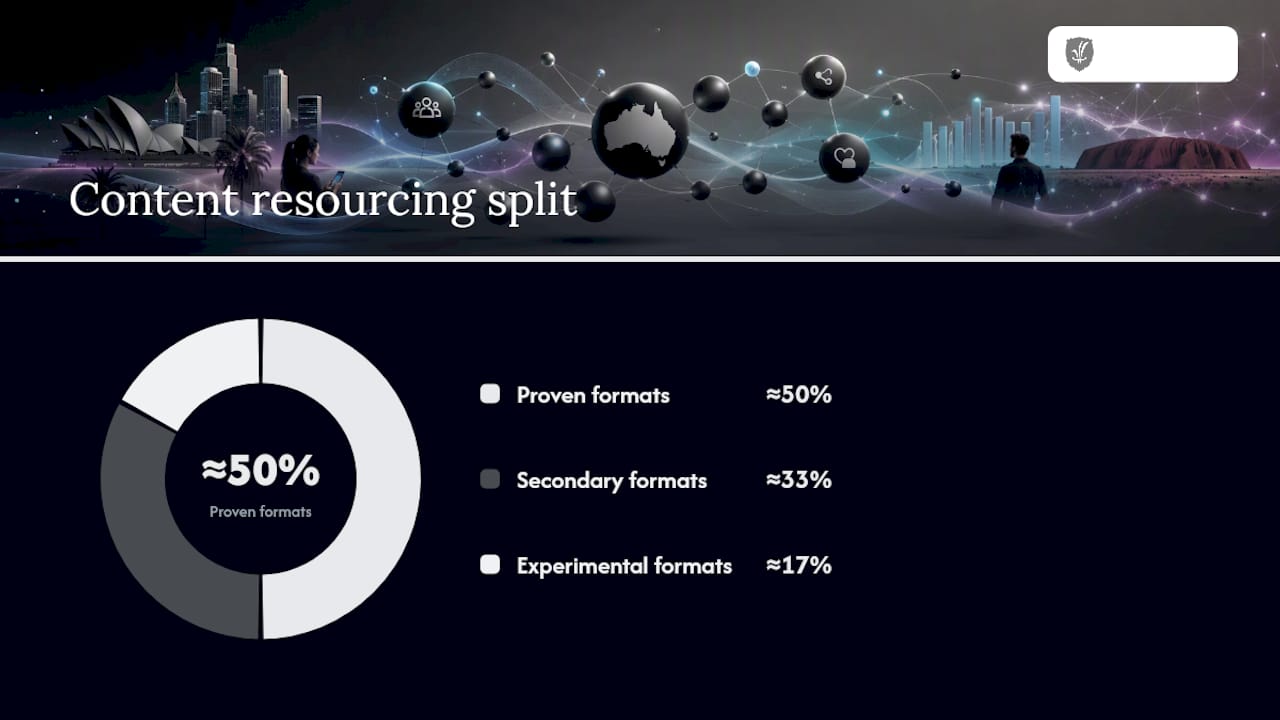
- A 3-month calendar — weekly themes mapped against your content pillars, with a resourcing split so effort matches priority (a common approach allocates roughly half your output to proven formats, a third to secondary formats, and the rest to experimental content).
Buffer's cyclical model of goal setting, audience definition, content pillars, platform choice, scheduling, analysis and evaluation is a useful frame to structure this around, since it treats strategy as a repeating loop rather than a one-off document.
Pro Tip: Keep every strategy document to one page. Recruiters skim. A dense five-page plan gets ignored; a tight one-pager with clear numbers gets remembered.
Content creation and short-form video skills that get results
You don't need a studio. A phone with decent stabilisation, a lapel mic, and free editing software like CapCut or DaVinci Resolve covers most entry-level production needs. What actually separates hireable content from amateur content is the script structure: hook in the first two seconds, one idea per video, and a clear call to action before the ten-second mark.
Practical skills worth building now:
- Writing hooks that work without sound, since a large share of viewers watch muted.
- Structuring captions with a scroll-stopping first line, not a buried CTA at the bottom.
- Designing thumbnails that read clearly at a thumbnail size, not just full screen.
- Repurposing one core idea (a client tip, a data point, an industry trend) into a short video, a carousel and a text post.
- Tracking which format each asset performs best on, then feeding that back into your next content pillar decision.
Record watch time, saves and shares for each repurposed asset. That comparison, one idea across three formats with three different results, is exactly the kind of evidence that shows you understand distribution, not just production.
Running paid social tests that prove you can optimise
Small budgets teach the same lessons as big ones if you structure the test properly. Set one clear objective (traffic, leads or conversions), then split a modest budget across two or three audience segments so you can compare rather than guess.
- Define the hypothesis — "Audience A will convert better than Audience B because of X."
- Run the test — same creative, different audiences, or same audience, different creative. Never change both variables at once.
- Record the result — CTR, cost per acquisition, and conversion rate, with sample size noted honestly.
- Iterate — state what you'd change next and why.
The strongest portfolio evidence is not the size of the budget you managed. It is being able to show a hypothesis, a result and a next step, since explainable decision-making tends to persuade hiring managers more than raw spend figures. A modest lift of a couple of percentage points on click-through rate, framed with a clear next test, reads as more competent than a vague "we ran ads and it went well."
Analytics and reporting: the metrics that actually matter
Employers do not need forty metrics. They need four, tracked consistently: reach, engagement rate, click-through rate and conversions. Engagement rate is simply (likes plus comments plus shares) divided by reach, expressed as a percentage. Anything more granular than that is usually noise until you're managing a much larger account.
- Weekly — quick check on posting consistency and any anomalies.
- Monthly — a one-page summary comparing the month against your KPI targets.
- Quarterly — a strategy review that asks whether the platform mix and content pillars still make sense.
Active engagement, replying to comments and messages rather than just publishing, is one of the biggest drivers of post performance according to Buffer's 2026 analysis. A single slide showing engagement rate trending upward over eight weeks, alongside a note on what changed, says more than a spreadsheet of raw numbers ever will.
Community management and brand safety skills
Live engagement is where reputational risk actually lives, and employers know it. A documented response framework, not ad-hoc replies, is what separates a professional community manager from someone who just answers comments when they remember to.
- Acknowledge comments and messages within a set window (commonly within a few hours during business days).
- Escalate anything touching customer safety, financial claims or legal complaints immediately, never handle it solo.
- Follow a three-step pattern: acknowledge, assess or escalate, then resolve or report.
- Log recurring complaint types so patterns get fixed at the source, not just the symptom.
The national unit BSBMKG546 frames this well: mitigation planning for brand and message integrity is treated as a core competency, not an afterthought.
Pro Tip: Keep a redacted log of one dispute you resolved well: what triggered it, how you responded, and the outcome. That single artefact demonstrates judgement no certificate can.
Where AI actually belongs in your social media workflow
AI speeds up ideation, first drafts, caption variations and repetitive formatting. It should never be the last set of eyes on anything that touches brand voice, factual claims or a paid campaign. The skill employers are hiring for isn't prompting, it's knowing where the boundary sits.
- Use AI for content brainstorming, first-draft captions and repurposing scripts into multiple formats.
- Fact-check every AI-generated claim before it goes anywhere near a client or employer's channel.
- Review AI drafts for bias or tone mismatches against brand guidelines.
- Always apply a human edit pass, particularly on anything customer-facing.
- Keep one deliverable that shows the mix: an AI-drafted first version alongside your edited final, with notes on what you changed and why.
That last artefact is genuinely persuasive in an interview. It shows you can use AI to scale output without losing quality control, which is exactly what the 11426NAT diploma pathway treats as central to modern campaign execution.
Building a portfolio that proves you can do the job
A one-page artefact per competency, structured as audience, platform choice, KPI definitions, measurement method, mirrors exactly what SIRXMKT006 and BSBMKG527 require as evidence. That language (platform selection, engagement metrics, analytics services) is also what recruiters scanning a resume against a job ad are trained to look for.
- Build one artefact per skill: strategy document, a repurposed content set with metrics, a small paid test writeup, a community escalation log.
- Nationally recognised units and the 11426NAT Diploma of Social Media Marketing with Artificial Intelligence demonstrate end-to-end capability formally, distinct from a short course or a platform certificate.
- A realistic pathway runs roughly six to nine months: structured study, portfolio building alongside it, one pro bono or freelance client to generate real metrics, then applying with documented evidence rather than a bare qualification list.
Documented growth, an engagement rate that moved from 1.8% to 2.6% over a quarter, for instance, tends to persuade hiring managers more than a stack of certificates alone.
How CanterburyTDI helps you build these skills into a career
CanterburyTDI is built around the same idea this article keeps coming back to: employers hire evidence, not enthusiasm. The Advanced Diploma of Digital Marketing covers strategy, content, paid social and analytics as one connected discipline, taught by industry practitioners rather than generic course writers, so the artefacts you build during study are the same ones you'd put in a portfolio afterward.
If AI-assisted workflows are where you want to specialise, the Diploma of Artificial Intelligence goes deeper into the governance and application side that the workflow section above only sketches out. Both courses run 100% online and self-paced, which matters if you're studying around a current job rather than pausing your income to retrain. Course design comes from industry experts, and student support is there for the stretches where you're stuck on a real assignment, not a hypothetical one.
If you're weighing this up against other routes, the honest next step is to look at the course pages directly and see which units line up with the skill gaps you've identified in your own work. From there, enrol now to lock in your place, or start drafting your first one-page strategy artefact this week while you compare options: there's no reason the portfolio-building has to wait for enrolment day.
Sources
FAQ
What skills are required for a career in social media marketing?
Strategy and audience research, content and short-form video production, paid social fundamentals, analytics and reporting, community management, and increasingly AI-assisted workflows. Employers weigh documented evidence of each, not just familiarity with posting.
What is the 5-5-5 rule for social media?
Definitions of this rule vary across sources and it isn't part of any nationally recognised training standard, so treat it as informal industry shorthand rather than a fixed framework. A more reliable planning method is the SMART KPI approach outlined in SIRXMKT006.
What are the 7 Cs of social media marketing?
Like certain popular frameworks, the "7 Cs" framing isn't standardised and different sources list different terms. Buffer's cyclical model of goal setting, audience definition, content pillars, platform choice, scheduling, analysis and evaluation covers the same practical ground and is worth following instead.
What is the 3-3-3 rule in marketing?
This is another informal shorthand with no single agreed definition, and it doesn't appear in the national training units this article draws on. Rather than chasing catchy rules, build your content calendar around documented content pillars and measurable KPIs, as covered in the strategy section above.
How long does it take to become job-ready in social media marketing?
Basic competence in individual skills can build within weeks, but a documented, hireable skill set across strategy, content, paid, analytics and community typically takes six to nine months of study and portfolio building. CanterburyTDI's Advanced Diploma of Digital Marketing is structured around that same end-to-end capability.
Recommended
- Prove It: AI and Data Digital Marketing Skills for Australia, 2026
- Get Hired in 6–9 Months: Evidence First Digital Marketing in Australia
- Launch and grow your digital marketing career in Australia
- 3–9 Month Digital Marketing Career Change in Australia, Evidence First
This article provides general information only. Course requirements, study pathways, credit arrangements and career outcomes may vary. Always confirm current requirements with the relevant education provider or authority.