

Pick one channel that matches what you already do well, build one result you can point to, and use structured training only to speed that up. That's the whole strategy. Choose your channel this week, ship a live project or a small paid campaign within a month, document what happened, and start applying once you have that single artefact. Vocational education and training can help support the evidence needed for digital marketing roles, but it does not replace practical experience.
Table of Contents
- How do you actually make a digital marketing career change?
- Which channel matches your existing skills?
- What portfolio evidence do employers actually check?
- Do you need a VET diploma or will a short course do?
- How do you study for a new career without quitting your job?
- How do you land your first digital marketing role?
- What does a nationally recognised diploma actually deliver for career changers?
- What are the different digital marketing roles and career paths?
- What are the biggest challenges in a digital marketing career change?
- Why does your online presence matter for getting hired?
- Where to check the details before you commit
- Where CanterburyTDI fits into your transition
How do you actually make a digital marketing career change?
Most people overcomplicate this. They enrol in three courses, read a dozen "beginner's guide" articles, and still have nothing to show an employer six months later. The faster path skips the noise and treats the transition as a milestone sequence, not a study plan.
Here's how that sequence usually plays out, whether you're starting close to marketing already or coming from somewhere completely unrelated:
- Weeks 1 to 2: Map your transferable edge. Identify which channel your current skills already serve, whether that's writing, analysis, client communication, or process management.
- Weeks 3 to 8: Foundation learning. Pick one structured course or unit that teaches the mechanics of that channel properly, not a scatter gun of free tutorials.
- Weeks 6 to 16: Build evidence. Run a live project or a small paid campaign in that channel and track the results as you go.
- Weeks 12 to 20: Publish and network. Turn the project into a case study, put it somewhere public, and start talking to people in the industry.
- Weeks 16 onward: Apply. Start applying once you have one strong artefact, not once you feel "ready" in the abstract.
If your background sits close to marketing already, say you've done client communications, content writing, or basic analytics, expect the tighter end of this: three to six months. Starting from somewhere unrelated, like manufacturing or hospitality, usually stretches this to six to twelve months, because building believable evidence takes longer when you're also learning the fundamentals.
Pro Tip: Don't wait until the roadmap is finished to start networking. Message two people working in your target channel by week four. Their feedback on your first draft project is worth more than another module.
Which channel matches your existing skills?
The channel you pick shapes everything else, including what evidence employers will expect to see. A former teacher walking into paid media cold competes on unfamiliar ground; the same teacher moving into content or SEO already understands audience, structure, and clear explanation.
Some mappings show up again and again among successful career changers:
- Teachers and trainers tend to move fastest into content marketing and SEO, where explaining complex ideas clearly is the actual job.
- Finance and analyst backgrounds fit performance marketing and conversion rate optimisation (CRO), where the work is largely reading numbers and adjusting spend.
- Sales professionals often land well in email marketing and demand generation, since both rely on understanding buyer psychology and follow-up cadence.
- Operations and project managers frequently move into marketing operations, running the systems, workflows, and campaign logistics that keep teams organised.
Each mapping changes the artefact you need. A content or SEO move needs published, measurable work. A performance or CRO move needs campaign data and a testing log. Target titles reflect this split too: "Content Marketing Coordinator" or "SEO Specialist" for the first group, "Performance Marketing Analyst" or "CRO Specialist" for the second, "Email Marketing Coordinator" or "Marketing Automation Specialist" for the third.
Trying to learn every channel at once is the most common way people stall. Going deep in one that already plays to your strengths gets you employable evidence faster than spreading effort thin.
What portfolio evidence do employers actually check?
Employers hiring for digital marketing roles increasingly weigh demonstrated results over a stack of course certificates. A portfolio with measurable outcomes tends to beat a résumé padded with isolated credentials, because certificates confirm you sat through material, not that you can produce a result.
Three artefacts cover most of what a hiring manager wants to see:
- A live project URL. A blog you've grown, a landing page you've built, a small business's social account you've managed for three months, something they can click and check right now.
- Paid campaign experience. Even a modest spend, $50 to $200 on a Google or Meta campaign for a real product or cause, teaches budget management, targeting, and reporting in a way theory never does.
- A documented case study. One page covering the objective, what you did, the numbers, and what you'd change next time.
Statistic Callout: A practical career transition typically centres on exactly these three pieces of evidence, a live project, real paid campaign exposure, and a documented case study, and suggests three to nine months is realistic for a focused, part-time change while working.
Sourcing a project doesn't require quitting your job. Internal initiatives at your current workplace, local small businesses that can't afford an agency, not-for-profits needing help, and small freelance gigs on marketplaces all work. Structure each artefact the same way: what the goal was, what you changed, what happened, in numbers, in under 300 words. Hiring managers skim. Make it swimmable.
Do you need a VET diploma or will a short course do?
It depends on how much structure you need and how an employer will read the credential. Nationally recognised VET qualifications, listed on Training, carry a currency and recognition that free certificates and most short courses don't. The 11422NAT Diploma of Digital Marketing is the current replacement for the earlier 10931NAT Diploma, which became non-current in March 2026; always check the live listing before enrolling anywhere, because course codes and currency periods change.
The 11422NAT Diploma's units cover designing and running organic, paid, and omnichannel campaigns, plus using AI tools within marketing work. For readers wanting to go further into specialist territory, the 11266NAT Advanced Diploma of Digital Marketing covers SEO, SEM, social, ecommerce, and marketing automation, aimed at people heading toward specialist or managerial roles rather than entry-level ones.
A structured diploma earns its cost when you need the scaffolding: assessment deadlines that force you to finish projects, capstone-style tasks that double as portfolio pieces, and a credential an employer can verify. A targeted short course suits you better if you already have most of the fundamentals and just need one specific gap filled, say, a paid ads platform you haven't touched.
Before enrolling anywhere, ask the provider three things:
- Do assessments produce work you can actually show an employer, or just quizzes?
- How much flexibility exists for someone studying around a full-time job?
- What support is available if you fall behind during a busy work period?
Pro Tip: Ask to see a sample assessment brief before enrolling. If it reads like a real campaign task rather than a comprehension test, it's more likely to become usable portfolio evidence.
How do you study for a new career without quitting your job?
Realistically, you need five to eight hours a week to make consistent progress, split across learning and building. The trick that most career changers miss: don't treat study and portfolio work as separate. Use your assessments as your public projects wherever the course allows it.
Formats that suit working professionals fall into three broad types:
- Self-paced online diplomas, which let you shift study around shift work or irregular hours rather than fixed class times.
- Evening or weekend short courses, useful for filling one specific skill gap quickly.
- Micro-sprints, short, intense two to four week bursts focused on producing one artefact, like a single campaign or case study.
On funding, it's worth checking whether your employer has a training or professional development budget before paying out of pocket, since some businesses will fund a relevant qualification if you can show it benefits your current role too. Fee-for-service and payment plans are the other common routes, and most nationally recognised providers publish payment options clearly rather than requiring lump sums up front.
How do you land your first digital marketing role?
Target roles where your prior experience is an asset, not a handicap. Competing for a generic junior marketing role against twenty other career changers puts you on price and availability. Competing for a specialist coordinator or operations role in an industry you already know puts your domain knowledge to work.
- Pick roles that reward your background. A former nurse targeting healthcare marketing coordination, or a former retail manager targeting ecommerce marketing operations, starts ahead of someone with no industry context at all.
- Build your transition narrative around a stack, not a leap. Frame it as foundation plus new capability: "ten years managing client relationships, now applying that to email marketing sequences," not "starting over."
- Use STAR structure for interview stories. Situation, task, action, result, drawn from your portfolio case study, gives interviewers something concrete rather than a vague claim of enthusiasm.
- Plan your first ninety days before you're asked to. Focus early wins on measurement: audit what's currently tracked, fix one obvious gap, and document the before-and-after.
Framing prior experience this way changes how a hiring manager reads your résumé: not as a gap to explain away, but as depth most junior candidates simply don't have yet.
What does a nationally recognised diploma actually deliver for career changers?
Look for a course code you can verify directly on training.gov.au, industry-designed units, and assessments built around real campaign work rather than multiple-choice quizzes. CanterburyTDI structures its Advanced Diploma of Digital Marketing around exactly that combination, practical skills delivery aimed at AI-augmented marketing roles, with flexible online study designed for people working full-time.
Course assessments, when built well, double as portfolio material: a capstone campaign brief becomes your case study, a channel strategy assignment becomes evidence you can show in an interview. Before committing to any provider, ask directly how assessments translate into work you can actually present, what support exists for students juggling jobs and study, and whether the curriculum reflects current industry tools rather than outdated methods.
What are the different digital marketing roles and career paths?
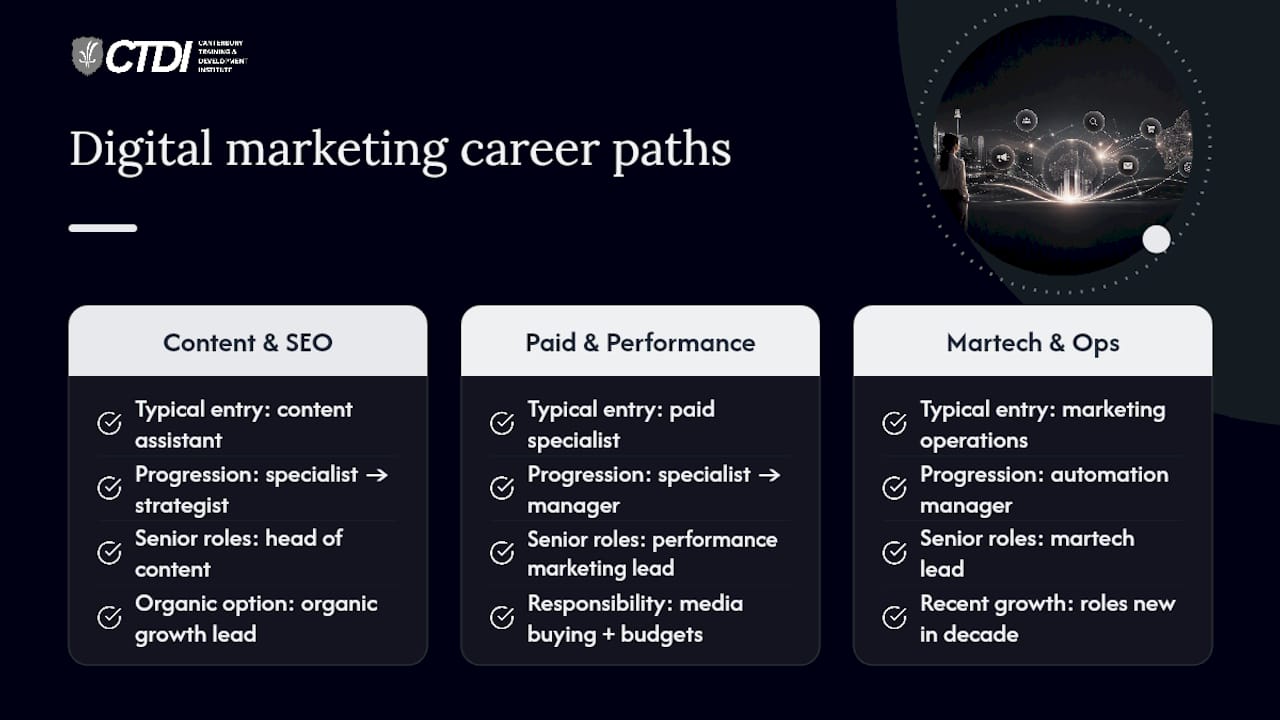
Digital marketing isn't one job, it's a cluster of specialisms that share a toolkit but diverge quickly once you're a few years in. Entry points typically include marketing coordinator, content assistant, or social media coordinator roles, where you're executing campaigns someone else has planned.
From there, progression usually splits by channel. Content and SEO specialists often move toward content strategist or SEO manager roles, then into head of content or organic growth lead positions at larger organisations. Paid media and performance marketers tend to progress from specialist to paid media manager, then performance marketing lead, roles that increasingly blend media buying with budget accountability. Marketing operations specialists, often the career changers with strong process backgrounds, move toward marketing automation manager or martech lead roles, positions that barely existed a decade ago.
Generalist roles exist too, particularly at smaller businesses and agencies, where a "digital marketing manager" might touch social, email, and paid campaigns in the same week. That breadth suits some career changers well early on, giving exposure across channels before specialising. Others prefer to specialise from day one, particularly those with a strong existing skill in one area, like the finance-background career changer who moves straight into performance marketing.
There's no single "correct" path through this. What matters more is that the role you target next actually builds on the evidence you've created, rather than requiring you to start proving yourself from zero again.
What are the biggest challenges in a digital marketing career change?
The most common stumbling block isn't skill gaps, it's proving capability without prior job titles to point to. Job ads asking for "two years' experience in digital marketing" filter out career changers automatically, regardless of what they can actually do.
The fix is the portfolio strategy already covered: a live project and documented results outrank a résumé gap in most hiring conversations, because they answer the "can you actually do this" question directly rather than asking an employer to take it on faith.
A second challenge is decision paralysis. Digital marketing has enough sub-specialisms, SEO, paid social, email, marketing automation, content, that new entrants often try to learn all of them at once and end up shallow in everything. Picking one channel and going deep, as covered earlier, solves this directly.
A third challenge is timeline mismatch. People expect a fast turnaround and get discouraged when month two arrives without an offer. Realistic timelines run from three months for a close-background transition to twelve months or more starting from scratch, and evidence-building is usually the bottleneck, not learning theory.
Financial pressure during the transition is real too. Studying while working, rather than quitting to study full-time, protects your income during the change and is the more sustainable route for most people with existing financial commitments.
Why does your online presence matter for getting hired?
Hiring managers in marketing check your online presence before they check your résumé, largely because it's the fastest way to see whether you understand digital channels or just claim to. A LinkedIn profile with no activity, no shared work, and a generic summary undercuts an otherwise strong application for a marketing role in a way it wouldn't for, say, an accounting position.
Treat your own presence as your first campaign. If you're targeting content or SEO, publish regularly, even short posts breaking down a campaign you admired or a lesson from your own project. If you're targeting paid media or performance roles, share the results and lessons from your practice campaigns, including what didn't work, since honest reflection reads better than a highlight reel. If you're targeting marketing operations, document the systems or workflows you've built, even internal ones from your current job, reframed for a marketing audience.
This isn't about performing confidence you don't feel. It's about giving a hiring manager searching your name something that confirms the story your résumé tells. A quiet, inactive profile leaves that story unverified.
Where to check the details before you commit
Verify course currency directly on training.gov.au for the 11422NAT Diploma and 11266NAT Advanced Diploma. For the practical roadmap behind this guide, read how to launch and grow a digital marketing career and how to convert study into portfolio evidence.
Where CanterburyTDI fits into your transition
If the roadmap above makes sense but you'd rather not stitch together your own curriculum from scattered tutorials, that's exactly the gap a structured, nationally recognised diploma is built to close. CanterburyTDI's Advanced Diploma of Digital Marketing is delivered fully online and self-paced, so you can study around a full-time job rather than putting your income on hold, with course design built around the practical, AI-augmented skills employers are asking for now.
It suits you if you're past the "which channel" decision and want a structured path with trainer support, assessment work that doubles as portfolio evidence, and a credential you can verify against training.gov.au rather than a certificate of completion with no external recognition. If your business is looking to upskill a marketing team rather than one individual, CanterburyTDI's corporate training partnerships cover that route too. For individual learners ready to move, the next step is straightforward: check current course details and enrol when you're ready to turn this roadmap into a structured study plan.
Recommended
- 6–9 Month Path to Digital Marketing in Australia With Live Projects
- Launch and grow your digital marketing career in Australia
- Fast Track to Digital Marketing Careers in Australia with VET Diploma
- What does a digital marketing certificate cost in Australia?
This article provides general information only. Course requirements, study pathways, credit arrangements and career outcomes may vary. Always confirm current requirements with the relevant education provider or authority.