

An industry-focused learning pathway is a structured sequence of study and applied practice that deliberately maps what you learn to a specific job role, a set of employer expectations, and a recognised credential. It is not a loose bundle of subjects. It is built backwards from the work you want to do, then validated against the qualification standards set by the Australian Qualifications Framework and delivered through models like VET and TAFE that already speak that language. If you want a straight answer on where to start, CTDI runs accredited online pathways in artificial intelligence, digital marketing, and environmental management that are built specifically for career-focused learners who want stackable credentials without pausing their life to get one.
That is the short version. The rest of this guide unpacks how these pathways are actually built, what separates a genuinely industry-aligned program from a marketing label, and how to pick one without getting burned by vague promises.
Key Takeaways
The strongest industry-focused learning pathways combine mapped competencies, high-stakes applied practice, and an employer-recognised credential, with career support built in rather than added on.
| Point | Details |
|---|---|
| Definition | A pathway maps study directly to job roles and recognised credentials, not just general subject knowledge. |
| Check the framework | Confirm the AQF level and whether the credential stacks toward a bigger qualification later. |
| Demand real evidence | Ask for named employer partners and a sample assessment task before enrolling anywhere. |
| Budget beyond tuition | Factor in materials, placement fees, and credentialing costs alongside course fees. |
| Consider CTDI | CTDI offers AQF-aligned, self-paced online pathways in AI, digital marketing, and environmental management with built-in career coaching. |
Table of Contents
- What does an industry-focused learning pathway actually include?
- Why do learners choose industry-focused pathways over traditional study?
- What components make a learning pathway actually effective?
- What does a real industry-validated technology pathway look like?
- How do you choose the right pathway for you?
- How long do these pathways take, and what do they cost?
- Why choose CTDI for an industry-focused learning pathway?
- What are the practical next steps to enrol and prepare?
- How do pathways keep up with fast-moving industry trends?
- Publisher perspective: why integrated career support matters
- Ready to start an industry-focused learning pathway with CTDI?
- Sources
What does an industry-focused learning pathway actually include?
Strip away the branding and most credible pathways share the same skeleton. They map competencies to real job tasks, build in high-stakes practical work, and finish with an assessment that leads to a credential an employer actually recognises.
- Mapped competencies — each module ties to a skill an employer has said matters, not a syllabus item that seemed interesting to a curriculum writer.
- Industry projects or placements — applied work that mirrors what happens on the job, sometimes with an actual employer partner attached.
- Assessment aligned to AQF or stackable credentials — the qualification sits at a recognised level, so it means something outside the institution that issued it.
- Employer-validated learning outcomes — the skills taught have been checked against what hiring managers in that field are actually asking for.
- Career coaching built into the curriculum — not a separate careers office you visit once in third year, but ongoing guidance woven through the study itself.
Where this gets confusing is the difference between a microcredential, a diploma, and full VET/TAFE qualification. A microcredential proves you can do one discrete thing. A diploma proves broader competence across a role. Full VET and TAFE programs sit closer to trade-level depth and often carry credit-transfer value into higher education. Future Skills Organisation has done useful work mapping technology pathways this way, connecting learners to specific job families rather than generic "IT skills." It is a good example of what industry validation looks like when it is done properly, and CTDI's own online diplomas follow the same logic: skills first, credential second, career outcome always in view.
Why do learners choose industry-focused pathways over traditional study?
The gap between finishing a course and being useful in a job is where most graduates lose momentum. Industry-aligned pathways exist specifically to close that gap.
When career services and career-relevant tasks are built into the curriculum itself, rather than bolted on as an optional extra, graduates arrive with stronger, more employer-ready toolkits. Research from Harvard Business School Publishing makes this point clearly: curricular integration, not a separate careers office down the hall, is what produces practical readiness. That is the design principle behind a good pathway, and it is why the CTDI structure builds career coaching into the course rather than treating it as an afterthought.
Statistic callout: Government policy is catching up to this shift too. Initiatives like the NSW Digital Compact explicitly back stronger partnerships between education providers and industry to close digital skill gaps, a sign that the demand for career-integrated training is being recognised at a policy level, not just in course marketing.
The practical payoff for you as a learner looks like this: portfolio-ready projects you can actually show a hiring manager, contacts made during placements or industry projects, and stackable digital badges that let you prove specific competencies without redoing an entire qualification. None of that happens by accident. It happens because the pathway was designed with the destination in mind from day one.
What components make a learning pathway actually effective?
Good pathways follow a three-part design, and once you know what it looks like, you can spot the difference between a program built around outcomes and one built around filling a timetable.
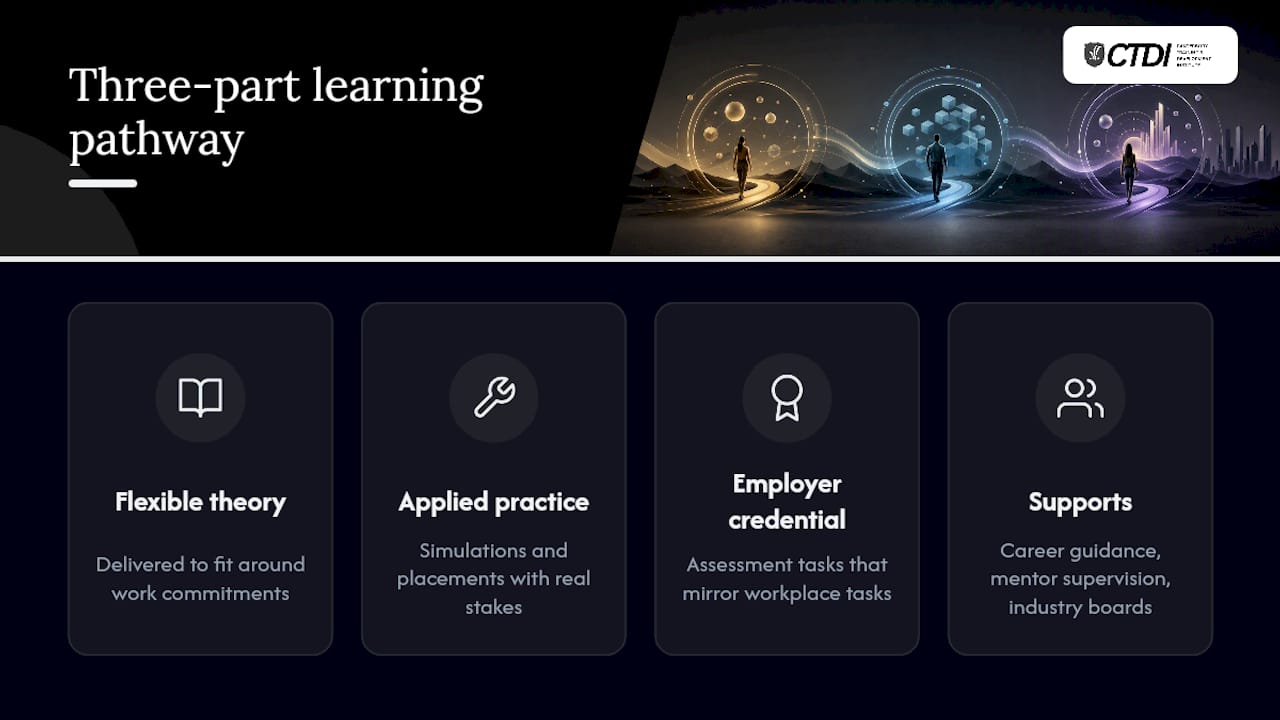
The first part is flexible foundational theory, delivered in a way that fits around work or other commitments rather than demanding you show up to a lecture theatre at 9am. The second is high-stakes applied practice: simulations, live projects, or placements where getting it wrong actually costs something, because that pressure is what builds real competence. Skillwell's overview of skills-based training makes the case that mastery through practice, not passive content consumption, is what separates skills-based models from traditional lecture-and-exam formats. The third part is credentialing and assessment that an employer can actually interpret, meaning the assessment tasks look like real workplace tasks rather than abstract exam questions.
Around that core sit the supports that make the difference between finishing and dropping off: integrated career counselling, mentor supervision during practical work, and input from industry advisory boards who keep the curriculum honest about what the job market actually wants. A good pathway also builds authentic assessment. That means the test you sit looks like the work you'll do, not a multiple-choice quiz on theory you'll never apply.
Pro Tip: When you're comparing providers, ask directly: "Can you show me an example of a graded assessment task?" A provider running genuinely high-stakes practicals will have a concrete example ready. One that hesitates or gives you a vague answer about "practical components" probably hasn't built the assessment side properly.
If you want to see this applied to a specific field, CTDI's guide on designing corporate learning paths that work walks through how this structure gets built in practice.
What does a real industry-validated technology pathway look like?
Technology is where this model is easiest to see clearly, because the skill gaps are specific and the job roles are well defined. Future Skills Organisation's approach to technology career pathways works by mapping skills directly against what employers in that sector are asking for, then building industry partnerships around that mapping so the pathway stays current.

A useful comparison point comes from EIT Campus, whose AI-driven industry upskilling pathway sequences modules by hour-ranges rather than vague "modules" with no time commitment attached:
This structure, drawn from EIT Campus's AI-driven industry pathway, moves learners from foundation modules into applied project work in a deliberate sequence rather than dumping everything into one long course. That progression matters because it lets you build competence in layers instead of being thrown into complex applied work before you have the underlying knowledge to handle it.
The roles these pathways target are specific too, not generic "tech jobs":
- Implementation specialists who translate technical systems into business outcomes
- Systems engineers working across integrated production and safety environments
- AI operator and oversight roles, where human-in-the-loop judgement is the actual skill being hired for
Statistic callout: ServiceBridge.ai frames the shift from passive operator roles to implementation specialist roles as a resilience strategy for workers, pointing to sizeable skill gaps in industrial AI roles that reward people who've built human-in-the-loop oversight competence rather than narrow technical execution alone.
How do you choose the right pathway for you?
Before you commit money and months of your life to a pathway, run it through a short checklist. This is the difference between enrolling in something that gets you hired and enrolling in something that just looks impressive on a brochure.
- Check the AQF level. Ask exactly where the qualification sits and what that level means for further study or credit transfer. CTDI's guide to nationally recognised courses explains this in plain terms if the framework itself feels dense.
- Ask what the assessment actually looks like. Request a sample task. If it's a multiple-choice quiz on theory with no connection to workplace tasks, be sceptical.
- Ask who the employer partners are, by name. Vague answers like "we work with industry" without a single named organisation is a red flag.
- Ask for graduate outcome data. Even approximate figures on job placement or role progression tell you more than any marketing copy.
- Confirm whether credentials stack. Can you build toward a bigger qualification later, or is this a dead end once you finish?
- Check the delivery mode fits your life. Self-paced online, cohort-based, or blended, and whether that matches how you actually learn and work.
- Ask what student support looks like day to day. Mentor access, response times, and whether career coaching is built in or something you have to chase down yourself.
Some frameworks worth knowing about here: career-personality mapping tools such as the Holland Code (RIASEC) model can help you sanity-check whether a pathway actually suits how you like to work, before you spend money finding out the hard way.
The clearest green flag is specificity. A provider that can tell you exactly which employers validated the curriculum, exactly what the final assessment task looks like, and exactly what role you're being trained toward is a provider that has done the work. Vagueness on any of those three points is the clearest warning sign there is.
How long do these pathways take, and what do they cost?
Timelines vary enormously depending on what you're actually trying to achieve, and providers rarely make this clear upfront.
Microcredentials sit at the shortest end, often just hours to a few weeks, built around one specific competency. Short diplomas typically run a few months. Full diploma-level qualifications usually run several months to close to a year, particularly when delivered self-paced around work commitments. Cohort-based accelerator models sit somewhere in between: Cognizant's Skills Accelerator runs an intensive 9-week part-time format with weekly live sessions, aimed at career changers who want speed over a drawn-out timeline.
On cost, budget for more than just tuition:
- Tuition fees, which vary by qualification level and provider
- Materials or software access costs, particularly relevant for technical fields like AI or digital marketing tools
- Placement or practicum fees, where applicable, plus the reality of unpaid placement hours if a program requires them
- Assessment or credentialing fees, sometimes charged separately from tuition for the final certification step
Look out for funding signals too. Government training subsidies and VET loan schemes exist in various forms, and a provider that clearly explains what subsidy pathways you might qualify for is usually more transparent across the board. CTDI's guide on building digital skills for career growth covers how microcredential stacking can also spread cost over time rather than requiring one large upfront commitment.
Why choose CTDI for an industry-focused learning pathway?
CTDI runs nationally recognised vocational courses delivered entirely online and self-paced, built by industry experts across artificial intelligence, digital marketing, and environmental management. Every course is designed against AQF standards, with corporate partnership arrangements that keep the curriculum tied to what employers are actually hiring for.
Match that against the checklist from earlier in this guide and the alignment is direct:
- AQF-aligned qualifications — you know exactly where each course sits and what it leads to
- Stackable credentialing — build toward a bigger qualification over time rather than starting from scratch each time
- Industry-expert course design — content built by people who work in the field, not academics writing from theory
- Self-paced, 100% online delivery — study around work, caring responsibilities, or a job you're trying to transition out of
- Corporate partnership pathways — CTDI's corporate training partnerships show how employers are engaging directly with the curriculum, not just accepting graduates after the fact
Designing a rubric around real workplace tasks, rather than abstract theory, makes it far easier for an employer to interpret what a graduate can actually do. That single design choice is often what separates a credential that gets you hired from one that just gets you a certificate.
CTDI's student support model reflects this same philosophy: mentor access, structured study guidance, and career coaching are part of the enrolment, not an add-on you have to seek out separately once you're already struggling.
What are the practical next steps to enrol and prepare?
Once you've decided a pathway model suits you, the actual process of moving from research to enrolment is straightforward if you take it in order.
- Shortlist two or three pathways that match your target role, based on the checklist criteria above.
- Request a course guide from each one and compare AQF level, assessment structure, and named employer partnerships side by side.
- Confirm credit-transfer options if you already hold prior qualifications or partial study elsewhere.
- Check industry placement or project requirements so you know exactly what applied work is expected and when.
- Enrol in your chosen pathway and set a 30/60/90-day study plan that breaks the course into manageable, trackable milestones.
- Start preparation work while you wait to begin, including refreshing your LinkedIn profile, drafting early portfolio pieces, and doing light pre-course reading in your chosen field.
CTDI's guide on career development strategies is a useful companion for step six, particularly if you're changing careers rather than building on existing experience.
How do pathways keep up with fast-moving industry trends?
A pathway that was accurate two years ago can be dangerously out of date today, particularly in fields like AI and digital marketing where tools and best practice shift every few months.
The strongest programs handle this through industry advisory boards that review curriculum on a rolling basis, not once every accreditation cycle. Employer partners flag skill gaps as they emerge, and course content gets updated in response rather than waiting for a scheduled overhaul. This is part of why the theory-plus-practicals-plus-credential design works better than a static syllabus: the applied and credentialing components can be refreshed without tearing up the whole qualification structure.
For learners, the practical implication is simple. Ask any provider how often course content is reviewed and who is involved in that review. A provider that can name the review cycle and the people involved is one that treats currency as a genuine design principle, not a marketing line about being "future-proof."
Publisher perspective: why integrated career support matters
The biggest mistake in vocational education is treating career services as a separate department, a place you visit once when you're already anxious about what comes after graduation. Pulling down that wall between "learning" and "career support" and building both into the same curriculum is where the real gains sit. When mentoring, industry projects, and career coaching happen inside the course rather than beside it, students stop treating job-readiness as an afterthought and start building toward it from week one.
This is not a small structural choice. It changes how a student experiences the entire pathway, because every project and every assessment becomes a chance to build something an employer will actually want to see, rather than an exercise to be forgotten once it's marked. CTDI's model reflects this directly: career coaching sits inside the course structure, and course design draws on input from industry advisory input rather than being set once and left untouched for years.
The pathways that produce genuinely job-ready graduates are the ones where the line between "studying" and "preparing for work" barely exists. That is the standard worth holding every provider to, including CTDI itself.
Ready to start an industry-focused learning pathway with CTDI?
CTDI is built specifically for learners who want a credential that means something to an employer, not just a certificate to file away.
If you're ready to move from research to action, enrol now and start building a pathway around the career you actually want, on a study schedule that works around your life rather than against it. Not ready to commit yet? Request a course guide first and compare the structure against everything covered in this article, including the AQF level, assessment style, and stackable credential options. Either step moves you closer to a qualification that carries real weight the day you finish it.
Sources
- What career-focused curriculum looks like | Harvard Business School Publishing
- Learning Pathways into Technology Careers | Future Skills Organisation
- AI-driven industry: Safety, Security, and Smart Integration upskilling | EIT Campus